Staring at your church's social media feeds, wondering what to post next? It can feel like a constant, overwhelming chore, especially when you're juggling a dozen other ministry responsibilities with limited time and volunteers.
The secret to turning that weekly task into a powerful ministry tool is having a plan. It's about getting intentional—defining your goals, truly understanding your online audience, and building a content calendar that actually connects with your community right where they are, every single day. A tool like ChurchSocial.ai can make this process simple and sustainable.
Why Your Church Needs a Social Media Plan
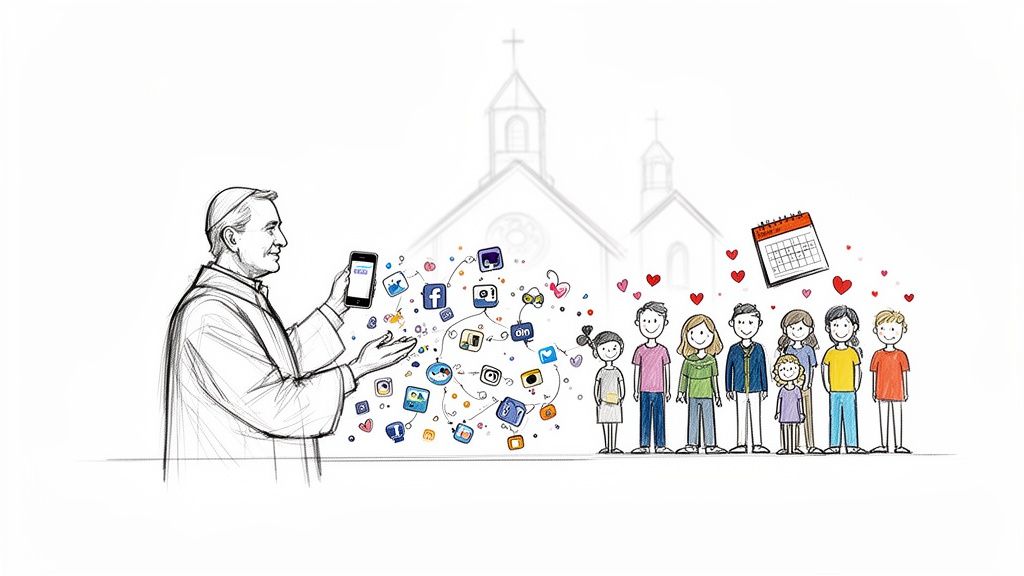
Posting on the fly is like preaching a sermon without any notes. You might land a few good points, but the message won't have the depth or impact it could. A solid plan transforms your social media from a reactive chore into a proactive outreach strategy. You stop just posting to fill the void and start building a genuine extension of your ministry online.
Suddenly, every post has a purpose. That Monday prayer post isn't just content; it's digital pastoral care. A Wednesday event reminder isn't just an update; it's a personal invitation to find community. This kind of intentionality makes sure your online presence is always supporting your church's real-world mission.
From Overwhelmed to Organized
Let’s be honest: the biggest hurdle for most church teams is the relentless demand for new content. What on earth do you post between Sundays? How do you create compelling videos without a film crew and a professional editor?
A good social media plan provides the roadmap, answering these questions by creating a repeatable system.
This is exactly why we built ChurchSocial.ai. We saw this struggle firsthand and wanted to help churches like yours. Imagine taking one Sunday sermon and, with just a few clicks, turning it into a full week of meaningful social media content.
- Create AI-generated reels from your sermons, instantly giving you engaging short-form video clips perfect for Instagram and TikTok.
- Generate social media posts, blogs, and even small group questions directly from the sermon transcript.
- Use our graphic templates and editor to create and post beautiful photos and carousels for announcements, sermon quotes, and verses.
A social media plan tells you the "what" and "why." A tool like ChurchSocial.ai provides the "how"—empowering your team to bring that plan to life without burning out.
More Than Just Posts—A Ministry Tool
At the end of the day, a strategic plan is what allows you to foster a thriving online community without the constant stress. Using a simple drag-and-drop calendar, you can easily manage and update all of your social media in one place. ChurchSocial.ai even integrates with tools like Planning Center and other church calendars to create content for your events.
This streamlined process frees you and your team to focus on what actually matters: people. You’ll have more time to reply to comments, answer direct messages, and pray for the people you're connecting with online. Your social media becomes less about broadcasting a message and more about building real relationships.
First Things First: Define Your Ministry Goals and Audience
Before you even think about posting a single graphic or sermon clip, we need to pump the brakes. The absolute most important first step is to figure out your ‘why’ and your ‘who.’ If you skip this, you’re basically just shouting into the void and hoping someone hears you. An effective plan always ties every single post back to the core mission of your church.
Let's move past flimsy goals like "getting more followers." Sure, growth is a nice bonus, but it's what we call a vanity metric. Real ministry impact comes from specific, measurable results that actually push your church's vision forward.
Setting Goals That Actually Matter
Your social media goals should be a direct reflection of what you're trying to accomplish as a ministry. Instead of just chasing numbers on a screen, let's focus on actions that build real community and help people grow spiritually.
Here are a few examples of what solid, ministry-focused goals look like:
- Increase small group sign-ups by 15% this semester by sharing video testimonials and hosting live Q&As with group leaders.
- Boost attendance for our upcoming VBS by getting event posts and behind-the-scenes content in front of 5,000 local families.
- Add 50 new subscribers to our weekly devotional email by creating compelling posts based on Sunday's sermon.
- Generate 20% more in online giving during the end-of-year campaign through a series of powerful impact stories.
See the difference? These goals are tangible. They give your team a clear finish line to run towards and make it painfully obvious whether your social media efforts are paying off. This kind of clarity is a game-changer, especially when you're working with limited time and resources.
A well-defined goal transforms your social media from a content-churning machine into an intentional ministry engine. It means every post, story, and reel has a specific job to do for your church’s mission.
The payoff for this kind of strategic thinking is huge, both financially and spiritually. Research has found that while only 21% of churches feel they have an effective digital strategy, the ones that do report 32% higher donations coming from their online engagement. That stat alone shows how much of an impact a thought-out social media plan can have. You can dig into more of the data on church digital strategies and their outcomes if you're curious.
Knowing Exactly Who You're Talking To
Once your goals are locked in, you have to get crystal clear on who you're talking to. A message designed for everyone usually ends up connecting with no one. Your "audience" isn't one big blob of people; it's a mix of different groups with very different needs.
Think about these distinct segments of your audience:
- Your Current, Engaged Members: These folks want to stay in the loop, feel encouraged, and get details about upcoming events. For them, you're posting sermon reminders, volunteer opportunities, and fun community highlights.
- New Families in Your Community: These are the people actively looking for a church to call home. They need to see what you're all about—your core values, what your kids' ministry is like, and how genuinely welcoming you are.
- The Online-Only Viewer: This person might live on the other side of the country or be unable to attend in person. They connect with your church almost exclusively online and are looking for deep spiritual content, like sermon clips and full live streams.
Understanding these different groups helps you craft content that speaks their language. For example, a polished, high-energy reel might grab the attention of a young family scrolling through Instagram. At the same time, a simple, heartfelt text post with a prayer could be exactly what that online viewer needed to see.
With a tool like ChurchSocial.ai, you can easily create both. It lets you turn a single sermon into AI-generated reels perfect for outreach and also helps you write thoughtful posts for deeper connection.
Build Your Content Pillars and Calendar
Alright, you’ve set your goals. Now for the fun part: turning that strategy into an actual, tangible plan. This is where we figure out what you're going to post day in and day out.
The secret to finally ending the dreaded "what do we post today?" panic is to establish content pillars.
Think of content pillars as the main themes or topics that will guide everything you create. They're like the big sections in your church's online magazine. They bring consistency and balance to your feed, making sure every post serves your ministry goals without sounding like a broken record.
Establishing Your Core Ministry Themes
The great news is you don't have to invent these from scratch. For most churches, your content pillars will flow naturally from the life of your congregation. You're just putting names to the stories you're already telling.
Here are a few foundational pillars that work for just about any church:
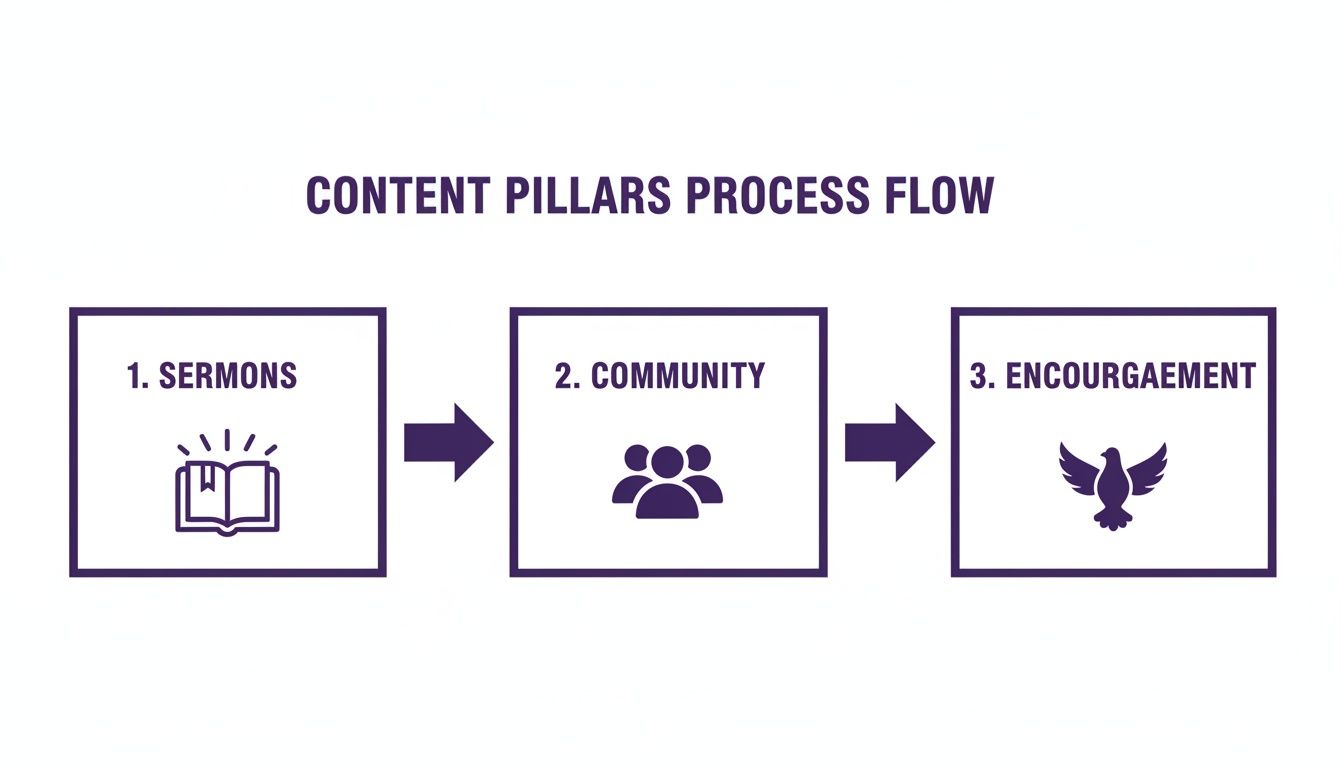
- Sunday Sermon Insights: This is your bread and butter. It’s all about extending the Sunday message into the week with key takeaways, AI-generated sermon reels, scripture graphics, and thought-provoking questions.
- Community and Connection: This pillar is all about your people. Think volunteer spotlights, event announcements, photos from last Sunday's fellowship, and baptism stories. This is where the life of the church shines.
- Midweek Encouragement: Think of this as your digital pastoral care. It's where you offer prayers, short devotionals, and uplifting quotes to support your community between Sundays.
Having clear content pillars means you never start from a blank slate. Instead of asking "What should I post?" you can ask, "What 'Community and Connection' post can we share today?" This simple shift makes content creation much more manageable.
A powerful, and often missed, opportunity here is to actively share stories from your members. Weaving in a solid user-generated content strategy builds incredible engagement and shows the real-life impact of your ministry in a way that nothing else can.
Mapping Your Pillars to a Content Calendar
Once you've got your pillars, it’s time to map them to a content calendar. This is just a simple visual tool showing what you’re posting, where, and when. It’s the single best way to bring order to the chaos and create a consistent social media presence.
A calendar helps you create a healthy, balanced diet of content. You can see at a glance if you're posting too many event reminders and not enough encouragement. That variety is what keeps people coming back for more.
Let’s be honest, though. Building and updating a calendar in a spreadsheet is a grind, especially when plans inevitably change. This is where a dedicated tool becomes a ministry lifesaver. ChurchSocial.ai gives you a simple, visual drag-and-drop calendar that makes planning and rescheduling posts almost effortless.
Better yet, it integrates directly with tools like Planning Center and other church calendars. Your events automatically show up, and the platform can even generate draft posts for them. That’s hours of admin work saved every single month. For a deeper look, check out our guide on how to build a church social media content calendar.
A Sample Weekly Content Schedule
So, what does this look like in the real world? Here’s a sample weekly schedule that balances our three core pillars: Sermon Insights, Community, and Encouragement.
This is a great starting point to see how you can create a rhythm for your content, ensuring a healthy mix of post types across your main platforms.
Sample Weekly Church Content Calendar
See the rhythm? This kind of schedule ensures your feed stays active and engaging all week long. With a platform like ChurchSocial.ai, you could schedule all of these posts in a single planning session, freeing you up to focus on ministry, not media.
Let AI Do the Heavy Lifting in Content Creation
Okay, you've got your content pillars and a calendar sketched out. That’s a huge win. But let's be real—the biggest bottleneck for most church teams is the actual creation of all those posts.
How do you keep up a steady stream of high-quality, engaging content when you're running on a small staff or dedicated volunteers? The answer isn't to work harder; it's to work smarter. The secret is hiding in plain sight: your Sunday sermon is a goldmine of content just waiting to be tapped.
This isn't about reinventing the wheel every day. It's about taking one powerful message and repurposing it into an entire week's worth of social media content. This is exactly why we built ChurchSocial.ai—to turn a time-sucking chore into a simple, almost automatic process.
Turn One Sermon into a Week of Content
Picture this: the Sunday service wraps up, and within a few minutes, you have the raw material for every social post you'll need until next Sunday. This is a real, practical workflow that uses AI to handle the grunt work. All you have to do is upload your sermon transcript or audio file to ChurchSocial.ai, and the platform gets right to work.
The system is designed to actually understand the sermon—it pulls out the core message, identifies the key points, and snags the most powerful quotes. From there, it generates a variety of content formats, including AI-generated reels from your sermons, social posts, blogs, and more. This ensures your message connects with people in the way they prefer to consume it, whether they're scrolling Instagram or reading a blog post.
Think of it as a sustainable content engine. A few core ministry activities can fuel a consistent and diverse online presence without burning out your team.
Get Engaging Video Reels, Instantly
Let's talk video. Short-form video on Instagram Reels, TikTok, and even Facebook is no longer optional if you want to reach new people. But who has time to scrub through an hour-long sermon to find good clips and then edit them?
This is where AI is an absolute game-changer. The AI Sermon Clip Creator inside ChurchSocial.ai automatically finds the most powerful, shareable moments from your message. It then generates multiple short video reels, complete with animated captions and your church's logo. A task that used to eat up hours of editing time is now done in minutes. Suddenly, you have a steady supply of clips that actually stop the scroll.
Your Sunday sermon is already packed with impactful content. The goal isn't to create more, but to package it in a way that connects with a scrolling audience. AI-powered tools make this possible for any church, regardless of size or budget.
The numbers back this up. While 86% of church leaders know that live streaming is important, a shocking 64% of churches don't have a plan to repurpose that content afterward. That's a massive missed opportunity, especially when short-form video gets 88% more engagement on average. If you're looking to go deeper, a great guide can help you master AI content creation for social media.
Draft Captions, Blogs, and More with AI
Video is just the start. That sermon transcript is a treasure trove for all your written content, too. ChurchSocial.ai's writer can take that single transcript and instantly draft all sorts of materials:
- Compelling Captions: Need a few caption ideas for your new sermon reel? It’ll generate several options, each with a slightly different tone or call-to-action.
- Blog Posts: Easily turn a sermon series into a set of articles for your church website. This is great for SEO and gives people a resource to catch up if they missed a Sunday.
- Small Group Questions: Create a ready-to-use discussion guide based on the sermon's main points. Your small group leaders will thank you for it.
This doesn't just save a ton of time; it also keeps your messaging tight and consistent across every platform. If you're curious about how else this technology can serve your ministry, check out our guide on using AI for churches.
Empower Anyone with Professional Graphic Templates
Finally, not everyone on your team is a graphic designer—and they shouldn't have to be. A truly sustainable social media plan empowers volunteers to create great-looking content without friction.
ChurchSocial.ai comes packed with a library of professional graphic templates and an easy-to-use editor. Anyone can jump in, pick a template for an announcement or a sermon quote, pop in the new text, and post it directly. This gives your whole team the confidence to contribute, knowing every single post will look polished and on-brand.
Schedule Posts and Engage Your Community
You've done the hard work of creating brilliant content, and your calendar is packed with great ideas. But what good is the most powerful sermon clip if it gets posted at 2 AM when no one is around to see it? Creating your content is only half the journey—the other half is getting it in front of your community and sparking a real conversation.
This is where consistency and authentic engagement become your most powerful ministry tools. It’s about shifting from just broadcasting messages to actually building relationships, one comment and prayer request at a time. The real goal is to turn your social media feed from a static announcement board into a living, breathing extension of your church community.
The Power of Scheduling in Advance
For any busy ministry team, scheduling posts ahead of time is an absolute game-changer. Instead of scrambling every single day to figure out what to post, you can batch all that work into one or two focused sessions each week. That simple change frees you and your team from the tyranny of the urgent and lets you focus on what really matters: people, not platforms.
Consistency is how you build trust and momentum online. When your community knows they can count on a daily prayer or a midweek encouragement post, they're far more likely to make checking your page a regular habit.
A unified tool makes all the difference here. With ChurchSocial.ai, you can use the simple drag-and-drop calendar to schedule and manage everything for Facebook, Instagram, and more from one central hub. You can literally plan out an entire week or even a month of content in a single sitting. This ensures your ministry maintains a steady, encouraging presence online, even when you're busy with offline tasks.
Beyond Posts to Real Conversations
Once your content is scheduled and ready to go, your role shifts from content creator to community builder. Engagement isn't just a metric to track; it's digital discipleship. It’s about showing your community that you’re listening and that you genuinely care. Answering a question, celebrating a praise report, or simply liking a comment shows that there are real people behind the screen who are invested in their lives.
Did you know that a whopping 85% of churches report their congregations are actively scrolling through social media every single day? It’s also been shown that churches using content calendars can boost their posting consistency by 400%, which often leads to 45% faster follower growth. Consistent scheduling simply creates more opportunities for these crucial engagement moments to happen. You can find more insights about the impact of social media for churches here.
Turning passive followers into an active online congregation takes intentionality. Here are a few practical ways to spark those conversations:
- Ask Thoughtful Questions: Don't just post a verse. Ask something like, "How has this verse encouraged you this week?"
- Respond Promptly: Try to reply to comments and DMs within a few hours. It sends a powerful message that people's voices are valued.
- Acknowledge Prayer Requests: Even a simple, "Praying for you now," can have a profound impact on someone going through a tough time.
Authentic engagement is the bridge between your online content and real-life ministry. Every interaction is a chance to pastor, encourage, and connect with someone on a deeper level.
With ChurchSocial.ai, managing these interactions becomes so much simpler. Because the AI helps generate and schedule your core content, it frees up valuable time for your team to invest in these high-impact, personal conversations. This strategic approach ensures your social media plan doesn't just broadcast information but actively builds and nurtures your church community online.
Measure Your Impact and Refine Your Plan
So, how do you actually know if all this work is making a difference for your ministry? You can create and schedule the best content in the world, but if you aren't measuring its impact, you're flying blind. This last piece of the puzzle is all about demystifying analytics and turning that confusing data into clear, actionable insights for your church.

This creates a powerful feedback loop: you plan, you post, you measure, and then you refine. It’s what turns your social media from a simple to-do list into a dynamic, evolving strategy that grows right alongside your community. This data-driven approach is what ensures your efforts are always tied directly to your ministry goals.
Key Metrics to Watch for Ministry
Don't get bogged down by dozens of confusing numbers. For most churches, just a few key metrics will tell you the most important stories about how your content is connecting with people. These are the numbers that matter.
- Engagement Rate: Honestly, this is probably the most important metric. It shows you how many people who saw your post actually interacted with it—they liked, commented, or shared it. A high engagement rate on a simple prayer prompt tells you that post really hit home with your community.
- Reach: This is a simple one: it's the total number of unique people who saw your post. Tracking reach helps you understand which sermon clips or event announcements are breaking out beyond your immediate followers.
- Website Clicks: Is your goal to get people to sign up for a small group or visit your online giving page? Then this metric is your best friend. It directly shows you if your posts are actually getting people to take that next step.
By focusing on these core metrics, you can quickly see what’s working and what isn’t. You might discover that your AI-generated sermon reels get the most shares, while simple verse graphics spark the most comments—both are valuable insights.
Using Data to Refine Your Strategy
Once you start paying attention to these numbers, you can finally start making informed decisions instead of just guessing.
You’ll begin to learn the best times to post for your specific audience. You'll see which sermon topics generate the most discussion, and what kinds of questions lead to the most heartfelt prayer requests in the comments.
This cycle of learning and adjusting is the real secret to a successful social media plan. It’s about being a good steward of your time and resources, making sure every post has the greatest possible ministry impact. You can dive deeper into turning these numbers into results in our guide on how to measure social media ROI for your church. It'll help you make the case for the value of your work.
A Few Lingering Questions
As you start putting your plan into action, a few practical questions always pop up. We get these from church leaders all the time, so let's tackle them head-on and get you moving forward.
How Many Times a Week Should Our Church Really Post?
This is a big one. The honest answer? Consistency will always beat frequency.
Focus on creating 3-5 high-quality posts per week on whatever platform you’ve chosen as your primary one. It's so much better to share a handful of posts that genuinely connect with people than to overwhelm them with generic content just for the sake of posting.
Tools like ChurchSocial.ai are a lifesaver here. Its simple drag-and-drop calendar allows churches to easily manage and update all of their social media, which means your church can maintain a steady, encouraging presence online, even when ministry gets hectic.
Which Social Media Platform is Best for a Smaller Church?
Don't buy into the lie that you have to be everywhere at once. You don't.
For most churches, especially smaller ones, Facebook is a non-negotiable. Its reach across different age groups is just unmatched. After that, Instagram is fantastic for visual storytelling—think photos from the youth group event or short, impactful video Reels.
The key is to master one or two platforms where your people are already hanging out. The ChurchSocial.ai dashboard lets you manage multiple accounts from one spot, so when you are ready to expand, it’s a seamless transition.
The goal isn’t to stretch your team thin across a dozen platforms. It's to build deep, meaningful community on the one or two that matter most. Start there.
How Do We Create Good-Looking Content Without a Designer?
This is the most common hurdle we see, but thankfully, it's easier to overcome than ever. You don’t need a design degree or a huge budget—you just need the right tools. In fact, authentic content often connects far better than something that looks overly polished.
This is where ChurchSocial.ai really shines.
- The AI Sermon Clip Creator is a game-changer. It takes your sermon audio and automatically generates shareable video reels.
- The graphic templates and editor come loaded with beautiful, church-specific designs that any volunteer can customize in just a few minutes.
These features make it possible for anyone on your team to create content that looks professional and feels authentic, completely removing that "we don't have a designer" bottleneck.
Ready to stop guessing and start building a real online ministry? ChurchSocial.ai provides everything you need to plan and manage your church social media accounts from one simple platform. Give it a try and see just how easy it can be.