Preparing a sermon is a unique blend of deep spiritual work and practical communication. It all starts with prayerful study of the biblical text, but it doesn't end there. The journey continues through structuring a clear message, finding illustrations that actually land, and rehearsing for a delivery that feels authentic.
This whole process is about making sure the message is not only faithful to Scripture but truly connects with the people listening.
The Evolving Art of Sermon Preparation
Let's be honest: while the core of preaching a biblically sound message is timeless, the way we prepare and deliver it has changed. This guide is built to be your practical, actionable workflow for sermon prep, designed specifically for busy pastors trying to bridge solid biblical study with modern communication realities.

We're going to walk through a process that honors the sacred work of exegesis while also embracing the practical need to craft a compelling message. And we’ll take it one step further, showing you how to use today's tools to get that message far beyond the four walls of your church.
A Modern Workflow for Today's Church
My goal here is to give you a sustainable rhythm for sermon prep. One that not only enriches your Sunday delivery but also equips you to disciple your community all week long. You'll see how to streamline the hard parts, save yourself some precious time, and make sure your message connects with everyone from long-time members to first-time visitors.
This workflow extends beyond what happens in your study. The final, critical step is thinking about your message’s reach after you've preached it. This is where a single sermon becomes a powerful engine for discipleship and outreach.
With a platform like ChurchSocial.ai, this last part becomes surprisingly simple. You can manage your church's social media accounts with ease. Imagine being able to:
- Create AI-generated reels from your sermon's most powerful moments.
- Generate social posts, blogs, and small group questions right from your sermon transcript.
- Use professional graphic templates and an easy editor to create engaging photos and carousels.
- Easily manage and update all your church's social media accounts from a simple drag-and-drop calendar.
By thinking about digital distribution from the start, you prepare a message that not only feeds the flock on Sunday but also reaches the community online throughout the week. This approach transforms a single sermon into a continuous stream of encouragement and outreach.
To give you a clearer picture, here’s a quick overview of what this modern sermon preparation process looks like from beginning to end.
A Modern Sermon Preparation Workflow at a Glance
This table lays out the roadmap we'll be following. It's a comprehensive approach that ensures nothing falls through the cracks, from the first moment of prayerful consideration to the final social media post.
Building a Foundation in Prayer and Exegesis
Before you ever crack open a commentary or type a single note, the real work of sermon prep begins. It starts in quiet dependence. Every message that truly connects isn't built on human eloquence or sharp research, but on a foundation of prayer and an honest wrestling with the biblical text. This is ground zero.

This first phase isn’t about gathering information; it’s about seeking direction. It’s about asking the hard questions: What does my congregation really need to hear from God this week? What burdens are they walking in with?
Prayer changes the question from "What will I say?" to "God, what do you want to say through me?" This spiritual groundwork is what keeps a sermon from being just another lecture. It ensures it becomes a timely word for the very real people in your care.
Beginning with Prayerful Dependence
Prayer isn't a box to check at the beginning; it’s the thread woven through the entire process. But starting here is absolutely critical. It protects the sermon from becoming a purely academic exercise and keeps the main thing the main thing: spiritual transformation, not just information transfer.
Want a practical tip? Try praying through your church directory or membership list. This simple act connects your study to the faces and needs of your congregation. It grounds your exegesis in pastoral reality, making sure the sermon you prepare is actually for the people you serve.
This foundational prayer is about yielding your agenda. It's admitting that without the Holy Spirit's guidance, even the most well-researched and brilliantly structured sermon will fall flat.
Transitioning into Effective Exegesis
Once your heart is oriented through prayer, it’s time to roll up your sleeves and get into the work of exegesis—the careful, systematic study of Scripture to discover its original intended meaning. You have to understand what the text meant to its first audience before you can ever hope to figure out what it means for your church today. The goal is simple: let the text speak for itself.
An effective exegetical process doesn't need to be overwhelming. It usually boils down to three key stages:
- Contextual Analysis: Who wrote this? To whom? When and where? Getting a handle on the historical, cultural, and literary backdrop is crucial for accurate interpretation.
- Textual Observation: What does the passage actually say? This means reading closely, identifying key terms, noting sentence structure, and following the author's flow of thought.
- Theological Coherence: How does this one passage fit within the chapter, the book, and the entire story of the Bible? This step is your guardrail against misinterpretation.
This deep dive is where you unearth the core truth of your message. For a more detailed walkthrough, you can explore our resources on expository sermon preparation.
Practical Tips for Deep Study
We all feel the pressure of the clock. While some pastors aim for around 20 hours for a full prep cycle, the quality of that time is what truly matters. It’s not about being locked in an office for days on end.
Here’s a technique that has worked wonders for me: about ten days before you preach, spend just one hour on preliminary exegetical work. Dig into the original languages, map out the sentence structure, or do a quick dive into the historical background. Then, just let it simmer. Your mind will keep working on it in the background, and you'll be amazed at the insights that surface when you come back to it later.
Ultimately, a great sermon is built on two pillars: dependence on God and diligence in His Word. This blend of prayerful seeking and rigorous study is what ensures the message you deliver is biblically faithful, pastorally sensitive, and spiritually powerful.
Crafting a Memorable Sermon Structure
You’ve done the deep work of prayer and exegesis, and you've found the core truth of the text. Now for the hard part: building a sermon that actually connects. This is where you shift from being a student of the Word to a guide for your people, shaping that truth into a journey that grabs their attention, makes sense, and sticks with them.
A good sermon structure isn't just about organizing your points; it's about creating an experience.
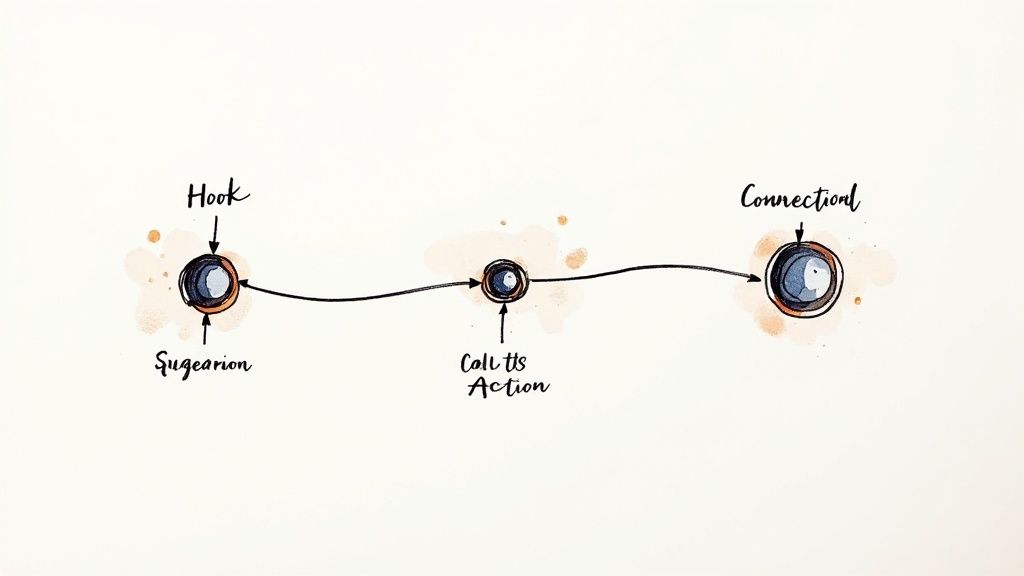
Without a solid framework, even the most profound insights get lost in the shuffle. The goal here is to build a structure that carries your main idea from the first sentence to the final prayer.
The Power of a Strong Introduction
Let's be honest, you've only got a minute or two to convince people this is worth their time. The start of your sermon is everything. A strong hook answers the unspoken question in every single person's mind: "Why should I care about this today?"
You can pull people in a few different ways:
- A Compelling Story: Kick things off with a personal story or a modern-day scenario that tees up the tension in the passage.
- A Provocative Question: Ask something that taps into a real human struggle or a deep spiritual question everyone has.
- A Surprising Statistic: Drop a startling fact or number that makes the topic feel immediate and relevant.
The point is to build a bridge between their world and the world of the text right away. That’s what keeps them listening.
Developing Logical Main Points
Once you have their attention, the body of your sermon has to deliver. This is where you lay out your main points, making sure they flow logically from the biblical text and build on each other. Don’t just list random observations; you're trying to build a cohesive argument.
Think of it like this: just as authors use story structure templates to create a compelling narrative, a preacher needs a clear framework for the message. Whether you go with a classic three-point outline or something more narrative-driven, every point has to serve a purpose.
Here's a practical tip: try phrasing each point as a full, memorable sentence. Instead of a one-word topic like "Grace," frame it as, "Grace isn't just for our salvation; it's for our survival on Tuesday morning." This gives your people a clear handle to grab onto.
Weaving in Relatable Illustrations
Biblical truth hits different when it’s connected to real life. Illustrations and stories are the tools that close the gap between an ancient text and our modern world. They put flesh and bone on big theological ideas and help the message stick long after everyone has gone home for lunch.
Effective illustrations don't just entertain; they illuminate. They should serve the text, not overpower it. The best stories are often found not in illustration books, but in your own life and in the lives of the people you pastor.
This is why spending time with people is a non-negotiable part of sermon prep. It keeps you from becoming a "Reformed monk" who crafts sermons in an academic bubble. Real conversations give you a wellspring of authentic stories that will connect far more than any canned example ever could.
Crafting a Conclusion with a Clear Call to Action
The conclusion is your last shot to drive the point home. Don't just trail off. A good conclusion summarizes the main idea and answers the most important question of all: "So what?" A powerful ending moves people from just hearing the Word to actually doing what it says.
This "call to action" doesn't have to be a dramatic altar call every week. It could be a simple, practical step to take, a question to reflect on with their family, or a specific prayer to pray. The goal is to give your congregation a tangible way to apply the truth they've heard, turning a Sunday sermon into Monday's obedience.
Using Technology to Streamline Your Preparation
Let's be honest: in the life of a pastor, time is the one resource you can never get more of. While the heart of sermon prep will always be prayerful, deep study of the Word, modern tools can give you back precious hours.
This isn't about replacing the Holy Spirit with an algorithm. It's about being a wise steward of your energy. Think of it this way: what if you could spend less time on administrative grunt work and more time with the very people you're preparing the message for?
Smart Tools for Smarter Study
The right tech can turn hours of manual research into minutes of focused discovery. It’s not a distraction; it’s a powerful partner in the exegetical process, helping you find those golden nuggets of insight more efficiently.
Here’s how these tools can practically help:
- AI-Powered Research: Imagine quickly summarizing historical commentaries, defining Greek or Hebrew terms, or finding cross-references in seconds. This gives you an incredible foundation to build on.
- Outline Generation: We’ve all been there—staring at a blank page. AI can suggest potential sermon structures or main points based on your passage, giving you a creative spark to get moving.
- Illustration Discovery: Instead of endlessly scrolling for a modern-day story that fits, these tools can help you find relevant analogies that connect with your congregation today.
This isn't some futuristic idea; it's happening right now. A recent study found that 61% of pastors use AI tools weekly or even daily in their sermon prep. And 64% lean on them for the heavy lifting of research and outlining. Pastors are turning to common tools like ChatGPT, Grammarly, and Microsoft Co-Pilot to support their preaching ministry. You can dig into those numbers more on the use of AI in sermon prep.
From Sermon Prep to Social Media Content
One of the biggest mindset shifts in modern ministry is thinking beyond the Sunday morning service. Your message has the power to disciple and encourage people all week long, but that requires a plan.
Technology should serve your ministry, not complicate it. The goal is to find tools that seamlessly integrate into your existing workflow, saving you time while amplifying your message.
What if creating content wasn't another task on your to-do list, but a natural outcome of your sermon prep? This is exactly why we built ChurchSocial.ai. It closes the gap between your study and your church's digital presence, turning one sermon into a week's worth of meaningful connection points.
Imagine finishing your sermon notes and, just a few minutes later, having a system that can:
- Generate AI Reels: Automatically find the most powerful quotes from your sermon and create short, shareable videos for Instagram and TikTok.
- Create AI-Generated Content: Instantly create social posts, blogs, and other materials directly from your sermon transcript.
- Use Graphic Templates: Access our graphic templates and editor to create and post engaging photos and carousels.
This integrated approach means you're not just preparing a sermon; you're building a comprehensive discipleship resource. For example, once the sermon is preached, its transcript becomes the raw material for so much more. You can learn more about this by exploring the benefits of a professional sermon transcription service.
By bringing a tool like ChurchSocial.ai into your workflow, you ensure the Word you faithfully prepared continues to speak, encourage, and reach people long after the Sunday service ends. It's about working smarter so you can focus on what matters most: shepherding your flock.
Don’t Let Your Sermon Die on Sunday
The benediction is over, the last worship song has been sung, and your congregation is heading out for lunch. But is the sermon’s work done?
Not even close.
A message that lands with power on Sunday morning shouldn't be locked away until the archives are dusted off. In a world where everyone is connected, the truths you preach can encourage, disciple, and reach people all week long—right on the devices in their pockets.

This means we need a small but powerful mindset shift. We need to start seeing the sermon not just as a one-time event, but as the raw material for a whole week of digital ministry. Taking that core message and adapting it for different platforms is one of the most effective content repurposing strategies a church can adopt today.
From the Pulpit to People's Pockets
The best way to make your sermon stick is to meet people where they already are. That means social media. Turning key moments from your message into short, vertical videos for TikTok, Instagram Reels, or YouTube Shorts isn't just a trend; it's modern-day outreach.
This reality changes how we even prepare a sermon. We're still preaching to the room, of course, but we should also have an ear for those "clipable" moments—the soundbites and stories that will resonate just as strongly online.
A two-minute clip of a powerful point might be the first "sermon" someone has heard in years. A well-designed graphic with a key quote could be the exact dose of hope a church member needs to get through a brutal Wednesday afternoon. This isn't about chasing likes; it's about being faithful missionaries in the digital space.
A sermon that only exists on Sunday is a missed opportunity. When you plan for digital distribution, you turn one hour of preaching into an entire week of ministry, creating a cohesive discipleship journey for your church and a powerful evangelistic tool for your community.
A Workflow That Actually Works for Ministry
Let's be honest. The biggest hurdle here is time. Most pastors and church staff are already stretched thin. The thought of adding "social media content creator" to the job description is enough to make anyone want to take a nap.
This is where having the right tool can make or break your entire strategy. It needs to do the heavy lifting so you can stay focused on shepherding your people.
We built ChurchSocial.ai for this exact reason. It’s designed to be the bridge between your Sunday message and your weekly digital outreach, making the whole process feel almost automatic. Imagine a system where your sermon transcript becomes the fuel for a vibrant, engaging online presence—without you spending hours editing video.
With ChurchSocial.ai, you can:
- Create AI-Generated Reels: It finds the most powerful quotes and moments from your sermon and automatically turns them into short, shareable videos ready for social media.
- Generate AI Content from Sermons: Instantly spin off AI-generated content like social media posts, blogs, or even small group discussion questions right from your sermon transcript.
- Use Our Graphic Editor: Our graphic templates and editor allow you to create and post beautiful photos and carousels with ease.
The goal is to remove the technical headaches. To see just how simple it can be, check out our guide on how to get your sermon on video.
Manage Your Message with Confidence
Creating content is one thing; managing it is another. A great digital presence requires consistency and planning. ChurchSocial.ai brings all of that under one roof, with a simple drag-and-drop calendar that allows churches to easily manage and update all of their social media.
Plus, we integrate with Planning Center and other church calendars to create content for events. This means you can seamlessly weave event promotions and announcements into your content schedule. You get a cohesive digital strategy that serves your church and reaches your community—without burning out your team. It completely changes how you prepare for a sermon by building the digital extension right into your existing workflow.
Adapting Your Sermon for Today’s Congregation
A sermon that’s biblically sound is one thing. A sermon that actually connects with people is another. It’s easy to preach to an empty room, but landing a message with a real, living congregation means knowing who’s actually out there listening—both in the seats and on their screens.
The truth is, the church isn't a monolith. It’s a dynamic community, and its needs are always changing.
Your awareness of the specific audience you're speaking to should shape everything, from the stories you tell to the application points you make. An illustration that hits home for a retiree might fly right over the head of a college student. This isn't about compromising the message; it's about being a good steward of it.
Understanding the New Congregational Mix
Let’s be honest: the landscape of church has changed. A lot. Recent data shows that while U.S. church attendance is back up to about 85% of what it was before the pandemic, the faces in the crowd are different. We're seeing an 18% jump in Millennial attendance, while the Boomer generation's presence has started to decline. You can dig into more of the numbers and discover more insights on these demographic shifts.
This isn't just a spreadsheet of statistics; it's a pastoral reality. It means your congregation is more multigenerational and culturally diverse than it’s ever been. Your prep time has to account for this blend of brand-new believers, seasoned saints, young families juggling everything, and digital natives who’ve never known a world without a smartphone.
Preaching That Connects Across Generations
So, how do you actually bridge that gap from the pulpit?
- Vary Your Illustrations. Don't pull all your stories from the same well. Mix it up. Talk about current events, a classic book you just read, a personal story from your own life, or even a scene from a movie everyone’s talking about. This is how you avoid speaking only one generation's language.
- Focus on Universal Truths. While your stories might change, the core human experience doesn't. Hope, fear, joy, and the desperate need for grace—these things are timeless. Ground your sermon in biblical themes that hit on these universal chords.
- Create Digital On-Ramps. You have to accept that a good chunk of your audience engages with your church primarily online. This is where tools like ChurchSocial.ai can be a game-changer. Imagine taking a key point from your sermon and letting AI instantly turn it into a reel for Instagram or a discussion question that a Millennial can share with their friends.
When you thoughtfully consider who you're speaking to, you move beyond just delivering information. You start crafting a message that invites everyone—no matter their age or background—into a real encounter with God’s Word.
Lingering Questions on Sermon Prep
As you dial in your sermon prep workflow, a few common questions always seem to pop up. Let's tackle some of the ones I hear most often from pastors who are right there in the trenches with you.
What’s the Right Amount of Time to Spend on a Sermon?
Honestly, there's no magic number here. The time it takes can swing wildly depending on your experience level and how complex the passage is. Most seasoned pastors I know land somewhere in the 10 to 20-hour range for one message.
But the goal isn't to clock in and out. It's about finding a rhythm that's both healthy for you and honors the text.
The real game-changer is working smarter, not just longer. When you can use tools to help with the heavy lifting of research and content organization, you cut down on the busywork. That frees you up for what really matters: deep, prayerful study.
How Do I Actually Connect with a Younger Audience?
Connecting with younger generations isn't about chasing trends. It boils down to being authentic, telling stories they can see themselves in, and offering clear, practical wisdom for the things they're actually dealing with. But here's the kicker: the connection can't stop when the last song ends.
You have to extend the conversation online. This is where having a tool built specifically for churches can make all the difference. For example, a platform like ChurchSocial.ai can take the heart of your message and spin it into content for the apps younger folks are scrolling through all day. Think about it—pulling short video clips from your sermon or creating discussion prompts for Instagram stories with just a couple of clicks. It's all about continuing the discipleship conversation long after everyone's gone home.
The question isn't just how to make the sermon engaging, but how to keep the engagement going. Digital tools create a bridge between your Sunday message and their Monday reality.
Is Using AI in Sermon Prep Cheating?
This is a big one, and a valid question for ministry leaders today. The consensus seems to be landing here: AI is an incredible ministry assistant, but a terrible ghostwriter. Your unique voice, your personal time in the Word, your prayer-filled insights, and your heart for your people have to be the core of the message.
Use it to spark ideas for illustrations. Let it check your grammar. Have it spin up a rough outline when you're staring at a blank page. The key is that you maintain total theological ownership and personal integrity over the final sermon you preach from the pulpit.
Ready to see your sermon's impact ripple out into the community all week? ChurchSocial.ai gives you everything you need to turn one message into a week's worth of engaging social media content. Create AI-generated reels, draft social posts straight from your sermon transcript, and plan it all out on one simple calendar. Start your free trial today and see how easy it can be.