Preaching is a sacred trust. It's also an immense pressure. The old model—locking yourself away for hours to prepare a message that only lives for an hour on Sunday morning—just doesn't cut it anymore. We need a new blueprint.
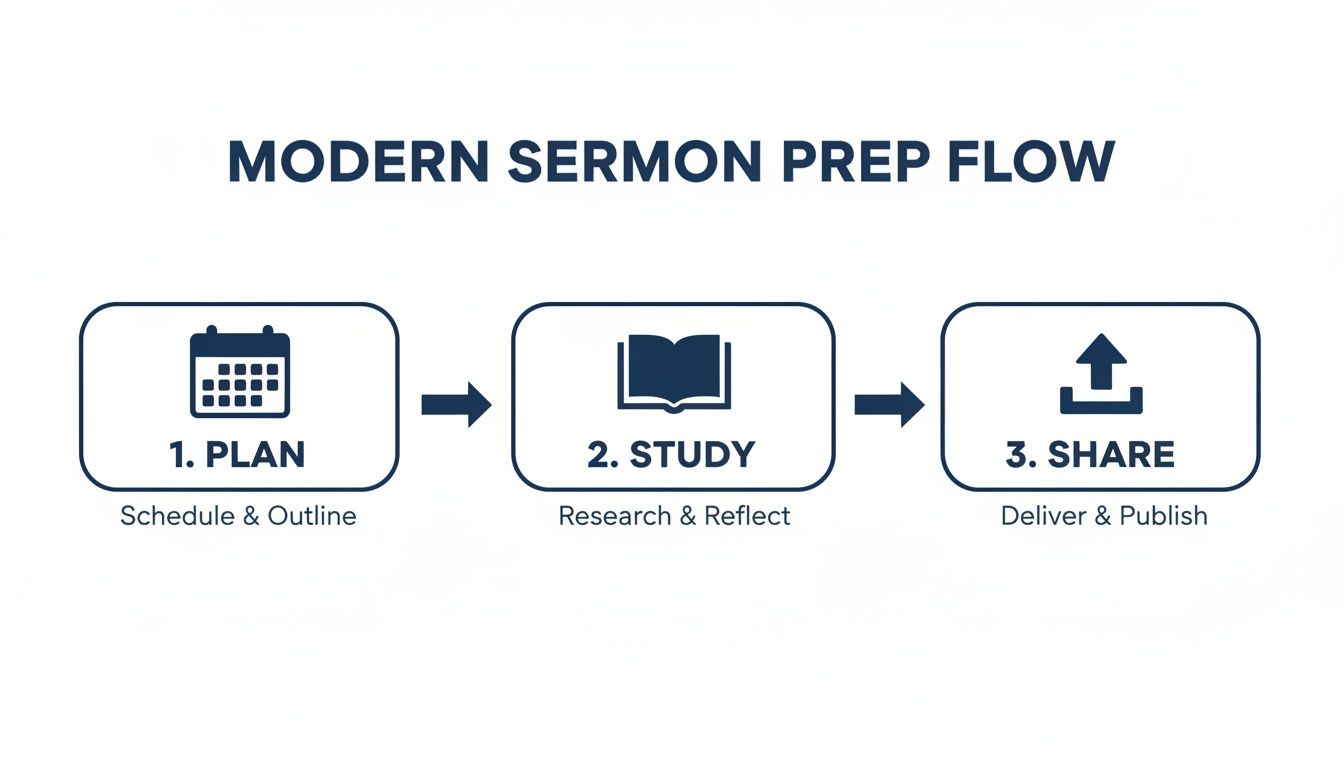
This guide lays out a practical framework for preparing sermons that not only land with power on Sunday but echo throughout your community all week long. It’s a process built around three core ideas: plan, study, and share. Following this path turns a single sermon into a week-long conversation with your people.
The Grind is Real, But There’s a Better Way
Let’s be honest: pastors and church leaders are stretched incredibly thin. The pressure to deliver a fresh, impactful message every single week is real.
Pastoral care statistics paint a stark picture. 45% of pastors spend just 10-15 hours preparing their weekly sermon. That’s a tiny window to craft a message for a global Christian community that just topped 2.6 billion people. It’s no wonder nearly half of all pastors under 45 have seriously considered quitting, often because they feel underprepared and overwhelmed. You can dig into more pastoral care statistics to see the full scope of the challenge.
This isn’t just a pastor problem. It’s a church-wide reality. With 20% of churchgoers now engaging with services online at least once a month, every sermon has to work harder. It needs to connect in the room and have a life online where your congregation lives Monday through Saturday.
This is where we need to shift our thinking. We need a process that transforms sermon prep from a frantic weekly scramble into a sustainable, life-giving ministry rhythm.
Let's take a high-level look at the workflow we'll unpack in this guide. Each stage is designed to build on the last, creating a seamless flow from initial idea to ongoing digital engagement.
The Modern Sermon Preparation Workflow
This table maps out our journey. It's about moving from high-level planning down to the nitty-gritty of sharing God's Word effectively in a hybrid world.
From Pulpit to Pocket: A New Workflow
Adopting a modern workflow doesn't mean you sacrifice theological depth for digital reach. It means you amplify it. It’s about being a better steward of the message God has entrusted to you.
Instead of seeing social media as one more thing on your to-do list, this blueprint bakes it right into the preparation process.
By thinking about digital distribution from the very beginning, you can craft illustrations, quotes, and application points that are not only powerful in the room but are also perfectly suited for a shareable graphic or a short video clip.
This is exactly where a tool like ChurchSocial.ai comes in, designed specifically to help churches plan and manage their social media. It bridges the gap between your Sunday message and weekday engagement. Once you've preached, its AI tools can help you automatically generate social media posts and even blog content from your sermon transcript, create AI-generated video reels of key moments, and design graphics using professional templates.
This integrated approach saves an incredible amount of time and ensures your sermon’s impact continues long after the final "amen."
Build Your Strategic Sermon Calendar
Let's be honest, that Sunday morning deadline comes around with relentless speed. Most pastors I know feel the constant pressure of the weekly sermon grind. It’s a major source of stress, but what if you could trade that frantic Monday morning scramble for a more focused, life-giving rhythm?
It starts by building a strategic sermon calendar. Instead of waking up and asking, "What am I preaching this Sunday?" you can start thinking, "What does our church really need to hear over the next six months?" That single shift in perspective is the key to creating a teaching ministry that truly serves your community.

From Reactive to Proactive Planning
A sermon calendar is so much more than a to-do list; it’s your roadmap for discipleship. When you plan your sermon series six months or even a year out, you gain an incredible amount of freedom. It lets your mind marinate on future texts, allowing you to read Scripture devotionally long before you have to dive into deep exegetical study. You’ll be amazed at the connections and illustrations that pop up in your daily life when a passage is already living in the back of your mind.
This long-range view also takes a huge weight off your worship and media teams. They can plan song sets, design series graphics, and schedule promotional content with total confidence because they know exactly what’s coming. That level of coordination elevates the entire worship experience and builds a genuine sense of anticipation in your church.
"A sermon calendar provides a structure for spiritual formation, ensuring your congregation receives a balanced diet of biblical teaching throughout the year, rather than just what feels urgent in the moment."
For instance, you can map out your year to bring a healthy variety of teaching styles to your congregation, keeping things fresh.
- January-February: Kick off the year with an expository series through a shorter book, like Philippians.
- March-April: Shift to a topical series on something practical, like relationships, leading up to your Easter services.
- May-August: Take a deep dive into an Old Testament narrative. Think Ruth or Nehemiah.
- September-November: Focus on a core doctrine of the faith, like grace or the work of the Holy Spirit.
- December: Wrap up the year with a traditional Advent series.
Integrating Your Calendar with Digital Outreach
A well-planned sermon calendar is the foundation for a powerful digital outreach strategy. Knowing your sermon topics for the next quarter means you can create and schedule all your supporting content weeks ahead of time. This is where tools built specifically for ministry can make a world of difference.
With ChurchSocial.ai, you can plan and manage all your church social media in one place. The simple drag-and-drop calendar makes it easy to schedule posts that promote your upcoming series. You can also use built-in graphic templates and an editor to create and post professional photos and carousels, giving you a consistent feel across all your channels.
What’s more, ChurchSocial.ai integrates with Planning Center and other church calendars. This means it can automatically create content for your church events, keeping your promotions perfectly in sync without any extra work. Imagine having all the social media posts for next month's sermon series scheduled and ready to go before you’ve even written the first message.
This proactive system frees you up to focus on what matters most: preparing sermons that are faithful to the text and truly connect with your people. It turns that dreaded Sunday deadline into an exciting opportunity for ministry. If you want to dive deeper into this integrated approach, check out our guide on how to create your church social media content calendar.
Uncover the Truth Within the Text
With your sermon calendar mapped out, it's time to roll up your sleeves and get into the text. This is where we shift from the big-picture plan to the heart and soul of sermon prep: actually understanding what the Bible is saying.
This part of the process, often called exegesis, is all about pulling the intended meaning out of the scripture. It's the opposite of reading our own ideas into it. Get this right, and your message is built on solid rock.

This can feel like a heavy lift, especially when you consider the reality for most pastors. Did you know that 95% of the world's 5 million pastors don't have formal theological education? Many are bi-vocational, working a full-time job while also shepherding their flock. This isn't a criticism; it's the reality of ministry on the ground.
That training gap is why having a simple, repeatable way to study Scripture is so crucial. This isn't about becoming a Greek scholar overnight. It’s about faithfully handling God’s Word with the integrity it deserves.
Ask the Right Questions of the Text
Before you even think about opening a commentary, your first job is to get curious. Just sit with the passage. Read it again and again. Let it wash over you.
As you read, start asking questions like an investigator trying to understand the world of the text. This is the first, non-negotiable step in honest interpretation.
- Who wrote this? Knowing the author’s story (like Paul, the former persecutor of Christians) can change everything.
- Who was the original audience? A letter to a church in culturally chaotic Corinth will read very differently than a personal note to a young leader like Timothy.
- What’s the historical setting? Were they living under Roman rule? Facing intense persecution? These details aren't just trivia; they shape the entire message.
- What kind of writing is this? You don’t read a poem the same way you read a historical account. Is it prophecy, a letter, or a narrative?
Answering these questions first keeps you from yanking a verse out of its world and misapplying it to ours. We have to understand what it meant then before we can possibly proclaim what it means now.
Nail Down the Central Truth
Once you’ve spent time in the text’s world, your next mission is to find the main point. Every passage has a "big idea" the author is driving home. Your entire sermon needs to be built around this one, solid truth.
If you can't state the main point of the passage in a single, memorable sentence, you probably don't understand it clearly enough to preach it yet.
Take John 3:16, for example. The central truth isn't just "God loves the world." That's true, but it's not the whole story. A sharper summary might be: "God’s immense love for a broken world is demonstrated through the sacrificial gift of His Son, which offers eternal life to anyone who believes." See the difference? That sentence becomes the anchor for your whole outline.
A great way to organize your thoughts and "Uncover the Truth Within the Text" is by using a dedicated Bible Study Journal.
Use Simple Tools for Deeper Insights
You don't need a seminary library to do good, solid research. So many powerful tools are available online for free.
Websites like the Blue Letter Bible or Bible Hub are fantastic. With just a click, you can do a quick word study to see the original Greek or Hebrew word, what it means, and where else it shows up in the Bible. This simple step can help you feel the full weight of the words you’re preaching.
If you want to go deeper into this specific method, our guide on https://www.churchsocial.ai/blog/expository-sermon-preparation lays out a more detailed framework. This foundational work is the most important thing you'll do all week. It gives you the confidence to stand up on Sunday and declare, "This is what God's Word says," because you've done the diligent work to understand it.
Structure Your Sermon for Lasting Impact
A powerful truth wrapped in a confusing structure will get lost. Once you’ve wrestled with the biblical text and done the hard work of exegesis, the next critical step is building a clear, compelling framework for your message.
This structure is what turns your deep research into a sermon your congregation can actually follow, remember, and apply to their lives. Think of it as the skeleton that holds everything together. Without it, even your most profound insights will feel like a random collection of disconnected thoughts.
A good structure guides your listeners on a journey, making the truth of the passage accessible and memorable.
Choosing Your Sermon Framework
There are a handful of proven ways to structure a sermon, but the best approach is always the one that flows naturally from the biblical text itself. The goal isn’t to force the passage into your favorite outline; it’s to let the text's own logic shape your message.
Two of the most reliable and effective structures are the expository and narrative models.
- Expository Structure: This is your classic "three points and a poem" model, though it's much more than that when done well. It breaks down the main idea of the passage into a series of logical points that you unpack one by one. This approach works perfectly for passages rich in doctrine or commands, like most of Paul’s letters.
- Narrative Structure: This model is tailor-made for preaching biblical stories. Instead of distinct points, you build the sermon around the story's natural arc—the setting, the rising tension, the climax, and the resolution. This lets your church experience the emotional and spiritual journey of the story as it unfolds.
No matter which model you choose, your main job is to show your listeners how your points flow directly from the Scripture you’re preaching. Don't just assume they see the connection. Explicitly point it out to anchor your authority in God's Word, not in your own clever ideas.
Crafting the Core Components
Every sermon, regardless of its structure, needs three essential components to truly connect: a compelling introduction, memorable main points, and a powerful conclusion. Getting these right is the difference between a message that is heard and one that sticks.
1. The Introduction Hook
You have about two minutes to answer the question on every listener's mind: "Why should I care about this?" Your intro has to grab their attention and build a bridge from their world to the world of the text.
You could start with a relatable story, a startling statistic, or a question that taps into a deeply felt need. If you get stuck, don't sweat it. Sometimes the best introduction becomes clear only after you've written the conclusion.
2. The Memorable Main Points
These are the load-bearing walls of your sermon. Aim for clarity over complexity. Phrase them in a way that’s easy to remember and repeat. Each point should explain, defend, illustrate, or apply a key aspect of the passage’s central truth. Use stories and illustrations to bring these points to life—it's how you make dense theological concepts understandable and relatable.
3. The Conclusion Call
A sermon shouldn't just end; it should land. Your conclusion is where you pull all the threads together and call for a response. This is your chance to answer the "So what?" question. What should people think, feel, or do because of what they’ve just heard? Make it clear, concise, and compelling.
Your conclusion is the last thing your congregation will hear—make it a powerful call to action that inspires them to live out the truth they’ve just received. This is the moment that often creates the most shareable soundbites.
Thinking about shareability from the very beginning is a game-changer. When you craft a powerful concluding thought, you’re not just ending a sermon; you're creating a moment that can be easily turned into a social media clip.
With a tool like ChurchSocial.ai, you can take that exact moment from your sermon video and instantly generate an AI-powered Reel, complete with captions. This simple step extends the impact of your closing challenge far beyond Sunday morning, reaching people online with a single, powerful call to action.
Extend Your Sermon Beyond Sunday
The sermon doesn't have to end when the final "amen" is said. In fact, its greatest impact might just be getting started. When you transform your Sunday message into a week-long conversation, you multiply its reach and help embed its truth into the daily rhythm of your congregation.
This doesn't mean you need to add a dozen more hours to your already packed schedule. With a smart workflow, that one sermon can become an entire week of digital content, meeting your community on the platforms they’re scrolling through every single day.
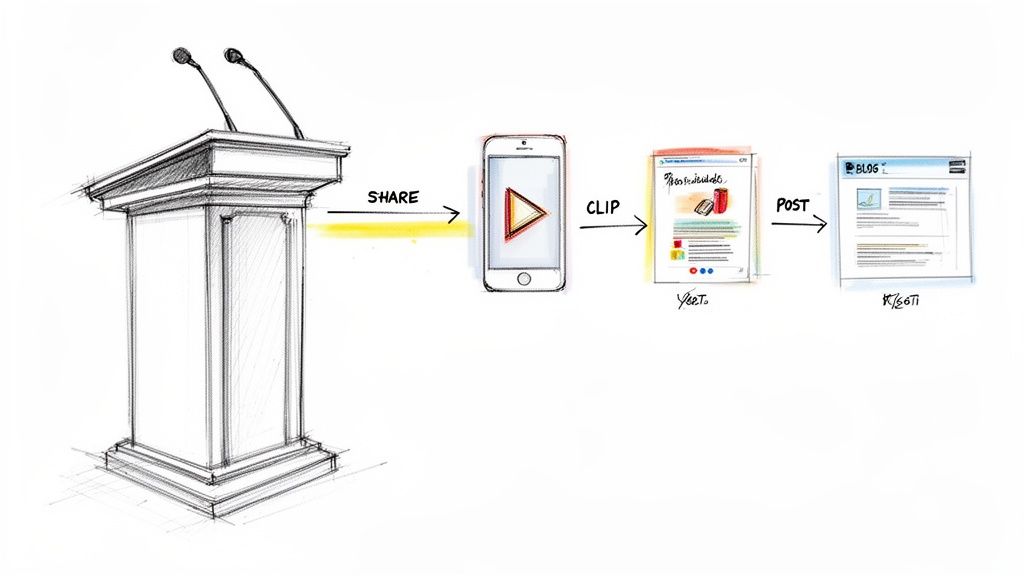
Think of it this way: your Sunday sermon isn't the final product. It's the source material. From that core message, you can create smaller, digestible pieces perfectly suited for different online spaces, from quick video clips to more reflective blog posts.
A Practical Workflow for Sermon Repurposing
It all starts with recording your sermon—not just for the archives, but with the specific goal of repurposing it later. Once you have a good quality video and audio file, the real fun begins.
Your sermon transcript is an absolute goldmine. Instead of just uploading the full-length video and calling it a day, you can pull out key quotes, powerful illustrations, and your main application points to create a whole host of digital assets.
This simple shift in strategy can turn one hour of preaching into multiple touchpoints during the week:
- Short Video Clips: Find the most compelling 60-90 second moments. This could be a powerful story, a key theological insight, or the main application challenge you gave. These are perfect for Instagram Reels, TikTok, and YouTube Shorts.
- Quote Graphics: Pull a few memorable, tweet-length sentences from your manuscript. Use a simple design tool to overlay them on a background image for platforms like Instagram and Facebook.
- Blog Posts: Your sermon notes already provide a perfect structure. Flesh out your main points with content from your transcript to create an article that reinforces the message and can be found by people searching for answers online.
- Discussion Questions: Turn your application points into thought-provoking questions. Post them in your church’s Facebook group or as an Instagram Story to spark conversation and help people reflect more deeply.
The Challenge of Modern Ministry Engagement
Let's be honest: ministry has changed. The art of sermon prep is facing new pressures. A recent Barna study noted that a staggering 46% of pastors under 45 have considered quitting, often citing feelings of being unprepared. This is happening at the same time post-pandemic weekly church attendance has dipped to 33%, which makes meaningful online engagement more critical than ever. For a deeper look, check out the latest church statistics for 2023.
This new reality demands a smarter way to connect with the 20% of our congregations who show up for online services each month. We need solutions that extend our reach without burning out our teams.
This is exactly where tools built for ministry can be a game-changer. A platform like ChurchSocial.ai, for example, is designed to automate this entire repurposing workflow. Its AI can take your sermon transcript and instantly generate social media captions, discussion questions, and even a solid draft for a blog post.
Better yet, its AI can generate reels from your sermons, identifying viral moments in your video and clipping them into shareable shorts, complete with captions. This empowers any church to boost its digital presence and keep the Sunday message alive all week long, no dedicated media team required. If you want to dig into the technical side, you might find our guide on getting your sermon on video helpful.
By embracing this approach, you honor the hard work you pour into your sermon by giving it a longer, more impactful life. You get to meet people where they actually are—on their phones, during their commute, and in their quiet moments—with the same timeless truth they heard on Sunday.
Deliver Your Message with Confidence
After all the hours of prayer, deep study, and careful outlining, the moment finally comes. All that preparation funnels down to this one sacred responsibility: stepping up to proclaim God’s Word. This is where your internal work becomes an outward act of worship and leadership.
Confidence in the pulpit isn’t about being a flawless orator. It's about being so intimately connected to the message that you can deliver it with genuine authenticity and Spirit-led conviction. The goal isn’t to memorize words, but to internalize the truth. When the flow of the message is in your heart, you're free to make real eye contact, connect with the people in front of you, and let the Holy Spirit guide the moment.
To truly step into that moment with confidence, it helps to understand the full scope of your role. Even the symbolism behind your clergy stoles symbolism and liturgical style can be empowering, reminding you that every element of your presentation contributes to an atmosphere of worship.
Beyond Memorization to Internalization
Almost every pastor I know wrestles with the notes question. Full manuscript? A simple outline on a single page? Nothing at all? The truth is, the right answer is whatever helps you communicate most clearly and effectively.
There’s no single "correct" way to do it. But I've found that the most compelling delivery almost always comes from a place of deep familiarity, where notes are more of a safety net than a script.
- Practice, Don't Just Recite: Instead of just reading your sermon over and over, try preaching it. Walk around your office or an empty sanctuary and talk through the message out loud. This is where you’ll find the natural rhythm and emotional tone.
- Know Your Transitions Cold: If you internalize anything, make it the transitions between your main points. Knowing exactly how you’ll get from one idea to the next is the key to navigating your sermon smoothly, even if you forget a specific illustration or sentence.
- Trust Your Prep Work: You’ve done the heavy lifting. You've wrestled with the text and put in the hours. Now, trust that work and allow yourself to be fully present with your congregation.
Connecting in a Hybrid Church World
Preaching today often means speaking to two different rooms at the same time: the people physically in front of you and everyone watching online. It takes a little intentionality to connect well with both.
Your body language and voice are your best tools. An open posture, purposeful gestures, and a dynamic vocal tone will engage the people in the room. For your online audience, just remember the camera is often a medium or close-up shot. Make sure your facial expressions are engaged and, every so often, look directly into the lens to create that sense of personal connection.
Before you start, always do a quick but critical tech check. Is the mic on and clear? Is the livestream audio balanced? A simple 30-second check can save you from a technical glitch that distracts from the message and ruins your recording.
And that quality recording is non-negotiable. It’s the raw material you'll use to give the sermon a life beyond Sunday morning. With a clean audio and video file, a tool like ChurchSocial.ai can work its magic. The AI can pull the transcript, generate thoughtful social media captions, and even automatically create shareable video clips from your most powerful moments.
This simple tech check is the final piece of your preparation. It ensures the message you deliver with confidence on Sunday can continue to minister with clarity all week long.
A Few Common Questions I Get About Sermon Prep
Every pastor I know runs into the same walls during the weekly sermon prep grind. Let's tackle a few of the most common questions head-on, building on the framework we've already laid out and showing how a modern workflow can make a real difference.
How Long Should This Actually Take Me?
I hear this one all the time. Most pastors say they spend 10-15 hours a week on a single sermon, but honestly, the clock isn't the real measure. It's about how effective those hours are. The goal is to get out of that Saturday night scramble and into a sustainable, structured rhythm.
This is where a strategic sermon calendar becomes your best friend. It just kills that weekly pressure. But the real game-changer is bringing smart tools into your workflow. Imagine getting hours back every week because an AI platform automatically generates social posts, blog content, and even AI-generated reels from your sermon. That's time you can pour back into study, prayer, or just being with your family.
What’s the Best Way to Beat Writer’s Block?
When you’re staring at a blinking cursor, it almost never means you've run out of ideas. It's usually a sign that the foundation isn't quite set yet. The fastest cure I've found is to just step away from the blank page and dive back into the biblical text. Go back to your exegesis. Find that core, undeniable truth of the passage again.
Sometimes, you just need to get out of your own head. Talk through the text with your spouse, a staff member, or a trusted elder. A fresh set of ears can unlock something you've been missing. This is another quiet win for having a sermon calendar—you’re not starting from a dead stop each week but from a theme you've already been thinking about.
How Do I Get My Sermons to Connect with Younger People?
Connecting with younger generations boils down to two things: relevance and authenticity. You have to use illustrations that make sense in their world and speak directly to the real-life stuff they're navigating. But the real work happens after the "amen." You have to continue the conversation where they actually live—online.
Think of your sermon as the opening line, not the final word. When you turn your main points into shareable Reels or spark a discussion on Instagram, you're showing them how the Bible speaks directly into their Monday morning. This isn't about chasing trends; it's about being a faithful missionary in a digital world.
Ready to get some time back and see your sermon's impact grow? With ChurchSocial.ai, you can automatically generate social posts, create shareable video clips, and manage your entire content plan from one spot. See how it works.