You've probably been there on a Tuesday afternoon. The Bible passage is open, your small group notes are half written, and the only question coming to mind is, “What stood out to you?” You already know what usually happens next. One person talks. Two people nod. Someone says, “I think it means we should trust God more,” and the conversation stalls.
That doesn't mean your group is disengaged. It usually means the question didn't give them enough to work with.
Church leaders and volunteers often assume good discussion happens naturally if the content is strong enough. It usually doesn't. Good conversation is built. The right question gives people a way in. It helps the quiet person speak, keeps the confident person from dominating, and turns a sermon or passage into something people can wrestle with together.
That matters in the room, and it matters online too. A church Instagram caption, a Facebook post after Sunday, or a midweek small group guide all rise or fall on the quality of the question underneath them. If you want people to reflect, reply, and grow, you need to know how to write discussion questions that move past summary and into meaning.
Beyond 'What Did You Think?' The Power of Great Questions
A weak question creates polite silence. A strong one creates movement.
When a group leader asks, “Did you like this passage?” people can answer in a sentence and move on. When the leader asks, “How does Jesus confront the kind of fear that hides behind control in this passage?” people have to slow down, interpret, and respond personally. That's where real ministry starts.

Guidance on classroom discussion writing is clear on one point. Effective discussion questions are open-ended and shouldn't be answerable with a simple yes or no. They should invite interpretation, evaluation, or comparison, and prompts that begin with words such as “why,” “how,” or “in what ways” tend to create richer dialogue, as noted in this guidance on open-ended discussion prompts.
Why churches feel this so sharply
Church settings add a few pressures that schools and workplaces don't always carry.
Some people in your group know Scripture well. Some are brand new. Some process out loud. Others need time. Some hear a sermon and instantly connect it to their week. Others need help making that bridge. A vague question doesn't unify that range. It exposes it.
Good discussion questions don't put pressure on people to sound smart. They give people something concrete to respond to.
That's why it helps to borrow tested patterns from reflection work. If you want examples of prompts that invite more personal processing, Soul Shoppe's collection of student reflection questions is useful because it shows how a question can be simple without being shallow.
Better questions build community online too
The same principle works on social media. A church post that says, “Sunday recap” gets skimmed. A post that asks, “Where do you see God asking you to trust Him before you have the full picture?” gives people a reason to comment, save, or share.
Writing strong questions isn't a personality trait. It's a ministry skill. Once you learn the patterns, you can use them in sermon guides, volunteer huddles, Bible studies, captions, reels, blog posts, and event follow-up.
Start with the Why Behind Your Questions
Before writing a single prompt, decide what you want the question to do.
That sounds obvious, but it's where many church leaders lose clarity. They write a question because the passage is interesting, not because the group needs a specific kind of conversation. The result is a discussion that feels active but goes nowhere.
Research on online learning found that when prompts required participants to justify, compare, or apply concepts, participation depth increased by roughly 30 to 40% in a 2019 study summarized by NC State's quantitative literacy discussion board guidance. The takeaway for churches is simple. Questions that ask people to think beyond recall produce stronger engagement.
Three goals that keep questions focused
I use three buckets when planning church discussion questions.
| Goal | What it helps people do | Church example |
|---|---|---|
| Knowledge | Understand the passage or idea more clearly | “What does Paul connect to spiritual maturity in this chapter?” |
| Application | Move biblical truth into daily life | “Where is forgiveness hardest for you to practice this week?” |
| Connection | Help people know each other and speak honestly | “When have you felt God's patience through another person?” |
A knowledge question is useful when the group needs clarity. If you're leading a study on the Trinity, don't begin with, “What does this doctrine mean to you?” Start narrower. Ask, “What does this passage show us about how the Father, Son, and Spirit relate to one another?” That gives the group a shared textual base.
An application question belongs where obedience, habits, or relationships are in view. After a sermon on forgiveness, a stronger question is, “What makes forgiveness costly in real life?” That's harder to dodge than, “Why is forgiveness important?”
Connection questions work when your group needs trust, not just insight. They're especially useful at the beginning or end of a discussion because they help people connect faith to lived experience.
A fast test before you finalize
Ask these three questions of every draft:
- What outcome do I want. Better understanding, practical response, or relational honesty?
- Can people answer from the text and from life. Good church questions often connect both.
- Will this question help this group, right now. A new believers group and a long-running elder cohort need different kinds of prompts.
Practical rule: If you can't name the purpose of a question in one sentence, the group probably won't know how to answer it either.
Purpose first. Wording second. That order saves a lot of awkward silence.
Your Toolkit of Question Formats
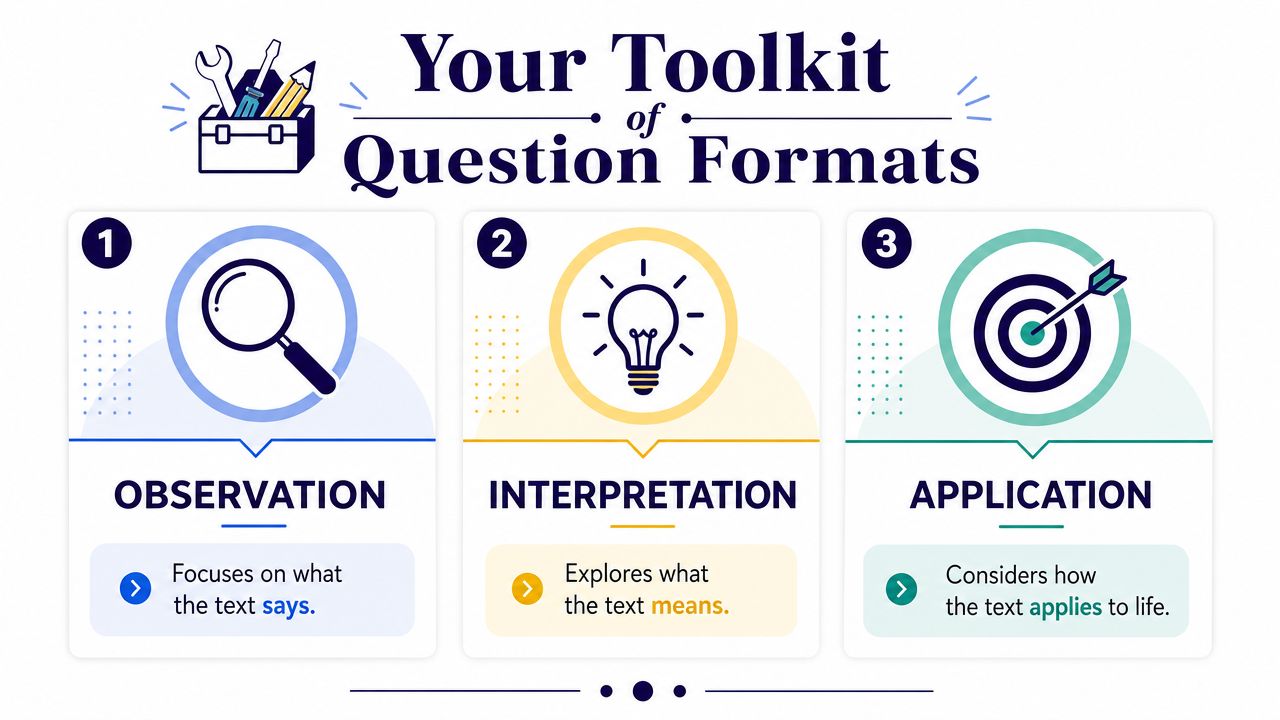
Once the goal is clear, the next step is choosing the right format. The easiest framework to use in church settings is Observation, Interpretation, and Application. It works for sermon follow-up, Bible studies, volunteer training, and even social captions built from Sunday's message.
Research on discussion design shows that open-ended prompts beginning with “why” or “how” produce 2 to 3 times as many replies per thread compared with yes/no questions, according to the summary provided in this discussion board practices video reference. That lines up with what many ministry leaders already notice. The wording of the question determines whether people stop at an answer or keep talking.
Observation questions
Observation asks, What does the text say?
These questions keep the group grounded. They work well early in the discussion because they slow everyone down and push them back into the passage instead of into instant opinion.
If your sermon topic is anxiety and trust in Matthew 6, observation questions might sound like this:
- Notice the repetition. “What words or ideas does Jesus repeat in this passage?”
- “What examples from everyday life does Jesus use to make His point?”
- Look for contrast. “What's the difference between worrying and seeking first the kingdom in these verses?”
These aren't shallow. They create shared footing.
Interpretation questions
Interpretation asks, What does the text mean?
At this point, discussion starts to open up. People compare ideas, connect themes, and explain why something matters. If you want more examples church leaders can adapt, this guide to small group discussion topics for churches gives a helpful range of ministry-friendly prompts.
For the same Matthew 6 sermon, interpretation questions could be:
- “Why do you think Jesus connects worry to what we value?”
- Push beneath the surface. “How does this passage challenge a culture that treats anxiety as normal and unavoidable?”
- “What does seeking first the kingdom look like in the logic of this passage, not just in church language?”
Interpretation questions should still be anchored. Open-ended doesn't mean vague.
Application questions
Application asks, How should this change us?
Through strong application questions, Bible study becomes discipleship. These questions don't demand a polished spiritual answer. They create room for honesty and action.
Try prompts like these:
- “Where does worry usually show up first in your week, work, finances, parenting, or relationships?”
- Make it specific. “What would it look like to seek God's kingdom first in that area over the next few days?”
- “What's one practical step of trust this passage calls you to take?”
A healthy discussion often moves through all three formats. Observation keeps the group grounded. Interpretation opens meaning. Application presses toward change.
From First Draft to Engaging Dialogue
Most weak discussion questions don't fail because the topic is bad. They fail because the wording is crowded, abstract, or trying to do too much at once.
In faith-based small-group discussions, participation increased by 38% when facilitators limited each question to one clear concept, and multi-layered questions reduced the number of participants who spoke by 41% on average, according to the summary provided in this faith-based facilitation guidance. That's a sharp reminder for every Bible study leader who writes a three-part question and wonders why nobody knows where to begin.
What to do in the drafting stage
A good first draft usually gets simpler before it gets stronger.
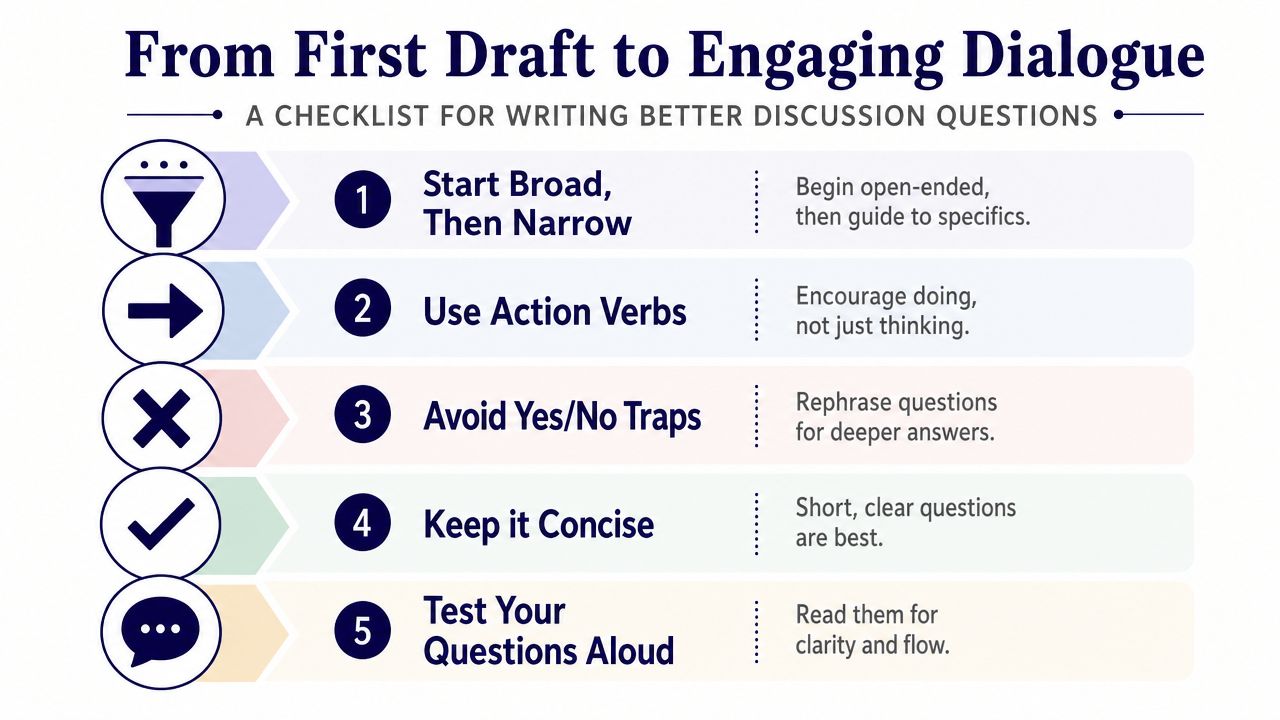
- Keep one idea per question. If you ask people to compare, evaluate, and apply all at once, they'll usually pick one part and ignore the rest.
- Use verbs that invite action. “Describe,” “compare,” “explain,” “name,” and “consider” all give people a clearer path than “share your thoughts.”
- Strip out insider language. Newer believers may not know what you mean by “idolatry,” “sanctification,” or even “conviction” if the context isn't clear.
- Read every question aloud. If you run out of breath saying it, your group will run out of energy answering it.
One practical way to sharpen your drafts is to look at a few ministry-ready examples like these discussion questions about prayer. You can hear the difference between a prompt that sounds spiritual and one that actually gives people room to respond.
Before and after
Before: “What does this passage teach us about faith, obedience, trust, and how we should live differently this week?”
After: “Where does this passage ask you to trust God before you have control of the outcome?”
The first question sounds thoughtful, but it's overloaded. The second asks for one kind of reflection and points toward a lived response.
A quick editing filter
Use this simple review before you hand questions to a leader or post them online:
| Check | Weak version | Stronger version |
|---|---|---|
| Clarity | “What are your thoughts?” | “What tension do you notice in this passage?” |
| Focus | “How do prayer, faith, obedience, and community all connect here?” | “How does prayer shape the response this passage calls for?” |
| Accessibility | “How does this text inform your theology of suffering?” | “What does this text teach you about suffering and God's presence?” |
Ask questions that a mature believer can answer deeply and a new believer can answer honestly.
That's usually the sweet spot.
Turn Sermons into Social Media Conversations
Churches often work hard on the sermon and then post a generic recap online. That misses a major opportunity.
A sermon already contains the raw material for discussion. It has a central text, a main claim, moments of tension, examples, and practical implications. Those pieces can become small group prompts, Instagram captions, reel hooks, story stickers, blog sections, and midweek follow-up posts if you extract them well.

Guidance from educational research recommends anchoring discussion questions to a specific piece of evidence from a text, such as a scene, event, or quote, because tying a question directly to a cited passage increases the likelihood of sustained, evidence-based discussion, as explained in the University of Michigan's guidance on using discussion questions effectively. Churches can use that same principle online. Don't ask, “What did you think of Sunday's message?” Ask, “When Jesus says, ‘Do not worry about tomorrow,’ what kind of fear is He confronting in us today?”
A practical weekly workflow
Here's a simple pattern many church communicators can use:
- Pull one specific sermon moment. A verse, a line from the message, or a clear illustration.
- Write one anchored question. Keep it focused on that moment.
- Adapt it by platform. A caption question can be slightly longer. A reel hook needs to be shorter. A small group handout can include follow-ups.
- Schedule the sequence. Post the short-form clip early in the week, the discussion graphic midweek, and the small group prompt before gatherings.
A platform like building online community for churches matters less than consistency and specificity, but tools do help with the workload.
Where a tool can reduce the lift
ChurchSocial.ai fits this workflow in a practical way. Churches can create AI-generated reels from sermons, generate AI content from the sermon transcript such as social posts and blogs, use graphic templates and an editor for photos and carousels, and organize it on a simple drag-and-drop calendar. It also integrates with Planning Center and other church calendars to create content for events.
That matters for volunteer-led teams because the bottleneck usually isn't ideas. It's time.
A sermon doesn't need to live for one hour on Sunday. With the right questions, it can shape conversation all week.
If your church wants social media to feel more pastoral and less promotional, discussion-driven content is one of the cleanest ways to get there.
Start Sparking Deeper Connections Today
Strong discussion questions aren't complicated, but they are deliberate. Start with the outcome you want. Choose the right format. Keep each prompt focused on one idea. Anchor it in the text. Then revise until the question sounds clear enough for a newcomer and substantial enough for a mature believer.
That approach changes the room. It also changes your church's digital voice. A better question can turn a quiet small group into an honest one, and a routine social post into a conversation that keeps the sermon alive after Sunday.
Most church leaders don't need more content. They need better prompts and a lighter workflow. That's why learning how to write discussion questions is so useful. It serves discipleship, leadership development, and community care at the same time.
The goal isn't to impress people with clever wording. It's to help people engage Scripture, respond honestly, and connect spiritual truth to real life.
If you want help turning sermons into discussion-ready content and scheduling it across your church's channels, ChurchSocial.ai gives churches one place to create sermon reels, generate posts and blogs from transcripts, design graphics and carousels, and manage everything on a visual calendar that works with Planning Center and other church calendars.