An editorial calendar is more than just a schedule—it’s the strategic roadmap for your church's entire digital ministry.
Think of it as the master plan for what you'll say, when you'll say it, and why it matters. It’s the tool that turns your social media from a stream of last-minute announcements into a thoughtful, week-long extension of your Sunday service.
From Chaos to Clarity: How a Calendar Transforms Your Ministry
Let’s be honest. Without a plan, managing a church’s social media feed often feels like you're just putting out fires. You remember the youth event at the last minute, scramble to post a sermon clip, and then struggle to find a decent graphic for the weekly Bible study.
This kind of reactive posting isn't just stressful; it creates a disjointed online presence that doesn’t truly reflect the vibrant life of your church.
An editorial calendar changes all of that. It becomes the single source of truth for your entire communications team, letting you thoughtfully map out content that aligns with your sermon series, key ministry events, and big seasons like Easter or Christmas. For a deeper dive, it's worth understanding the difference between a content strategy and an editorial calendar.
This proactive approach makes your messaging consistent and purposeful. Most importantly, it makes life a whole lot less stressful for your staff and volunteers.
From Last-Minute Stress To Strategic Impact
An editorial calendar is a direct answer to the most common headaches church communicators face. It turns frantic, last-minute activity into focused, intentional ministry.
Ultimately, a well-built calendar is what unlocks the true potential of your church's online ministry. It’s the framework that helps you serve your congregation effectively, not just on Sunday, but every single day of the week.
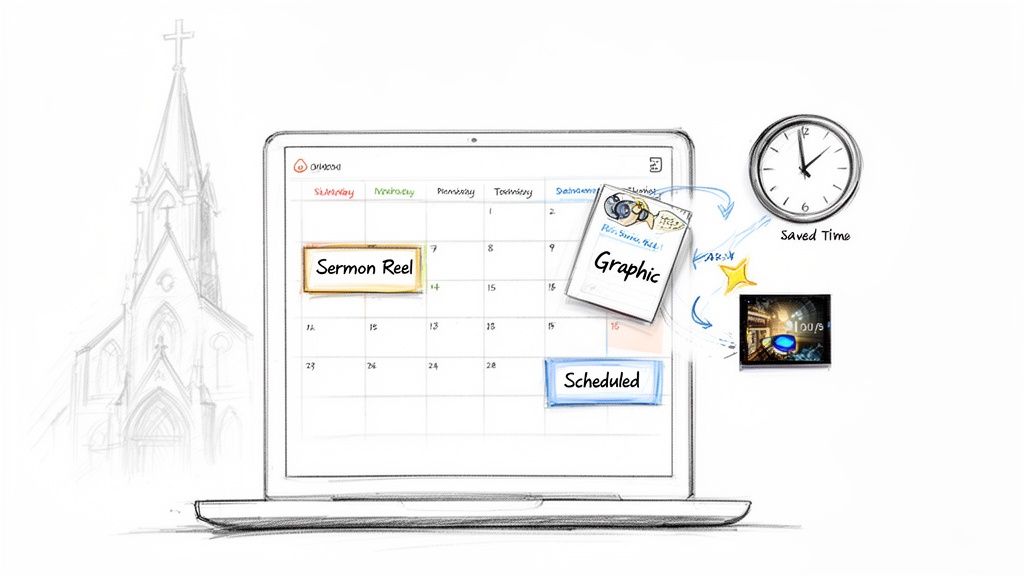
And with a platform like ChurchSocial.ai, this calendar becomes a living, breathing workspace. You can plan your themes, generate AI-powered content from your sermons, design graphics, and schedule everything in one simple, drag-and-drop interface.
The Essential Elements Of A Church Content Plan
An editorial calendar is what takes your church's communication strategy from a big-picture idea to a clear, actionable plan. It’s not about finding some complicated piece of software; it's simply about capturing the essential details needed to be intentional with your ministry online.
Think of it as the blueprint for your digital outreach. With a plan in place, every single post has a purpose, ensuring your message connects and your efforts aren't wasted.
Key Information To Track
So, what actually goes into this calendar? A solid editorial calendar for your church just needs to answer a few key questions for every piece of content. Getting this information organized is what separates a strategic approach from the stress of last-minute scrambling.
Here’s what you should track for each post:
- Publication Date: The specific day and time a post will go live. This helps you build a consistent presence your congregation can rely on.
- Target Platform: Where is this going? An AI-generated sermon reel might be perfect for Instagram, but a detailed event announcement belongs on Facebook.
- Content Pillar: Which core ministry theme does this support? Think in terms of categories like Sermon Reinforcement, Community Outreach, Volunteer Spotlights, or Spiritual Growth.
- Post Format: What is it? Is it an AI-generated reel from the sermon, a photo carousel from the youth group event, or a simple graphic announcing the next Bible study?
- Status: This is your simple progress tracker. A post can move from Idea to In Progress, then to Ready to Schedule, and finally, Published.
The chart below really drives home how an editorial calendar can turn a tangled, chaotic approach into a clear, focused strategy.
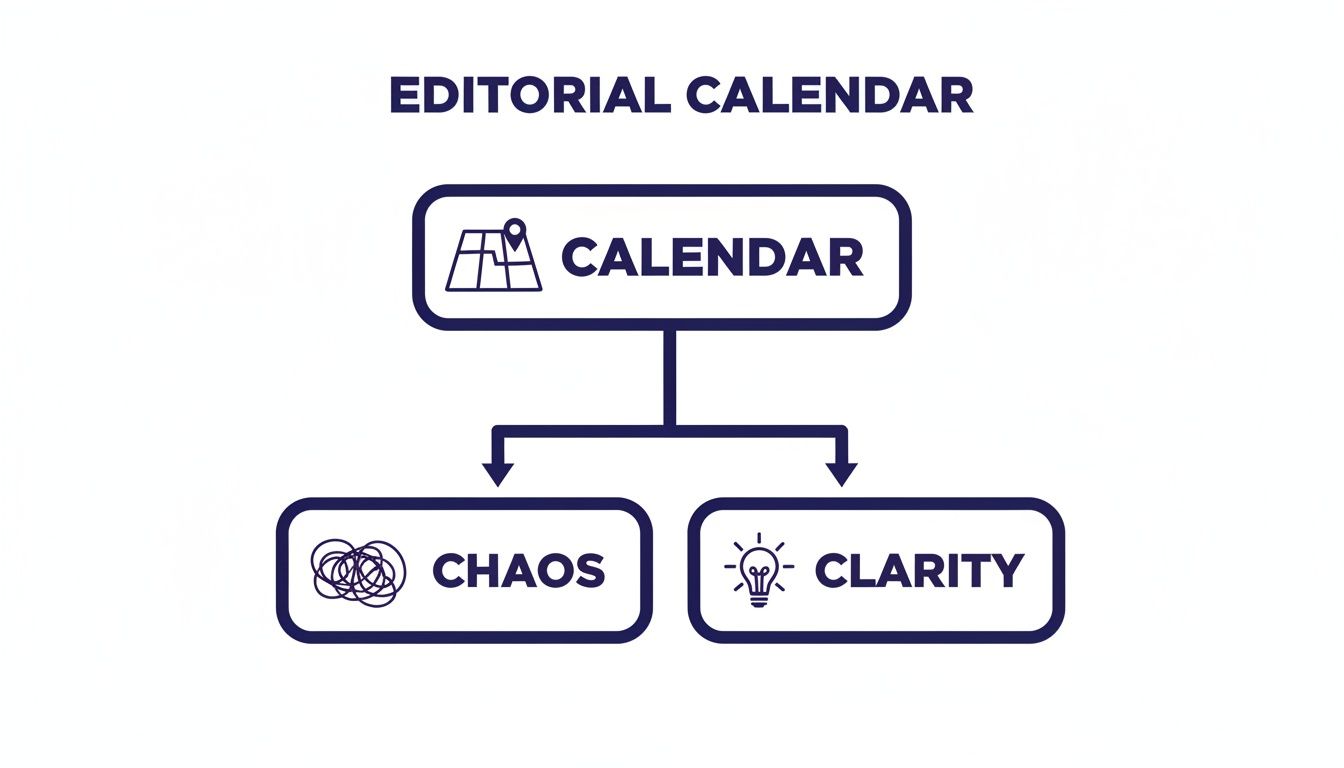
As you can see, a well-planned calendar is the tool that brings clarity and purpose to everything your church communicates online.
From Information To Action
Just gathering this information is a great first step, but a truly effective plan is always built on knowing who you’re talking to. Understanding your congregation is fundamental, and new tools are making this easier than ever. If you're curious, there are some great guides on mastering audience research with AI that can really help you refine your approach.
An editorial calendar is more than a schedule; it’s a ministry tool. It ensures the 'why' behind your church’s mission is woven into every post, every video, and every announcement you share online.
This is where a platform like ChurchSocial.ai pulls everything together. All these elements live in a simple, drag-and-drop calendar. You can generate social posts from sermon transcripts, create graphics from templates, and schedule everything in one spot. It organizes the details for you, turning your plan into an efficient engine for your ministry.
For more on building this foundational plan, be sure to check out our guide on how to create a content strategy.
The Real Payoff of Using an Editorial Calendar
Let's get real. Moving beyond just being organized, a well-run editorial calendar brings some game-changing benefits to your ministry's communication. It's how you finally shift from that stressful, last-minute posting scramble to a strategic rhythm that actually serves your congregation.
When you plan ahead, you stop just making announcements and start building a genuine, week-long conversation around your Sunday message. This kind of intentionality makes your church's online presence feel so much more cohesive and purposeful, and frankly, it deepens engagement in a way that random posts never will.
Reinforce Your Sunday Message
An editorial calendar is your secret weapon for making the sermon stick. Instead of the Sunday message vanishing by Monday morning, you can map out a whole week of content that echoes its core themes.
- Monday: Pop a key quote from the sermon into an AI-generated reel created with ChurchSocial.ai.
- Wednesday: Pose a discussion question tied to the message, using one of our branded graphic templates.
- Friday: Share a quick devotional or a real-life story that shows the sermon’s main point in action.
This approach keeps your congregation thinking about and applying the message all week long, turning a single sermon into a continuous stream of encouragement.
Save Time and Kiss Stress Goodbye
For any church staff member or volunteer, time is gold. An editorial calendar is a massive time-saver because it introduces you to the magic of batch-planning. Forget the daily panic of finding something to post; you can block out a few hours and knock out an entire month's worth of content at once.
With a clear plan, you stop wasting precious mental energy on the daily "what do we post?" hamster wheel. That frees you up to focus on the heart of ministry—connecting with people—instead of just feeding the content machine.
This proactive approach seriously cuts down on stress and helps prevent the burnout that's all too common in church communications.
Get Your Whole Ministry Team on the Same Page
A shared calendar is also brilliant for breaking down those invisible walls between ministry teams. When the youth, worship, and outreach leaders can all see the communications plan, everyone is finally pulling in the same direction.
The youth pastor knows exactly when to get photos in from the latest retreat, and the outreach team can schedule promos for the food drive weeks in advance. It becomes the one place everyone looks for what's happening, which builds teamwork and ensures no important event or story falls through the cracks. This consistency has a huge impact on your church's visibility. In fact, teams who use an editorial calendar publish 3x more consistently—a critical advantage when you're trying to connect with some of the 5.64 billion people online. You can dig into more stats on the power of consistency and see how ChurchSocial.ai helps churches map out their schedule by exploring the latest social media marketing statistics.
How To Build Your First Church Editorial Calendar
Putting together your first editorial calendar doesn't have to be some monumental task. Honestly, it’s a pretty straightforward process that brings an incredible amount of clarity to your entire communications ministry.
Let's walk through a simple, four-step approach I've seen work time and time again, designed specifically for busy church leaders like you. This framework is all about turning those big-picture ministry goals into a concrete, week-by-week action plan.
Step 1: Define Your Ministry Content Pillars
Before you can plan what to post, you need to know why you're posting. Think of Content Pillars as the core themes of your ministry—the foundational topics you want to communicate over and over again. Everything you create should be built on these.
For most churches, these pillars usually boil down to a few key areas:
- Sermon Reinforcement: Sharing key verses, quotes, and takeaways from the Sunday message. The goal is to help your congregation apply the teaching throughout their week.
- Community Stories: Highlighting baptisms, volunteer spotlights, and real stories of life change. This is where you showcase what God is doing in and through your church.
- Event Promotion: Building awareness for Bible studies, outreach events, and youth group activities. This often means integrating with your main church calendar, whether it's on Planning Center or another platform.
- Spiritual Growth: Providing devotionals, prayer prompts, and encouraging scripture to help your community grow in their faith daily.
Sticking to these pillars keeps your social media balanced and laser-focused on your core mission. No more random posts that don't serve a purpose.
Step 2: Choose Your Tool
Okay, you've got your pillars defined. Now you need a place to organize all your ideas. The tool you choose can be as simple or as sophisticated as you need, but the most important thing is that it's accessible to your whole team.
A basic spreadsheet can absolutely work when you're just starting out. But if you want to find real efficiency, a dedicated platform is the way to go. A tool like ChurchSocial.ai, for example, gives you a simple drag-and-drop calendar designed for ministry. It's not just a scheduler; it's a workspace where you can plan, create, and publish all in one spot.
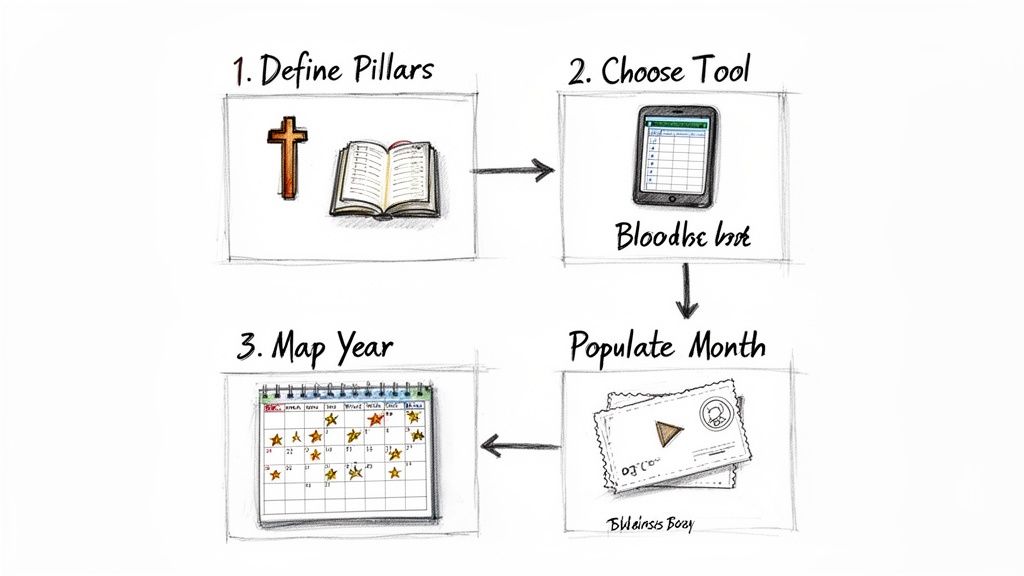
Step 3: Map Your Ministry Year
Now it’s time for the 30,000-foot view. Open up your calendar and start plotting the key dates and seasons for your church. This high-level planning is what prevents major events from sneaking up on you.
Get your calendar in sync with the natural rhythms of your ministry:
- Major Holidays: Think Easter, Advent, and Christmas.
- Church-Specific Events: VBS, mission trips, annual conferences, and member meetings.
- Sermon Series: Map out the start and end dates for each teaching series so your content can align perfectly.
This step gives you a strategic skeleton for the whole year, which makes the month-to-month planning so much faster. For a more detailed look at this process, check out our guide on creating a church social media content calendar.
An editorial calendar transforms your workflow from reactive to proactive. You'll stop chasing last-minute posts and start strategically building momentum for your ministry's most important moments.
Step 4: Populate Your First Month
With the framework in place, you can confidently start filling in your first month. This is where the plan really comes to life. Go day by day, assign a content pillar, decide on the post format, and get to work.
A typical week might look like this:
- Monday: Schedule an AI-generated reel from Sunday's sermon (Sermon Reinforcement).
- Wednesday: Use a graphic template to create a reminder for the midweek Bible study (Event Promotion).
- Friday: Post a short testimony from a church member (Community Stories).
When you use a tool like ChurchSocial.ai, this becomes incredibly efficient. You can generate social posts directly from sermon transcripts, use our graphic editor and templates, and schedule everything in minutes. That saves you valuable time for what really matters—people.
Turn Your Calendar Into An Action Plan with ChurchSocial.ai
A well-made editorial calendar is the blueprint for your church’s digital ministry, but a blueprint alone doesn't build the house. The real magic happens when your calendar stops being a static document and becomes a dynamic hub for creation and execution. This is where your strategy becomes an action plan that actually saves you precious ministry hours.
This is exactly what ChurchSocial.ai was designed to be. It takes the idea of what is an editorial calendar and turns it into an action-oriented workspace by building powerful content creation tools right into your schedule. It’s no longer just a place to jot down ideas; it’s where those ideas come to life with unbelievable speed.
More Than a Schedule—A Content Engine
At its heart, ChurchSocial.ai is a simple, visual drag-and-drop calendar. But unlike a basic spreadsheet or digital planner, every single entry is a launchpad for creating something new. This is where the real time-saving begins for your ministry team, turning one sermon into a whole week of engaging content.
A great plan is a great start, but the tools you use to execute that plan determine whether you save time or create more work. Your calendar should be a place of action, not just a list of tasks.
Instead of your team juggling multiple tools for video editing, graphic design, and writing, ChurchSocial.ai brings it all under one roof. This is a game-changer for pastors and volunteers who already wear too many hats. For more on how tech can support ministry leaders, check out our guide on finding the perfect app for pastors.
From Sermon to Social Posts in Minutes
Picture this workflow: After Sunday service, you upload the sermon transcript to ChurchSocial.ai. From there, right inside your calendar, you can:
- Generate Sermon Reels: Our AI automatically finds the most powerful, shareable moments from your sermon and creates short video clips—complete with captions—ready for Instagram and TikTok.
- Create Social Posts: Instantly get a week's worth of content, from discussion questions and key takeaways to encouraging quotes, all based on the sermon's message.
- Design Stunning Graphics: Dive into a library of professional, church-focused graphic templates. Our simple editor lets you pop in a key verse or an event announcement, making sure every visual looks fantastic and on-brand.
- Write Blog Content: With a single click, turn the sermon transcript into a well-structured blog post for your church’s website, extending your message to a whole new audience.
Here’s a glimpse of the ChurchSocial.ai calendar, where planning and creating happen in one seamless spot.
This unified dashboard lets you see your entire month at a glance while putting powerful AI creation tools right at your fingertips for every scheduled post.
This all-in-one approach transforms your editorial calendar from a simple planning tool into a powerful content engine. It even integrates with church calendars like Planning Center to help you create content for events well in advance. This is how you move from just planning your ministry’s message to amplifying it with consistency and excellence across every digital platform.
Common Calendar Mistakes And How To Avoid Them
Even the best-laid plans can go sideways, and an editorial calendar is no exception. A great strategy needs sustainable habits to back it up, but a few common pitfalls can easily trip up a church's content efforts, turning a helpful tool into a source of stress.
Recognizing these mistakes is the first step. The biggest one? Creating a schedule that’s way too rigid. Ministry is dynamic and often Spirit-led, and your calendar needs room to breathe. When an impromptu baptism happens or a powerful testimony emerges from a small group, you need the flexibility to share those moments without blowing up your entire plan.
Being Too Ambitious
Another frequent misstep is over-scheduling, which is a fast track to volunteer burnout. It’s tempting to plan a post for every platform, every single day, but consistency is far more important than frequency. A calendar packed with unrealistic goals will likely be abandoned within a few weeks, leaving you right back where you started.
The goal of an editorial calendar is to serve your ministry, not for your ministry to serve the calendar. If the plan is causing more stress than it’s solving, it’s time to simplify and refocus.
Ignoring What Works
Finally, many churches fall into the "set it and forget it" trap. They put content out there but never circle back to see what actually connected with their congregation. Your calendar should be a living document, constantly refined by what you learn. Look at which posts sparked conversation, which AI-generated sermon reels got the most shares, and which event announcements drove the most clicks.
Here are a few ways to sidestep these common issues:
- Build in "Flex Days": Leave one or two slots open each week for those spontaneous, in-the-moment ministry stories.
- Start Small and Scale: Begin by planning just three high-quality posts a week. Once that feels easy, you can gradually add more.
- Review and Refine Monthly: Set aside time each month to look at your analytics. Double down on the content formats and topics that your community clearly loves.
A platform like ChurchSocial.ai can help prevent these issues from the start. Its simple drag-and-drop interface makes it easy to adjust your schedule on the fly, and its AI tools can help you create quality posts without overburdening your team. This allows you to maintain a flexible and sustainable content rhythm that truly works for your church.
A Few Common Questions
Even with the best roadmaps, a few questions always pop up when you're starting a new journey. It's totally normal. Here are some of the most common things we hear from church leaders as they start using an editorial calendar.
How Far Ahead Should We Really Be Planning?
That's the million-dollar question, isn't it? A great place to start is planning one full month in advance. This gives your team enough breathing room to work ahead without feeling like you're trying to predict the distant future. It's a manageable, strategic buffer.
Now, for those big seasons—think Advent, Lent, or Easter—you'll want to push that out to two or even three months. The beauty of a tool like ChurchSocial.ai is that you can schedule posts way down the road, letting you get all that crucial holiday content locked in when things are a bit slower.
We Don't Have a Designer. How Do We Create Good Graphics?
This is probably one of the biggest hurdles for most churches, and it's exactly where planning pays off. When you know what's coming, you're not scrambling to throw together a graphic 10 minutes before you need to post it. You can anticipate your needs.
This is also why platforms like ChurchSocial.ai exist. They're built for this exact problem, giving you a whole library of professional templates and a super simple editor. You can create beautiful, on-brand posts for your sermon series, photos, and carousels without needing a design degree.
What’s the Difference Between a "Content" and "Editorial" Calendar Anyway?
You'll hear these terms thrown around a lot, often as if they're the same thing. They're close, but there's a key difference.
A content calendar is the what and when. It's a schedule of posts. An editorial calendar is the why. It’s the strategic layer on top, connecting every single post back to a bigger purpose—a sermon series theme, a ministry goal, or an outreach campaign. It turns your schedule into a roadmap.
Can We Use This for More Than Just Social Media?
Absolutely! And you really should. A great editorial calendar can become the command center for all your church communications. Think of it as the one place to coordinate your blog posts, email newsletters, website updates, and social media.
This is where things get really powerful. With ChurchSocial.ai, for example, you can generate an AI blog post from a sermon transcript and plan its publication right next to the social posts promoting it. Suddenly, everything is working together, creating a unified message that truly resonates.
Ready to stop the scroll-stopping scramble and bring some clarity to your church's digital outreach? ChurchSocial.ai gives you the drag-and-drop calendar, AI content tools, and graphic templates to make it happen. Start saving hours each week and amplifying your ministry's message by visiting https://churchsocial.ai.