It's easy to get caught up in the "what" of church content—what to post, what to write, what to record. But a truly effective strategy doesn't start there. It starts with "why."
Before you even think about a single social media graphic, you have to lay a solid foundation. This is about connecting your church’s deepest mission to every single thing you share online. It's the difference between just being active and being intentional.
Build Your Content Strategy on a Firm Foundation
What does a "win" look like for your church's online ministry? I can tell you from experience, it’s almost never about vanity metrics like likes and follower counts. Real success is about fostering genuine community, sparking spiritual growth, and making sure your church’s welcome extends far beyond your physical walls.
Every piece of content should be a tool for ministry, not just another item to cross off a to-do list.
This whole process starts by asking bigger questions. Instead of, "What should we post today?" try asking, "What is God calling our church to do, right now, in this season?" The answers you find will become the bedrock of everything else. If you want to dive even deeper into the nuts and bolts, this comprehensive content marketing strategy guide is a great resource.
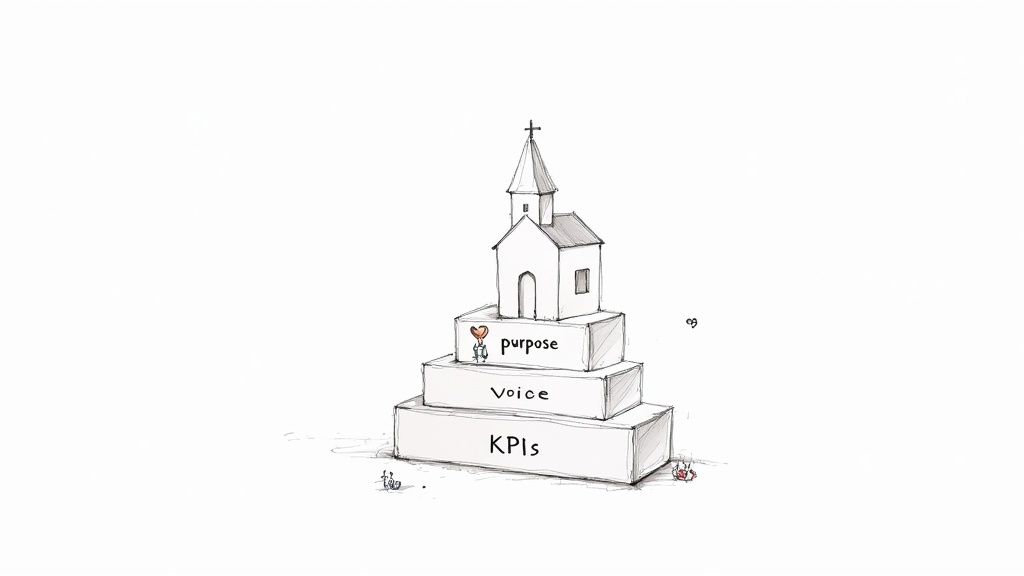
Figure Out Your Ministry Objectives
Your content strategy has to be wired directly into your church’s core mission. Think about your biggest priorities for the next six to twelve months. Are you trying to get more people plugged into small groups? Reach young families? Help your congregation go deeper with the Sunday message?
Your content should reflect those goals. For example:
- Goal: Increase small group sign-ups. Content Idea: Share short video testimonials from people whose lives were changed by their group.
- Goal: Reach new families in the community. Content Idea: Post a "behind-the-scenes" look at your vibrant kids' ministry on a Sunday morning.
- Goal: Deepen engagement with the sermon. Content Idea: Create a shareable graphic with the week’s key Bible verse or a thought-provoking question from the message.
- Goal: Boost VBS or Easter service attendance. Content Idea: Run a countdown on social media with sneak peeks and clear registration info.
When you define these objectives first, your content stops being random noise and starts becoming a powerful extension of your actual ministry.
Translate Goals Into Measurable KPIs
Okay, so you have your big-picture goals. Now, how do you know if you're actually getting there? That’s where Key Performance Indicators, or KPIs, come in.
KPIs turn a broad goal like "reach new families" into something you can actually track, like aiming for 20 clicks per month on the ‘Plan Your Visit’ link from your Instagram bio. They take the guesswork out of it.
Connecting Ministry Goals to Digital KPIs
See how to translate your church's mission into measurable digital outcomes that define a successful content strategy.
By tracking the right KPIs, you can make smart, data-informed decisions instead of just hoping for the best. For a full breakdown of how this works, you can learn more about what is a content marketing strategy in our detailed guide.
This is where a tool like ChurchSocial.ai is a game-changer. The dashboard lays out all your key metrics in one clean, easy-to-read place. No more digging through confusing native analytics to figure out what's working.
Establish Your Church’s Unique Voice
Last but definitely not least, how do you want your church to sound online? Your voice is the personality that comes through in your captions, videos, and emails. Is it warm and welcoming? Thoughtful and academic? Modern and full of energy?
Whatever it is, it needs to be an honest reflection of your church’s real-life culture.
Key Takeaway: An authentic online voice isn’t created; it’s captured. It should feel like a natural extension of the conversations happening in your lobby on a Sunday morning.
Defining your voice creates consistency. It helps your community feel a familiar, personal connection, whether they’re reading an Instagram post on Tuesday or listening to the sermon on Sunday. It’s the final piece of the foundation that makes every piece of content feel purposeful.
Develop Your Core Content Pillars
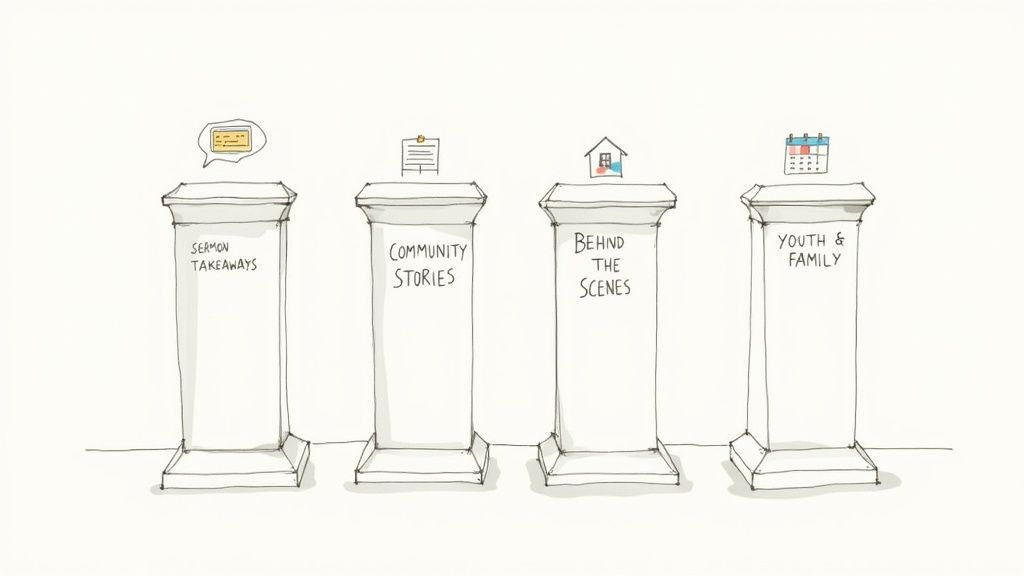
Okay, you've nailed down your ministry goals and found your voice. Now for the fun part: deciding what you're actually going to talk about. This is where content pillars come in. Think of them as the main themes or buckets that hold all your content, making sure everything you post feels connected and intentional.
Without pillars, your church's social media can feel completely random. One day it's a service reminder, the next it’s a staff birthday, and the day after that it’s a random Bible verse. Content pillars bring order to the chaos. They create a reliable structure that moves your strategy from just making announcements to actively discipling and reaching people.
From Sunday Sermon to Weekly Content
For almost any church, the most natural and powerful content pillar is the weekly sermon. You already pour so much time and prayer into preparing that message. Why let all that incredible insight just vanish after Sunday morning?
Instead, think of the sermon as the starting point for a whole week of content. You can create multiple touchpoints that reinforce the main idea, keeping it fresh in people's minds long after they’ve left the building. This isn't about adding more to your plate; it's about being a good steward of the work you're already doing.
And this is where a tool like ChurchSocial.ai can be a game-changer for your team.
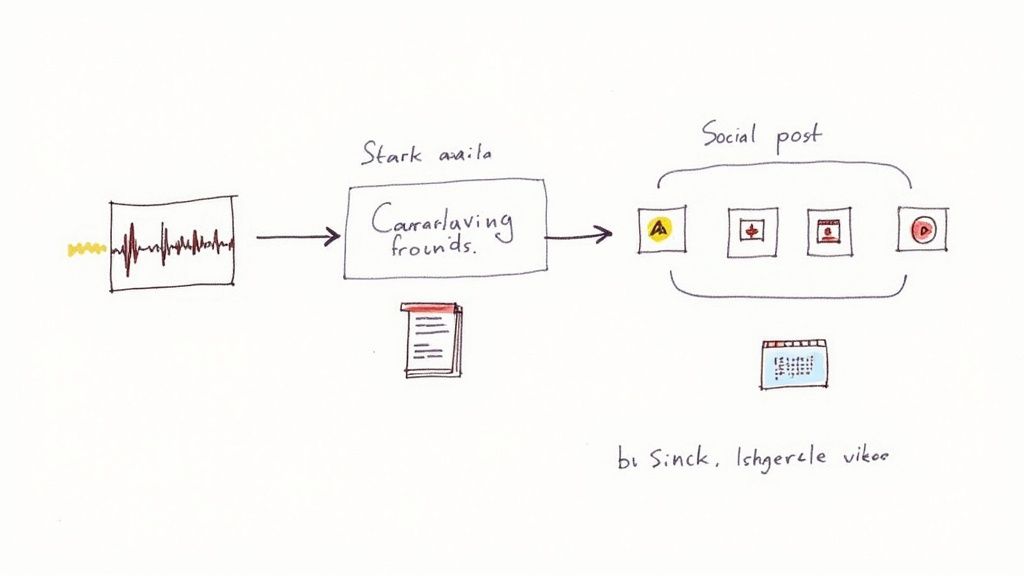
You can simply upload your sermon transcript, and its AI engine gets to work, generating a whole suite of content assets directly from that week’s teaching. This includes AI-generated reels from your sermons, social posts, and even blog content, ensuring your online presence is always cohesive and rooted in Scripture.
Brainstorming Your Church's Content Pillars
The sermon is a fantastic starting point, but what else is your church all about? Think about the other key areas of your ministry and mission. Your goal is to land on 3-5 pillars that truly represent who you are and what you want to be known for.
Each pillar should serve a different purpose, whether it's spiritual formation, community building, or outreach.
Here are a few ideas to get you started, along with some practical examples for each:
Pillar 1: Sermon Takeaways & Discipleship
- The Goal: Help your congregation take the Sunday message and apply it to their Monday-through-Saturday lives.
- What it looks like: Quote graphics with key verses, short video Reels from the pastor summarizing a main point, or discussion questions for small groups.
Pillar 2: Community & Outreach Stories
- The Goal: Show, don't just tell, how your church is making a real difference.
- What it looks like: A photo carousel from a recent service project, a quick video testimonial from a volunteer, or a "Ministry Partner Monday" shout-out to a local nonprofit you support.
Pillar 3: Behind the Scenes & Team Culture
- The Goal: Pull back the curtain and humanize your ministry. This builds trust and connection.
- What it looks like: A quick clip of the worship team rehearsing, photos of volunteers setting up for the service, or an "Ask Me Anything" Q&A with a staff member on Instagram Stories.
Pillar 4: Youth & Family Resources
- The Goal: Equip and encourage parents while engaging the next generation.
- What it looks like: Shareable graphics with family conversation starters, a link to a helpful parenting podcast, or a highlight reel from the youth group's last event.
Key Takeaway: Your content pillars aren't just topics. They are promises to your audience about the kind of value you will consistently bring to their feeds. They build trust and give people a reason to keep coming back.
By clearly defining these pillars, you create a simple but powerful roadmap for all your content. This intentional approach ensures every single post works together to tell a bigger, more compelling story about your church's heart and mission.
Choose the Right Channels for Your Community
So, you've got your content pillars sorted out. That's a huge win, but it's really only half the battle. Now you have to figure out where you’re going to share all this great content.
The temptation is to be everywhere at once, but that's a surefire recipe for burnout. The real goal is to show up in the right places—the digital spaces where your community already hangs out. It's much smarter to pick one or two primary channels and absolutely knock it out of the park.
Selecting Your Primary Platforms
Different social media platforms feel different and serve different purposes. Thinking through these nuances is the key to picking the right one for your church's specific goals.
Facebook tends to be the digital town square for your existing congregation. It’s fantastic for building that tight-knit community feel, sharing event details, and live-streaming services for people who can't make it in person.
Instagram is all about visual storytelling and is often where you'll connect with younger families. It's the perfect place to share the heart of your church through beautiful photos, short video Reels, and behind-the-scenes Stories.
Not sure where to start? Just ask. A simple survey asking your congregation where they spend their time online will give you all the data you need to point your efforts in the right direction.
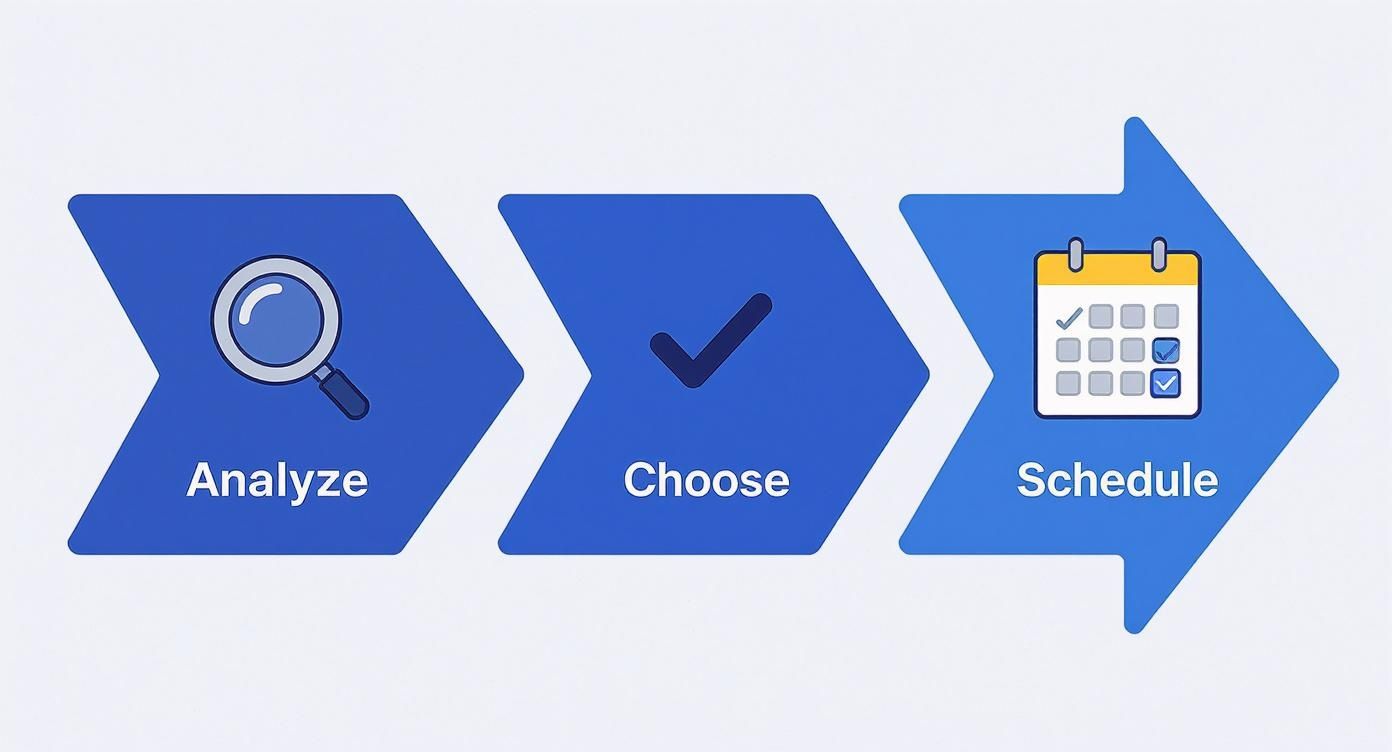
It’s a simple flow: analyze your community, choose the channels that make the most sense, and then get consistent with your schedule.
Establishing a Sustainable Posting Cadence
Once you've landed on your platforms, the next question is how often to post. The magic word here is sustainability.
It is so much better to post three high-quality, meaningful pieces of content every single week than it is to post twice a day for a month and then go silent for two.
Key Takeaway: Consistency is what builds trust and reliability with your online audience. A realistic posting cadence that your team can actually maintain is far more valuable than an ambitious one that fizzles out.
This is where having a documented distribution plan becomes a game-changer. Research from Power Digital Marketing shows that organizations with a documented plan are three times more likely to get strong results. Yet, a shocking 38% of marketers don't have one. Those who do, however, see much higher engagement by mixing channels like social media and email.
Simplifying Your Scheduling Workflow
Juggling multiple channels and a consistent posting schedule can feel like a lot, I get it. But the right tools can make all the difference. A simple, visual, drag-and-drop calendar can completely transform your workflow from a complicated headache into an easy-to-manage process.
This is exactly what we had in mind when building ChurchSocial.ai. Our simple drag-and-drop calendar allows churches to easily manage and update all of their social media from one place. And when ministry life happens and plans change, you can just drag and drop to adjust.
For a deeper dive, check out our guide on effective content distribution strategies for churches. A unified view keeps you consistent, prevents content from falling through the cracks, and frees you up to focus on what really matters: people.
Let’s be honest. The idea of creating fresh, engaging content every single day is enough to make any church communicator’s head spin. Most ministry teams are already stretched thin, and adding "full-time content creator" to the job description just isn't realistic.
But what if your content strategy wasn't about working harder, but smarter? What if you could turn what feels like a chore into an efficient, repeatable workflow that actually fuels your ministry?
This shift isn't just a "church thing." It's happening everywhere. A recent study showed that over 80% of marketers are now using AI in their strategies, and for good reason. They're chasing efficiency and the ability to do more with less—a challenge every single one of us in ministry knows all too well.
Turn Sermons into a Week of Content
Imagine this: you upload Sunday’s sermon file, and a digital ministry partner immediately gets to work. That’s the magic behind a platform like ChurchSocial.ai. It grabs that single, powerful piece of content and multiplies its impact, spinning out dozens of social media posts, blog ideas, and even AI-generated reels.
Suddenly, that one-hour message becomes the foundation for an entire week of discipleship and outreach.
- AI-Generated Reels: The AI can pinpoint the most impactful moments from the sermon and turn them into short, shareable video clips, complete with captions.
- Engaging Social Posts: It writes captions that grab attention, poses thought-provoking questions, and pulls out key quotes, all tailored for different platforms like Facebook and Instagram.
- Blog & Newsletter Starters: It can generate a solid summary or a detailed outline for a blog post, helping you go deeper on a topic without staring at a blank page.
This "repurposing" model is a game-changer. It ensures your online content is always connected to what’s being taught from the pulpit, reinforcing your church’s message all week long. To see exactly how this works, check out our guide on AI for churches.
Empower Your Team with Simple Design Tools
Let's talk about graphics. Creating beautiful, on-brand visuals shouldn't require a graphic design degree, but it often feels that way. This is a major hurdle for many churches trying to produce professional-looking content consistently.
ChurchSocial.ai tackles this head-on with a built-in graphic editor and a library of templates designed specifically for ministry. Anyone on your team—from the lead pastor to a dedicated volunteer—can jump in and create stunning photos and carousels in just a few minutes.
Key Takeaway: The right tools remove creative bottlenecks and empower your whole team to contribute. It makes a high-quality, consistent online presence accessible to everyone, not just the person who knows Photoshop.
If you want to dig deeper into the nuts and bolts, there are some great resources out there on using AI writing articles effectively that really connect with people.
Automate Event Promotion and Workflows
How much time does your team really spend creating and scheduling posts for upcoming events? For most, it’s a lot.
By integrating with tools like Planning Center and other church calendars, this process can become almost entirely hands-off. When you add a new event to your church calendar, ChurchSocial.ai can pull the details—date, time, description—and automatically generate promotional posts for you.
This simple automation transforms a repetitive, time-sucking task into a smooth workflow. It frees up your team to focus on what matters most: ministry, not marketing logistics.
Here’s a look at how this shift can radically change your team's weekly workload:
Manual Workflow vs ChurchSocial.ai Workflow
This table breaks down how much time and effort your ministry can save on key content tasks by moving from a traditional approach to an AI-assisted one.
As you can see, the time savings are massive. This isn't about replacing people; it's about empowering them to build a sustainable content strategy that doesn't lead to burnout.
Measure Your Impact and Refine Your Strategy
So, you’ve built out your content strategy. That’s a huge step, but the work isn’t over. A plan for your church’s online ministry shouldn't be a "set it and forget it" document. Think of it as a living, breathing thing that needs to learn, adapt, and grow more fruitful over time.
The final, critical piece of the puzzle is learning how to measure what truly matters. Then, you can use those insights to continually sharpen your approach. This isn't about chasing empty numbers like follower counts or likes. For a church, the real win is ministry impact. Are you actually sparking meaningful spiritual conversations? Are you making it easier for a new family to get connected? Those are the questions that should drive everything.
Moving Beyond Vanity Metrics
It's easy to get a little thrill when a post gets a ton of likes, but let's be honest—that doesn't always translate to real-world ministry. A truly successful content strategy tracks meaningful engagement that ties directly back to your original goals.
Instead of getting hung up on surface-level numbers, start focusing on the metrics that tell a deeper story.
- Meaningful Comments: Look for the comments that ask genuine spiritual questions, share how a sermon hit home, or offer encouragement to others. These are infinitely more valuable than a simple fire emoji.
- Link Clicks to Ministry Pages: How many people are actually clicking the link in your bio to your "Plan a Visit" page? What about small group sign-ups or event registrations? This is a direct line from your content to real-life action.
- Shares and Saves: When someone shares your sermon clip or saves a graphic with a Bible verse, they're doing more than just engaging. They're personally endorsing your message and keeping it for later.
Tracking these specific actions gives you a much clearer picture of whether your content is actually helping people take their next step of faith.
Establishing a Rhythm of Review
To keep your strategy sharp, you need a simple, repeatable review process. You don't need fancy software or a data science degree—just a commitment to regularly ask good questions as a team. For most churches, a quarterly review is a great rhythm to get into.
Gather your team—whether that’s a couple of staff members, key volunteers, or just yourself—and walk through a straightforward content review.
Key Takeaway: The goal here isn't to judge past performance but to learn from it. Every piece of data, good or bad, is an insight that can make your future ministry efforts more effective.
During your review, ask practical, ministry-focused questions like these:
- Which sermon series sparked the most discussion online? This tells you exactly which topics are resonating most deeply with your people and the community around you.
- Did our event promotion posts actually lead to more RSVPs or sign-ups? It’s all about connecting the dots between your online efforts and your offline results.
- What kinds of questions are people asking most often in comments or DMs? This is an absolute goldmine for future content ideas. It can reveal where your community is wrestling and needs more guidance.
Answering these questions helps you see what’s truly clicking. Maybe you’ll discover that short, AI-generated Reels from sermons get twice the engagement of static graphics. Or perhaps you’ll find that posts promoting your local service projects are shared more than anything else.
These insights are invaluable. They allow you to double down on what works and pull back on what doesn’t. This cycle of creating, measuring, and refining is the engine that drives a powerful and sustainable content strategy, ensuring your online outreach grows more effective with each passing month.
Your Top Church Content Questions, Answered
Diving into a more intentional online ministry always kicks up a few questions. Building a content strategy is a process, and it's totally normal to feel a bit stuck at times. We hear the same great questions from church leaders all the time, so let's tackle them head-on and get you moving forward with clarity.
"Our Team Is Tiny. How Can We Possibly Create Enough Content?"
This is, without a doubt, the most common hurdle for any ministry, especially when your "team" is really just you and a few dedicated volunteers. The secret isn't creating more content; it's creating smarter content. It's all about getting the most mileage out of the work you're already doing every single week.
This is exactly why we built ChurchSocial.ai. Instead of staring at a blank screen trying to invent a week's worth of posts, you can take your single most powerful piece of content—the Sunday sermon—and let it do the heavy lifting.
Just upload your sermon transcript and watch it multiply. The AI can generate a whole week of diverse, ready-to-use posts:
- AI-generated reels featuring powerful clips from the message, perfect for Instagram.
- Quote graphics that pull out the most memorable lines.
- Discussion questions to get real conversations started on Facebook.
- Blog post outlines to build out your website's resource library.
This "create once, publish everywhere" model, paired with our graphic templates and editor, suddenly makes a high-quality online presence feel possible, even for a team of one.
"How Do We Actually Know if Our Content Is Working?"
For a church, success looks different. It's not about vanity metrics like follower counts or the number of likes. Your content is "working" when it helps you achieve your real-world ministry goals. It all starts by defining what winning looks like for you.
Trying to get more people to sign up for your new members' class? The only metric that matters is how many people clicked the sign-up link in your posts. Hoping to build a stronger community online? You should be measuring the number of meaningful comments and back-and-forth conversations.
Key Takeaway: The real impact of your content is measured in action. To see what's truly effective, you have to tie every post back to a tangible ministry outcome.
If your goal is to reach new people in your city, track how many times your sermon clips are being shared. Connecting your content directly to these outcomes is the only way to get a clear picture of its true value.
"What's the Single Most Important First Step to Take?"
Before you worry about what to post or where to post it, you have to nail down your "why." The most critical first step is to clarify the primary, singular purpose of your church's online ministry.
Is your number one goal to disciple your current congregation throughout the week? Or is it to reach unchurched and de-churched people in your specific community? Maybe it's all about connecting people into small groups and in-person events.
That one clear answer will become the guiding star for every other decision. It shapes your content pillars, dictates the channels you focus on, and defines the tone of your captions. Once your purpose is locked in, the rest of the strategy starts to fall into place naturally.
"How Do We Make Our Online Voice Feel Genuinely... Us?"
Authenticity isn't about chasing trends; it's about clarity and consistency. A great place to start is to brainstorm 3-5 words that describe the unique personality of your church. Are you "welcoming, biblical, and joyful"? Or maybe more "reverent, historic, and thoughtful"?
Use those words as a filter for everything you create. When you use tools like ChurchSocial.ai to generate content, think of the output as a fantastic first draft. The final, critical step is to have a real person review it, adding your church's unique phrases, specific stories, and even inside jokes.
This blend of AI-driven efficiency and a uniquely human touch is how you build an authentic online voice that feels like a natural extension of a conversation in your church lobby.
Ready to stop guessing and start building a content strategy that actually works? ChurchSocial.ai gives you the AI-powered tools, simple drag-and-drop calendar, and church-specific templates you need to streamline your workflow and multiply your ministry impact online. See how it works at https://churchsocial.ai.