Monday hits, and the service is over. The sermon is preached, volunteers are tired, the lobby signs are still leaning against the wall, and someone says, “We should post something this week.”
That moment is where most church social media breaks down.
Not because the church lacks heart. Usually it's the opposite. The team cares a great deal, but social media gets treated like a side task squeezed in between pastoral care, event planning, worship prep, and everything else. The result is familiar: inconsistent posting, rushed graphics, last-minute event promos, and a feed that doesn't reflect the life of the church very well.
Christian social media marketing works better when it stops being a scramble and starts becoming a repeatable ministry system. The churches that stay consistent usually aren't more creative. They're more organized. They know what to post, where to post it, and how to turn one Sunday message into content that serves people all week.
From Sunday Service to Daily Connection
A lot of churches live in a weekly content cycle without realizing it.
Sunday creates the raw material. The sermon, worship, announcements, testimonies, prayer moments, volunteer stories, and upcoming events all happen in one concentrated window. Then Monday arrives, and the team acts like it has to invent fresh content from scratch. That's exhausting, and it's unnecessary.

The real problem isn't ideas
Most churches don't have a content shortage. They have a workflow problem.
A pastor finishes a message with five strong lines that could become clips. A ministry leader has photos from a serve day sitting on a phone. Someone already wrote clear event details in the bulletin or Planning Center. But none of that becomes usable social content unless somebody has time to collect it, edit it, caption it, and schedule it.
That's where teams burn out.
Practical rule: If your church starts each week with a blank screen, your process is costing you more than your platform choice.
Christian social media marketing is more sustainable when you treat social as a daily extension of Sunday ministry. The goal isn't to “keep the algorithm happy.” The goal is to keep the conversation going after the service ends.
What daily connection actually looks like
A healthy church feed doesn't sound like a running commercial. It feels like ongoing pastoral presence.
That can look like:
- A sermon clip on Monday that reinforces the core message while it's still fresh
- A devotional reflection midweek that helps people apply the sermon in ordinary life
- A volunteer spotlight that shows the church is a real community, not just a stage
- An event reminder that explains why the event matters, not only when it starts
This kind of rhythm changes how social media feels for the team and for the audience. Instead of random announcements, people experience continuity. They see the same mission showing up in different formats across the week.
The good news is that this doesn't require a full media department. It requires a playbook. Once the team knows how to capture Sunday, organize assets, and repurpose content intentionally, social media starts functioning like ministry support instead of ministry drag.
Laying the Foundation for Your Digital Ministry
Before choosing post formats or editing sermon clips, decide what your church is trying to do online.
That sounds obvious, but it's where a lot of Christian social media marketing goes sideways. Churches often start with tactics first. They ask whether they should post Reels, try TikTok, or boost event graphics. Those questions matter, but they matter less than audience and mission.
Social media is already where people spend attention. As of 2025, an estimated 5.24 billion people use social media, spending about 2 hours and 21 minutes per day on these platforms, and 58% of consumers discover new businesses via social media, which makes it a mainstream discovery environment for churches too, not just brands, according to Dreamgrow's social media marketing statistics.
Know your two core audiences
Most churches are speaking to at least two groups at the same time.
The first is your internal audience. These are members, regular attenders, volunteers, parents, small group leaders, and people who already know your church. They need reminders, encouragement, next steps, and a sense of ongoing connection.
The second is your external audience. These are local residents, new movers, people invited by friends, spiritually curious neighbors, and those checking out your church before ever walking through the doors. They need clarity, warmth, and low-friction ways to understand who you are.
If you don't separate those audiences, your feed gets confusing. Every post either sounds insider-heavy or overly generic.
Set goals that reflect ministry, not vanity
Follower count is easy to watch and hard to use. Ministry goals are harder to define, but much more useful.
A better planning frame looks like this:
- For attendance goals ask whether social is helping people visit a service, class, or event.
- For discipleship goals ask whether people are engaging with teaching, discussion prompts, or devotional content.
- For community goals ask whether members are responding, sharing, commenting, and taking the next step into groups or serving.
- For outreach goals ask whether local people can quickly understand what your church is about and what to do next.
A simple planning framework like Sup Growth's content planning can help teams connect content themes to concrete outcomes instead of posting whatever feels urgent that week.
For churches that need a more structured planning model, this guide to a social media strategy is useful as a practical starting point.
A church social strategy should answer two questions clearly: who are we trying to serve, and what action do we hope this content leads to?
When those answers are clear, your calendar gets simpler. You stop posting to fill space. You start publishing with intent.
Choosing Your Platforms and Content Pillars
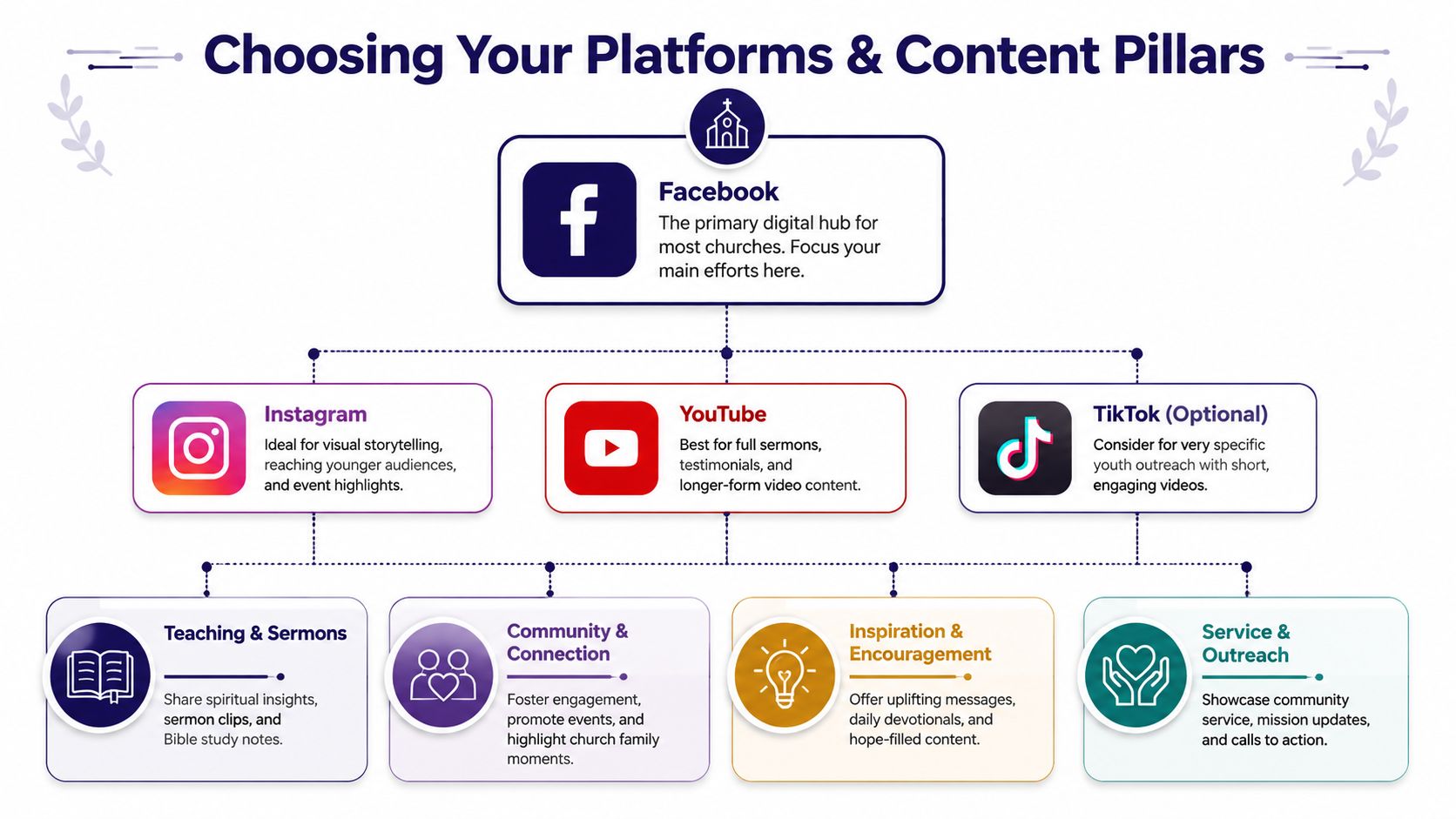
A church doesn't need to win every platform. It needs to be useful in the right places.
That distinction matters. Teams get burned out when they assume faithful digital ministry means being active everywhere. In practice, a narrower approach usually produces better content, better follow-through, and less frustration.
Recent church-marketing discussion points to a more focused strategy, with some churches seeing better results by focusing on Instagram and Facebook over TikTok and adjusting ministry groups based on performance data, as noted in this church marketing platform discussion.
Choose based on real church capacity
Platform choice should come from three filters: who you're trying to reach, what format your team can sustain, and what action you want people to take.
Here's a practical way to consider this:
| Platform | Best use in church context | Common mistake |
|---|---|---|
| Congregational updates, events, community interaction, ministry groups | Posting only flyers and announcements | |
| Visual storytelling, short video, church culture, family and younger adult engagement | Treating it like a bulletin board | |
| YouTube | Sermons, testimonies, teaching archives, searchable long-form video | Uploading full messages with no clipping strategy |
| TikTok | Focused outreach with short, native-feeling video | Starting here before the team can maintain it |
Facebook still matters because many churches already have an established audience there. A Capterra summary cites a 2017 survey in which 84% of Protestant pastors said their church used Facebook as its primary online communication tool, and it also notes that almost 85% of churches use Facebook. The same source cites a 2013 Barna finding that 54% of Christian millennials watched online videos about faith or spirituality, which helps explain why video became so central to church communication over time in Capterra's church social media overview.
Build around content pillars, not random ideas
Once the platform mix is set, content pillars make the calendar manageable. They keep your feed balanced and prevent over-posting one kind of message.
A reliable church framework includes four pillars:
Teaching and sermons
Sermon clips, key takeaways, Scripture reflections, Q&A snippets, and Bible study notes.Community and connection
Volunteer thank-yous, baptism photos, ministry moments, small group life, and behind-the-scenes glimpses.Inspiration and encouragement
Prayer prompts, short devotionals, hope-filled captions, and midweek pastoral encouragement.Service and outreach
Local mission updates, event invitations, serve opportunities, and practical ways to get involved.
If your team needs help organizing these themes into an actual calendar, this content strategy resource for churches gives a useful structure for turning pillars into weekly publishing decisions.
The strongest church feeds usually feel balanced. They teach, invite, encourage, and reflect real community life.
That balance is what keeps a church account from sounding repetitive. It also helps different audiences find something relevant without every post trying to do everything at once.
The Ultimate Weekly Social Media Workflow
Sunday service ends, the room clears, and by Monday morning the same question shows up again. What are we posting this week, who is writing it, and where are the sermon clips?
Churches stay consistent when that question already has an answer.
The teams that post well every week usually follow the same rhythm. They collect assets early, create in batches, schedule before the weekend, and leave space to respond to people while the conversation is active. That structure works for a communications director with staff support, and it also works for a ministry assistant or volunteer who has a limited number of hours.
Monday and Tuesday for planning and asset gathering
Start with what Sunday already produced.
Gather the sermon title, key points, Scripture references, quotable lines, announcement copy, event details, photos, and raw video. Put it in one shared workspace so no one is digging through texts, inboxes, and half-remembered conversations on Wednesday afternoon. If your church uses Planning Center or another calendar system, pull those dates into the same view so your posting plan matches what the church is doing.
Then make a few clear decisions for the week:
- What the church needs to communicate right now
- Who each post is for
- Which posts have a firm deadline
- Which sermon moments can become multiple pieces of content
This step saves time later. It also prevents a common church communications problem: strong ministry activity with weak coordination.
Midweek for creation and repurposing
Midweek is where the weekly plan either gets built or gets delayed.
The fastest approach is to create from one source, not five. For most churches, the sermon is that source. One message can produce a short reel, a quote graphic, a carousel, a devotional caption, a discussion prompt for small groups, and a follow-up email or article. The work gets much lighter when the transcript, video, and event details are easy to access together.

ChurchSocial.ai was built around that exact church workflow. It turns sermon transcripts into social posts and blogs, creates AI sermon reels, provides templates for graphics and carousels, manages a drag-and-drop calendar, and pulls event details from church tools such as Planning Center.
For church teams, the bottleneck is usually production, not ideas. Editing clips, writing captions, resizing graphics, and checking dates across multiple tools can consume the whole week. AI helps by reducing the repetitive work so the team can spend more time reviewing, refining, and publishing content that serves people.
Workflow test: If your team cannot batch a full week of content in one focused session, the process is too scattered.
Thursday for scheduling and the weekend for engagement
Schedule the week before the weekend starts.
That gives the team room to focus on ministry conversations instead of rushing to publish from the lobby or parking lot. Use Thursday to load posts, confirm links and times, and check that event promotions still match current plans. Then use the weekend to respond to comments, answer direct messages, and notice the questions people keep asking.
A repeatable weekly rhythm can be this simple:
- Plan on Monday with sermon notes, events, and ministry priorities.
- Create on Tuesday or Wednesday using transcript-based copy, clips, and graphics.
- Schedule on Thursday so the calendar is set before the busiest ministry days.
- Engage through the weekend when attention, attendance, and conversation are highest.
This workflow fits how churches already operate. Sunday creates the core message. The rest of the week turns that message into daily points of connection people can see, save, share, and respond to.
Creating Content That Connects and Converts
The most effective church accounts don't feel like ad campaigns. They feel like communities.
People can tell the difference quickly. A feed built entirely around “Join us this Sunday,” “Register now,” and “Don't miss this event” starts to sound transactional. It may communicate information, but it rarely builds trust or interest on its own.
Red Palm Marketing notes that community-driven posts receive more engagement than sales posts, and that stronger engagement can increase reach for later content. The same source also cites broader research showing social media marketing had an average success rate of 4.17 compared with 3.17 for traditional marketing when campaigns are measured and optimized carefully in Red Palm Marketing's guide to Christian digital marketing.

Community-driven posts generally receive more engagement than sales posts. This higher engagement increases your reach for all subsequent posts, while a sales-only feed can go dead upon launch.
What connecting content looks like
Church content connects when it serves the audience before it asks anything from them.
That includes stories of changed lives, volunteer appreciation, simple teaching moments, honest behind-the-scenes photos, prayer prompts, and captions that invite participation. Even event promotion works better when it starts with the purpose of the event instead of the logistics.
A good caption might ask, “What's one thing God has been teaching you this week?” A weaker caption just repeats the service time people already know.
What usually misses
The issue isn't promotion itself. Churches need to promote events, classes, and next steps. The problem comes when every post sounds like a flyer.
Watch for these patterns:
- Announcement-only posting that never shows real church life
- Generic stock imagery that looks polished but doesn't feel true
- Captions with no invitation to respond
- Constant self-focus where every post says what the church wants instead of what people need
A simple creative standard helps here. Use real photos when possible. Keep the wording warm and plain. Let testimonies breathe. Don't over-design every post into something that feels corporate.
A church feed should sound like a pastor, ministry leader, or trusted volunteer speaking to people, not like a generic brand account.
That's also where templates help. The technical side of design can slow teams down, especially when the message is already clear. If your system gives volunteers clean templates, editable graphics, and reusable layouts, they can focus on clarity and tone instead of trying to become designers overnight.
Measuring What Matters for Ministry Growth
Church social media gets healthier when the team stops asking, “Did that post get a lot of likes?” and starts asking, “Did that post help the right people take the right next step?”
That shift changes everything.
A church can post something that earns attention but produces no ministry movement. It can also publish something quieter that drives event registration, sparks real conversation, or helps a newcomer understand how to visit. Christian social media marketing needs that second kind of measurement.
Start with ministry-aligned metrics
Worcester State University's social analytics guidance recommends defining success before posting, pulling data regularly from platform-native tools, and comparing results against past performance to identify patterns and improvement opportunities. It also emphasizes tracking practical metrics such as reach, engagement, and click-through rate, while warning against confusing raw activity with qualified outcomes in Worcester State University's social media analytics guide.
For churches, that usually means separating metrics into a few categories:
Visibility
Reach and post views tell you whether people are seeing the content.Response
Comments, shares, saves, and meaningful engagement show whether the content connected.Action
Link clicks, registrations, form submissions, volunteer inquiries, and message responses show movement.Quality
Not every inquiry is equal. A flood of vague messages is different from a real next-step conversation.
This is why monthly review matters. If a sermon clip gets views but no clicks to the message page, it may be useful for awareness but weak for follow-through. If an event post gets fewer likes but strong registrations, it may be doing its job well.
Review patterns, not isolated wins
Single posts can be misleading. Patterns are more trustworthy.
Look at a fixed reporting window each month and ask:
| Question | Why it matters |
|---|---|
| Which topics consistently get saves or shares? | These often signal lasting value |
| Which post types drive clicks? | They reveal what moves people to act |
| Which content gets comments from actual members or newcomers? | It shows community relevance |
| Which posts attract activity without real follow-up? | They may be vanity-heavy |
TikTok reporting can be more limited historically, so regular snapshots matter if your church is active there. The same principle applies anywhere. Save the data before it disappears into the platform.
If your team wants a clearer framework for connecting analytics to ministry outcomes, this church social media ROI guide is a practical reference.
The healthiest reporting habit is simple: review, learn, adjust, repeat. Don't chase random spikes. Build from what repeatedly helps people engage, respond, and move closer to real community.
If your church wants a simpler way to plan, create, schedule, and manage social content from sermons, events, and weekly ministry rhythms, ChurchSocial.ai is built specifically for that church workflow. It brings sermon-based content creation, graphics, scheduling, and calendar management into one place so staff and volunteers can spend less time chasing assets and more time serving people.