If you're leading a church stewardship campaign right now, you're probably carrying two pressures at once. You need to invite generosity with conviction, and you need to avoid making the church sound anxious, repetitive, or fixated on money.
That tension is normal. Most campaigns struggle not because the church lacks vision, but because the plan gets reduced to a sermon series, a pledge card, and a few hurried reminders. Churches end up running a short appeal when what they need is a disciplined communication system that builds trust, gives people time to respond, and keeps the conversation going long after Commitment Sunday.
The strongest campaigns still honor the spiritual roots of stewardship. They just pair that tradition with better planning, cleaner follow-up, and smarter digital communication. That's how a church stewardship campaign becomes more than a seasonal push. It becomes a steady, year-round conversation about discipleship, mission, and generosity.
Laying the Foundation for Generosity
A church stewardship campaign starts in the wrong place when the first question is, “How much do we need?” Start with, “How do we want our people to understand generosity this year?”
That shift matters because stewardship isn't only a funding mechanism. It's a discipleship invitation. People can sense the difference between a church that is forming generous disciples and a church that is trying to close a gap before year-end.

Start with theology before tactics
Pick a campaign theme that reflects your church's actual ministry priorities. If your ministry year is centered on local outreach, spiritual formation, or family discipleship, stewardship language should reinforce that direction. Don't invent a detached giving slogan just because it sounds polished on a banner.
Your steering team should include more than finance-minded people. You need pastoral voice, communications judgment, administrative discipline, and at least one person who understands donor follow-up. In many churches, the best campaign team includes:
- A pastor or teaching leader who can connect generosity to spiritual formation
- A finance or operations leader who can keep the numbers credible and clear
- A communications lead who can maintain message consistency across every channel
- A follow-up coordinator who can track responses and make sure no one disappears after the ask
Practical rule: If the campaign theme sounds like it could work for any church in any city, it probably isn't specific enough for your congregation.
Use giving data to set realistic goals
Good stewardship planning is pastoral, but it should also be specific. You don't need a complicated analytics stack to do this well. You do need to review your own records carefully and decide what kind of response you're seeking from different groups.
Historic giving patterns show why this matters. One stewardship dataset reported that 66% of adults donated to a church or religious center in 1999, while only 1% of those earning $75,000 to $99,999 gave 10% or more of their income according to this stewardship research summary. That kind of concentration is one reason broad, generic appeals often underperform. Participation matters, but deeper commitment among engaged givers matters too.
So segment your congregation before you write the first letter. Common groups include:
- New members who need teaching and a simple first step
- Consistent non-pledgers who may be giving but haven't made an annual commitment
- Recurring givers who respond well to clarity and vision
- Lapsed households who often need a personal conversation, not another mass email
Build trust into the foundation
If trust is low, no amount of creative language will rescue the campaign. People give more freely when they understand how money is handled and what ministry it supports. That's why campaign planning should include a commitment to transparent reporting from day one.
A helpful companion read on this is fostering trust in church finances, especially if your church is rebuilding confidence after weak communication, leadership turnover, or budget confusion.
Keep your financial goal clear, but don't make it the headline. The headline is the mission. The goal is the tool that supports it.
Mapping Your Campaign Calendar
Most weak campaigns aren't under-inspired. They're under-planned.
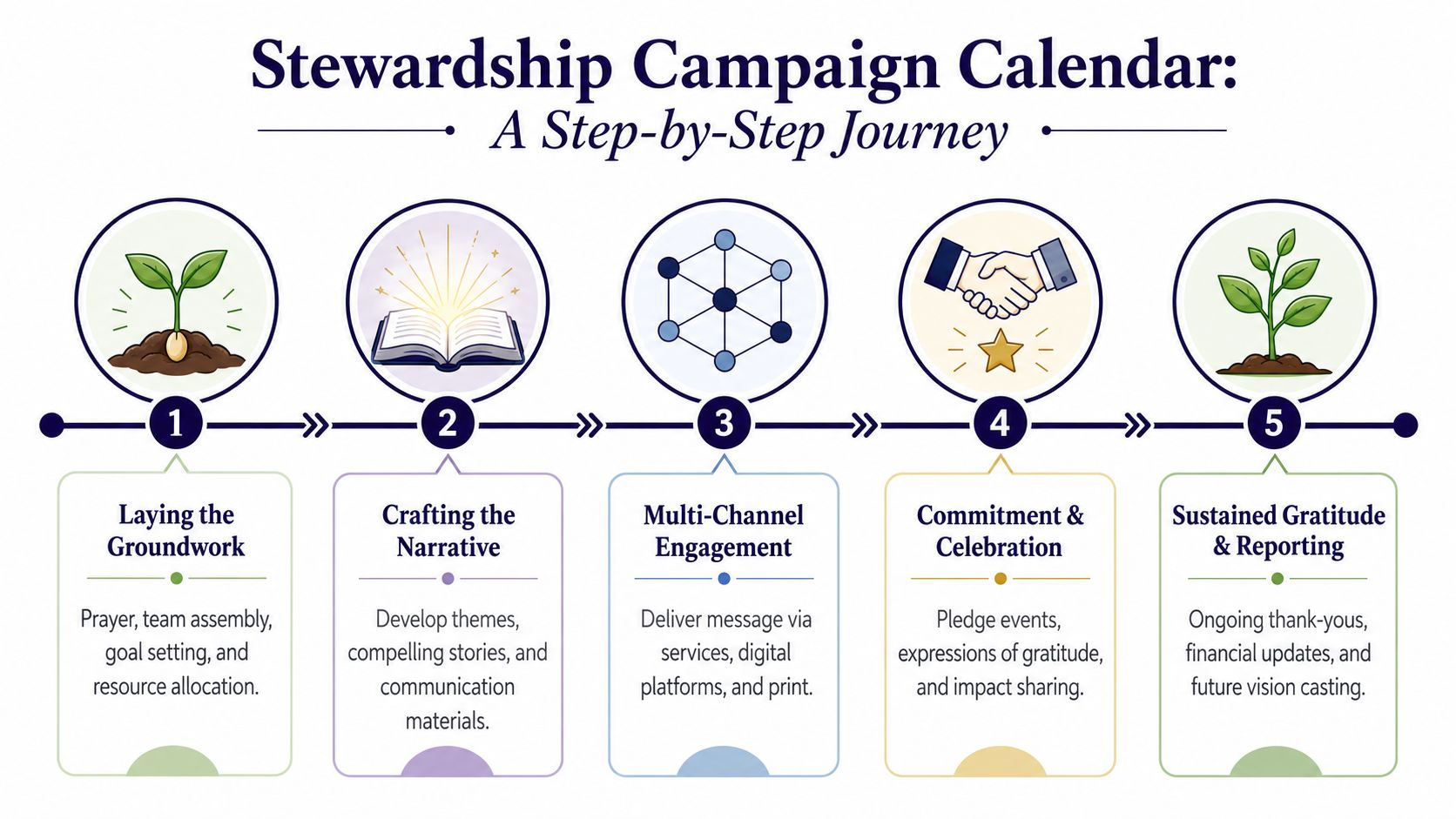
A high-functioning church stewardship campaign runs on a real calendar, not a vague intention to “start talking about it in the fall.” One planning guide recommends a 5 to 6 month workflow with committee recruitment, data tracking, a multi-week communication sequence before Commitment Sunday, and 1 to 3 months of post-campaign analysis and follow-up, as outlined in this annual stewardship planning guide.
Treat the campaign like an operations project
When churches compress stewardship into a few weekends, several things break at once. The pastor carries too much of the message, volunteers don't know their role, follow-up gets sloppy, and no one has time to adjust if early response is weak.
A longer campaign calendar gives you room to do four things well:
- Prepare the story instead of improvising the message
- Coordinate every channel so the congregation hears one clear invitation
- Track response patterns while the campaign is still active
- Follow through after commitments with reporting and gratitude
If your church calendar already feels crowded, build stewardship into the existing rhythm instead of treating it like an isolated event. Your ministry events, sermon schedule, email cadence, and social plan should all reinforce the same timeline. A centralized planning approach like a church events calendar for ministry coordination helps teams spot conflicts early and keep communication aligned.
A sample timeline you can adapt
This kind of structure keeps the campaign from feeling chaotic.
| Phase | Timing | Key Actions |
|---|---|---|
| Foundation | Early planning window | Confirm campaign leaders, define the theme, review prior giving patterns, set response goals, assign communications ownership |
| Message development | Next planning stretch | Write pastor letters, collect impact stories, prepare print pieces, map sermon alignment, draft email and announcement copy |
| Pre-campaign communication | Final weeks before launch | Begin congregation-wide messaging, brief ambassadors, prepare pledge tools, schedule website updates and service announcements |
| Commitment period | Campaign month | Deliver sermon emphasis, send coordinated reminders, collect commitments, monitor responses, make personal follow-up calls |
| Reporting and follow-up | Months after commitment | Thank participants, review new and lapsed pledgers, share ministry impact, report progress, note improvements for next cycle |
What usually goes wrong
Churches rarely fail because they lacked sincerity. They fail because no one owned the workflow from beginning to end.
Watch for these common breakdowns:
- Late creative decisions that delay everything downstream
- Conflicting ministry dates that bury stewardship communication
- Too much reliance on one Sunday instead of a sequence
- No response tracking until the campaign is already over
The campaign calendar is the first act of stewardship. It shows your church will handle people's attention with care, not urgency and confusion.
A calm, staged process gives people time to pray, ask questions, and respond thoughtfully. That's almost always better than trying to create pressure in a single weekend.
Crafting a Compelling Stewardship Message
Most churches don't need a more polished ask. They need a more credible one.
A stewardship message falls flat when it leans too hard on need, too little on mission, and almost not at all on trust. That's why many church stewardship campaign materials sound heartfelt but still don't move people. The language may be warm, but the congregation has tougher questions. What will this support? Why should I believe this will be handled well? Why does this matter now?
Move from pressure to purpose
The strongest stewardship messaging frames giving as participation in God's work, not as rescue for a strained budget. That doesn't mean you hide financial reality. It means you interpret it through mission.
A useful way to test your message is to read every draft and circle language that sounds defensive, vague, or transactional. Then rewrite it around ministry outcomes, spiritual response, and gratitude. If a line could have come from a generic fundraising letter, cut it.
Try building your message around three layers:
- Biblical conviction grounded in your preaching and discipleship language
- Ministry clarity that shows what generosity makes possible
- Human response that invites prayerful action instead of emotional pressure
Address donor fatigue honestly
One of the biggest blind spots in stewardship planning is assuming that inspiration alone will overcome skepticism. It won't. A recent church stewardship perspective argues that many campaigns overemphasize themes while missing the harder issue of low trust or donor fatigue, and it points to the need to shift from numbers to narrative while also offering proof of financial integrity and ministry impact in this stewardship strategy article.
That insight should change how you write.
If your congregation is tired, don't answer fatigue with more hype. Answer it with clarity. Show where giving goes. Name ministry wins. Acknowledge that people are careful with recurring commitments. Give them reasons to believe the church is careful too.
When trust is thin, polished language can make things worse. Plain speech, clear reporting, and visible accountability usually work better.
Build proof into the message
A compelling stewardship message includes evidence, not just emotion. Not fake urgency. Not grand promises. Evidence.
That evidence can look like:
- Specific ministry stories tied to actual church life
- Simple financial categories that help people understand spending priorities
- Leadership visibility so members know who is accountable
- Regular reporting habits that continue after the campaign ends
Here are message lines that tend to work better in practice:
- “Your giving supports ministry we can name.”
- “We're inviting every household to take a prayerful next step.”
- “We'll report back clearly on what this generosity makes possible.”
And here are the lines that usually underperform:
- “We're behind and need everyone to step up.”
- “If everyone just gave a little more, we'd be fine.”
- “This is our most important giving moment ever.”
The first set respects the congregation. The second set creates resistance.
Keep the theme durable
Choose a theme that can survive repetition across sermons, print, email, and conversations. If the phrase is too abstract, it will get weaker every time you reuse it. If it's grounded in Scripture, mission, and a visible ministry outcome, it will hold together all campaign long.
A good message doesn't just motivate the pledge. It prepares the church to keep talking about generosity after the campaign is over.
Amplifying Your Message Across Every Channel
A solid stewardship message still underperforms if people only hear it once, in one format, on one Sunday.
Churches communicate in layers now. A sermon may carry the theological weight, but email drives reminders, the website answers practical questions, printed materials help households discuss commitments, and social media keeps the message visible between Sundays. In a healthy church stewardship campaign, these channels don't compete. They reinforce each other.
Match the channel to the job
Not every platform should do the same work.
Print is useful when you need something people can hold, take home, and revisit. That's where pastor letters, commitment instructions, and concise ministry overviews still matter. Email works best for sequence. You can send a clear timeline, answer common questions, and remind people of key dates without relying on Sunday attendance alone.
Your website should function like a campaign hub. Keep it simple. Include the theme, the purpose, the giving or pledge path, and a short explanation of what happens next.
Social media serves a different role. It keeps stewardship from becoming invisible during the week. That doesn't mean posting donation graphics every day. It means publishing a mix of mission stories, sermon clips, short teaching moments, ministry photos, event reminders, and gratitude content that supports the larger campaign.

Build a repeatable content rhythm
Most churches lose momentum because they create campaign content manually every few days. That creates delays, inconsistency, and message drift.
A better system uses one core message and adapts it into multiple formats:
- From the sermon pull a short clip, a quote graphic, a devotional thought, and a caption for midweek encouragement
- From one impact story create a web feature, a testimony slide, an email paragraph, and a short social post
- From one key date produce bulletin copy, platform announcement language, an email reminder, and a social countdown
Your content workflow matters as much as your copy. Teams that think in distribution, not one-off creation, usually communicate with more consistency. A practical framework for that is covered in these content distribution strategies for church teams.
What good multi-channel stewardship looks like
Here is the difference in practice.
A weak campaign sends a letter, mentions stewardship from the platform twice, posts an image with a giving link, and hopes people connect the dots.
A strong campaign sounds unified across touchpoints:
- Sunday service introduces the spiritual invitation
- Email gives the next action and key dates
- Printed handouts help families discuss the commitment at home
- Social posts and video clips keep the message present during the week
- The website answers questions without forcing people to hunt for details
Good stewardship communication doesn't feel louder. It feels more coherent.
Keep social media pastoral, not promotional
Churches often get social stewardship wrong in one of two ways. They either ignore it completely, or they post graphics that feel like fundraising ads.
The better approach is pastoral and mission-centered. Share what generosity does. Share how members can pray. Share short teaching excerpts on contentment, trust, gratitude, and discipleship. Use visuals from ministry life, printed materials, offering moments, handwritten notes, or workspace planning scenes. In many cases, those images work better than staged people photos because they feel grounded and usable across formats.
If you treat social media as part of the discipleship conversation, it becomes a support system for the campaign rather than a loudspeaker for asks.
Executing the Pledge and Follow-Up Process
The giving moment should feel clear, calm, and easy to complete. If people have to guess where to click, what to fill out, or whether their commitment was received, the church has introduced friction at the worst possible time.
That's why pledge mechanics matter. A church stewardship campaign can have strong preaching and thoughtful messaging, yet still lose momentum if the response process is clumsy.
Make the commitment path simple
Physical pledge cards still have value. They work well in worship, create a tangible moment of response, and can be effective for members who prefer paper. But paper alone creates extra handling, more room for data entry errors, and slower follow-up.
Digital options solve different problems. They help members respond outside the room, support recurring giving habits, and reduce administrative lag. One stewardship guide reports that churches adopting online giving platforms see an average increase of 26% in donations, according to The Complete Guide to Church Stewardship from Vanco.
That doesn't mean every church should abandon cards. It means most churches should offer both.
Plan Commitment Sunday with precision
A smooth commitment weekend usually includes:
- A clear in-service explanation so no one wonders what the response means
- Visible instructions for both paper and online options
- A worshipful response moment that fits your church tradition
- Immediate collection and recording procedures handled by trained people
- Fast acknowledgment so members know their commitment was received
Use the worship service to dignify the moment, not to confuse it. If people are invited to bring cards forward, explain the process clearly. If you're emphasizing digital response, place the link or QR path where people can easily see it and revisit it later.
Follow-up should feel personal
After the commitment is made, the church's tone matters as much as its systems. Respond quickly. Thank people without turning the note into another appeal. Clarify next steps if recurring gifts need to be set up or updated.
Good follow-up often includes:
- Prompt thank-you communication from a pastor or ministry leader
- Internal tracking so commitments and actual giving records stay aligned
- Pastoral follow-up for households that asked questions or need help using the giving tools
If you're sorting through platforms and systems that affect donor records, workflows, and integrations, a practical starting point is this church management software comparison.
The commitment moment is not the finish line. It's the beginning of a trust test. The church now has to prove it will handle each response with gratitude and competence.
When churches do this well, members feel seen. When churches do it poorly, even willing givers can feel like line items.
Sustaining Stewardship Year-Round
The annual campaign isn't complete when the commitments are counted. That's where many churches gradually lose trust.
Members respond generously, and then the church goes silent. No meaningful updates. No steady gratitude. No visible connection between the commitment they made and the ministry they're supporting. By the time the next church stewardship campaign arrives, the congregation remembers the ask more clearly than the impact.
Reporting is part of discipleship
People don't need constant fundraising language. They do need evidence that the church remembers what it asked them to support.
Year-round stewardship communication should include:
- Ministry impact updates that connect giving to real church life
- Financial clarity presented in language normal people can understand
- Pastoral gratitude that feels sincere and specific
- Ongoing teaching on generosity outside the campaign window
Many churches improve by establishing a rhythm. Monthly or periodic reporting, brief ministry stories, and clear thank-yous often do more for future generosity than another polished annual launch.
Keep the relationship warm after the ask
A healthy follow-up plan doesn't treat every giver the same way. New givers often need encouragement. Longtime givers deserve meaningful gratitude. Households that made a first pledge may need reassurance and practical help if they want to set up recurring giving or adjust their records.
Use a simple timeline like this one.
| Phase | Timing | Key Actions |
|---|---|---|
| Immediate thanks | Right after commitments begin arriving | Send acknowledgment, confirm receipt, answer setup questions, notify pastoral leaders of notable follow-up needs |
| Early reporting | In the weeks after the campaign | Share broad participation themes, celebrate generosity, reinforce the ministry vision behind the commitments |
| Midyear encouragement | During the ministry year | Publish short impact stories, give financial clarity, thank recurring givers, remind the church what generosity is accomplishing |
| Pre-next-cycle review | Before the next campaign begins | Evaluate response gaps, review communication performance, update donor segments, refine trust-building materials |
Challenge the stop-talking habit
Some leaders worry that too much communication about stewardship will tire people out. The opposite is often true when the communication is rooted in gratitude and impact. Silence creates suspicion. Consistent reporting creates confidence.
Keep the tone grounded:
- Thank without flattery
- Report without spinning
- Teach without pressure
- Invite without panic
The churches that handle stewardship best rarely disappear after the pledge season. They keep telling the truth about ministry, money, and mission in a measured way all year long.
A mature stewardship culture doesn't come from one strong fall campaign. It comes from repetition, credibility, and follow-through.
ChurchSocial.ai helps churches keep that year-round stewardship conversation organized and consistent. If your team needs an easier way to turn sermons into short videos, create social posts and blogs from transcript content, design branded graphics, and schedule everything on a drag-and-drop calendar, ChurchSocial.ai gives you one place to manage it. With Planning Center and church calendar integrations, it can help your stewardship message stay visible across the whole ministry year instead of fading after one campaign window.