Sermon preparation is where deep spiritual discipline meets modern communication. It's the journey from a prayerful idea to a message that truly connects, moving people to action. This process involves four key movements: selecting a passage, a deep study of the text, finding ways to connect authentically with your people, and finally, using the right tools to amplify the message far beyond Sunday morning.
The Art and Science of Modern Sermon Preparation
Have you ever sat in a pew, completely captivated, and wondered how a simple idea became such a powerful, life-changing sermon? It's not magic. It's a process that marries timeless spiritual practice with smart, effective communication. Answering the question "how do I prepare a sermon" goes way beyond just writing a speech; it’s about carefully crafting an experience that speaks directly to the hearts and minds of your congregation.
This guide breaks down that journey into four clear, connected stages. We'll start with prayerful selection, dive into deep study, work on forging that authentic connection, and then wrap up with how to amplify your message in the digital world. Each step builds on the last, making sure your final message is biblically solid, culturally relevant, and ready to make a real impact.
This is what that workflow looks like from a 30,000-foot view.
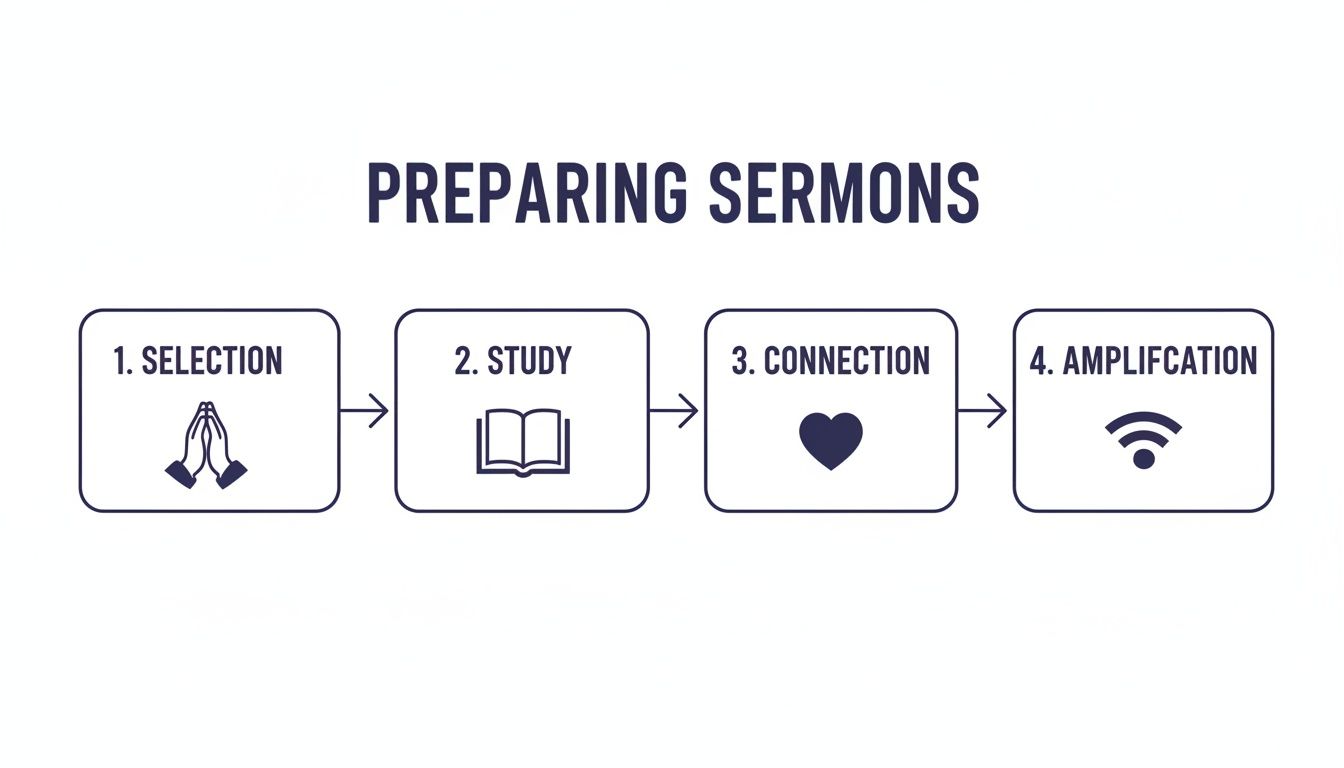
As you can see, modern sermon prep doesn't just end when you say "amen." It now extends into a continuous cycle of engagement long after the service is over.
From Ancient Pulpits to Digital Platforms
The painstaking effort behind sermon preparation has always been a hallmark of impactful ministry. Think back to the 4th century—St. John Chrysostom, the "Golden-Mouthed" preacher, meticulously prepared over 1,000 sermons, drawing massive crowds. Fast forward to the Reformation, where Martin Luther's intense dedication to prayer and study for each message helped spark a movement that changed the world.
That same commitment is alive today. A Lifeway Research study found that 77% of pastors still spend 10-20 hours every single week on sermon prep. That effort pays off, too. Churches with well-prepared sermons saw a 25% higher weekly attendance retention after the pandemic. You can explore more of these trends and historical insights here.
This long history proves a simple truth that still holds: thoughtful preparation is what allows a message to take root in people's lives.
The goal is to move beyond just writing a speech and toward crafting an experience that resonates with your congregation long after they've left the sanctuary. This requires a process that honors deep biblical study while using new tools to extend your message's impact.
This framework outlines the core stages for getting there.
The Four Pillars of Modern Sermon Preparation
This table summarizes the core stages involved in preparing and delivering a powerful sermon in today's world.
By mastering these four areas, you can ensure your hard work in the study translates into genuine life change in the pews and beyond.
Extending Your Message Beyond Sunday
In the past, a sermon's reach was confined to the people inside the four walls of the church. Today, the hours you pour into preparation can inspire people all week long. That final stage, Amplification, is where your carefully crafted message gets a second life online.
This is where a tool like ChurchSocial.ai can become a game-changer for your ministry. It’s built to help you take your sermon and effortlessly repurpose it for all your church's social media channels. Imagine one place where you can:
- Create AI-generated reels from your sermon, pulling out the most powerful moments for social media.
- Generate content from the transcript, like insightful social posts, blogs, and more.
- Use graphic templates and an editor to design beautiful, on-brand photos and carousels.
- Use a simple drag-and-drop calendar to easily manage and update all your social media.
- Integrate with Planning Center and other church calendars to create content for events.
When you build this final step into your sermon prep workflow, you guarantee that your hours of prayer and study create a ripple effect, reaching people far beyond your church building.
Starting with Prayer and Purposeful Passage Selection
Let's be honest. The most powerful sermons don't start with a blank document and a blinking cursor. They begin much earlier, in the quiet, often unseen moments of prayer.
Before you even think about commentaries, outlines, or illustrations, the real first step is creating space to listen. This isn’t just checking a box; it’s about spiritual alignment. It's where you ask God, "What does my community really need to hear right now?"
So much of a pastor's most important work happens in these "in-between times." It’s in those quiet hours of study that you move beyond what you simply want to preach and start discerning what God is calling you to say. This is the bedrock. Get this right, and every point and application that follows will have a solid foundation.
Listening to Your Congregation's Needs
A great sermon bridges the gap between divine truth and daily life. To pull that off, you have to know what's actually happening in the lives of your people. What are the questions they're asking? The struggles they're facing? The joys they're celebrating?
Purposeful passage selection means listening in two directions: to God and to your community.
Here are a few practical ways to tune in:
- Lobby Conversations: Pay attention to the recurring themes you hear in the lobby, at community events, or over coffee. Are people worried about finances? Navigating tricky parenting seasons? Desperate for hope?
- Prayer Requests: Your prayer team has a direct line to the heart of the congregation. Look for the patterns in the needs being shared—grief, celebration, or persistent struggles.
- Cultural Moments: What's happening in your city or in the news that is on everyone’s mind? A sermon that speaks into a shared cultural experience from a biblical perspective can be incredibly timely.
When you do this, your sermon choice feels less like a lecture and more like a lifeline.
Choosing a passage isn’t about finding a text to fit your idea. It’s about finding God's idea in a text that fits your people's reality. This discernment is the cornerstone of a message that resonates.
Choosing Your Preaching Approach
Once you have a feel for the needs of your people, you can think about the best way to address them. Your choice will usually fall into one of two main camps, each with its own strengths.
Expository Preaching (The Long-Haul Series)
This is the classic approach of working sequentially through a book of the Bible, or a large chunk of it. It’s a fantastic way to build deep biblical literacy in your congregation and show them the grand, unfolding story of Scripture.
- The Big Win: It forces you to preach the whole counsel of God—even the difficult or often-ignored passages. Your church gets a truly balanced diet.
- Think: A multi-month series walking through the book of James, exploring the practical outworking of faith week after week.
Topical Preaching (Addressing a Pressing Need)
Here, you start with a specific subject—like forgiveness, anxiety, or purpose—and then explore what various scriptures have to say about it. This method is incredibly effective for speaking directly to the immediate, felt needs in your church or the surrounding culture.
- The Big Win: It offers direct, practical wisdom on a topic that is already top-of-mind for your listeners.
- Think: A four-week series on mental health, drawing from the Psalms, the words of Jesus, and Paul’s letters to offer biblical hope and practical next steps.
Whether you're planning a year-long journey through Romans or a short, focused series on navigating conflict, the goal is always the same: pick a path that's faithful to the text and deeply relevant to the people in the pews. Getting this first step right makes all the difference.
Unpacking the Scripture with Deep Exegetical Study
Alright, you've prayerfully landed on a passage. Now the real work begins. Think of this next phase as biblical archaeology—you're moving from a surface reading to carefully digging into what the text meant to its original audience. This is the only way to faithfully understand what it means for your church today.
This process is called biblical exegesis. It sounds academic, but it's incredibly practical. The entire goal is to draw the meaning out of the scripture, not read your own ideas into it. It’s the difference between delivering God's message and simply offering your own commentary. This deep study becomes the steel frame of your sermon, giving it integrity and earning the trust of your listeners.
Don't underestimate how much this groundwork matters. A Barna Group study found that 62% of Millennials point to "relevant, everyday-life applicable sermons" as the top reason they keep coming to church. That relevance doesn't just happen; it's a direct result of your prep work. In fact, studies show pastors who follow a structured, deep-study approach see 35% higher satisfaction scores from their congregations.
Start with the Context
Before you can nail down what a passage means, you have to understand its world. No verse is an island. It’s part of a sentence, which is part of a chapter, all within a larger story written to real people in a real place and time.
To get your bearings, start by asking three crucial questions:
- Who wrote it? Was it Paul, the highly-trained Pharisee writing to churches he’d personally planted? Or Peter, the fisherman, writing to believers scattered by persecution? The author’s voice and background are a huge part of the message.
- Who was it for? Getting a clear picture of the original audience is non-negotiable. Were they Jews or Gentiles? Were they facing down Roman persecution, fighting off false teachers, or dealing with drama inside the church?
- What was going on? What was daily life like for the people who first heard these words? Understanding their culture, their politics, and their struggles unlocks layers of meaning we would completely miss otherwise.
Answering these questions first prevents you from yanking a verse out of its home and forcing it to say something it was never meant to say.
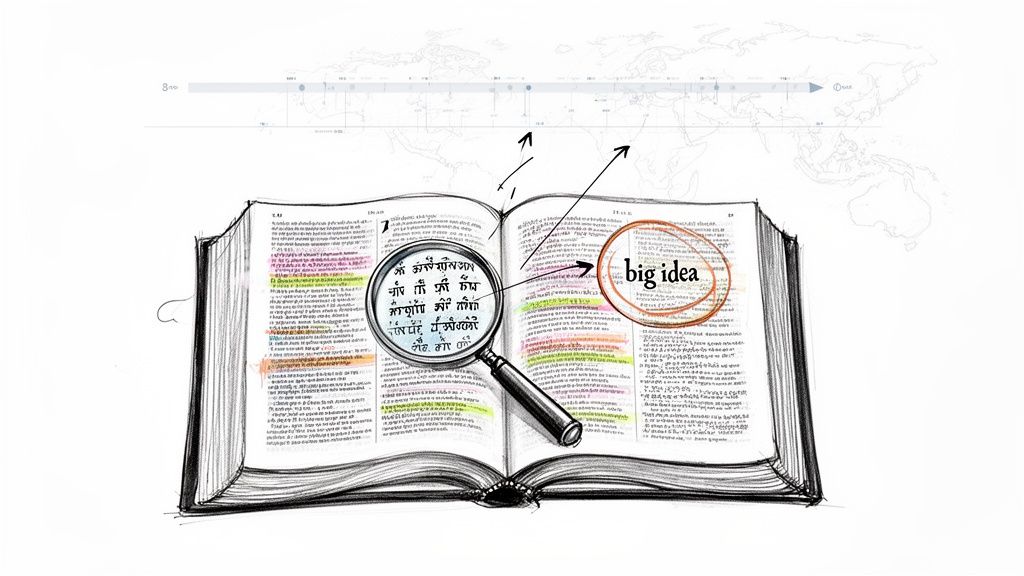
Find the One Big Idea
Once you're immersed in the context, your next job is to hunt for the central truth of the passage. I call this the "Big Idea." If your congregation forgets every story and every outline point by lunchtime, what is the one non-negotiable truth you want lodged in their hearts and minds?
This Big Idea becomes the thesis for your entire sermon. Every illustration, every point, and every application you share should serve to either explain, prove, or apply that one central truth. A sermon without a clear Big Idea feels like a collection of interesting-but-disconnected thoughts, leaving people more confused than inspired.
A sermon that tries to say everything often ends up saying nothing. Your deep study should lead you to one powerful, memorable, and biblically-grounded 'big idea' that anchors the entire message.
For a much deeper dive on how to do this well, check out our guide on expository sermon preparation. It really breaks down how to move from text to a solid outline.
Structure Your Sermon for Impact
All that exegetical work you did? It's about to pay off by giving you a rock-solid structure for your message. A clear structure is a gift to your listeners—it helps them follow along, remember the key points, and know how to apply the truth to their lives.
Here’s a classic, battle-tested framework:
- A Compelling Introduction. Your intro has one job: grab their attention and introduce the tension or problem that your Big Idea solves. Please, don't start with, "Today we're in John chapter 3..." Hook them with a relatable story, a startling question, or a surprising fact that makes them lean in.
- A Well-Supported Body. This is where you unpack the Big Idea. Your main points should flow directly from the text itself. You're not inventing points; you're discovering them during your study. Ground each point in the passage, explaining how it supports that central truth.
- A Memorable, Actionable Conclusion. Your conclusion shouldn't just be a summary. It needs to drive the Big Idea home and call for a response. Restate your central truth in a fresh, powerful way and give people a clear "now what?" This is where the truth of God's Word moves from their heads to their hands and feet.
Crafting a Message That Resonates and Inspires Action
You've done the hard work of deep exegetical study, laying a solid foundation of biblical truth. But let's be honest—an ancient text, no matter how powerful, needs a bridge to connect with people's lives today. This is where you build that bridge.
This is the part of the process where we move from academic study to powerful, relatable storytelling. It's where you finally answer the question on every listener's mind: "So what? What does this mean for me on Monday morning?" The goal isn't just to inform; it's to transform. And that only happens when you skillfully weave the "then and there" of the Bible with the "here and now" of your congregation's daily grind.
From Text to Storytelling
People don't remember points; they remember stories. Illustrations are the windows that let light into the theological concepts you've so carefully unpacked. They make abstract truths feel concrete, memorable, and real.
Think beyond the standard, go-to sermon stories. The most effective illustrations can be found everywhere:
- Personal Anecdotes: Got a relevant, vulnerable story from your own life? Sharing it builds an immediate connection and a sense of trust.
- Cultural Touchpoints: Referencing a popular movie, a current event, or even a song shows how Scripture speaks directly into the world people actually live in.
- Historical Examples: A compelling story about a historical figure can bring a biblical principle to life in a way that’s both surprising and powerful.
The trick is making sure every illustration serves the "big idea" of your sermon. It can't just be an interesting tangent; it has to clarify, reinforce, or apply the central truth you're driving home.
Developing Actionable Next Steps
A sermon that inspires on Sunday but doesn't equip for Monday has missed the mark. The application is where your message gets legs. You have to be crystal clear about what you want people to think, feel, or do differently because of what they’ve heard.
So, avoid those vague calls to "try harder" or "be better." Instead, give them concrete, practical next steps they can actually take.
The most impactful sermons don't just end with a conclusion; they end with a commission. They offer clear, grace-filled, and achievable next steps that empower people to live out the truth they've just heard.
To make your application really stick, think about the different people in your room. A next step for a college student is going to look a lot different than one for a retiree or a young parent.
Meeting People Where They Are
Crafting a message that truly connects means knowing who you're talking to. For instance, recent Barna data points to a gender gap in faith, but also shows that Gen Z guys are showing a renewed interest, looking for sermons that tackle real-world stuff like work and mental health. Pastors who don't prepare culturally relevant content risk losing a huge part of their community. This is precisely why connecting ancient truth to modern problems is so vital for a healthy, growing church. You can see more on the latest church attendance statistics and what they mean for your ministry.
Your sermon prep has to be sensitive to these realities. Keep asking yourself:
- How does this passage speak to the single mom?
- What hope does this text offer the person battling anxiety?
- How does this truth challenge the successful business owner?
When people feel seen and understood, their hearts open up. You can also get some great ideas from our article on how to preach in a way that truly engages your audience.
This is also where your sermon prep starts to bleed over into your church's digital outreach. Those stories, quotes, and next steps you're developing for Sunday? That’s prime material for social media content that keeps the conversation going all week long.
Platforms like ChurchSocial.ai were designed for exactly this. As you're crafting your sermon, you can start thinking about how its key elements can be repurposed. That powerful illustration can become an AI-generated sermon reel. A clear application point can become a thought-provoking graphic. ChurchSocial.ai helps you plan and manage your church social media accounts, bridging the gap not just between the Bible and your congregation, but between your Sunday message and their daily digital lives.
Amplify Your Sermon's Impact All Week Long
After pouring 10 to 20 hours into prayer, study, and crafting your sermon, the last thing you want is for that message to be a distant memory by Monday afternoon. The sermon doesn't have to end with the benediction. A final, crucial stage in modern sermon prep is intentionally multiplying that message, turning one Sunday morning event into a week-long conversation.
This is where your role shifts a bit, from preacher to digital shepherd. It’s about taking the core truths you've worked so hard on and placing them right in the digital pathways your congregation walks every single day. The goal is simple: keep the message alive, accessible, and applicable long after everyone has gone home.
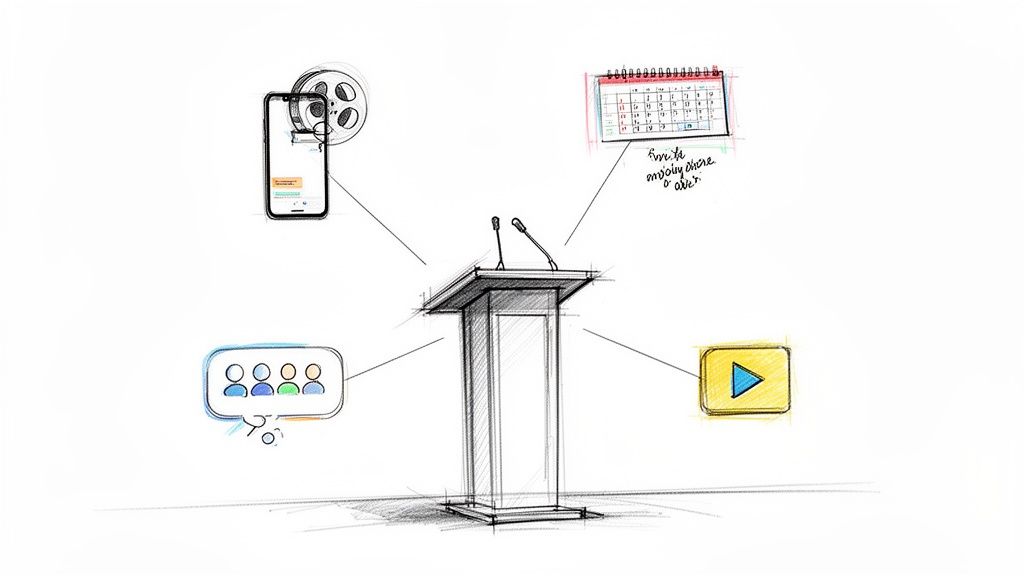
Don't worry, this doesn't mean adding another ten hours to your already packed week. It’s about working smarter by repurposing your most valuable asset: the sermon itself.
From Sermon Transcript to Social Content
Think about what you already have by Sunday afternoon: an audio or video recording, a transcript, and a full set of notes. That single sermon is a goldmine of potential content that can engage your church family all week. This is exactly where a tool like ChurchSocial.ai becomes a game-changer for busy pastors and church communicators.
ChurchSocial.ai is built to take your sermon and do the heavy lifting for you. Just upload your sermon file, and it can automatically generate a full week's worth of content.
Don't let your sermon be a one-time event. Treat it as the source material for a week-long ministry conversation that meets people where they are every day—on their phones.
This simple shift in mindset completely changes how you view the sermon prep process, adding a whole new dimension to its potential impact.
Instantly Create Shareable Sermon Clips
One of the most effective ways to extend your sermon's reach is through short-form video. These quick, bite-sized clips are perfect for Instagram Reels, TikTok, and YouTube Shorts. They can highlight a key point, a powerful story, or a challenging question from your message.
With ChurchSocial.ai, this process is incredibly simple.
- AI-Generated Reels: The AI scans your sermon transcript to pinpoint the most compelling and shareable moments.
- Automatic Generation: It then creates a series of short video clips, complete with animated captions that grab attention even when viewed on mute.
- One-Click Sharing: You can look over the AI-generated reels and schedule them directly to your social media accounts right from the platform.
What used to take a skilled video editor hours can now be done in minutes. For more on the technical side of capturing your message, check out our article on getting the best video for your sermon.
Generate Posts, Questions, and More
Beyond video, your sermon transcript can fuel all sorts of written content. The AI content generator in ChurchSocial.ai can transform your sermon into multiple formats, giving you fresh, relevant material to post all week long.
Imagine creating all of this from just one sermon:
- Social Media Posts: Generate thought-provoking captions for Facebook or Instagram that dive deeper into one of your key points.
- Small Group Questions: Create a ready-to-use discussion guide for your small groups based on the week's message, helping them apply the teaching in community.
- Blog Recaps: Turn your sermon into a well-structured blog post for your church website. This becomes a great resource for members and can even reach new people through search engines.
Design and Schedule with Ease
Maintaining a consistent and professional look across your church’s social media is important. ChurchSocial.ai comes with easy-to-use graphic templates and a built-in editor, so you can create and post beautiful, branded photos and carousels without any design experience.
Once all your content is ready—from AI-generated reels to custom graphics—you can organize it on a simple drag-and-drop calendar. This lets you plan and schedule your entire week of post-sermon content in a single session. The platform even integrates with tools like Planning Center and other church calendars to create content for events.
By building this final step into your sermon prep workflow, you ensure that the message God gave you doesn't just reach people for an hour on Sunday. It echoes throughout their entire week.
Common Questions About Sermon Preparation
The work of preparing a sermon is a unique mix of deep spiritual wrestling and very real, practical deadlines. As we wrap up this guide, let's tackle some of the most common questions pastors and church leaders have about the whole process.
How Long Should It Take to Prepare a Sermon?
I get this question all the time, and the truth is, there’s no magic number. But what I see consistently among seasoned pastors is a window of 10 to 20 hours a week dedicated to their message.
The real goal isn't to clock in and out; it's to be truly ready. A much better focus is building a consistent, repeatable weekly workflow. You need dedicated blocks of time carved out for prayer, deep study, writing, and actually practicing the delivery. A streamlined process will always beat just logging hours.
Think about where you can reclaim some of that time. Instead of starting from square one on your post-sermon content, you can automate that whole piece. Using a tool like ChurchSocial.ai to plan and manage your church social media accounts frees you from the task of creating social media assets, giving you more margin to focus on the core message itself.
What Is the Best Way to Outline a Sermon?
One of the most durable and effective sermon outlines is the simple "Text-Illustration-Application" model. It’s been around forever because it works. This framework ensures your message is biblically solid, connects with people on a human level, and challenges them to actually do something.
Here’s a quick look at how it works:
- Text (The "What?"): Start with the biblical truth you dug up in your exegesis. Clearly explain what the passage is saying.
- Illustration (The "So What?"): This is where you connect the dots. Use a compelling story, a personal anecdote, or a relevant cultural example to show how that truth plays out in real life.
- Application (The "Now What?"): Land the plane with a clear, practical call to action. What should people do this week in response to what they just heard?
A strong outline doesn't just help your congregation follow along. It also makes it much easier for tools like ChurchSocial.ai to spot the key moments perfect for creating powerful sermon clips.
How Can I Make My Sermons More Engaging for a Younger Audience?
Younger generations aren't looking for a polished performance; they crave authenticity, relevance, and a sense of ongoing conversation. They want to see how the timeless truths of Scripture intersect with the messy, complex issues they’re navigating right now.
This means you’ve got to be willing to use personal stories, connect the Bible to current cultural conversations, and not sidestep the tough topics.
Crucially, engagement can't stop when the service ends—it has to continue online. You can extend the message by using a platform like ChurchSocial.ai to push out AI-generated reels and discussion prompts on Instagram and TikTok. This approach meets them right where they are and keeps the conversation going all week long.
How Can I Manage Sermon Prep and Social Media with a Small Team?
For solo pastors or churches with small, scrappy teams, efficiency is everything. The key is to work smarter, not harder.
Stop thinking of social media as a separate, time-sucking chore. Instead, see it as a natural extension of your sermon prep. Repurpose your most valuable asset—the sermon itself.
An all-in-one platform like ChurchSocial.ai was built for this exact scenario. You can upload your sermon audio and let it automatically generate dozens of assets—reels, graphics, and posts—and then schedule them all in one go with the simple drag-and-drop calendar. This gives your church a consistent, professional online presence without driving you or your team into the ground. Beyond just the sermon's content, the preacher's role also involves their public presentation, which includes practical details like choosing the right clergy stole for pastors.
Ready to amplify your sermon's impact without adding more hours to your week? ChurchSocial.ai is the all-in-one platform that turns your message into a full week of engaging social media content. Generate AI sermon clips, create stunning graphics, and schedule everything with a simple drag-and-drop calendar. Start saving time and reaching more people today at https://churchsocial.ai.