Every good sermon starts long before you step into the pulpit. It begins with a solid foundation—the prayerful, thoughtful work of turning a biblical passage into a clear, focused message that actually connects with people.
This early work is what gives your sermon its structure, clarity, and authentic spiritual authority. Everything else you build—your points, your stories, your application—will rest on this foundation.
Laying a Prayerful and Purposeful Foundation
Before a single point is written down, the whole process needs to be saturated in prayer. I always start by asking for the Holy Spirit’s help to think clearly and to communicate in a way that’s both convincing and captivating. Prayer shifts our focus from performance to dependence, ensuring the message comes from God's guidance, not just our own cleverness.
If you're looking for ways to deepen that time, these prayer discussion questions can be a great resource for personal reflection or even for your staff to use together.
From Scripture to a Single Big Idea
Once you've prayerfully landed on a passage, the real work begins. It’s time for exegesis—digging into the text to uncover its original meaning. This isn't a quick skim. It means exploring the historical and literary context.
Ask yourself: Who wrote this? Who were they writing to? What was the primary reason they wrote it? Answering these questions protects your sermon from misinterpretation and grounds it firmly in biblical truth.
From that deep study, the goal is to distill the entire passage into one central, memorable truth. Call it the "Big Idea" or the main preaching point.
Your entire sermon should be built to explain, illustrate, and apply this one single idea. Resisting the temptation to cover too much ground is key to a message that sticks.
Before we move on, let's summarize the essential building blocks that make up a strong sermon outline. These are the core components you'll rely on every single time.
Core Components of a Sermon Outline
Having these elements clearly defined not only helps you preach better but also makes your message far more useful beyond the Sunday service.
Why a Clear Foundation Matters More Than Ever
A clear, focused foundation isn't just about making your Sunday delivery smoother. It’s what unlocks your sermon's potential to reach people all week long. In fact, smart sermon planning often means thinking about your topics and themes ahead of time, a process that gets a lot easier when you understand how to create a content calendar.
When your entire sermon is built on a single, powerful idea, it becomes incredibly easy to repurpose for your church's social media.
This is critical today. Research shows that younger generations are increasingly engaging with church through apps and social media. A clear, focused sermon can be easily broken down for these platforms. You can learn more about these ministry trends and see for yourself why a strong digital presence is no longer just a nice-to-have.
With a tool like ChurchSocial.ai, that single "Big Idea" from your outline can become the engine for an entire week of digital content. You can manage your entire church social media presence in one place. Imagine effortlessly turning your key points into:
- AI-Generated Reels: Automatically create short, engaging video clips right from your sermon transcript.
- Social Media Posts: Create AI-generated content from your sermon transcript, like thought-provoking captions and questions based on your core message.
- Blog Content: Take one of your sermon points and let AI expand it into a full blog post for your church website.
This initial, prayerful work on your sermon outline doesn't just prepare you for the pulpit; it prepares your message to travel, meeting people right where they are, long after the Sunday service has ended.
Structuring Your Sermon for Natural Flow and Impact
Once you’ve nailed down your core message, it's time to build the scaffolding that will hold it all together. A sermon isn't just a pile of good ideas; it’s a guided journey. You're taking your listeners from a place of curiosity to a destination of conviction and, hopefully, action. The structure is your roadmap.
Many of us grew up on the classic "three-points-and-a-poem" model. And hey, it’s simple. But it's not the only way to preach, and sometimes it can feel a little stale. To really make an impact, your structure needs to serve the biblical text and connect with your people right where they are.
Choosing Your Sermon Structure
The flow of your sermon dramatically affects how your audience hears and remembers the message. Different passages and topics just naturally call for different approaches.
Here are a few trusted structures I’ve found work well:
- Deductive: This is the classic, straightforward approach. You start by laying out your main point—your Big Idea—right at the top. The rest of the sermon is spent proving or explaining it with your supporting points. It’s direct, crystal clear, and perfect for teaching foundational, doctrinal truths.
- Inductive: Think of this as building a case. You present evidence, share stories, or ask probing questions that slowly lead the listener toward the main point. You don't reveal your hand until closer to the end. This method is fantastic for building intrigue and works especially well when you're addressing a felt need or a skeptical crowd.
- Narrative: This style simply follows the natural arc of a story, usually a biblical one. The sermon unfolds right alongside the narrative, pulling out theological truths and applications as the plot moves forward. It’s incredibly engaging and helps people experience the text, not just analyze it.
This whole process really starts with a solid foundation. You pray, you study, and you land on your theme before you even start thinking about structure.
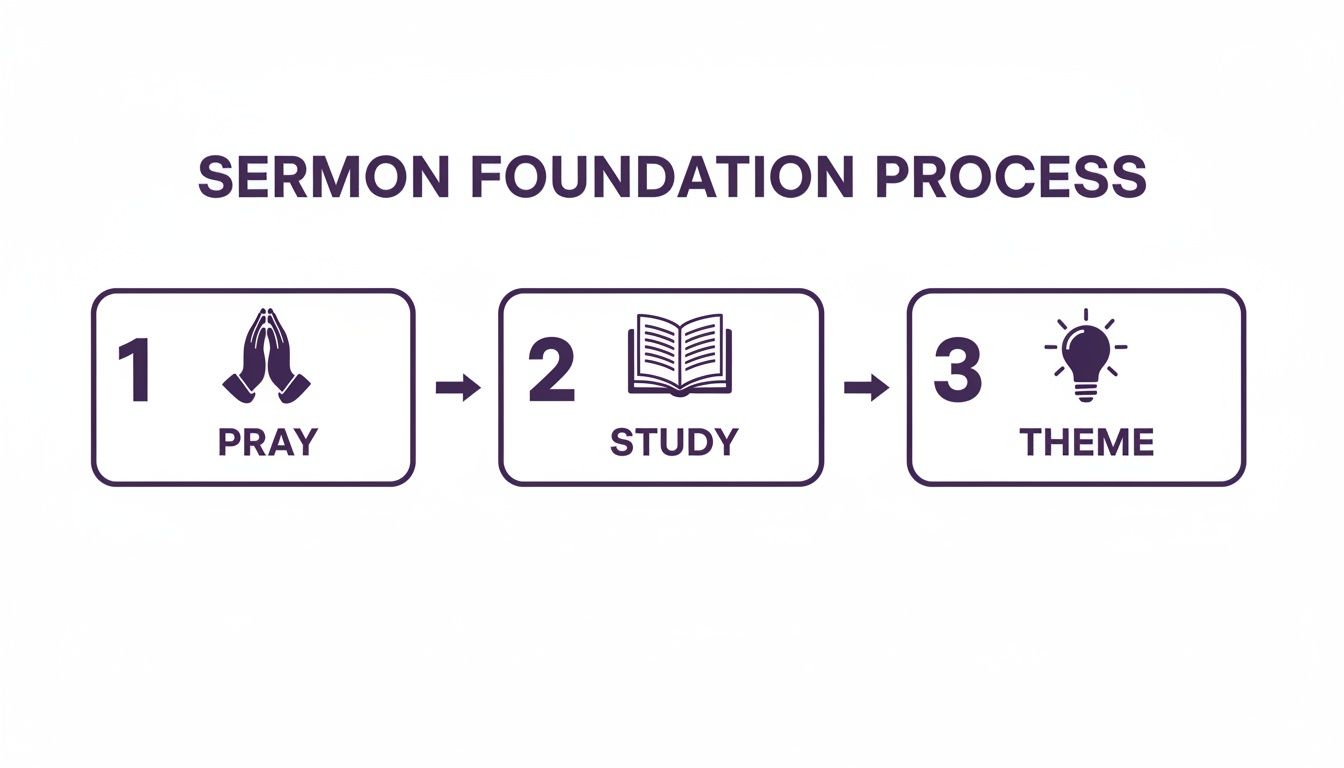
Getting those first steps right ensures that whatever structure you choose is built on solid rock, ready to be shaped for your congregation.
Crafting Memorable Main Points
Think of your main points as the pillars holding up your Big Idea. They need to be clear, distinct from one another, and logically flow from your central message. One of the best tips I ever received was to aim for parallelism—structuring your points in a similar grammatical or conceptual way. It creates a rhythm that makes them so much easier for people to hang onto.
For example, instead of a disjointed list like this:
- We should pray more.
- Studying the Bible is important.
- The need for community.
Try a parallel structure that locks in:
- Connect with God through prayer.
- Understand God through Scripture.
- Grow with God through community.
See the difference? That simple tweak makes the flow feel intuitive and the points much stickier. If you're preaching through a single passage, our guide on expository sermon preparation has more on how to pull your points right out of the text itself.
The Art of Introductions and Conclusions
How you start and how you finish can make or break your sermon. The introduction’s only job is to grab attention and build a bridge from your listeners' world into the world of the text. Kick things off with a compelling story, a provocative question, or a surprising statistic that makes everyone lean in and think, "Okay, where is he going with this?"
Your conclusion, on the other hand, is your final shot to drive the message home. It needs to land the plane. Summarize the Big Idea one last time and call for a specific, clear response. Don't just trail off. End with purpose, leaving your congregation with an actionable takeaway that will stick with them long after the service is over.
A great sermon begins by connecting with a person’s life and ends by challenging them to change it. Your introduction and conclusion are the bookends that make this possible.
Getting your ideas organized is key to delivering them well. The principles for mastering structure in writing apply just as much to speaking from a stage.
Ultimately, a strong structure is a gift to both the preacher and the people. For you, it provides confidence and clarity. For your congregation, it makes the message easy to follow, understand, and apply. A well-structured sermon is also a goldmine for your digital outreach, as it's far easier to break down into shareable social media clips that can extend your message throughout the week.
Bringing Your Message to Life with Stories and Application
A solid outline is the skeleton of your sermon, but it’s the stories and application that give it a heartbeat. This is where you connect abstract truth to the real world your congregation lives in.
Without this crucial step, even the most biblically sound message can feel academic and distant. People might leave informed, but they won't leave transformed. The goal is to build a bridge from the ancient text to their modern lives.

Weaving in Powerful Illustrations
Think of illustrations as windows that let light into your main points. They help people see the truth you're explaining. A great story doesn’t just repeat the point; it illuminates it from a new angle, sparking that "aha!" moment for your listeners.
I’ve found that using a mix of illustration types works best.
- Personal Stories: When you share a personal struggle or victory (with wisdom, of course), it builds a powerful connection. It shows you’re in the trenches with them.
- Current Events or Pop Culture: Tapping into a shared cultural experience can make a biblical principle feel instantly relevant. It grabs attention and makes the truth stick.
- Analogies and Metaphors: These are fantastic for simplifying complex ideas. Comparing faith to running a marathon, for example, makes concepts like endurance and perseverance instantly click.
I recommend writing out your key illustrations in full when you draft your outline. This helps you nail the timing and ensure the story serves the main point instead of hijacking it. The story should always be the servant of the truth. For more on this, check out our guide on using movie clips for sermons.
From Information to Actionable Application
This is where the rubber meets the road. Every person listening is asking one question, even if it's subconsciously: "So what?" How does this change my Monday morning, my tense family dinner, or my private anxieties?
Vague application points like "pray more" or "trust God" rarely land with impact. They're not wrong, but they're not specific enough. The goal is to provide clear, actionable steps someone can take this week.
An effective application doesn't just tell people what to do; it shows them how to do it. It moves your sermon from being merely informative to truly transformative.
Instead of saying, "Be more generous," challenge them with something concrete. "This week, find one person who is struggling and meet a tangible need. Maybe it's with your time, your money, or a simple act of service." Now they have a handle to grab onto.
Turning Your Sermon into a Week-Long Conversation
When you craft these practical application points in your outline, you're doing more than just improving your Sunday message. You're creating fantastic content to continue the conversation online all week long.
This is where a tool like ChurchSocial.ai really shines. After you preach, the AI can instantly turn those application points into compelling social media posts for your church.
Just imagine what you could do:
- AI-Generated Reels: ChurchSocial.ai can find the moments in your sermon where you discuss application and automatically create short, shareable AI-generated reels.
- Blog Post Expansions: Take one application step and let the AI expand it into a full blog post for your website, offering deeper insights and more examples.
- Discussion Prompts: "On Sunday, we talked about grace in our relationships. What's one practical way you can show grace to a family member this week? Share in the comments!"
By thinking about application from the very start, you're not just preparing a 30-minute talk. You're building a resource that can encourage and equip your community every single day.
Spotting and Fixing Common Sermon Outline Mistakes
Even the most powerful message can get lost in a clunky structure. Once you have the bones of your sermon down—your passage, main idea, and key points—it's time to step back and play editor. This is where you put on a critical hat and look for the weak spots, ensuring your outline is a solid roadmap for Sunday, not a confusing maze.
Think of it less like writing and more like sculpting. A lot of common mistakes can creep in during the outlining process, turning a clear message into something that feels rambling or disconnected. Catching these before you step into the pulpit is the secret to preaching with genuine clarity and confidence.
The "Too Much Information" Trap
One of the easiest traps to fall into is trying to cram everything in. You've spent hours digging into a passage, and you've unearthed so many incredible gems. It’s natural to want to share every single one. But a sermon isn't a lecture or a data dump; it's the focused delivery of a single, life-changing truth.
When your outline balloons to five, six, or even more main points, you've already lost your audience. Most people can only really track and remember three to four big ideas in one sitting. Anything more than that just becomes noise, and the core message gets buried.
The fix? Get ruthless with your red pen. Keep your "Big Idea" front and center and cut anything—no matter how interesting—that doesn't directly support, explain, or illustrate it.
The Disconnected Story and Vague To-Do List
Another classic mistake is using an illustration that doesn't quite land. A fantastic story that isn't clearly tethered to your point becomes a distraction, not a window into the truth. It might get a laugh or a nod, but if it doesn't make the biblical point clearer, it's working against you. Make sure every story serves the point, not the other way around.
The same goes for application. Telling people to "love more" or "be more faithful" is nice, but it’s not all that helpful. Your application has to be concrete and actionable, giving your listeners a clear next step they can take on Monday morning.
A great sermon outline isn't measured by how much information it holds, but by how clearly it guides someone on a journey from understanding to real-world action.
To help you spot these issues in your own outlines, here's a quick troubleshooting guide for some of the most common problems pastors run into.
Sermon Outline Troubleshooting Guide
This table is a quick reference to help you identify and fix common issues that can weaken your sermon's impact before you even preach it.
Fixing these snags in your outline does more than just make for a better Sunday morning; it sets you up for incredible engagement all week long.
From a Tight Sermon to Great Social Content
When your message is clear, focused, and well-structured, it becomes a goldmine for your church's social media.
This is where a tool like ChurchSocial.ai becomes a game-changer. After you've preached that polished sermon, our platform helps you plan and manage your church social media accounts with ease.
- Create AI-Generated Reels: Our AI can find those powerful, punchy moments in your sermon and turn them into shareable AI-generated reels perfect for Instagram and Facebook.
- Generate AI Content: Those specific, actionable application points you worked so hard to create? ChurchSocial.ai can spin them into AI-generated content like social posts, blogs, and more.
- Use Graphic Templates and Editor: Quickly create and post beautiful photos and carousels for your sermon series or pull quotes using our simple templates and editor, keeping your church's online presence sharp and consistent.
By cleaning up these common outline mistakes, you're doing more than just building a better sermon. You’re creating a powerful communication engine that feeds your Sunday message and gives you a deep well of content to connect with your community online all week.
Take Your Message Beyond Sunday with ChurchSocial.ai
Your sermon shouldn't have to compete for attention on a Sunday morning and then disappear. The truth is, a well-thought-out sermon outline is more than just your guide for the pulpit—it’s the perfect starting point for a week-long conversation with your church family.
As more and more of our community life happens online, your message has the chance to inspire and encourage people every single day. We built ChurchSocial.ai to make that not just possible, but incredibly simple.
Once you’ve preached the sermon, the real work of digital ministry can kick off without adding a mountain of tasks to your plate. Just upload your sermon transcript, and our AI gets to work, generating a whole suite of content pulled directly from your teaching.
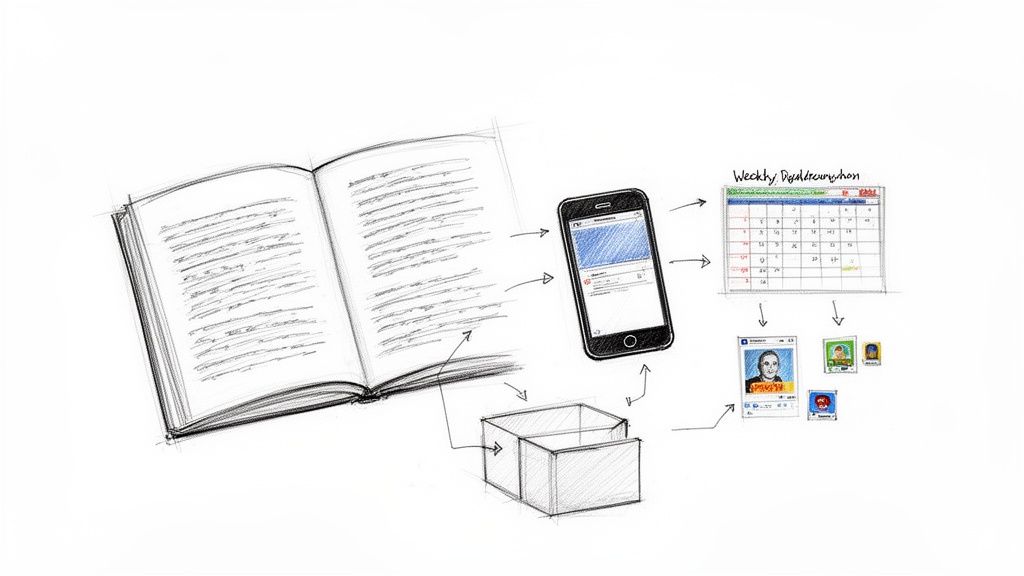
From Sermon Outline to Social Content
The clearer your sermon outline is, the easier it is to create powerful digital content from it. Think about it: every main point, every illustration, and every application point is a ready-made opportunity to connect with your community online.
Instead of staring at a blank screen wondering what to post, ChurchSocial.ai can instantly create AI-generated content from the sermon transcript:
- Engaging Social Posts: Our AI finds the core themes in your sermon and spins them into thought-provoking captions and questions for platforms like Facebook and Instagram.
- Insightful Blog Articles: Got a really strong point in your sermon? Let our AI expand on it, turning it into a full blog post for your church website with added context and practical takeaways.
- Thoughtful Small Group Questions: Your small group leaders will love this. We can automatically generate discussion questions based on the sermon, sparking deeper conversations throughout the week.
This keeps your message consistent, from the pulpit to the phone screen, and continues to minister to your people long after the Sunday service has ended.
Grab Attention with AI-Generated Reels
Let's be honest: video is king online, but who has time to edit sermon clips? Our AI Reel Creator is the answer. It’s smart enough to analyze your sermon transcript and video to pinpoint the most powerful, memorable, and shareable moments.
In just a few minutes, it creates AI-generated reels—compelling, vertical videos perfectly formatted for Instagram, TikTok, and YouTube Shorts. This one feature can dramatically expand the reach of your message, connecting you with people who might never walk through your church doors.
With Gen Z and young adults primarily consuming content digitally, a tool that bridges the Sunday sermon with online platforms is no longer a luxury—it’s a necessity for ministry outreach. You can discover more insights about these crucial church statistics and see why a strong digital presence is so vital for growth.
By turning your key sermon points into short, punchy videos, you’re meeting people right where they are, offering biblical truth in a format they actually watch.
Manage Your Entire Social Presence in One Place
Repurposing your sermon is a huge win, but it's only part of the equation. ChurchSocial.ai is designed to be your all-in-one hub for managing your church's entire social media presence, freeing you up to focus on what matters most: ministry.
Our platform also includes:
- Graphic Templates and Editor: Create and post beautiful, professional photos and carousels for your sermon series, announcements, or quote cards. We have a huge library of templates and an editor that’s simple enough for anyone to use.
- Simple Drag-and-Drop Calendar: Plan, manage, and update all of your social media posts across every platform from one visual calendar. You can see your whole week or month at a glance and move things around in seconds.
- Planning Center Integration: We integrate directly with Planning Center and other church calendars. This allows us to create content for your events, making sure your community always knows what’s going on.
Learning how to make a sermon outline is the first step. Taking that message beyond Sunday is the next. With ChurchSocial.ai, managing your church's social media stops being another burden on your to-do list and becomes a natural part of your ministry. You can amplify God's Word and build a thriving online community, all while getting valuable time back in your week.
A Few Common Questions About Sermon Outlines
As you get into a rhythm of planning your sermons, you'll find a few questions tend to pop up over and over. Getting these sorted out can be the difference between feeling stuck and stepping into the pulpit with confidence. Let's tackle a few of the most common ones I hear from pastors.
How Detailed Should My Sermon Outline Be?
Honestly, the right level of detail is whatever serves you best when you're preaching. Some guys I know thrive with a full manuscript—every single word written out. It helps them nail their timing and be incredibly precise. Others preach powerfully from a skeleton outline that’s just a few key phrases, scripture references, and a reminder about an illustration.
I've found a good middle ground is an outline that fits on one or two pages. That limitation forces you to be clear and concise, but it still gives you enough structure to stay on track.
The goal is to create a guide, not a rigid script. Your outline should be detailed enough to keep you from rambling but flexible enough to let the Holy Spirit lead in the moment.
Ultimately, this is your tool. Play around with different formats until you find what gives you the most freedom and confidence.
What's the Difference Between an Exegetical and Homiletical Outline?
This is a huge one. It's a critical distinction in sermon prep, and it helps to think of them as two different maps for two different journeys.
- An exegetical outline is the map for your private study. It’s technical. It follows the biblical author's original flow of thought, the grammar, and the structure of the passage. Its job is to help you figure out what the text says.
- A homiletical outline is the map you give your listeners—it's the one you preach from. It’s built on the truth you dug up in your exegesis, but it's designed to be engaging, clear, and memorable for people today.
You have to do the hard work of moving from what the text says (exegesis) to how you're going to say it (homiletics). Your private study is the foundation, but your public outline is the bridge you build to connect that truth to your congregation.
How Can I Make My Main Points More Memorable?
Memorable points are sticky. They’re the ones that follow people out to the car and into their week. The substance of your points is obviously what matters most, but how you phrase them can make a massive difference.
Try a few of these simple techniques:
- Use Alliteration: Points that start with the same letter just sound good and are easier to recall (e.g., "Receive God's Grace, Reflect God's Grace, Respond to God's Grace").
- Ask a Question: You can frame your big idea as a question and then make each point a progressive part of the answer.
- Create Action Statements: Phrasing your points as short, punchy commands makes them easy to remember and apply.
As a general rule, stick to three or four main points at the most. That’s a manageable number for people to follow along with. And most importantly, anchor every point to a great story. People forget points, but they remember stories—and the stories will help them remember the truth you're teaching.
A solid sermon outline is the first step, but making sure that message keeps impacting your community all week long is the next. With ChurchSocial.ai, you can effortlessly turn your Sunday teaching into a vibrant online conversation. Stop spending hours trying to master social media and start turning your sermons into a full week of ministry.
Learn how ChurchSocial.ai can help you amplify your message.