Using movie clips for sermons is one of the best ways I’ve seen to make big theological ideas stick. They grab people’s attention, make your point unforgettable, and connect your message to the culture we live in. But here's a pro-tip I've learned over the years: the most powerful—and legally safest—approach is to create these moments from your own sermons. This way, the clip is perfectly tailored to your teaching and you don't have to worry about copyright strikes.
Why Visual Storytelling Is a Ministry Game-Changer
We live in a world that communicates through screens. For the modern church, this isn't a threat; it's a huge opportunity to speak the language of our congregations and communities.
When you weave cinematic, movie-style clips into your sermons, you’re not just trying to be trendy. You're being a smart communicator in a culture that thinks in stories and learns with its eyes.

A good visual can make complex theology feel personal and real. Think about it: a well-placed clip can be the bridge between an abstract spiritual concept and a concrete, lived experience, sparking that "aha!" moment you're praying for. We talk a lot more about this dynamic over in our guide on what is visual storytelling.
Extending Your Message Beyond Sunday
The power of a great visual illustration doesn't just stop when the service ends. With streaming services and short-form video dominating our culture, these movie-style clips are your best bet for extending a sermon's reach long after Sunday is over.
The audience is already there. Pew Research found that 27% of U.S. adults still watch religious services online, even after churches reopened. Pair that with the fact that global social media use has shot past 4.9 billion users, and you see the opportunity. Many people who would never watch a full 35-minute sermon will happily engage with a 30 to 90-second cinematic clip that meets them where they are.
This is where the real potential is unlocked. Instead of worrying about fair use and licensing copyrighted movie clips, you just create your own. This move completely sidesteps the legal headaches and ensures your visuals are 100% in sync with your message.
The most powerful source of sermon illustrations isn't Hollywood—it's the God-given message you've already prepared. Transforming your own teaching into shareable clips ensures authenticity and amplifies your unique voice.
Your Sermon, Your Cinematic Clips
This might sound like a lot of work, but it's gotten so much easier. Tools like ChurchSocial.ai are built for this. With ChurchSocial.ai, you can create AI-generated reels from your sermons and use the sermon transcript to create AI-generated content like social posts and blogs. Our graphic templates and editor help you create and post beautiful photos and carousels, while our simple drag-and-drop calendar allows you to easily manage all of your church's social media. We even integrate with Planning Center and other church calendars to help you create content for events.
If you really want to connect with your audience, it's worth understanding the core principles behind mastering stories in video. By creating your own clips, you’re not just making content; you're building a bridge to a digital-first generation that expects high-quality visual stories, and you're doing it with your own authentic voice.
Let's break down how this strategy pays off both inside your church walls and online.
Sermon Clip Impact At a Glance
The table below really highlights the dual benefit of integrating short, cinematic video clips into your church's communication—both for the people in the room and the ones you're trying to reach online.
Ultimately, creating your own sermon clips isn't just a content strategy. It's a ministry strategy that allows you to be a more effective teacher and a more compelling witness in a visually driven world.
Before you drop that perfect scene from The Avengers into your Sunday sermon, let's talk. It's incredibly tempting to use a powerful movie clip to make a point stick, but doing so opens up a legal can of worms that most pastors would rather avoid.
Using copyrighted movie clips isn't as simple as hitting "play." It's a tricky area of copyright law, and a simple mistake could land your ministry in hot water.
The Myth of "Fair Use" for Churches
Many church leaders assume they're covered. They think their non-profit status or the "Fair Use" doctrine gives them a free pass. But that’s a dangerous assumption.
Fair Use isn't a law; it's a legal defense. That means you only find out if your use was "fair" after you've been sued and you're arguing your case in court. That's a gamble most ministries can't afford to take. Courts look at four key factors to decide, and it's rarely a clear-cut win for churches just illustrating a point.
The U.S. Copyright Office has a great primer on these factors, but the big one for us is the "purpose and character" of the use.
For your use to be considered fair, it generally needs to be transformative. You have to add a new meaning or message to the original clip, not just use it to support your existing one. Showing a scene about sacrifice to illustrate a sermon on sacrifice? That's usually not transformative, and it crumbles the foundation of a Fair Use defense.
The "Public Performance" Problem
Even if you think you have a solid transformative argument, you run into another wall: the "public performance." Your church sanctuary, and especially your livestream, are legally considered public venues.
Showing a movie clip in that setting, without a specific license, is technically copyright infringement. And no, your church’s streaming subscriptions don't count.
- Streaming Services Are a No-Go: That Netflix, Disney+, or Amazon Prime account is for personal viewing only. Their terms of service flat-out forbid public screenings. Using a clip from these platforms breaks their rules and copyright law.
- How Much You Use Matters: A 30-second clip is better than a five-minute one, sure. But if that short clip is the "heart of the movie"—the most iconic line or pivotal moment—you could still be in trouble.
- The Impact on their Wallet: If your use of a clip could, in any way, hurt the studio's ability to sell or license their movie, your Fair Use argument gets much weaker. This is why studios are so protective.
A Better, Safer, and More Powerful Way
So, what's the solution? Stop trying to navigate the legal maze altogether. The best way to eliminate the risk is to create your own movie-style clips from your own sermons.
This move not only dodges every single copyright issue but also creates content that is 100% tailored to your message.
Instead of borrowing a message from Hollywood, you can amplify the one God has already given you. This strategy transforms your sermon from a one-time event into a library of powerful, legally safe, and highly relevant content.
This is the very reason we built ChurchSocial.ai. Forget spending hours hunting for a legally sketchy clip. Just upload your sermon, and our AI gets to work. It pinpoints the most powerful moments and generates dozens of engaging, shareable reels—complete with dynamic captions and your church's branding. It even helps you schedule them out.
By switching to this model, you're not just protecting your ministry from legal headaches; you're building a more authentic and impactful online presence. You can see how we handle content and empower your ministry by checking out our terms and conditions, which are designed to keep your outreach effective and ethical.
How to Source Powerful and Appropriate Sermon Clips
Finding that perfect clip—one that lands with theological weight, connects emotionally, and won't get you a cease and desist letter—can feel like searching for a needle in a haystack. You need something that elevates your message, not something that distracts from it or puts your ministry at risk.
While there are a few ways to go about this, they definitely aren't all created equal.
Many churches understandably start with dedicated church media subscription services. These platforms are a great resource, offering libraries packed with pre-cleared mini-movies and sermon bumpers designed specifically for a church audience. This route certainly calms the nerves when it comes to copyright worries.
The catch, though, is that these clips can sometimes feel a bit... generic. A well-produced video on grace is nice, but it might not capture the precise angle you've spent the last week praying over and preparing. It can feel like a stock photo when what you really need is a family portrait.
The Most Overlooked Source: Your Own Sermon
This leads us to the single most powerful, legally sound, and deeply relevant source for cinematic clips your church can possibly use: your own sermons.
It's a complete paradigm shift. Instead of hunting for an outside clip to shoehorn into your message, you're mining cinematic gold directly from the message God has already given you. This approach completely sidesteps any copyright headaches and guarantees the content is a 100% perfect match for your church’s unique voice.
The big hurdle has always been the sheer amount of time and technical skill it takes to pull this off. Sifting through a 40-minute sermon to find a compelling 60-second nugget and then editing it professionally? That’s a huge ask for a busy pastor or a volunteer. But this is where modern tools have completely changed the game.
The most effective way to illustrate your sermon isn't by borrowing a clip from Hollywood, but by transforming your own God-given teaching into a powerful, movie-style moment that's ready to share. This ensures 100% legal safety and 100% message alignment.
This is exactly why we built platforms like ChurchSocial.ai. You can simply upload your sermon audio or video, and our AI gets to work. It analyzes the entire message, identifies the most powerful quotes and stories, and then automatically generates dozens of compelling, movie-style clips, complete with dynamic captions and your church's branding.
A task that used to eat up an entire afternoon for your media team can now be finished in just a few minutes. Your weekly sermon is no longer a one-time event; it becomes a deep well of content you can draw from for social media, small groups, and even future sermon illustrations.
This flowchart really simplifies the decision-making process when you're weighing whether to use an external clip.
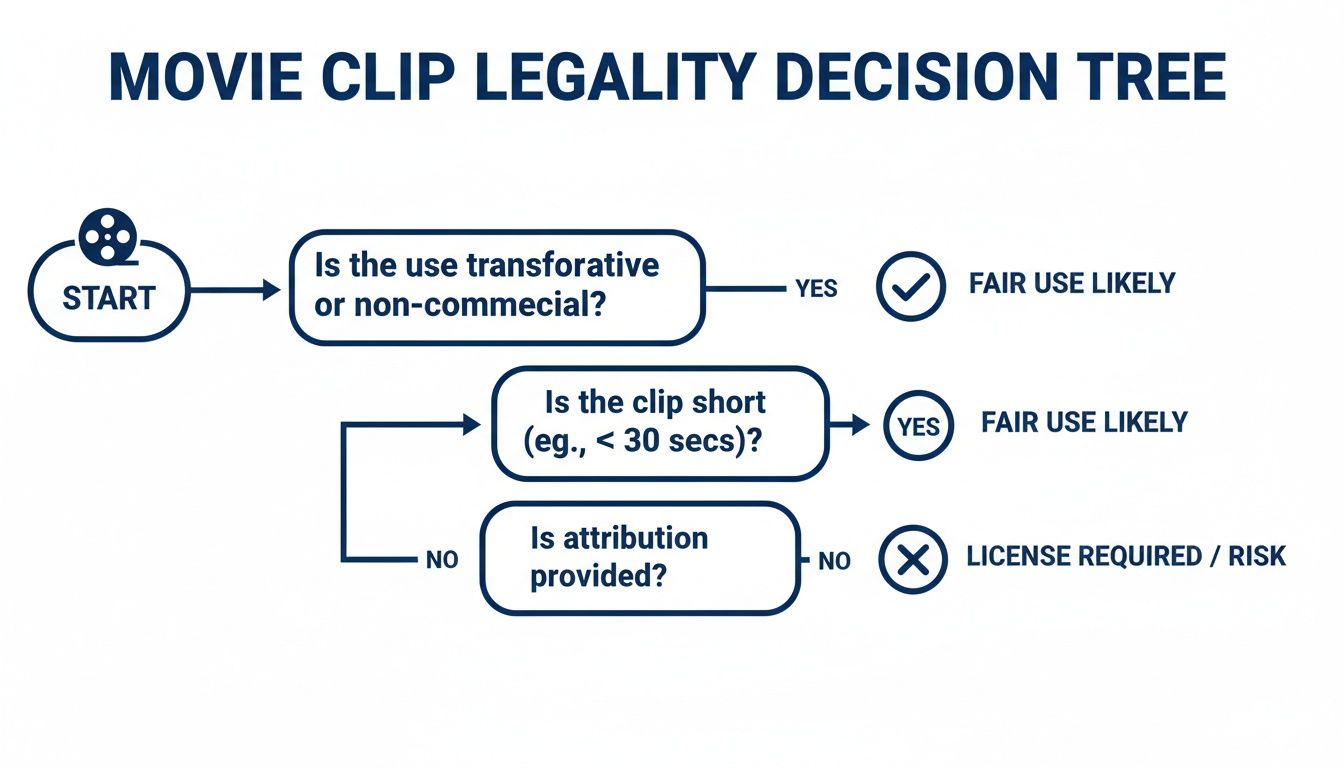
As you can see, trying to use copyrighted material is a complicated path filled with legal question marks. In contrast, creating clips from your own teaching is a direct, clear, and risk-free strategy.
Comparing Your Sourcing Options
To make the best choice for your ministry, it really helps to see the different approaches laid out side-by-side. Each has its uses, but one clearly stands out for its safety, relevance, and long-term kingdom impact.
Here’s a quick look at the main ways churches get movie clips for sermons.
Sermon Clip Sourcing Options for Churches
At the end of the day, while clips from outside sources can occasionally fill a gap, the most sustainable and authentic strategy is to build a system for creating clips from your own teaching.
This approach empowers your church to amplify its unique voice, turning every single sermon into a powerful tool for discipleship and outreach that you can share confidently on any platform.
Weaving Clips Seamlessly Into Your Sermon Narrative
Finding the right visual is only half the battle. A powerful movie clip can absolutely elevate a sermon, but if it's dropped in awkwardly, it feels less like a profound illustration and more like a jarring commercial break.
The goal here is to move beyond just "showing a video." We want to create a cohesive, memorable experience where the clip feels like a natural extension of your point—a visual paragraph that says something words alone can't quite capture.
Setting the Stage for the Clip
How you introduce a clip is everything. Please, avoid the generic, "Now, let's watch this short video." That kind of language immediately signals to your congregation that you're taking a break from the sermon.
Instead, you need to build a solid bridge from what you’re saying directly to the visual you're about to share.
Here are a few ways I’ve seen this done masterfully:
- Pose a Question: "We all wonder what true, selfless love looks like in a moment of crisis. I was reminded of that this week when I saw this..." This piques curiosity and gives everyone a specific theme to look for.
- Make a Direct Connection: "It’s one thing to talk about the weight of temptation, but it’s another to see that struggle play out. This next moment captures that internal battle perfectly." Now, your audience knows exactly why they're watching.
- Create an Emotional Anchor: "Sometimes a feeling is so overwhelming it’s hard to put into words. This scene does an incredible job of showing us what pure, unshakeable hope feels like."
The secret is to give the clip context before it plays. This primes your audience to receive its message in the way you intend, making sure it supports your sermon rather than derailing it.
The Critical Moments After the Clip
What you do in the seconds after a clip finishes is just as important as the setup. A moment of silence can be powerful, but you have to jump back in and connect the dots before that emotional impact fades.
Never just ask, "Wow, powerful stuff, right?" and move on. Instead, grab a specific detail from the clip and use it as your springboard. You could say, "Did you see the look on his face when he made that choice? That’s the face of someone who understands sacrificial love." This anchors the big idea in a small, memorable detail.
The best way I can put it is you have to "preach into" the clip and then "preach out of it." Frame it with your point beforehand, then immediately unpack its meaning afterward, tying it directly to a biblical truth.
Beyond Illustration to Integration
When you get this right, the sermon feels incomplete without the clip, and the clip’s full meaning is only unlocked by the sermon. This level of intentionality is what people have come to expect. Pew’s research on online religious services found that two-thirds of U.S. adults who regularly stream services are “extremely” or “very” satisfied with what they see. That satisfaction often comes from thoughtful production.
Yet, so many churches still just post the full, unedited sermon online, which struggles to hold anyone's attention on social media. This might be part of a bigger problem. According to Barna-related data, the percentage of pastors who feel their church is 'very effective' at outreach plummeted from 13% to a staggering 1%. You can read more on how these trends impact church effectiveness in Carey Nieuwhof’s analysis. This tells us we need to create content that isn’t just preached, but produced with real intention.
This is exactly why creating shareable clips from your own sermons using a platform like ChurchSocial.ai is so powerful. The AI helps you find those perfect, cinematic moments from your own teaching, so the integration is flawless because the clip is the sermon. The platform lets you manage this whole process—from generating clips to scheduling them on a simple drag-and-drop calendar—making seamless visual storytelling an achievable reality for any church.
Turning Your Sermon Into a Social Media Ministry
Your sermon’s impact shouldn't stop when the Sunday service ends. Let's be honest, your community spends a huge chunk of their week scrolling through social media. This is where your message can continue to resonate, transforming from a one-hour event into a seven-day-a-week conversation.
But this requires a new way of thinking. The old method of just uploading the full-length service recording and hoping people watch it is becoming less effective. Online, people consume content differently—in short, punchy, engaging bites. To truly connect, you have to meet them right where they are.
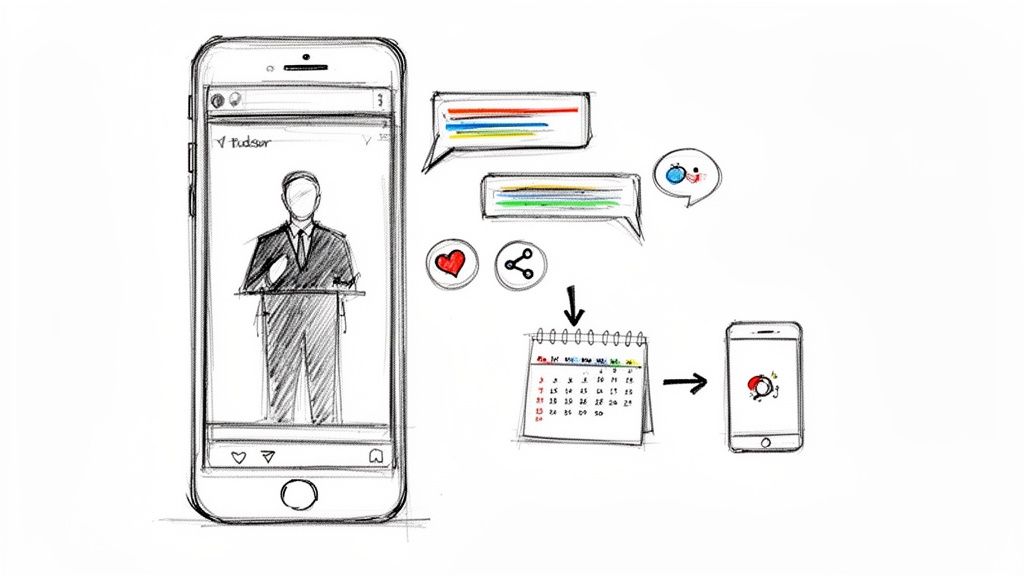
This means getting your content ready for vertical platforms like Instagram Reels and TikTok, adding clear captions, and making sure every post has your church's unique feel. It's all about turning the most powerful moments of your sermon into shareable movie clips for sermons that stop the scroll and start a real conversation.
The Shift From Broadcaster to Editor
Moving from a full-service livestream to powerful, on-demand sermon clips means churches need to start thinking more like film editors than just broadcasters. And the data backs this up. Take Anthem Church, for example. They found that after nearly four years, their average live viewership had dwindled to fewer than 10 homes, with most people tuning out after just ten minutes.
Where did they see real engagement? With on-demand video clips they posted throughout the week. This makes sense. Virtual viewers often "channel surf," looking for the most compelling content. In a world where someone can switch churches with a simple swipe, a well-edited, impactful clip can be the difference between being ignored and being shared.
This is where having a smart workflow is a lifesaver for your ministry. Trying to manually edit, caption, and design graphics for every social media post is a huge time-suck that can quickly burn out even the most dedicated volunteer or staff member.
Automating Your Digital Ministry Workflow
The good news? You don't need a huge team or a Hollywood-sized budget to create amazing, engaging content from your sermons. This is exactly why platforms like ChurchSocial.ai exist—to help you work smarter, not harder, to get your message out there.
Our platform handles the heavy lifting, turning a single sermon into a goldmine of content.
- AI Sermon Clip Creator: Just upload your sermon, and our AI pinpoints the most powerful, shareable moments. It then automatically generates dozens of movie-style clips, already formatted perfectly for your social feeds.
- Dynamic Captions: Every single clip comes with accurate, easy-to-read dynamic captions. This not only makes your message accessible but also connects with the 85% of users who watch videos with the sound off.
- Branded Graphics: With our simple graphic editor and templates, you can easily create beautiful, branded images and carousels to go along with your clips or highlight key quotes.
- AI-Generated Posts: The AI doesn't stop at visuals. It also writes compelling social media captions to accompany your clips, saving you hours of brainstorming.
Using a tool like ChurchSocial.ai, you can literally plan and schedule a whole month of sermon-based content in just a few minutes. For even greater impact, consider implementing powerful content repurposing strategies with your sermon clips.
A Sunday sermon can become a Monday devotional, a Wednesday discussion starter, and a Friday encouragement. By repurposing your core message into various digital formats, you minister to your congregation all week long.
This kind of automated workflow is a total game-changer. Our drag-and-drop calendar lets you manage all your social accounts from one central spot. We even integrate with Planning Center, helping you create content for upcoming events and keeping your digital presence fresh and relevant.
This isn't just about posting more; it's about creating a consistent, high-quality digital ministry that reflects the heart of your in-person experience. To learn more about making your message shine on screen, check out our guide on putting your sermon on video. By embracing this modern approach, you can turn your Sunday message into a powerful ministry that reaches people far beyond your church walls, all week long.
Got Questions About Using Movie Clips in Your Sermons?
You're not alone. The idea of using a powerful movie scene to drive home a point is exciting, but it brings up a lot of questions about the legal, practical, and technical sides of things. We hear these all the time from pastors and media teams, so let's clear the air and get you some straight answers.
Can I Just Show a Clip from Netflix or Disney+ in Service?
The short answer is almost always no. When your church pays for a streaming service like Netflix or Disney+, that subscription is for personal, private viewing only. Showing it to a public audience—which is exactly what a church service is—violates their terms of service and, more critically, copyright law.
Some folks might bring up the idea of "Fair Use," but leaning on that is a huge risk. Fair Use isn't a permission slip; it's a complicated legal argument you’d have to make in court after you’ve already been sued. For a church just trying to illustrate a point, it's rarely a solid defense. To stay above board, your best bet is to use clips from services that license media for churches or to create your own clips with a tool like ChurchSocial.ai.
What's the "Right" Length for a Sermon Clip?
This is a great question, and the answer completely depends on where people will be watching it. The context is everything.
- For Your Sunday Service: When you have a captive audience, you can go a bit longer. A clip that’s 2-4 minutes long can work beautifully as the emotional anchor for your message or a central illustration that you unpack.
- For Social Media: Online, you're fighting the scroll. You have to think short and punchy. Aim for 30-90 seconds on platforms like Instagram Reels, TikTok, or YouTube Shorts. The goal is to land one powerful, memorable idea that makes someone stop and think.
This is where AI-driven tools can be a massive help. A platform like ChurchSocial.ai is built to listen to your full sermon and automatically find those high-impact, bite-sized moments, packaging them perfectly for social media.
Do We Really Need to Add Captions to Our Videos?
Yes. 100%. In today's world, captions aren't optional if you want your ministry to be effective online. They do two things that are just too important to overlook.
First, captions make your content accessible to the deaf and hard-of-hearing community. That's a huge part of being a welcoming church for everyone. Second, a massive number of people on social media—some studies say up to 85%—watch videos with the sound off. Without captions, your message is completely silent to them.
Trying to transcribe and sync captions by hand is a frustrating time-sink. That’s why automated tools are such a game-changer for church media workflows. ChurchSocial.ai automatically generates accurate, dynamic captions for every single clip, making sure your message is seen and understood, even with the volume off.
Captions are not just an add-on; they are a ministry tool. They ensure your message is accessible to everyone and effective for anyone scrolling silently through their feed.
Can a Small Church on a Tight Budget Really Make Pro-Level Clips?
Absolutely. This is one of the most incredible shifts we've seen in ministry tech. The playing field has been completely leveled, putting high-quality content within reach for any church, no matter its size or budget.
An all-in-one platform like ChurchSocial.ai was designed for this very reason. It rolls the job of a video editor, a graphic designer, and a social media scheduler into one simple, affordable tool. All you have to do is upload your sermon, and its AI gets to work:
- Generating dozens of shareable clips.
- Adding your church’s logo and branding.
- Creating clean, easy-to-read captions.
- Even writing suggested social media posts to go with them.
This kind of approach means you don't need a bunch of expensive software subscriptions or a highly specialized staff member. It empowers any church to transform its weekly sermons into a powerful, professional online ministry.
Ready to transform your sermons into a week-long ministry without the legal headaches or technical burnout? ChurchSocial.ai is the all-in-one platform designed for churches. Start creating AI-generated reels, branded graphics, and social posts from your sermons in minutes. Plan your entire social media calendar with our simple drag-and-drop tool and see your digital outreach grow. Learn more and start your journey today at https://churchsocial.ai.