A powerful sermon always begins with the same foundational rhythm: prayerfully selecting a biblical text, diligently studying its meaning, and then unearthing its core truth. This isn't just about finding good ideas; it's about building your message on the solid rock of Scripture, turning a speech into a life-changing encounter with God's Word.
Starting with a Solid Foundation in Scripture
The real work of sermon prep starts long before you ever type out your first point. It begins in the quiet moments of prayer and deep study, laying a foundation that will hold up the entire message. Skip this part, and even the most polished sermon can feel hollow.
This initial phase is less about finding an interesting verse and more about asking God what His people need to hear this week. It means setting aside my own favorite topics or hobby horses and just listening for the Holy Spirit's lead. This posture of submission is what ensures the message comes from a divine calling, not just human ingenuity.
The Centrality of Prayer and Study
Before I ever crack open a commentary or fire up my Bible software, my first move is always prayer. I have to ask for wisdom, for clarity, and for a heart that’s open to what the text is actually saying. This is what separates a lecture from a sermon—inviting God into the process right from the jump.
Once a passage has been prayerfully chosen, the real digging begins. A huge part of preparing a preaching sermon is simply knowing how to study the Bible well, and this beginner's guide to studying the Bible is a fantastic starting point if you need a refresher. It’s all about moving past a surface-level reading to get at the real context.
I always start with a few key questions:
- Who wrote this? Understanding the author's background and purpose is crucial.
- Who were they writing to? This frames the message in its original historical setting.
- What kind of writing is this? Is it a historical account, poetry, prophecy, or a letter? The genre changes how you read it.
- What’s the context? A verse yanked out of its chapter or book can mean something entirely different.
This simple flow—from prayer to unearthing the core message—is my guide every single week.
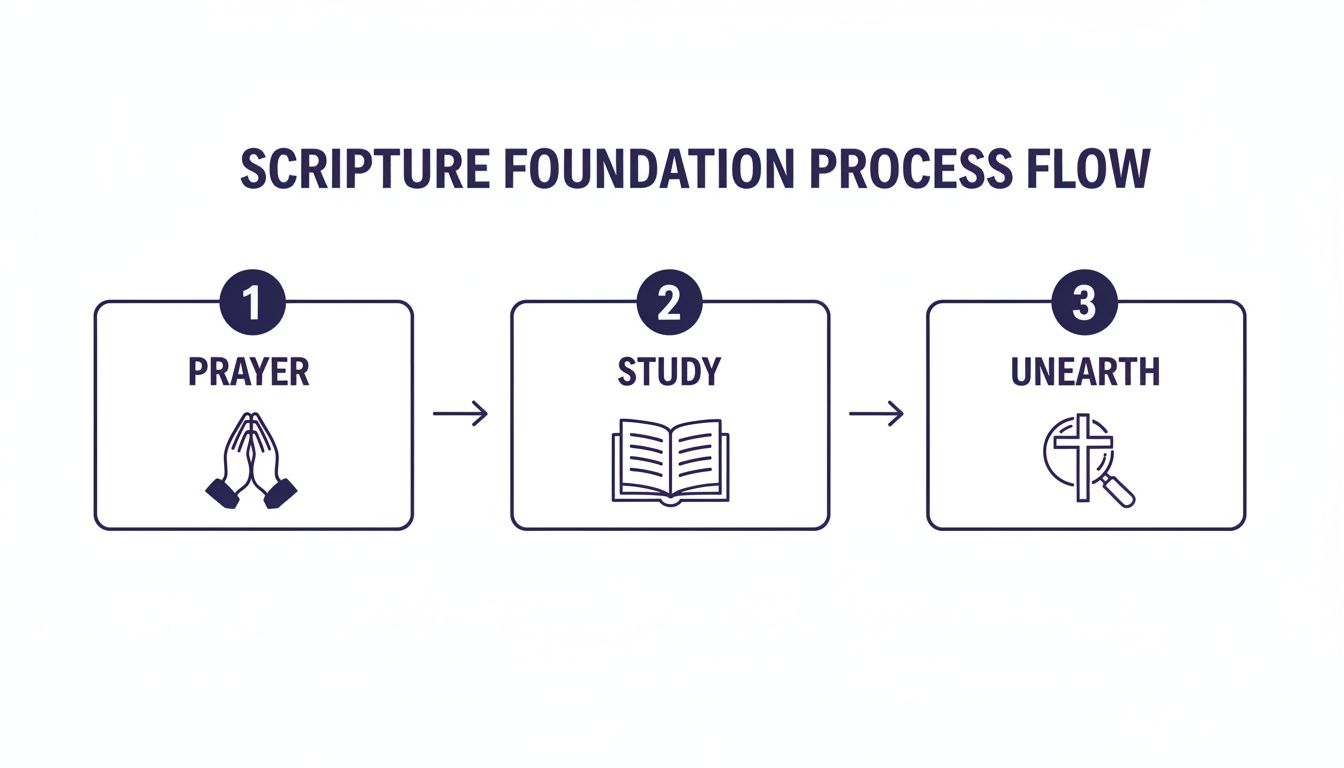
It’s a visual reminder that spiritual preparation (Prayer) has to come before the intellectual work (Study) if you want to get to genuine biblical insight (Unearth).
Navigating the Demands of Preparation
Let’s be honest: the pressure to deliver a fresh, impactful message every single Sunday is immense. Pastor burnout is a real and growing problem, and it directly impacts sermon quality and the health of our churches. It's a heavy weight to carry.
That’s why having a clear, repeatable process for this foundational stage is a lifeline. It gives you structure and confidence, especially on those weeks when inspiration just isn't there. If you want to go deeper on this specific method, our guide on https://www.churchsocial.ai/blog/expository-sermon-preparation is a great resource.
The discipline of deep biblical study is the preacher’s primary defense against burnout and superficiality. It refills the well from which you draw, ensuring you are pouring from a place of spiritual and intellectual fullness, not emptiness.
Ultimately, this first stage is all about wrestling with the text until it speaks clearly to you. You have to let God's Word shape you, the preacher, before you can ever hope for it to shape your congregation. When you build this solid scriptural foundation, every other step of sermon prep becomes more intentional, more powerful, and more faithful to the God who gave us His Word.
Build a Sermon Structure That Sticks
Alright, so you’ve spent time in the text and wrestled it to the ground. You have a good handle on its core truth. Now what? Now you build the frame that will hold it all up.
Even the most profound biblical insight will fall flat if the delivery wanders. A solid structure is the skeleton for your sermon. It gives it shape, strength, and moves your congregation logically and emotionally from point A to point B without getting lost.
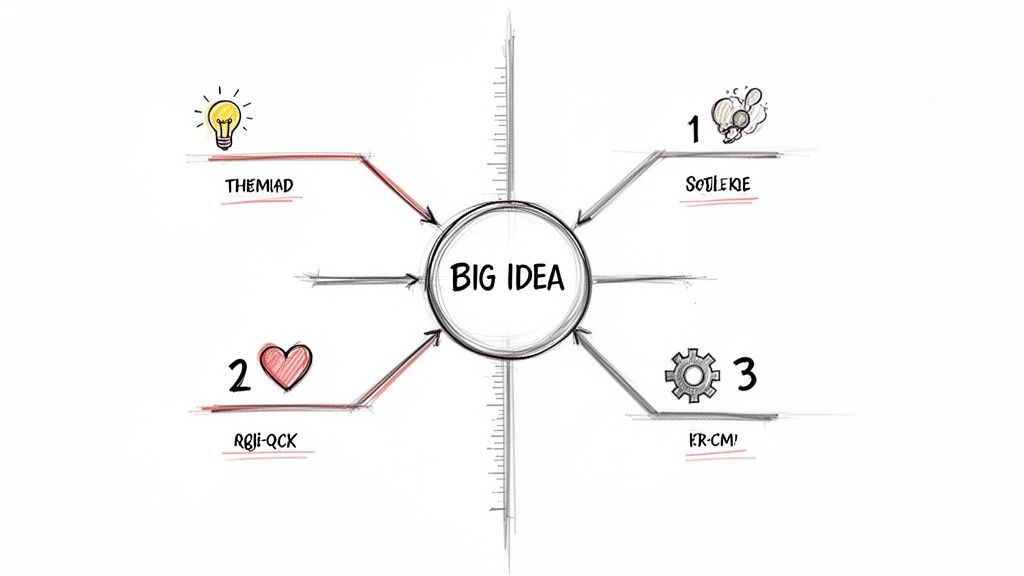
The first thing I always do is boil everything down into one, single sentence. We call this the "Big Idea." This is your anchor. It’s the one thing you want people to remember when they walk out the door. For instance, if you're preaching on Philippians 4:13, your Big Idea might be something like: "True strength for any situation comes not from our own grit, but from Christ's power working in us." Every story, every point, every application has to serve that one idea.
From Big Idea to Clear Outline
Once you’ve nailed down your Big Idea, you can start building out the outline. This is all about flow. You want your points to build on each other, taking your listeners on a clear and compelling journey.
A simple, time-tested outline that just works is:
- The Hook: Grab their attention right away. Introduce the problem or tension that the text speaks to.
- The Points: Usually 2-4 points that unpack your Big Idea, flowing naturally from the passage itself.
- The Landing: Bring it all home. Summarize the Big Idea and give a clear, practical call to action.
This basic framework turns a collection of thoughts into a cohesive message that actually persuades. For anyone wanting to really sharpen this skill, the principles of mastering structure in writing are incredibly helpful, as they apply to any form of powerful communication.
Picking the Right Structural Model
But hey, not every sermon needs to be a classic three-pointer. Different texts—and different Sundays—call for different approaches. Knowing a few structural models can make your preaching much more dynamic and effective. Honestly, some of the different styles of preaching just work better with certain structures.
To help you decide, here’s a quick look at a few common sermon structures I've found useful.
Sermon Structure Models at a Glance
Choosing the right structure is about matching your method to your message. It's not one-size-fits-all. This table breaks down a few popular models to help you see which might be the best fit for your next sermon.
No matter which model you choose, a thoughtful structure shows you respect your listeners. It makes the message easy to follow, simple to remember, and practical to apply.
A well-structured sermon ensures the Word of God can do its work long after everyone has gone home for lunch.
This upfront work on structure doesn't just benefit Sunday morning, either. It pays dividends all week long. With a clear outline, turning your main points into social media posts or small group questions becomes almost effortless.
Tools like ChurchSocial.ai are built for this. With ChurchSocial.ai, your church can use AI to instantly generate social posts, blogs, and other content directly from your sermon transcript. The clear points you worked hard to develop become the fuel for a week's worth of follow-up material, reinforcing your message without adding a ton of extra work to your plate.
Making the Message Resonate Through Story and Application
A sermon with a solid foundation and clear structure is a great start. It's intellectually sound. But to truly connect, it needs a heart.
This is where your message shifts from a well-organized lecture on an ancient text into a life-altering encounter with God. It’s the moment you build a bridge between the biblical world and the world your congregation lives in from Monday to Saturday.
You do this with two key elements: compelling illustrations and practical application. Illustrations open the heart, and application guides the hands and feet. Without them, even the most profound truth feels distant and irrelevant.
Crafting Illustrations That Connect
Think of illustrations as the windows of a sermon. They let the light in, helping people see a familiar truth in a completely new way. A good story can accomplish in two minutes what 20 minutes of abstract explanation never could. The goal isn't just to entertain; it's to forge an emotional and spiritual connection point to the biblical text.
So, where do you find these powerful illustrations?
- Your Own Life: Nothing beats authenticity. A personal story of struggle, failure, or grace, when shared vulnerably, breaks down walls. Preaching from your scars, not just your successes, shows everyone that the gospel is for real, broken people.
- Current Events & Culture: What are people already talking about? A nod to a popular movie, a major news story, or a trending topic can create an instant bridge of relevance. It shows how Scripture speaks directly into our contemporary moment.
- The Stories of Others: Pay close attention to the lives of people in your church and community. Biographies, historical accounts, and even conversations in the lobby are goldmines for stories of faith in action.
The key is to make sure the illustration genuinely illuminates the text, rather than overpowering it. The story should always serve the Scripture, never the other way around.
Developing Actionable Application
Information alone doesn't lead to transformation. One of the most critical parts of sermon prep is answering the "So what?" question for your listeners. It's not enough for them to understand what the text means; they need to know what to do with it.
Application shouldn't feel tacked on at the end. It needs to flow naturally from the main points you’ve already established. A weak application is vague, like "Love your neighbor more." A strong one is specific, measurable, and achievable.
The ultimate goal of a sermon is not just to inform the mind but to transform the life. Practical application is the bridge that carries truth from the listener's ear to their everyday existence.
For instance, instead of just saying "Be more generous," you could offer specific, concrete challenges:
- This week, identify one person to bless with an unexpected act of generosity.
- Sit down with your spouse for an honest conversation about your budget, asking God where you can be more sacrificial.
- Commit to praying for one missionary by name every single day for the next month.
These are tangible steps that empower your congregation to put their faith into practice right away.
This is also where your sermon prep fuels your church's discipleship all week long. The powerful illustrations and specific application points you develop are perfect for social media. Imagine taking a compelling story from your sermon and turning it into an AI-generated reel with ChurchSocial.ai.
You can use its AI to isolate that powerful moment and share it on Instagram or TikTok, reaching people who couldn't make it to the service. Those practical application points? They can be transformed into engaging social media posts or carousels using ChurchSocial.ai's graphic templates and editor, asking questions like, "Which of these challenges are you taking on this week?"
This extends the life of your sermon and keeps the conversation going long after Sunday, reinforcing the message and encouraging real-world action.
Fine-Tuning Your Delivery: From the Study to the Stage
You've done the hard work. The exegesis is solid, your outline is clear, and you've found stories that will connect. But now comes the crucial final step: bringing that message to life. This is where we move the sermon from the page to the pulpit, honing our delivery so God's Word can be heard clearly and without distraction.
The goal isn't a polished, perfect performance. Far from it. We're aiming for authentic connection. When you deliver a sermon with genuine confidence, you remove the barriers that can stand between your congregation and the text, allowing the Holy Spirit to move more freely.
The Myth of Over-Rehearsing
So many pastors I talk to worry that practicing their sermon will make them sound robotic. In my experience, the exact opposite is true. Rehearsing your sermon out loud is one of the most powerful things you can do in those final hours of prep. It helps you internalize the message, moving it from your head to your heart.
When you actually speak the words, you catch all the clunky transitions and awkward phrases you didn't notice on the screen. You start to feel the rhythm of the message. This isn't about memorizing every word; it's about becoming intimately familiar with the flow. The more comfortable you are with the material, the more freedom you'll have to be present and engage with your people in the moment.
The process of writing out and rehearsing a sermon helps you get more familiar with what you’re going to say. Manuscripting your sermon can help free you from your manuscript.
That familiarity is a massive confidence booster. When you know where you're going, your anxiety drops, and you can focus on connecting with your listeners instead of just trying to remember what's next.
Your Physical Presence Matters
Your body language and your voice are powerful tools in your communication toolbox. They communicate just as much, if not more, than your carefully chosen words. A monotone voice can put people to sleep, while dynamic, engaged delivery can pull them to the edge of their seats. You don't need to be a Broadway actor, but you do need to be a good steward of the physical tools God has given you.
As you practice, think about these elements:
- Vocal Variety: Are you speaking at the same pace and volume the whole time? Try varying your pitch and speed. Lean in and slow down for a key point. Speed up with excitement during a compelling story. Use pauses for emphasis.
- Body Language: How are you standing? An open, confident posture invites people in. Use gestures that actually reinforce what you're saying, not just random hand movements that distract. Make a point to look at different sections of the room.
- Movement: If you're not stuck behind a pulpit, use your space with purpose. Moving to a different spot on the stage can be a great non-verbal cue that you're shifting to a new point in the sermon.
A confident, authentic delivery is a critical part of how to prepare a preaching sermon because it builds trust. When your church sees that this message has genuinely impacted you, they'll be far more open to letting it impact them.
And here’s a bonus: all this work on the front end makes your church's social media management easier afterward. When you’ve delivered a message with such clarity and passion, grabbing clips for social media becomes a breeze. A tool like ChurchSocial.ai can easily find those high-impact moments. Imagine taking your best-delivered points and turning them into AI-generated reels that can reach a whole new audience online, extending your ministry's impact with almost no extra effort.
Extending Your Sermon's Reach All Week Long
The final “amen” has been said, the last prayer offered, and people are heading out for lunch. For most pastors, this is the finish line. But what if it wasn't? In our constantly connected world, Sunday morning is less of a finish line and more of a starting pistol for a week-long conversation.
A sermon's impact shouldn't be trapped inside a 35-minute window on a Sunday morning. When your church starts thinking about its message's entire lifecycle from the very beginning, you unlock discipleship opportunities that echo long after the service ends. It's all about strategically repurposing your message to meet your community where they already are—on their phones and in their social media feeds.
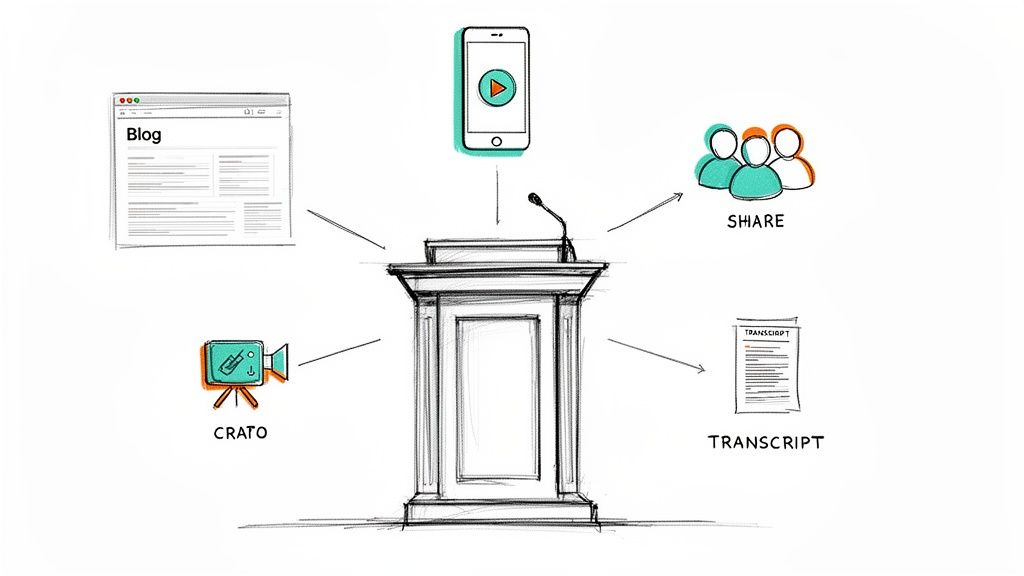
This isn’t just a nice-to-have anymore; it's a ministry necessity. The digital shift in how people engage with church is massive and permanent. Before the pandemic, Lifeway Research found that a mere 27% of churches offered live-streaming. That number exploded to 92% in the aftermath. It's a clear signal that sermon prep has to include a plan for reaching people both in the pews and on their screens, especially as in-person attendance has leveled out around 85% of what it was before.
From Sermon Transcript to Digital Discipleship
The bedrock of any good repurposing strategy is the sermon transcript. Once you have the full text of your message, you're holding the raw material for dozens of content pieces. The trick is having a system to transform it that doesn't add a ton of work to your church's already slammed week.
This is where a dedicated platform like ChurchSocial.ai can be a game-changer for your church. Instead of grinding it out on Monday, imagine a different kind of workflow. With ChurchSocial.ai, you can simply upload your sermon transcript and watch it generate an entire suite of assets for you.
- Engaging Blog Posts: Your sermon can become a well-structured blog post for your church website, reinforcing the message for those who were there and reaching new people through search.
- AI-Generated Content: Instantly generate discussion questions, social posts, and other content based on your main points, equipping your teams with material that flows right out of Sunday's teaching.
- Graphic Templates: Pull out thought-provoking quotes and design beautiful photos and carousels using a library of templates and an easy-to-use editor.
By planning for content repurposing from the start, you multiply the return on every hour invested in sermon preparation. The message doesn't just get heard once; it gets seen, shared, and discussed all week long.
This approach saves your church an incredible amount of time, yes, but it also creates a wonderfully cohesive message across all your church's communication channels.
Creating Shareable Moments with Video
Let's be honest: video is king online. While your full sermon recording is valuable, it's the short, punchy clips that get noticed and shared on platforms like Instagram, TikTok, and Facebook. But finding and editing those perfect moments has always been a major headache, usually falling to a talented (and busy) volunteer or staff member.
That whole process can now be largely automated. For instance, ChurchSocial.ai uses AI to scan your sermon video, pinpoint the most compelling segments, and automatically create shareable, AI-generated reels, captions and all. Your church can turn a powerful illustration or a key application point into a ready-to-post video in minutes. For more on getting your recording setup right, check out our guide on how to get your sermon on video.
A Seamless Social Media Workflow
Creating all this great content is one thing. Actually getting it posted consistently is another battle entirely. A scattered, last-minute approach just doesn't work. That's why integrating your content creation with a planning tool is so critical.
With ChurchSocial.ai, your church can easily manage and update all of its social media. The simple drag-and-drop calendar allows you to schedule all the AI-generated content from your sermon, the graphics you've created, and more. It can even integrate with Planning Center and other church calendars to automatically create content for upcoming events.
This kind of unified system turns sermon repurposing from a nagging weekly chore into a streamlined, sustainable ministry strategy. It extends your reach as a pastor, helps disciple your congregation throughout the week, and opens up new doors for outreach—all by getting the most mileage out of the message you so carefully prepared.
Preaching Sermon FAQs
After you’ve put in the work of studying, structuring, and honing your sermon, a few practical questions almost always pop up. Getting better at preparing to preach is a lifelong process of refining your craft. Let's tackle some of the most common questions I hear from pastors.
How Many Hours Should I Spend Preparing a Sermon?
There’s no magic number, but if you talk to most seasoned pastors, they'll tell you they land somewhere between 10 to 15 hours for a single sermon. That time isn't just fluff—it's what allows for deep, prayerful study of the text, thoughtful planning, finding illustrations that actually connect, and, of course, rehearsal.
Trying to cram everything into a few hours on a Saturday night almost always results in a shallow message. It might sound fine, but it will lack the biblical depth and real-world application your people are hungry for. The time you invest in the study is a direct deposit into the spiritual bank account of your congregation.
One practical way for your church to protect that precious study time is to get other tasks off your plate. For example, using a tool like ChurchSocial.ai to plan and manage your church social media accounts can easily give you back a few hours a week. Imagine what you could do with that time reinvested into study, prayer, or just catching your breath.
What Are Some Common Mistakes to Avoid?
Even the most experienced preachers can fall into a few predictable ruts. Just being aware of these common pitfalls can help you steer clear and deliver a message that truly honors God and serves your people.
- Forgetting to Pray First: It's so easy to just dive into commentaries and Greek word studies. But starting there, instead of sitting before God in prayer, can produce a sermon that's intellectually sound but spiritually powerless.
- Having No Clear Point: A sermon that tries to say everything ultimately says nothing. If you have five main points, I can almost guarantee your people won't remember a single one by the time they get to their cars. Land on one, clear "Big Idea" and make everything in the sermon serve that single truth.
- Preaching Information, Not Transformation: It's a huge missed opportunity to simply give people information about the Bible without showing them how it changes their lives on Monday morning. They need to know what the text means for their marriage, their job, and their fears.
- Treating Sunday as the Finish Line: In our connected world, your sermon doesn't have to end when the service does. Not having a plan to repurpose your message online means you’re missing a massive discipleship opportunity throughout the week.
Preaching is truth communicated through personality. To do it well, we need to give the depths of ourselves to our people. Avoiding these common mistakes helps ensure the message, not the method, takes center stage.
How Can I Find Fresh Illustrations for My Sermons?
Good illustrations are everywhere; the trick is learning to see them. Start by reading widely and not just theology. Biographies, history, science articles, and even current events are gold mines for fresh material. Most importantly, just listen. Listen to the stories of the people in your church and your community.
And don't forget, your own life is one of your most powerful sources. Be willing to share your own struggles, questions, and moments of grace. It makes the truth feel real. The key is to capture these ideas when they strike. Use a simple notes app on your phone and create an "Illustration File." When you see or hear something, jot it down immediately. Over time, that file will become one of your most valuable preaching resources.
How Do I Prepare a Sermon When I Feel Burned Out?
First of all, give yourself some grace. Every single person who steps into a pulpit regularly faces seasons of burnout. It’s not a sign of failure; it's a sign you’re human. The first step is to just be honest with God about where you are. This is a time for leaning, not for guilt.
In those weeks, it’s okay to lean more heavily on your tools. Pull a trusted commentary off the shelf or listen to another gifted teacher preach on the passage just to get the pump primed. Sometimes, the best thing you can do is focus on the simple, core truth of the text. A straightforward message delivered faithfully from an honest heart is far more powerful than a complex one delivered from a place of sheer exhaustion.
This is also a perfect time for your church to delegate what it can. Let a tool do what it's good at. For instance, you can hand off your church's entire post-sermon social media workflow to ChurchSocial.ai. Let it create AI-generated reels and schedule posts with the simple drag-and-drop calendar. That frees up your limited mental and emotional energy for the one thing only you can do: preparing your heart to preach God's Word.
Ready to save time and extend the reach of every sermon you preach? ChurchSocial.ai is your all-in-one ministry partner. Instantly create AI-generated reels, social posts, and blog content from your sermons, manage your entire social media presence with a simple drag-and-drop calendar, and design stunning graphics with our easy-to-use templates.