Preparing a sermon is more than just an intellectual exercise; it’s a deeply spiritual process that blends careful study with pastoral care. It’s about moving from a quiet moment of prayerful study to delivering a clear, life-changing message on Sunday morning. This journey involves choosing a scripture, digging into its meaning, finding its core truth, and then building a message that truly connects.
Building Your Sermon From Prayer And Study
Long before you type a single word of your manuscript, the real work of sermon prep has already begun. The foundation of any powerful sermon isn’t a clever outline or a touching story—it's built in the quiet, unseen hours of prayer and deep engagement with God's Word. This first phase is less about crafting a speech and more about encountering God yourself.
The whole process starts with listening. It begins by asking a simple, crucial question: "What does my congregation need to hear from God this week?"
This question transforms sermon prep from a dry academic task into a genuine act of pastoral love. You might be preaching through a book of the Bible, following a thematic series, or addressing a specific cultural moment. No matter the approach, the goal is always to land on a text that is both faithful to Scripture and deeply relevant to the people sitting in the pews.
Finding The Heart Of The Message
Once you’ve settled on a passage, the excavation work begins. This is where you get your hands dirty, digging into the historical context, the original language, and the literary shape of the text. You have to understand the world the passage was written in to correctly interpret what it means for us today. It keeps us from forcing our modern ideas onto an ancient text, allowing the Word to speak for itself.
This deep study isn't just about gathering facts; it's a sanctifying process for the preacher. I've heard it said that every worthwhile sermon cuts the preacher’s heart before it ever reaches the congregation, and I've found that to be absolutely true. The message has to confront and convict you first.
To go deeper into this exegetical work, check out our detailed guide on expository sermon preparation.
This entire workflow—from foundation to final delivery—is a journey. You can see how it breaks down into a few key phases.
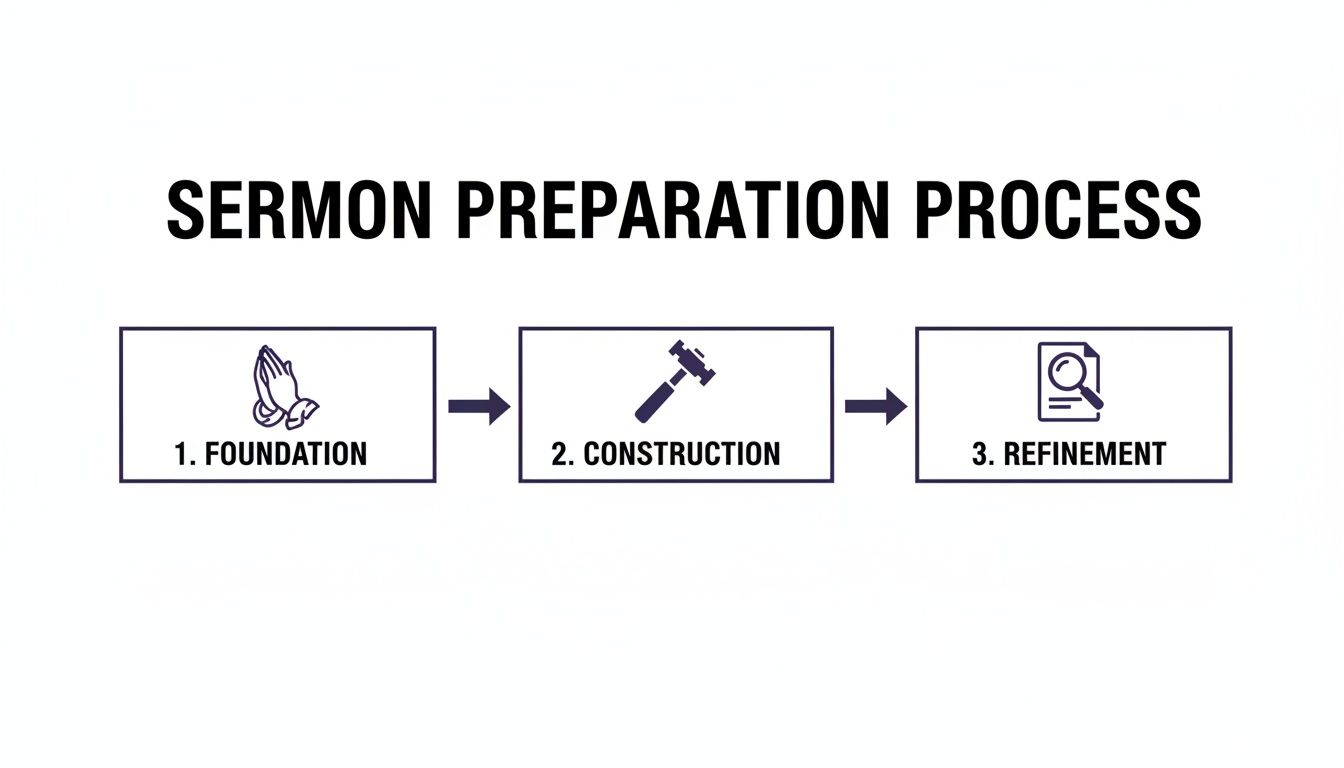
This visual helps show that sermon prep isn't random; it's a structured process that starts with a solid foundation of study and prayer before you even think about building the message itself.
Distilling Your Core Idea
After all that prayerful study and careful exegesis comes the most critical step: distilling everything you've learned into a single, memorable truth. Some call it the "Big Idea" or the central proposition. Essentially, it's the one thing you want your listeners to remember long after they've walked out the door.
The "Big Idea" acts as the compass for your entire sermon. It ensures that every point, illustration, and application is intentionally pointing in the same direction, creating a message that is clear, cohesive, and compelling.
Having this central theme locked in is vital. It keeps your sermon from wandering into a collection of disconnected thoughts and instead shapes it into a unified message that guides the listener toward a specific spiritual truth. This clarity is the bridge between your private study and your public proclamation.
And while this foundational work is deeply personal and spiritual, managing your church's social media doesn't have to be. Once your sermon is prepared, platforms like ChurchSocial.ai can help extend its reach. You can instantly turn your sermon transcript into AI-generated social posts, blogs, and even video reels, ensuring the message continues to minister throughout the week. By using smart tools, you can schedule this content effortlessly, freeing up more time for the sacred work of prayer and study that started the whole process.
Crafting a Sermon That Connects and Transforms
Once you’ve wrestled with the text and nailed down its core truth, the next part of your sermon prep is all about architecture. You’re building a structure that can carry the weight of that truth from the pulpit to the pews. A powerful message without a solid framework is like a car with no chassis—it might have all the right parts, but it’s going nowhere.
The structure you pick is critical, and thankfully, it’s not a one-size-fits-all situation. More often than not, the biblical text itself will give you the blueprint.
Choosing Your Sermon Structure
Take a close look at the natural flow of the passage. Does it lay out a logical argument and build to a powerful conclusion? If so, a deductive structure is your best friend. You state the big idea right at the top and then spend the rest of the time supporting it. This approach is fantastic for clarity, especially when you're teaching foundational doctrines.
But what if the passage unfolds more like a story, revealing truth bit by bit? That’s where an inductive structure really shines. You can lead your listeners on a journey of discovery, building suspense until you land on the main point together at the very end.
And of course, for narrative passages, a narrative structure is a natural fit. Instead of chopping up a great story into abstract points, you just retell it. You draw out the tension, the climax, and the resolution, helping your congregation experience the biblical account in a fresh, powerful way.
No matter which structure you choose, the goal is always the same: create a clear path that makes your main point unforgettable.
Building Your Message Piece by Piece
With a framework in place, it's time to start adding the walls and windows. Your introduction is your one shot to grab everyone's attention. You need to create a sense of curiosity or need that makes people lean in. If you're looking for ideas, it's worth learning how to write an engaging hook that pulls people in from the very first sentence.
From there, your main points should flow directly from that central idea. Think of them as the pillars holding everything up—they need to be clear, distinct, and firmly planted in the biblical text. Each point should build on the last, moving the message forward. For a deeper dive, check out our guide on how to develop a sermon outline.
Finally, you land the plane with your conclusion. This isn't just a quick summary of what you've already said. It’s your final appeal. It’s where you call for a specific response—repentance, worship, a next step of faith. A great conclusion doesn't just end the sermon; it sends people out into their week with a renewed sense of purpose.
Illustrations and stories are the secret sauce that makes it all stick. They act as bridges, connecting lofty theological ideas to the messy reality of everyday life. The right story at the right time can make a difficult concept crystal clear and lodge the truth of your message in someone's heart long after they’ve gone home.
Navigating the Realities of Modern Ministry
Let's be honest: sermon prep isn't just a quiet, spiritual retreat. It's one of the most demanding parts of a pastor's weekly grind, and the pressure is only getting more intense. In today's world, ministry means juggling the sacred duty of preaching with a never-ending list of administrative tasks, pastoral care emergencies, and the constant hum of managing your church's social media accounts.
This isn't some abstract problem; it's the day-to-day reality for thousands of church leaders. The time you carve out for deep, prayerful study often gets chipped away by a dozen other "urgent" things—from planning the next church potluck to counseling a family in crisis. This relentless pace is a major contributor to burnout, and it’s pushing some of our best leaders right to the edge.
The Weight of the Calling
The stats don't lie, and they paint a pretty sobering picture. Recent research shows that one-third of pastors in America are seriously thinking about leaving full-time ministry. It gets even starker when you look at the next generation: 46% of pastors under the age of 45 are contemplating quitting.
This isn't just a local issue, either. Worldwide, there are about 5 million pastors, and only a tiny fraction have any formal theological training. This just goes to show the immense weight on leaders who often feel both under-equipped and completely over-extended. You can dive deeper into these global church findings to see the full scope of the challenges pastors are facing.
The emotional and spiritual toll is huge. Every single sermon carries the weight of eternal significance. The preparation process itself can feel like a painful act of self-exposure, forcing you to be vulnerable and confronted by the text long before you ever share it with your church.
Finding a Sustainable Rhythm
This reality isn’t a reason to despair, but it is a call to work smarter, not just harder. We need a more sustainable rhythm for ministry. The goal isn't to cut corners or replace the sacred work of preparation, but to wisely manage all the tasks that orbit around it. This is where technology can be an incredible assistant—not a replacement for the Holy Spirit.
Think of it like this: smart tools can take on the administrative load that so often steals time away from your most important work. They can help streamline your research, organize your thoughts, and even manage the follow-up communication that happens after the sermon.
By offloading these logistical and administrative tasks, pastors can reclaim vital time for the deep, prayerful contemplation that fuels authentic and Spirit-led preaching. It’s about creating margin for what matters most.
This shift lets you pour your energy where it’s truly irreplaceable—into hearing from God and wrestling with His Word. It protects the sanctity of your study time, making sure that when you step into the pulpit, you're not just delivering information but sharing a message that has first transformed you.
Extending Your Ministry Beyond Sunday
The modern pastor's job doesn't stop when the Sunday service ends. It now spills over into the digital world all week long. This is where tools designed specifically for churches, like ChurchSocial.ai, can make a world of difference.
Imagine this: you finish your sermon, and then, in just a few minutes, you have an entire week of social media content ready to go.
- AI-Generated Reels: Instantly turn your sermon transcript into short, powerful video clips—perfect for Instagram, TikTok, and Facebook.
- AI-Generated Content: Transform your key points into engaging social media posts, blogs, or small group discussion questions.
- Graphic Templates & Editor: Use our library of templates and a simple editor to create and post beautiful, branded photos and carousels for your sermon series or key quotes.
- Simple Drag-and-Drop Calendar: Easily manage and update all of your church's social media accounts from one place.
You can even integrate with church calendars like Planning Center to automatically create content for events. This isn't about adding more to your plate. It's about making the work you've already done go further, helping your message connect with your community long after everyone has gone home.
From the Page to the Pulpit: Rehearsal, Tech, and Taking Your Message Further
A sermon manuscript is just the starting point. The real magic happens when you move from the written word to the spoken message—this is where a good sermon has the chance to become a great one. It's the final, crucial phase of practice, timing, and learning how to truly connect with the people listening.
This isn't about memorizing a script. It’s about internalization. You need to know your material so well that it flows from a place of genuine passion, not like you're reading off a screen. Speaking your sermon out loud is non-negotiable. Do it multiple times. Record yourself and listen back; you'll be surprised by the awkward phrases or points that just don't land with the punch you thought they would.
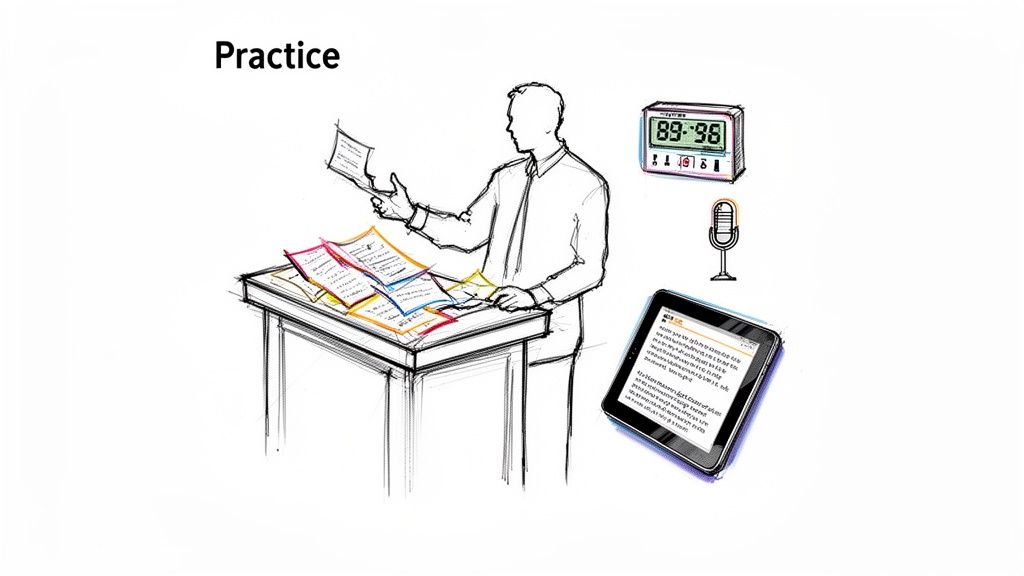
Running through your message out loud is also how you master the non-verbals. Your body language, the rise and fall of your voice, and even the power of an intentional pause—these are the elements that bring the biblical truth to life. Rehearsal gives you the freedom and confidence to look up from your notes, make eye contact, and truly engage.
Using Technology as a Partner, Not a Crutch
In these final stages, technology can be an incredible ally. While you can't automate spiritual discernment, modern tools can take care of the technical and organizational details, freeing you up for the deeper work of prayer and preparation. Think of it as support for the sacred process, not a replacement for it.
For instance, a simple timer app on your phone can give you an accurate feel for your sermon's length, taking the guesswork out of it. Presentation software like ProPresenter or PowerPoint helps you integrate visuals that support your message, ensuring your slides complement your points instead of distracting from them.
Technology’s best role in sermon prep is to handle the logistics so you can focus on the heart of the message. It should serve the sermon, not dominate it.
This tech integration extends right up to Sunday morning. A last-minute mic check or a test run of your slides is crucial. A solid technical setup, including reliable video systems for churches, is what makes a seamless experience possible for everyone, both in the room and online.
Balancing Modern Tools with Timeless Truth
Of course, the conversation around technology in ministry always comes with a healthy dose of caution. Many seminary professors agree that while tech can speed up certain tasks, sermon prep remains, at its core, a sacred time for hearing from God. As Tyshawn Gardner, a biblical studies professor, puts it, "A message that does not begin with the Holy Presence is not a sermon at all." You can dive deeper into this important balance in this Lifeway Research article.
This is precisely where a tool like ChurchSocial.ai comes in. It doesn't interfere with your sacred prep time; it amplifies your message after it's delivered. The work isn't done when you say "Amen." ChurchSocial.ai helps you carry the momentum of Sunday's message throughout the week.
- Generate AI Reels: Instantly clip the most powerful moments from your sermon transcript and turn them into short, shareable videos for social media.
- Create Post-Sermon Content: Effortlessly transform your message into AI-generated blog posts, social media captions, or small group discussion questions.
- Design Custom Graphics: Use simple templates to create beautiful graphics that visually reinforce your sermon's main points.
- Schedule with Ease: Plan out an entire week of social media content across all your platforms with a simple drag-and-drop calendar.
By using a purpose-built platform, you can steward the message God has given you without sacrificing the spiritual energy required to prepare it. You can focus on the pulpit on Sunday, knowing the digital outreach for the rest of the week is already taken care of.
Turn Your Sermon into a Week of Ministry
When you step down from the pulpit on Sunday, the ministry of that message is really just getting started. A sermon is a powerful moment, but its impact shouldn't be trapped within that one hour. The deep study and prayer you invested can continue to encourage, challenge, and connect with your congregation all week long.
The key is a small shift in thinking: see the sermon not as a finished product, but as the source material for a week of ongoing ministry.
In the past, follow-up was maybe a bulletin insert or a note in the midweek email. Now, you can reinforce the truth you preached across dozens of touchpoints, meeting people right where they are—on their phones during their commute, in their small group discussions, and as they scroll through their feeds.
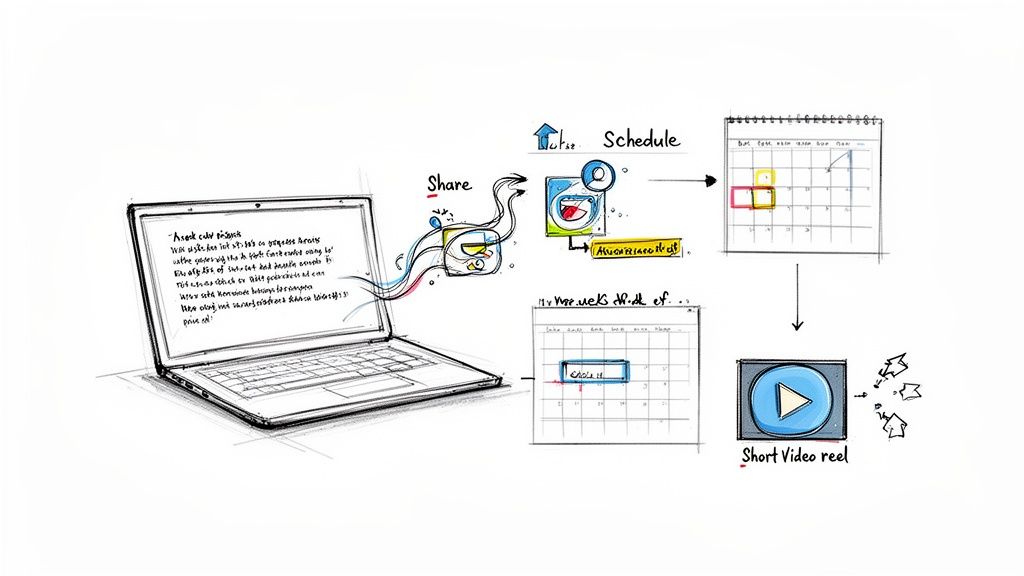
From Manuscript to Ministry Content
Think about it: the work you’ve already done is a goldmine. Your sermon manuscript is packed with everything you need to create a rich variety of content that serves your church. The big hurdles have always been finding the time and having the technical skills to pull it off. This is where a smart strategy, backed by the right tools, changes everything.
Instead of adding another massive project to your plate, you can simply repurpose your core message with incredible efficiency.
- Social Media Posts: Pull out the most powerful quotes, illustrations, or main points and turn them into shareable graphics or compelling captions.
- Discussion Questions: Reframe the application points from your sermon into questions that small groups or families can dig into during the week.
- Short-Form Video: Find the most impactful 1-2 minute clips from your sermon recording and create engaging reels for Instagram, TikTok, or YouTube Shorts.
You don't have to invent anything new. This is all about strategically breaking down the sermon you already prayerfully prepared and sharing it in different formats for different platforms.
Making Your Digital Outreach Effortless
This is where a platform like ChurchSocial.ai can transform a good idea into a sustainable reality. It was built to bridge that exact gap between your Sunday message and your weekly digital outreach, taking the technical headaches off your shoulders.
Imagine a simple workflow: after the service, you upload your sermon transcript. In minutes, AI helps you generate a whole suite of content. You can create AI-generated reels from the most powerful moments, draft social posts based on your key points, and even produce a blog post summary for your church website.
This isn't some futuristic idea; it's happening right now. The use of artificial intelligence in sermon prep and content creation has seen explosive growth. A huge majority of pastors now report using AI tools weekly or even daily—a massive jump from just a year ago. You can read more about how pastors are using AI on Faithwire.com. It’s clear church leaders are ready to see how these tools can support their work.
By automating the content creation, you get precious hours back. This isn't about replacing the pastor. It's about empowering the pastor to focus on people, prayer, and the next sermon, while technology handles the digital distribution.
With ChurchSocial.ai, you’re not just getting content ideas. You get all the tools to bring them to life. You can use the graphic templates and editor to design beautiful, on-brand images that match your sermon series, then use the simple drag-and-drop calendar to schedule it all across your social media channels. It’s a complete system for extending your sermon’s reach.
Integrating with Your Church's Rhythm
The best content strategy feels woven into the actual life of the church, not like a separate marketing effort. That's why integration is so important. ChurchSocial.ai connects with tools you’re likely already using, like Planning Center and other church calendars.
This means you can automatically create content promoting upcoming events, celebrating baptisms, or sharing announcements. It ensures your social feeds reflect the full, vibrant life of your church family—the sermon content provides spiritual depth, and the event content provides practical ways to connect.
Ultimately, turning your sermon into a week of ministry is just good stewardship. You've poured so much time, prayer, and energy into preparing God's Word. By repurposing it for your digital channels, you multiply its potential for impact, ensuring the message you preached on Sunday continues to work in people’s hearts long after they’ve left the building.
Common Questions About Sermon Preparation
The rhythm of sermon prep is deeply personal, but the practical challenges are universal. Every pastor I know has wrestled with these questions in their study. Finding solid answers can bring a whole new level of clarity and confidence to your weekly workflow.
How Long Should Sermon Preparation Take?
If you're looking for a magic number, you won't find one. But most seasoned pastors I've talked to land somewhere in the 10 to 20-hour range for a single sermon. That's a huge window, I know. It covers the whole process—from prayer and deep exegesis to writing, finding the right stories, and practicing the delivery.
The real goal isn't to punch a clock. It's to find a sustainable rhythm that fits your life and your specific gifts. The "Saturday night special" is a recipe for burnout. A much healthier approach is to block out dedicated time throughout the week. Maybe Mondays and Tuesdays are for deep study and prayer, Wednesday is for outlining, Thursday is for writing, and Friday is for practice.
A structured weekly schedule protects the sacred space needed for deep work. It helps ensure that both the spiritual and practical aspects of sermon prep receive the attention they deserve, preventing burnout and last-minute stress.
Think about it this way: when you guard that time, you're free to do the spiritual and creative work that only you can do. Let tools handle the rest.
What Is the Best Way to Overcome Writer's Block?
We've all been there. The cursor blinks on a blank page, the pressure mounts, and the words just... stop. When that happens, the best first move is often to step away from the keyboard. Go for a short walk. Change your scenery. Spend a few minutes in focused prayer. You'd be surprised how often a simple reset can clear your head.
Another trick I've found incredibly helpful is to just talk it out. Grab a trusted friend, your spouse, or another pastor and try to explain what you're trying to say. Vocalizing your thoughts and sticking points almost always sparks new connections. Hearing yourself explain the passage can unlock the very ideas you were struggling to put on paper.
And if all else fails? Just start writing. Write junk. Write the worst sentence you can think of. Getting something—anything—on the page breaks the inertia. You can always go back and fix it later.
How Can I Make My Sermons More Engaging?
Real engagement starts long before you step on stage; it starts with truly knowing your congregation. Who are you talking to? What are they going through?
Vary your illustrations. Use timeless parables, but also pull from current events or the simple stuff of daily life. This builds bridges with different generations and backgrounds. Make sure your application points hit on different life stages—from a student drowning in homework to a retiree figuring out their next chapter.
Ultimately, the most engaging sermons tap into the universal human experiences the Bible speaks to so powerfully: hope, fear, joy, and the search for meaning.
And remember, engagement doesn't have to stop when the service ends. Taking the message online creates so many more opportunities to connect.
With ChurchSocial.ai, you can turn one sermon into a full week of ministry. Our platform helps you create AI-generated reels from your sermon transcript, design beautiful graphics with our simple templates and editor, and manage and update all your social media with a drag-and-drop calendar. Visit ChurchSocial.ai to see how you can amplify your message and engage your community all week long.