A lot of church teams start this process the same way. Someone says, “We need a mission statement,” and the room gets quiet.
Not because people don’t care. Usually it’s the opposite. They care enough to feel the weight of it. The senior pastor wants something biblically faithful. The communications person wants something clear enough to use on the website. Ministry leaders want language that reflects what the church does. Then someone reads the current line on the bulletin or old brochure, and everyone realizes it sounds polite but says almost nothing.
That’s a normal place to start.
Learning how to write a church mission statement isn’t just a branding exercise. It’s a ministry clarity exercise. When a church gets the wording right, it usually isn’t because the team found a clever phrase. It’s because they finally agreed on their why, and that why started shaping decisions across preaching, discipleship, outreach, volunteer culture, and digital communication.
Why Your Church Needs More Than Just a Mission Statement
A mission statement can become wall decor fast. Framed in the lobby. Buried on the website. Printed in a membership class packet. Never used again.
That’s the failure point.
A healthy mission statement doesn’t exist to sound official. It exists to settle arguments before they start. It gives your staff and volunteers a shared filter for questions like these:
- Programming choices Which ministries fit our calling, and which ones are good ideas but not ours to carry?
- Communication tone What should people hear from us repeatedly online and in person?
- Volunteer alignment Are we recruiting people into activity, or into a clear purpose?
- Community engagement Are we reacting to needs randomly, or responding from conviction?
When the why is fuzzy, everything gets harder
I’ve seen churches spend hours debating event promotion, sermon series themes, and website copy when the underlying issue wasn’t tactics. The core issue was that nobody had agreed on the central mission strongly enough to use it as a decision tool.
That confusion shows up everywhere. Social media becomes a stream of unrelated announcements. Ministries create their own language. New guests hear different answers depending on who they ask. Staff members start pulling in different directions while thinking they’re being faithful.
A mission statement should answer a simple question clearly enough that a first-time guest, a volunteer, and a staff member would all answer it the same way.
Clarity affects engagement
This isn’t only anecdotal. A Leadership Network report indicates that 70% of mission-driven churches experience significantly higher member engagement, measured by attendance, donor rates, and responses to marketing materials, according to Vanco’s summary of church mission statement research.
That matters because engagement is rarely a communication problem alone. It’s usually a clarity problem first.
If your church says it exists “to love God and love people,” that may be true, but it’s also so broad that it won’t guide much. If your mission says what kind of discipleship you’re pursuing, who you’re trying to reach, and what kind of spiritual movement you want to build, people can rally around it.
More than a sentence
The strongest mission statements work in three places at once:
| Where it shows up | What it should do |
|---|---|
| Leadership | Guide priorities and trade-offs |
| Congregation | Give people language they can remember and repeat |
| Communication | Shape sermons, stories, social posts, and ministry messaging |
If it only works in one of those places, it still needs work.
A church doesn’t need more words. It needs sharper ones.
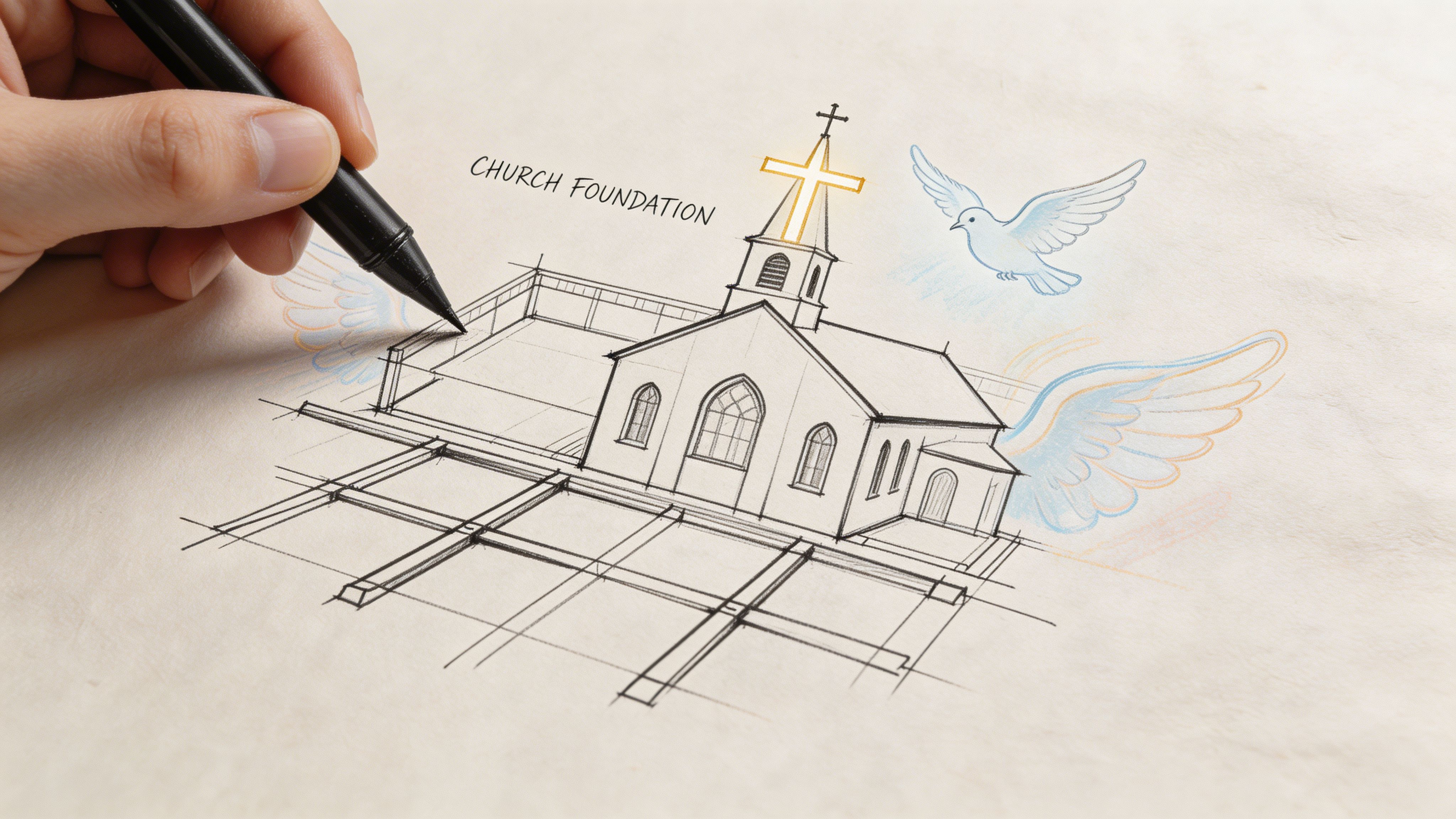
Laying the Foundation Before You Write a Single Word
Most weak mission statements aren’t ruined in the writing phase. They’re ruined before the first draft starts.
The team gathers too quickly. The loudest people dominate. Someone pastes together familiar church language. The result sounds respectable and forgettable at the same time.
The groundwork matters because mission language isn’t supposed to describe church in general. It’s supposed to describe your church’s calling with enough precision that people can act on it.
Start with prayer and honest diagnosis
The practice of formalizing church mission statements gained traction in the late 20th century, drawing from both corporate strategy and biblical mandates like the Great Commission in Matthew 28:18-20, and modern guidance emphasizes involving diverse teams so the final language carries real ownership, as noted in this guide on how to write a church mission statement.
That blend matters. Churches don’t need to choose between spiritual discernment and organizational clarity. You need both.
Before you write anything, ask the leadership team to answer these questions privately:
- What has God clearly entrusted to this church?
- Who are we most consistently effective at reaching and discipling?
- What keeps showing up in our sermons, ministries, testimonies, and service patterns?
- What do we say yes to too often that doesn’t fit our calling?
Those answers surface tension early. That’s healthy.
If your church is also forming or rebuilding ministries from the ground up, this practical guide on how to start a ministry is useful because it forces the same kind of foundational thinking. Calling comes before structure.
Choose the right people for the room
This work shouldn’t sit only with the senior pastor and communications director, even if those two will shape the final wording.
Bring in people who see the church from different angles:
- Senior leadership They guard theology, direction, and long-term fit.
- Ministry practitioners They know what happens in kids, students, groups, care, outreach, and worship.
- Trusted volunteers They hear what regular attenders understand and repeat.
- A newer member or attender They can spot insider language faster than staff can.
You don’t need a huge committee. You do need a representative room.
A common mistake is filling that room with people who all think alike, speak alike, and already agree on everything. That makes drafting faster, but it often produces generic language that doesn’t survive contact with the congregation.
Do the pre-work in writing
Don’t walk into the meeting cold. Ask each participant to submit short written responses ahead of time.
Use prompts like these:
- Finish this sentence Our church exists because God has called us to…
- Name recurring themes What words or ideas keep appearing in our preaching and ministry?
- Describe the fruit If our church is faithful over time, what changes in people and in our community?
- Spot the difference What makes our church distinct from the church down the street, in tone, emphasis, or mission?
That written input protects quieter voices and gives the facilitator raw material to work from.
Build internal alignment before external messaging
If your staff communication is already fragmented, mission work will expose it fast. The church might need to tighten handoffs, meeting notes, calendar visibility, and ministry messaging before the mission can be communicated consistently. This article on improving church team communication is worth reviewing: https://www.churchsocial.ai/blog/improving-internal-communication
Practical rule: Don’t finalize public-facing mission language while internal teams still interpret the church’s purpose in conflicting ways.
The best foundation isn’t excitement. It’s shared understanding.
A Practical Workshop for Crafting Your Mission Statement
Once the groundwork is done, stop treating the mission statement like a sentence-writing exercise. It’s a workshop.
That shift changes everything. Instead of waiting for one gifted writer to produce a line everyone tolerates, you create a process that draws out conviction, language, and clarity from the room.
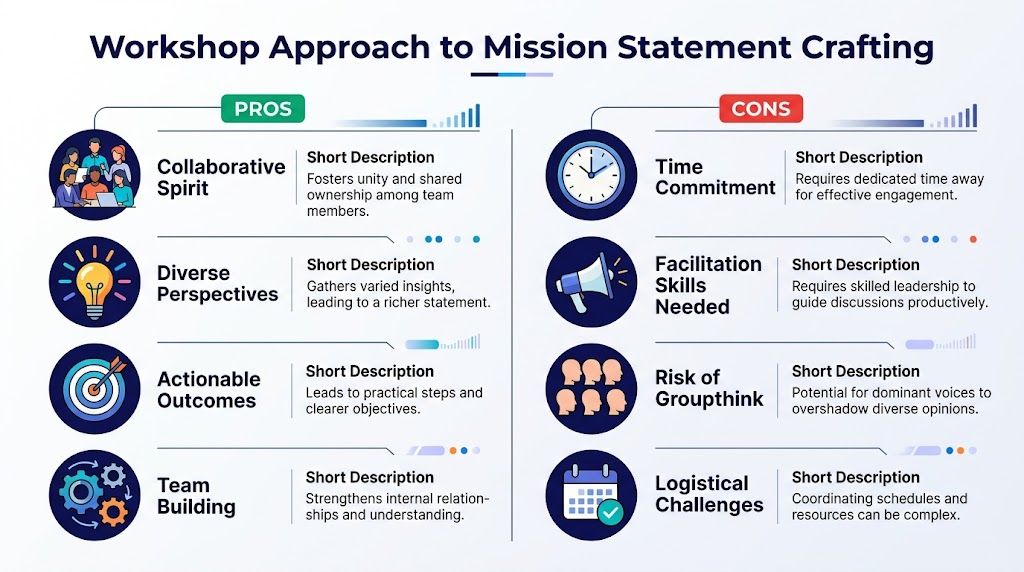
Use a retreat format if you can
A structured retreat-based process works well because people think better when they’re out of normal church traffic. According to Smart Church Management’s guidance on mission and vision statements, mission statements under 25 words achieve 40% higher recall rates among congregants, and vague verbs like “help” or “enable” reduce clarity.
That one data point should change how your team drafts. Your first instinct will be to explain too much. Resist it.
If possible, gather the board and a small group of senior leaders or staff in a distraction-free room. Split people into smaller teams. Give each team paper, a whiteboard, or flipcharts. Keep laptops closed for the first round.
Ask better workshop questions
Not all prompts produce useful language. Some lead to clichés fast.
These tend to work better:
- Identity question Who are we when we’re most faithful?
- Assignment question What does God want this church to do in this community?
- Future question What do we pray people become because this church exists?
- Boundary question What are we not trying to be?
The point isn’t to get polished wording yet. The point is to get patterns.
Move from broad language to sharp language
A good workshop usually has three phases.
Phase one gathers raw material
Give each team time to list words and short phrases that describe the church’s purpose. Tell them not to edit yet.
You’ll often see clusters like discipleship, neighborhood, Scripture, healing, worship, next steps, family, justice, evangelism, belonging, service, or multiplication.
That’s good. Let it stay messy for a bit.
Phase two groups the themes
Bring everyone back together and start grouping repeated ideas.
At this point, I usually ask the room to name the few themes that keep showing up no matter which group produced them. You’re looking for recurring conviction, not the most poetic phrase.
A simple table helps.
| Repeated theme | What it may mean |
|---|---|
| Discipleship | People are formed, not just gathered |
| Community | The church values belonging and relationships |
| Mission outward | The church isn’t inward-only |
| Transformation | The expected result is changed lives |
Phase three drafts real statements
Now start building drafts using a simple structure. One of the most useful is Cause + Action + Result.
That might look like this:
- Cause Why do we exist or who are we burdened for?
- Action What do we do?
- Result What change do we seek?
Here are sample structures, not templates to copy:
- We exist to reach ___ by ___ so that ___.
- We disciple ___ through ___ for ___.
- We lead people to ___ so they can ___.
This formula keeps the statement moving. It prevents vague church-speak from taking over.
If your sentence could belong to almost any church in any city without changing a word, it probably isn’t finished.
Watch out for the usual weak spots
The most common problems are predictable.
- Too broad “Love God, love people” is biblically sound but too general to guide ministry decisions.
- Too long If the team needs to explain the sentence every time they repeat it, it won’t travel.
- Too abstract Words like “facilitate,” “engage,” and “enable” often sound thoughtful while saying very little.
- Too trendy Language that feels current now can feel dated quickly.
- Too insider-heavy If only long-time members understand it, guests won’t.
One practical exercise helps here. Circle every verb in the draft. Then ask whether each verb creates an image.
“Make disciples” creates an image. “Connect people” can work if the object and result are clear. “Facilitate transformation” is weaker because nobody talks that way.
Learn from real examples
Some church mission statements work because they’re short and directional.
- Park Cities Baptist Church uses “To lead all generations to love Jesus.”
- East 91st Street Christian Center uses “Helping People Take Next Steps with Jesus.”
- Life.Church uses “To lead people to become fully devoted followers of Christ.”
- Hillsong Church uses “To reach and influence the world by building a large Christ-centred, Bible-based church.”
What do these examples have in common?
Not style. Focus.
Each one names an action and points toward a spiritual outcome. Even where the wording is broad, the listener can still tell what the church believes it exists to do.
End the workshop with three candidates, not one
Don’t force the room to approve a final statement on the spot.
A better close is to leave with:
- One strongest draft
- One slightly bolder version
- One simpler version
That gives your editing team something to refine without pretending the first workshop produced final language.
How to Edit and Refine Your Draft for Maximum Impact
The first draft usually tells you what the church wants to say. Editing tells you whether people will remember it, trust it, and use it.
That’s why refinement deserves its own process.
According to Carey Nieuwhof’s guidance on church mission statements, churches should test drafts with 10 to 20 congregants and look for 90% understanding and excitement. A 6 to 12 month live-test period is also recommended before finalizing, and churches that follow a refinement process see up to 30% higher volunteer retention.
Use an editing checklist, not just opinions
When a draft hits the editing stage, don’t ask the room, “Do we like it?”
Ask better questions:
- Is it clear Could a guest understand it without explanation?
- Is it biblical Does the wording reflect your convictions, not just communication trends?
- Is it memorable Can a volunteer repeat most of it after hearing it twice?
- Is it specific Would this statement still fit if your church changed cities or leaders?
- Is it active Does it use verbs people can picture and act on?
Those questions produce useful feedback. “I’m not sure I love it” doesn’t.
Test it in real church environments
A mission statement should survive outside the conference room.
Try it in places where church language gets exposed:
| Test setting | What to listen for |
|---|---|
| Staff meeting | Do leaders interpret it the same way? |
| Volunteer onboarding | Does it motivate or confuse? |
| New member class | Does it sound honest and compelling? |
| Website about page | Does it read naturally or feel padded? |
Read it out loud. Put it in a sermon slide. Include it in a social caption draft. If it becomes awkward in ordinary use, that’s a sign it still needs work.
Editing lens: A mission statement isn’t finished when leadership approves it. It’s finished when ordinary people can repeat it and ministries can use it.
Gather broad feedback without losing the core
Feedback helps, but only if you control the process.
Ask a small group of congregants and volunteers:
- What do you think this means?
- What words feel strong?
- What words feel vague?
- Would this make you excited to invite someone into this church?
Notice that none of those questions asks people to rewrite the statement from scratch. That matters. You’re testing resonance and clarity, not outsourcing authorship.
You’ll hear different preferences. That’s fine. Don’t let refinement turn into consensus-chasing. The aim is a sharper statement, not a sentence with no edges.
Know when to stop editing
Some teams over-edit because they’re anxious about commitment.
If a statement is biblically grounded, clear, memorable, and useful in ministry settings, publish it and start using it. You can still observe how it performs during the live-test period and revisit it later if needed.
Polished enough beats theoretically perfect.
Activating Your Mission on Social Media with ChurchSocial.ai
A mission statement that never leaves the boardroom won’t shape your church. A mission statement that drives your weekly communication starts to form culture.
That’s where a lot of churches stall. They finish the sentence, put it on the website, and then go right back to posting event graphics, holiday reminders, and sermon promos that don’t sound connected to anything deeper.
Your digital presence should feel like an extension of your mission, not a separate department.
Recent data summarized in ServeHQ’s article on church mission statements says the 2026 Vanderbloemen Church Tech Report found that AI-assisted mission audits can reduce content planning time by 40% while boosting engagement by 27% through localized, mission-driven social content: servehq.church/blog/church-mission-statements-13-diverse-examples-and-how-to-write-your-own/
Treat the mission like a content filter
Start with a simple question before anything gets posted: does this piece of content sound like us?
If your mission is about helping people take next steps with Jesus, your feed should regularly include content that invites movement. Testimonies. Scripture-based encouragement. Sermon clips with a clear discipleship angle. Event posts that show why the event matters spiritually, not just when it happens.
If your mission centers on serving the city, your social content should keep showing community engagement, practical compassion, local partnerships, and stories of people being sent.
That doesn’t mean every post quotes the mission statement. It means the mission becomes the editorial filter behind the post.
Build a weekly workflow from the mission
A practical church workflow often looks like this:
- Pull the weekly sermon theme
- Check it against the mission
- Create short-form content that reflects both
- Schedule supporting posts around ministries and events
- Review the week’s feed for consistency
Tools can simplify the work here. In one workflow, a church can use ChurchSocial.ai to turn a sermon transcript into social captions, blog drafts, and short video clips, then pair those with branded graphics and schedule them in a drag-and-drop calendar alongside events synced from Planning Center or other church calendars.
That matters because most churches aren’t struggling with ideas alone. They’re struggling with translation. They know their mission in principle. They just don’t have an easy process for turning that mission into Monday’s Instagram Reel, Wednesday’s carousel, or Saturday’s event reminder.
Map content types to mission categories
One of the cleanest systems is to create a few recurring content buckets based on your mission.
| Mission emphasis | Content expression |
|---|---|
| Discipleship | Sermon clips, devotional captions, reflection questions |
| Community | Group signups, member stories, behind-the-scenes ministry moments |
| Outreach | Local service opportunities, testimonies, invitation posts |
| Formation | Blog articles, scripture graphics, sermon recap carousels |
This keeps your feed from becoming random.
It also helps volunteers. A volunteer social media manager can look at the calendar and know what belongs there because the categories already come from the church’s mission.
Use sermon content more intentionally
Most churches are sitting on a weekly stream of mission-aligned material and barely using it.
Your sermons already carry your church’s convictions. They already reflect your theological voice. They already speak to the people you’re trying to reach and disciple.
So don’t start social planning from a blank page every Monday.
Pull a sermon clip that directly reflects the mission. Then build around it:
- Short caption post Distill one key takeaway
- Discussion prompt Turn a sermon idea into a comment-driving question
- Carousel Break one teaching point into a sequence for Instagram
- Blog post Expand the message for your website audience
- Reel or short video Use a strong clip with a single clear hook
If you want a broader look at how AI tools are changing this kind of workflow, this overview of an AI social media content generator gives helpful context for how teams are using automation to repurpose long-form content into platform-specific posts.
Keep the brand aligned with the mission
A mission-driven church feed should also look coherent.
That doesn’t mean every graphic needs the same background or template. It does mean your visuals, captions, and calls to action should feel like they came from one church with one voice. Color choices, language style, recurring phrases, and design rhythm all reinforce mission over time. This guide on church social branding is useful if your team needs a framework for consistency: https://www.churchsocial.ai/blog/social-media-branding-guidelines
Don’t ask social media to invent your church identity. Ask it to repeat your church identity clearly and often.
Make the calendar do pastoral work
The calendar is where mission either becomes rhythm or disappears.
When your content calendar includes sermons, discipleship moments, event promotion, volunteer appreciation, and local outreach in a mission-shaped pattern, people begin to recognize what your church is about without needing a formal explanation every week.
That’s the shift. The mission stops being a sentence your church owns and becomes a pattern your church lives.
Frequently Asked Questions About Church Mission Statements
What’s the difference between mission, vision, and values
Churches mix these up all the time, so it helps to keep the distinctions simple.
Mission is why you exist. It should stay focused and durable.
Vision describes what you believe God is calling you toward. It has more future shape to it.
Values explain how you behave while carrying out the mission. They show the character and priorities behind your ministry.
A quick way to test them:
- Mission Why are we here?
- Vision What are we becoming or building toward?
- Values How will we live and serve?
If your mission statement tries to do all three jobs, it will usually get too long.
How often should a church revisit its mission statement
Not constantly.
A church shouldn’t rewrite its mission every time leadership changes, attendance shifts, or a new ministry idea appears. A mission statement needs enough stability to shape culture over time.
That said, churches should revisit it periodically and ask whether the language still reflects current ministry reality, congregational understanding, and community context. A review is different from a rewrite. Sometimes the mission is still right, but the church hasn’t been using it consistently. Sometimes the wording needs sharpening because the church has grown, multiplied locations, or clarified its calling.
If you revisit it, ask whether the problem is the statement itself or your church’s application of it.
Can a small church do this without a consultant or large staff
Yes.
Small churches often do this well because they can gather the right people more easily and test language in real relationships faster. You don’t need a retreat center, a branding agency, or a communications department to write a good mission statement.
You do need:
- A small trusted group with spiritual maturity and honest perspective
- A clear process for brainstorming, drafting, and editing
- The discipline to keep it simple
- A plan to use it in preaching, volunteer culture, and communication
In some ways, smaller churches have an advantage. They often know their community well and can hear quickly when a statement feels too polished, too corporate, or unlike the church.
What if our current statement isn’t wrong, just weak
Then don’t throw it out too quickly.
Some older church mission statements are theologically sound but too broad, too long, or too passive for practical use. In that case, your job may be refinement rather than reinvention.
Look for the core conviction underneath the old wording. Ask what still rings true. Then rewrite for clarity, memorability, and usefulness.
The goal isn’t novelty. It’s language the church can live by.
Turning Your Mission Statement Into a Movement
A strong mission statement doesn’t finish the work. It starts it.
The true win isn’t producing a sentence your elders approve. The win is giving your church a shared language for discipleship, outreach, leadership decisions, volunteer culture, and everyday communication. That takes prayer before writing, honesty during drafting, discipline during editing, and consistency after launch.
Churches usually don’t drift because they lacked passion. They drift because they lacked clarity.
When the mission is clear, teams make better decisions. Volunteers understand what they’re joining. Guests hear a coherent message. Your website, sermons, events, and social content begin to sound like parts of the same ministry instead of disconnected pieces.
If you’re working through how to write a church mission statement, don’t rush to the final sentence. Do the deeper work first. Name the calling. Sharpen the language. Then build systems that keep the mission visible and repeatable across the life of the church.
For teams thinking beyond the statement itself, these practical ideas on church growth and communication alignment can help: https://www.churchsocial.ai/blog/church-growth-strategies
A mission statement becomes a movement when the church stops admiring it and starts using it.
ChurchSocial.ai helps churches turn mission into weekly communication by creating sermon clips, generating posts and blog content from sermon transcripts, designing branded graphics, and scheduling everything in a visual calendar that can also pull from Planning Center and church events. If your team has a clear mission but struggles to express it consistently online, explore ChurchSocial.ai.