Some weeks, church volunteer recruitment feels less like leadership and more like emergency coverage. A kids classroom is one person short. The welcome team is asking the same faithful people to serve again. The production lead is texting on Saturday night because someone backed out. Then Sunday comes, and the bulletin still says, “We need volunteers.”
That announcement usually creates awareness. It rarely creates a pipeline.
This is why so many churches stay stuck. A Lifeway Research article on volunteer development reported that 77% of Protestant pastors said developing volunteers is a current issue, which tells you this isn't a niche problem. It's normal. It's also fixable when you stop treating recruitment like a seasonal plea and start treating it like a repeatable ministry system.
Beyond the Bulletin Announcement
The churches that recruit well usually aren't louder. They're clearer, steadier, and more personal.
A bulletin blurb, slide, or stage mention can support church volunteer recruitment. It can't carry it. Public announcements are broad by design. Volunteers say yes when the ask feels specific, realistic, and connected to something that matters.
What doesn't work for long
Most churches drift toward a few habits when they're short on people:
- Last-minute appeals: These communicate urgency, but they also make serving sound chaotic.
- Vague invitations: “Help in kids ministry” feels heavy because nobody knows what that means.
- Open-ended asks: People hear “forever” even when you never say it.
- One-channel promotion: If the need only appears on Sunday morning, many people will miss it or forget it.
The deeper issue isn't effort. It's structure.
A desperate ask fills a schedule gap. A system builds a team.
What starts to work
Lifeway's guidance on recruitment strategy also notes that leaders should ask for short-term commitments, like six months, because open-ended asks reduce the chance of a yes in a culture where people guard their time carefully. That single shift changes the tone of your invitation. Instead of asking someone to join a ministry indefinitely, you're inviting them to try a defined season of service.
That matters because individuals aren't typically resisting service itself. They're resisting unclear expectations.
A healthy recruitment system usually includes four moving parts:
- Defined roles that people can understand quickly.
- Targeted outreach to people who are likely to fit.
- Simple follow-up so interest doesn't disappear.
- Consistent communication across in-person and digital channels.
A better mindset for busy teams
Church volunteer recruitment works better when you stop asking, “How do we get anyone to help?” and start asking, “How do we make the next yes easy, clear, and meaningful?”
That mindset changes everything. You write better role descriptions. You stop overloading the same leaders. You plan your asks earlier. You use social media and email to reinforce the invitation instead of improvising every week.
If you're already juggling events, sermons, and weekly communication, this approach also protects your time. Recruitment becomes a workflow, not a recurring fire drill.
Laying the Foundation for Recruitment
Before you post a single signup graphic or ask anyone in the lobby, define the role. If the role is fuzzy to staff, it will feel risky to everyone else.
The strongest volunteer roles are built from ministry purpose downward. People don't sign up for abstract need. They say yes when they can see where they fit, what they'll do, and how long they're committing.
Build roles from mission, not from leftovers
A lot of churches recruit backward. They notice what isn't getting done, then create a catch-all volunteer ask around the gap. That often produces broad roles with too many moving parts.
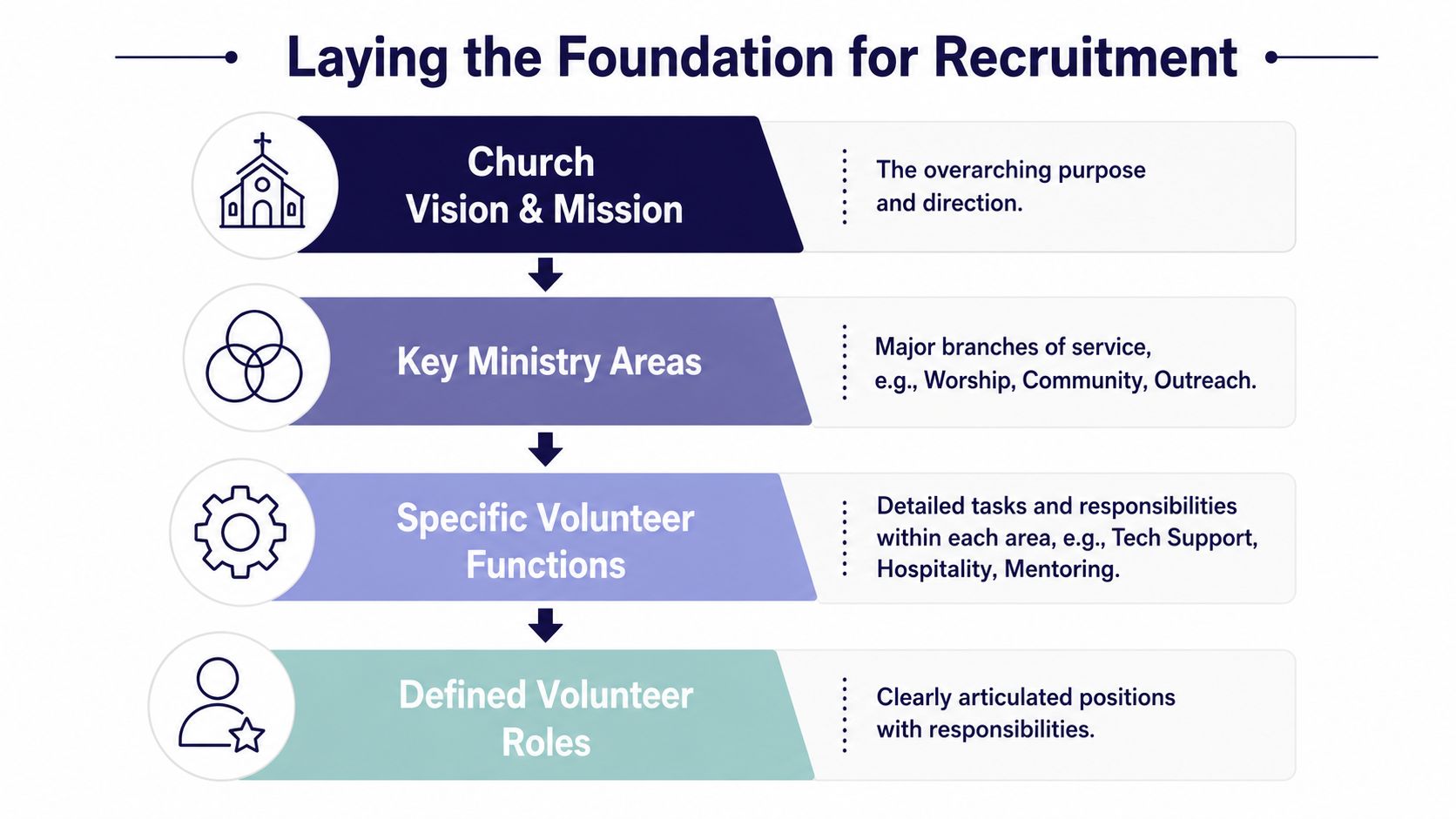
A better approach is to work down this chain:
| Level | Question to answer |
|---|---|
| Church vision | What are we trying to make possible? |
| Ministry area | Which team carries that part of the mission? |
| Function | What specific task supports that team? |
| Role | What will one person actually do, when, and with whom? |
If your church says hospitality matters, that doesn't automatically create a usable role. “First-time guest host for one service each month” does.
Design for the small yes
Modern volunteers often need roles with boundaries. That's why church leadership guidance increasingly recommends four-to-six month cycles and small yes invitations for people with limited time and fragmented schedules, as explained in Logos' guidance on recruiting and retaining church volunteers.
That doesn't mean lowering standards. It means reducing ambiguity.
Here are better role structures than the traditional indefinite ask:
- Seasonal team roles: A hospitality role for a ministry season rather than an ongoing undefined commitment.
- Project-based service: Event setup, photo capture, follow-up calls, or meal coordination tied to a clear window.
- Try-before-you-commit opportunities: Shadow once, then decide.
- Support roles with flexible timing: Prep work during the week that doesn't require being on campus every Sunday.
Practical rule: If a role can't be explained in a few plain sentences, it probably isn't ready to recruit for.
Write the internal role brief first
Before the public-facing invitation, create a one-page internal role brief with these fields:
- Role name: Keep it specific and human.
- Purpose: Why the role matters in ministry terms.
- Core responsibilities: The few tasks that define success.
- Time commitment: How often, how long, and for what season.
- Training needed: What you'll provide before they serve.
- Best-fit traits: Not personality labels, but observable strengths.
- Team lead: Who supports them after they say yes.
This is also where communication alignment matters. If ministry leaders and communications staff are operating from different descriptions, your recruitment language will drift. A practical way to tighten that handoff is to strengthen internal communication habits for church teams before you launch any volunteer push.
Good recruitment starts long before the first public ask. It starts when the opportunity is clear enough that a busy person can see themselves in it.
Crafting Compelling Volunteer Opportunities
Once the role is defined, the next challenge is language. Most churches undersell serving because they write role descriptions like internal task lists.
People don't respond to “Need 4 greeters.” They respond to a meaningful invitation with concrete expectations.

Stop publishing job labels
A public invitation should answer three questions fast:
- Why does this role matter?
- What would I do?
- What commitment am I making?
If any of those answers are missing, interest drops.
Compare the difference:
Weak version
We need volunteers for our welcome team. Sign up today.
Stronger version
Help people feel at home before service begins. Our welcome team serves one service at a time, offers a warm greeting, helps guests find their next step, and works alongside an experienced leader. If you want a practical way to serve people face-to-face, this is a simple place to start.
The second version gives purpose, task clarity, and emotional context. It feels like ministry, not staffing.
Use a simple invitation formula
For church volunteer recruitment posts, slides, and emails, this formula works well:
- Lead with impact
Start with the difference the role makes. - Name the task clearly
Use plain words, not ministry shorthand. - State the boundary
Mention frequency, season, or trial length. - Lower the pressure
Include training, shadowing, or a conversation step. - Give one next step
Don't bury people in options.
A few examples of strong lead lines:
- Help kids feel safe and known on Sunday mornings.
- Make it easier for first-time guests to find their way.
- Support worship services behind the scenes with calm, reliable tech help.
- Use your eye for detail to prepare the room before people arrive.
Match the message to the channel
The same opportunity should be adapted, not copied word-for-word, across your channels.
| Channel | What to emphasize |
|---|---|
| Sunday slide | Short headline and one action step |
| Context, expectations, team leader name | |
| Social graphic | One role, one benefit, one clear invitation |
| Website form | Details, FAQs, and response path |
This matters for events too. If your church already coordinates ministry moments through a central schedule, tying volunteer opportunities to your broader church events calendar workflow keeps the ask timely and easier to repeat.
Visual presentation matters as much as wording. A cluttered flyer with five needs listed at once usually underperforms a single focused graphic. Clean design, one ministry opportunity per asset, and a short call to action are easier to notice and share.
When your communication is clear, your personal asks get stronger too. The volunteer already saw the role, understands the commitment, and isn't trying to decode what you're inviting them into.
Your Multi-Channel Outreach Playbook
It is Thursday afternoon. Two volunteer spots are still open for Sunday, your team chat is quiet, and the bulletin blurb has been running for three weeks with little to show for it.
That is the moment a channel strategy matters.
Strong church volunteer recruitment uses personal invitation and repeated visibility at the same time. One-on-one outreach gets attention because it feels specific. Digital communication keeps the opportunity in front of people long enough for them to respond. If your staff is small, that combination is how you recruit consistently without turning every week into a scramble.

Start with a working list, not a broad announcement
Public announcements have a place, but they work better as support than as the main engine.
A more reliable approach starts with names. One planning rule I have seen work well is building a prospect list that is much larger than the number of open roles. Nick Blevins outlines that approach in this church volunteer recruiting framework. The point is simple. If you need ten volunteers, begin with a real pool of candidates instead of waiting for ten people to raise their hands on their own.
Build that list from people who already have some connection and context:
- Consistent attenders
- Parents and caregivers
- Recent members
- Small-group participants
- Referrals from current volunteers
- People who showed interest before but never got placed
This turns recruitment into a process you can track. You are no longer hoping the right person notices a slide during announcements.
Build outreach in layers
Busy churches usually do not have a messaging problem. They have a sequencing problem.
A practical outreach stack looks like this:
Start with a direct ask
Send a text, email, or make a short in-person ask to a specific person about a specific role.Reinforce it publicly
Put the same opportunity on social, in email, and on Sunday screens so it feels familiar when they see it again.Respond fast
Interest has a short shelf life. If someone replies on Tuesday and hears nothing until Friday, the window starts to close.Offer a low-pressure next step
A short conversation, team huddle, or preview works better than asking someone to jump straight into a serving schedule.
Public communication creates recognition. Direct outreach gets replies.
Use a repeatable weekly content workflow
The time drain is not posting. It is starting over every time.
Churches already have raw material for volunteer recruitment in sermons, testimonies, ministry stories, and upcoming ministry moments. ChurchSocial.ai helps staff turn that material into usable content faster. Teams use it to turn sermon transcripts into social posts and blog drafts, create short video clips, work from editable design templates, and schedule content in a visual calendar. That matters when one communications person is also handling slides, emails, and weekend updates.
A simple weekly rhythm can carry a lot of weight:
- Sunday: Pull a short clip or quote tied to serving, hospitality, or mission.
- Monday: Publish one post that highlights one open role.
- Wednesday: Share a volunteer story, team photo, or behind-the-scenes moment.
- Friday: Post a reminder with one next step and one point of contact.
That cadence keeps the ask visible without making your feed feel repetitive. If the role connects to a seasonal push or ministry event, these effective event marketing tips can help you tighten timing, frequency, and audience focus.
Match the channel to the response you want
Different channels do different jobs. Treating them all the same creates extra work and weaker results.
Text messages work best for personal invitations and quick follow-up. Email gives enough space for role details and expectations. Social media builds familiarity and reaches people who need to see an opportunity more than once before they act. Sunday screens help validate that the need is real and current.
That also means you should not ask every channel to carry the full message. A social post does not need every detail. It needs enough clarity for someone to think, "I could do that," and enough direction to know where to respond.
Sample outreach copy you can adapt
Text message
Hey Sarah, I thought of you for our first-time guest team because you're warm and steady with people. The role is simple and clearly supported. Would you be open to hearing what it looks like?
Subject: A role I think would fit you well
Hi James,
I'm reaching out because I think you'd be a strong fit for our production team. This role supports one service at a time and includes training before you serve. If you'd like, I can send a short overview and answer any questions before you decide.Thanks for considering it.
Social caption
Want a simple way to help people feel seen on Sundays? Our welcome team is opening a few spots for the next ministry season. Clear expectations, practical training, and a team to serve with. Send us a message or stop by the next steps area this weekend.
Protect the time or the system breaks
Multi-channel recruitment sounds manageable until nobody owns the follow-up.
Put prospecting, outreach, and response time on the calendar every week. Even one focused block is enough to keep names moving, messages going out, and interested people from going cold. Churches that recruit well are not less busy. They are more deliberate about the hours they already have.
Onboarding and Equipping New Volunteers
A yes is not the finish line. It's the handoff.
Many churches lose good people in the gap between interest and first serve date. Not because the role was wrong, but because the experience after the yes felt unclear. Silence, slow response, missing details, and vague first-day instructions all create anxiety.
The first week matters most
The new volunteer needs quick confirmation that they made a good decision. That doesn't require a complicated system. It requires sequence.
A simple onboarding path can look like this:
- Send a warm confirmation: Thank them, name the role, and explain the next step.
- Introduce a real person: Give them a team leader name and contact method.
- Share expectations in writing: Arrival time, dress guidelines, where to go, who they'll meet.
- Provide basic training: A short walkthrough is better than a long manual nobody reads.
- Let them observe first when possible: Seeing the role lowers nerves fast.
New volunteers don't need more inspiration first. They need less confusion.
Give them confidence before responsibility
Training should match the role. Don't overbuild the process for simple positions, but don't assume people can read your culture without help.
A parking volunteer may only need a quick pre-service walkthrough and a diagram of traffic flow. A kids ministry volunteer may need a longer process, more shadowing, and clearer policy communication. The principle is the same. Every volunteer should know what success looks like before they are responsible for delivering it.
A useful outside reference comes from workplace learning teams. Even though churches operate differently, some insights for HR and L&D managers on onboarding checklists transfer well, especially the idea that a strong first experience removes uncertainty step by step.
A practical onboarding checklist
Use this as a baseline and adapt it by ministry:
| Stage | Action |
|---|---|
| Immediately after yes | Send confirmation and next-step message |
| Before first serve | Share schedule, location, role summary, and contact person |
| First serve day | Welcome personally and pair with a leader or experienced volunteer |
| After first serve | Follow up with thanks and one check-in question |
| First month | Confirm fit, answer questions, and adjust if needed |
The churches with stronger volunteer cultures usually do ordinary things consistently. They reply quickly. They train clearly. They check in. None of that feels flashy, but it keeps people from drifting away before serving ever becomes life-giving.
Nurturing and Retaining Your Ministry Team
The best recruitment win is the volunteer who wants to keep serving.
Retention doesn't happen through appreciation alone, but appreciation is one of the clearest signals that your church notices people, not just empty roles. It also protects your recruitment pipeline. When serving feels supported and sustainable, current volunteers invite others naturally.
Set realistic expectations for capacity
A common leadership benchmark says a healthy, sustainable volunteer level is around 57% to 65% of average weekly attendance, with a practical ceiling of about 70% because some people can't serve and new people are always entering the church community, as discussed in this church leadership benchmark conversation.
That matters because it changes the goal. You're not chasing total participation. You're maintaining a healthy pipeline, replacing natural drop-off, and caring for the people already serving.
Build a culture people want to stay in
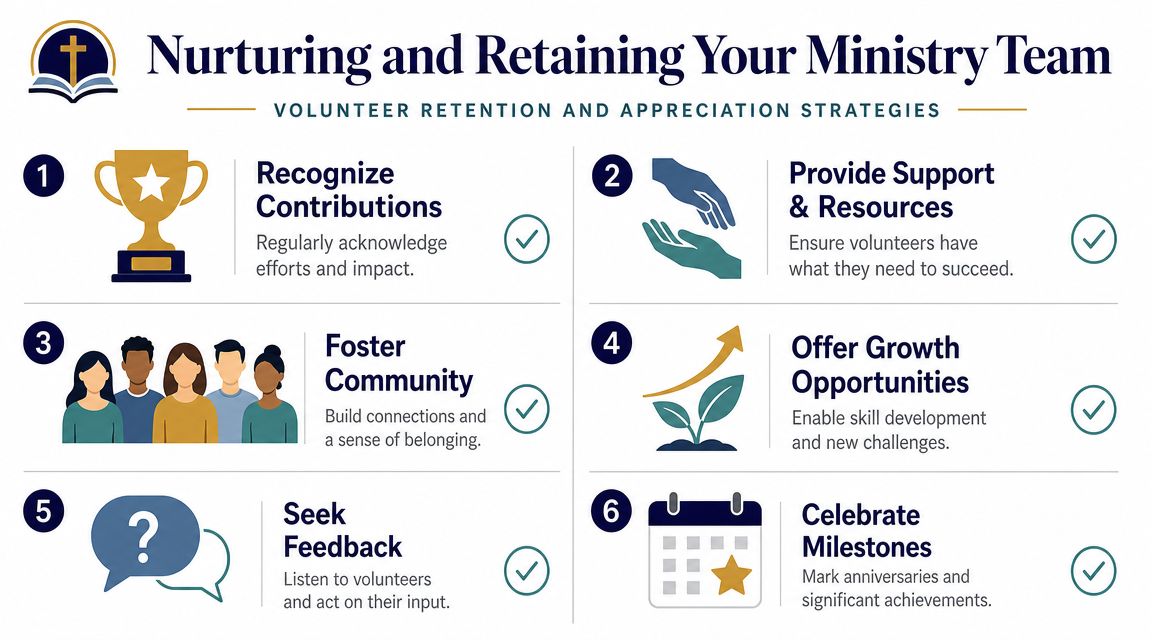
Retention usually improves when churches do six things well:
- Notice faithfulness: Thank people specifically, not generically.
- Ask for feedback: Let volunteers tell you what's confusing, heavy, or working well.
- Prevent overload: Rotate wisely and respect the boundaries you promised.
- Create community: Team belonging keeps people engaged longer than duty alone.
- Mark milestones: First serve, season completion, and ministry anniversaries matter.
- Offer growth: Some people want to mentor, lead, or try a new role over time.
Some workplace thinking around rethinking employee retention methods is useful here too. People stay where support, recognition, and clarity work together. Churches aren't companies, but volunteers still respond to consistent care.
For churches trying to strengthen the long game, these volunteer retention strategies for church teams are worth reviewing alongside your recruitment plan.
Retention is where ministry culture becomes visible. If volunteers feel seen, equipped, and reasonably scheduled, recruitment gets easier because serving becomes something people recommend instead of something leaders keep rescuing.
If your team is trying to recruit volunteers without adding another weekly scramble, ChurchSocial.ai can help you turn sermons, events, and ministry needs into scheduled social posts, reels, graphics, and blog content from one calendar. That makes it easier to keep volunteer opportunities visible, timely, and consistent while your staff stays focused on people.