A great sermon outline is more than just a list of talking points; it's the architectural blueprint for your message. It's the process of taking a deep dive into a biblical passage, pulling out that one core idea, and then building a solid structure around it—complete with key points, compelling stories, and real-world application.
A solid outline doesn’t fence you in. It frees you up to deliver a message with clarity and power.
The Blueprint for a Spirit-Led Message
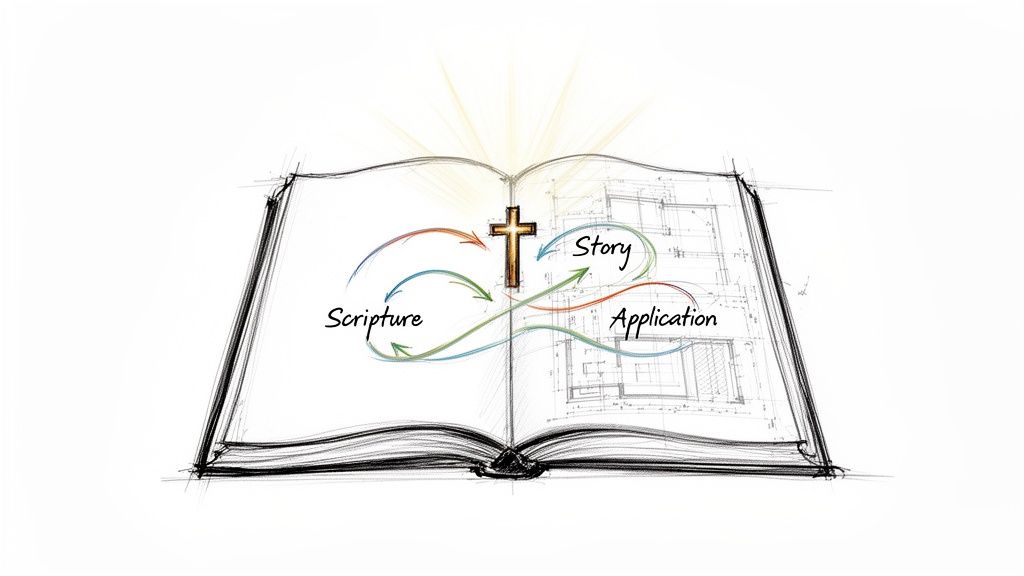
We’ve all been there—staring at a blank page on a Tuesday, knowing Sunday is just around the corner. It can be intimidating. But what if we saw the outline not as a chore, but as the foundational plan for a message that connects, convicts, and inspires real change?
That shift in perspective turns outlining from a rigid task into a dynamic act of spiritual preparation.
A well-crafted outline becomes your roadmap. It ensures every story you tell, every scripture you reference, and every application point you make is placed with intention. This structure helps you build momentum, guiding your listeners on a journey that leads to a powerful conclusion.
From Blank Page to Clear Path
For many pastors, the toughest part of sermon prep is bridging the gap between deep study and a final manuscript. The secret is to view your outline as a tool for freedom, not a cage. When you know exactly where you’re going, you can be more present and authentic in the pulpit, free to follow the Spirit’s leading without ever losing your core message.
This framework is what helps organize all those thoughts swirling in your head after hours of prayer and study. If you're looking to go deeper into letting the text shape your message, our guide on expository sermon preparation is a great resource for that.
A great sermon outline achieves two critical goals: it honors the truth of the biblical text and it connects that truth to the real-world needs of your congregation. It’s the bridge between ancient wisdom and modern life.
Beyond Sunday Morning
The work you put into a strong outline pays dividends long after the service ends. A clear, well-organized sermon isn't just easier to deliver—it's also a goldmine of content for your church’s social media all week long.
Think about it: your sermon's main points, illustrations, and takeaways are already perfectly organized. This makes it incredibly simple for your team to create engaging content. For instance:
- Main Points as Social Posts: Each major section of your outline can easily be turned into a thoughtful social media post or a carousel.
- Illustrations as Video Clips: That compelling story you shared? It’s the perfect raw material for a short, shareable video reel.
- Application Questions for Engagement: The practical steps in your conclusion are ideal for sparking conversations on Facebook or Instagram.
Using a tool like ChurchSocial.ai makes this process even smoother. With ChurchSocial.ai, you can create AI-generated reels from your sermons and generate content like social posts and blogs directly from the sermon transcript. You can also use our graphic templates and editor to create and post photos and carousels. Our simple drag-and-drop calendar allows churches to easily manage and update all of their social media, turning your sermon prep into a sustainable system for keeping your community engaged seven days a week.
Finding Your Sermon's One Big Idea
Every truly memorable sermon—the kind that sticks with people long after they’ve headed home—is built around a single, powerful idea. This isn't just a broad topic like "grace" or "forgiveness." It's a sharp, portable truth that grabs the entire message and makes it stick.
Think of it as the North Star for your sermon. Every story you tell, every point you make, and every application you draw should point directly back to this one central theme. Without it, a sermon can easily become a collection of interesting but disconnected thoughts, leaving your listeners confused about what they were supposed to take away.
From Biblical Text to Actionable Truth
Discovering your Big Idea starts way before you ever type "Point 1" into your outline. It begins with prayerful, thoughtful study of a specific biblical passage. The goal here is to move from the wide-angle view of the text to a laser-focused principle—the main truth God is communicating through those verses.
You have to ask some deep questions of the scripture:
- What's the main subject here?
- What is the author really saying about that subject?
- Why did this matter to the original audience, and why does it still matter for us today?
Once you’ve boiled it down to a timeless theological principle, your next move is to translate it into a modern, relatable statement. This statement should connect with a real-world tension or question your congregation is wrestling with.
The goal isn't just to explain a biblical concept. It's to deliver a powerful truth that answers a question people are actually asking, even if they don't know how to put it into words.
Let's say you're studying Ephesians 2. The theological principle is that salvation is by grace through faith. That's true, but it's not quite a Big Idea yet. To make it land, you could frame it as: "God's grace isn't just a safety net for your past; it's the fuel for your future." See the difference? This version is actionable, memorable, and pushes back against the common idea that grace is just a passive thing.
Making Your Message Connect
Nailing down a single, relevant Big Idea has never been more critical. Research from Barna Group's State of the Church report shows a fascinating trend: U.S. church attendance is back up to 32% after dropping from 48% in 2009 to a low of 28%. A key factor in this rebound? Sermons that are culturally relevant and speak to real life. This is especially true for younger generations, with Millennial participation up by 18% and Gen Z volunteering at 21%. You can check out all the latest church engagement trends in the full report.
This anchor point is the foundation for everything else in your sermon outline. Once you have it, the rest of the structure starts to fall into place, supporting and delivering that one truth with clarity and power.
Your Big Idea also becomes the engine for your weekly content strategy. When you have a clear, compelling message, creating social media content that reinforces it becomes so much easier. Imagine turning that Big Idea into a sharp graphic for Instagram or a short video for TikTok.
With a tool like ChurchSocial.ai, you can drop in your sermon transcript and instantly get social posts, carousels, and even AI-generated reels that echo your core message. Our templates and simple calendar help you plan a whole week of content that keeps the conversation going, all centered on that one powerful truth you shared on Sunday.
Now that you have your Big Idea, you need a framework to build around it. There are a few classic structures that work really well.
Comparing Popular Sermon Outline Structures
Choosing the right structure depends entirely on your text and your Big Idea. Some passages lend themselves to a simple, direct approach, while others need a more narrative or problem-solving framework. Here’s a quick breakdown of three effective sermon outline structures to help you pick the best one for your message.
Each of these frameworks gives you a reliable blueprint. Don't feel locked into one forever—the best communicators learn to switch between them depending on what the message calls for. Pick the one that feels most natural for the Big Idea you’re trying to land.
Choosing a Structure That Serves Your Message
Okay, you’ve wrestled with the text and nailed down your Big Idea. Now it's time to build the scaffolding that will hold it all together. The structure of your sermon isn't just about organizing your points; it's about taking your listeners on a journey that feels natural and makes sense.
Think of it like building a house. The Big Idea is your foundation. But the framework—the walls, rooms, and roof—is what makes it a home people can actually live in and move through. Get the structure right, and the message clicks. Get it wrong, and even the most profound truth can feel confusing.
The Expository Structure
The expository outline is a classic for a reason. It lets the biblical text drive the sermon from start to finish. You’re not imposing a structure onto the passage; you're discovering the structure that's already there.
If you’re preaching through a story in Genesis or a chapter in Romans, the natural breaks in the text become the main points of your message. It’s an incredibly powerful way to do deep-dive Bible teaching. For example, preaching on Philippians 4:4-9, your outline might naturally break down into:
- The Command to Rejoice (vv. 4-5)
- The Antidote to Anxiety (vv. 6-7)
- The Focus for Our Minds (vv. 8-9)
The key here is to show your work. You're not just telling your congregation what the Bible says; you're teaching them how to see it for themselves.
The Topical Structure
While an expository sermon camps out in one passage, a topical outline pulls from multiple scriptures to tackle a specific subject or question. This is a game-changer for addressing the real-world issues your congregation is facing—things like parenting, anxiety, or finding purpose.
Let's say you're preaching a topical sermon on "Finding Rest in a Busy World." Your outline could be built around key verses from different parts of the Bible:
- Point 1: The Command to Rest (Exodus 20:8-10)
- Point 2: The Example of Rest (Mark 6:31)
- Point 3: The Promise of Rest (Matthew 11:28-30)
This approach helps people see a cohesive biblical perspective on a single issue. The main challenge? Making sure every verse is handled in its proper context and genuinely supports the sermon's Big Idea.
The Narrative Structure
Sometimes, the best way to get a point across is to simply tell a good story. A narrative outline immerses your listeners in a biblical account, letting the truth unfold through the plot, characters, and conflict.
Instead of laying out three points on courage from the story of David and Goliath, you walk people through the story's arc. You start with the impossible challenge, move to the dismissal by authority, build to the moment of faith-filled action, and land on the surprising victory. The Big Idea—that God’s power shines brightest in our weakness—emerges from the story itself.
This little flowchart can help you visualize how to find that core idea, no matter which structure you end up using.
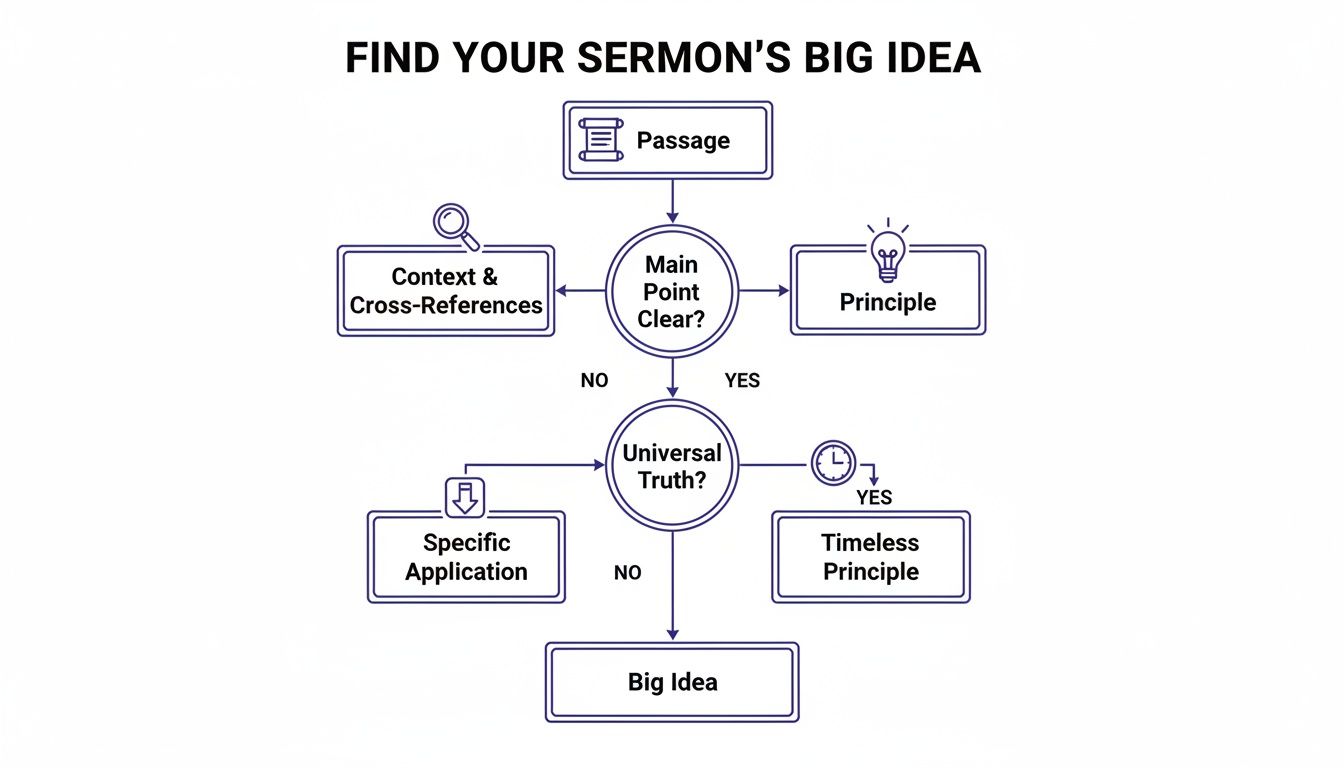
This process keeps you anchored to a singular, powerful truth from Scripture, regardless of the path you take to get there.
No matter which structure you choose, the transitions between your points are what create a smooth, logical flow. A good transition doesn't just say, 'My next point is...' It shows how the next idea builds on the previous one, guiding your listeners step by step.
Ultimately, this is all about keeping people engaged. A recent Pew Research analysis found the median sermon length to be around 5,500 words, which takes about 37 minutes to deliver. A tight, logical outline is absolutely essential to hold attention for that long. You can explore the full research on modern sermon lengths to see just how critical structure really is.
Once you’ve preached your sermon, its life is just getting started. This is where your outline becomes a content-creation machine. With a tool like ChurchSocial.ai, you can plug in your sermon transcript and instantly generate social media content. Imagine your expository points becoming a carousel, your topical sermon becoming a blog post, or a key moment from your narrative sermon becoming an AI-generated reel—all done in just a few minutes, extending the impact of your Sunday message all week long.
Bringing Your Outline to Life
An outline gives your sermon a skeleton, but the content you pour into it gives the message its heart and soul. This is where you move beyond a logical progression of points and start crafting a memorable, life-changing encounter with God's Word. It's the art of bridging the gap between an ancient text and our modern world, ensuring your congregation doesn't just hear the truth but actually feels it.
To do that, you have to think beyond simply explaining the scripture. The magic happens when you connect the dots with illustrations, personal stories, and cultural touchpoints that resonate with your listeners' everyday lives. This is how abstract theology becomes concrete, relatable truth.
Sourcing and Integrating Illustrations
Think of illustrations as the windows of a sermon—they let the light in. You can find them anywhere: current events, a piece of history, a scientific discovery, or even a simple story from your own life. The only rule is that the illustration has to serve the main point, not become a distraction.
- Personal Stories: Nothing connects like authenticity. Sharing a personal struggle or a moment of clarity that ties into the passage can build a powerful bond with your listeners.
- Cultural Touchpoints: Referencing a popular movie, song, or event can make your message feel immediate and relevant, showing how timeless truths speak directly to our contemporary culture.
- Historical Examples: Stories of faith from church history or even major world events can add weight and perspective, reminding people they’re part of a much larger story.
My advice? When you find a good story, write it out fully in your notes. This little step helps you trim the fat, find the punchline, and get a feel for how much time it will actually take to tell. A well-told story feels natural, not rehearsed.
Placing Strategic Application Points
One of the biggest mistakes I see preachers make is saving all the "what to do" stuff for the last two minutes. When you do that, you're unintentionally training your congregation to tune out until the very end.
Instead of one big call to action, try sprinkling practical application throughout the entire message. Attach a "so what" to each of your main points, challenging your listeners with small, actionable steps along the way.
For a point on forgiveness, the application might be, "This week, who is one person you can start praying for instead of resenting?" This approach transforms the sermon from a lecture into an ongoing dialogue with the Holy Spirit, prompting reflection and action in real time. These smaller prompts build momentum toward your final, overarching call to action.
Embedding Delivery Cues
Your outline is more than just a list of things to say; it’s your script for an engaging encounter. To really elevate your delivery, try embedding cues directly into your manuscript. This isn't about being robotic—it's about being intentional.
You can add simple notes in parentheses or even a different color:
- (PAUSE) – Give a key statement room to breathe and land.
- (Softer Tone) – Create intimacy for a personal story.
- (Look Up / Make Eye Contact) – Remind yourself to connect with faces, not just your notes.
- (Ask Reflective Question) – Prompt a moment of silent, internal response.
These little reminders turn your notes from a safety net into a powerful communication tool, helping you use your voice, pacing, and presence to amplify the message.
Finally, remember that the impact of these elements can extend way beyond Sunday. A powerful illustration is perfect for a short social media video. A compelling application point can become a thought-provoking graphic. To see how this works, check out our guide on creating effective church sermon graphics.
With ChurchSocial.ai, you can easily use our graphic templates and editor to create and post engaging photos and carousels that reinforce these key sermon moments, keeping the message alive all week long.
Turn Your Sermon Outline Into a Content Engine
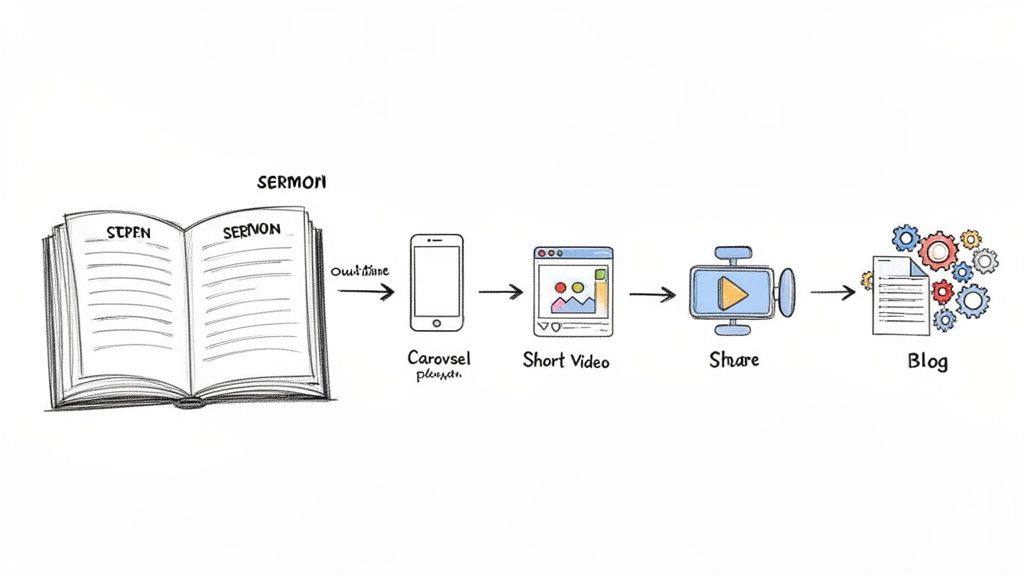
The life of your sermon shouldn't stop when the last "amen" is spoken. A well-built outline is far more than a preaching guide; it’s a content goldmine, just waiting to fuel your church’s social media all week long.
When you start seeing your outline through this lens, sermon prep becomes something bigger. It transforms into a sustainable system for creating meaningful content. The whole mindset shifts from, "What am I going to say on Sunday?" to "How can this message serve our community for the next seven days?"
And the best part? You've already done the heavy lifting. The core ideas, the powerful quotes, and the practical next steps are all sitting right there in your notes.
Mining Your Outline for Digital Gold
Before you even think about stepping into the pulpit, take a few minutes to scan your finished outline with an eye for shareable content. Look for those short, punchy statements or probing questions that can stand on their own.
You’re basically hunting for these key elements:
- Powerful Quotes: Is there one sentence that perfectly sums up your Big Idea? Pull it out. That’s your tweet.
- Key Takeaways: What are the 2-3 main points you absolutely want people to remember? That’s a perfect Instagram carousel.
- Discussion Questions: What questions did you bake into the sermon itself? Repurpose them to spark a real conversation on Facebook.
- Compelling Stories: That personal anecdote or historical illustration you’re sharing? It’s ideal for a short video clip.
This one small step during your prep work empowers your communications team—or even a dedicated volunteer—to have a week's worth of content ready to fly, all of it reinforcing what you shared on Sunday.
The goal is to move from a single event (the Sunday sermon) to a week-long conversation. Your outline provides the script for that entire conversation, not just the first part of it.
Embracing Technology to Amplify Your Message
Technology can make repurposing your content incredibly simple. Platforms like ChurchSocial.ai were designed for exactly this workflow. Imagine just dragging and dropping your sermon transcript and letting AI handle the rest.
With a tool like ChurchSocial.ai, your church can:
- Generate Social Posts: Instantly create captions, posts, and even blog articles from your sermon content.
- Create AI-Generated Reels: Turn powerful moments from your sermon into short, engaging video clips. We actually break down that whole process in our guide to turning a sermon into a video.
- Design Branded Graphics: Use professionally designed templates and a simple editor to create stunning photos and carousels that match your church's brand.
- Manage Your Calendar: Use our simple drag-and-drop calendar to easily manage and update all of your social media. We also integrate with Planning Center and other church calendars to create content for events.
This kind of system takes all the pressure off your team. Instead of staring at a blank screen on Monday morning, they have a rich well of sermon-based content to draw from. If you really want to unlock this potential, it’s worth learning how to repurpose content for all the different places you’ll be sharing it.
A Sustainable System for Digital Discipleship
When you integrate content planning directly into your sermon preparation, you create a seamless and sustainable workflow. It guarantees your church's online voice is always authentic, consistent, and directly tied to the spiritual journey you're leading your people on.
This turns sermon prep into the very engine that drives your entire digital outreach, keeping your community connected and engaged with the heart of your ministry all week long.
Answering Your Sermon Outlining Questions
As you get more comfortable building sermon outlines, you're bound to run into a few questions. Every pastor has their own unique style, but some common hurdles pop up for just about everyone. Let's tackle a few of the most frequent questions I hear from ministry leaders.
Getting these figured out will help you step into the pulpit with more confidence each week.
How Detailed Should My Sermon Outline Be?
Honestly, there’s no magic formula here. The right amount of detail comes down to your personal preaching style and what makes you feel most prepared.
Some pastors are masters of the minimalist, one-page outline. They just need the Big Idea, their main points, and the key scriptures. This gives them a ton of freedom to be flexible and conversational during the message.
On the other hand, plenty of communicators prefer a much more detailed "phrase outline" or even a full manuscript. They write out every illustration, every transition, and every application point. This approach provides a huge sense of security, ensuring nothing important gets missed.
If you're just starting out, aim for a happy medium. Create an outline that feels like a reliable safety net, not a restrictive script. It’s always better to have a little more material than you need, but give yourself permission to follow the Spirit’s leading in the moment. Your outline is there to support you, not suffocate your sermon.
A great sermon outline is detailed enough to give you confidence but flexible enough to let you be authentic.
What Are the Best Tools for Creating Sermon Outlines?
Pastors have never had more options. You can find people using everything from classic word processors to the latest note-taking apps.
- Classic Software: You can't go wrong with Google Docs or Microsoft Word. They're familiar, powerful, and get the job done.
- Note-Taking Apps: Tools like Evernote, Apple Notes, or Notion are fantastic for keeping all your research, random thoughts, and sermon series organized in one spot.
The real game-changer, though, isn't just the tool you use to write the outline, but what you can do with it after Sunday. This is where a tool built for ministry really shines.
For instance, with a platform like ChurchSocial.ai, your sermon prep becomes the fuel for your entire week's content. Its AI can take your sermon transcript and instantly generate social media posts, create shareable graphics from professional templates, and even produce AI-generated reels. Our simple drag-and-drop calendar allows your church to easily manage and update all of its social media. Suddenly, your outline isn't just for Sunday—it’s the start of a week-long discipleship journey for your church.
How Do I Make My Sermons More Practical?
Real, life-changing application begins long before you write a single point. It starts with listening. Spend your week paying attention to the struggles, joys, and real questions your congregation is wrestling with. Your sermon should feel like a direct, caring response to those conversations.
As you’re studying the text, keep asking one simple question: "So what?" Why does this ancient truth matter to someone sitting in traffic on Monday morning?
Weave that practical application into every single point of your sermon, not just as an afterthought in the conclusion. Try using active, encouraging verbs in your sub-points. Instead of a bland heading like "The Importance of Generosity," reframe it as something like, "A First Step to Generosity When Your Budget is Tight." That simple shift makes the idea feel immediately accessible.
How Can I Avoid My Sermons Sounding Formulaic?
Feeling like you're stuck in a preaching rut? It happens to all of us. The best way to break out is to intentionally mix things up.
A simple strategy is to alternate your sermon structure. If you just finished a long, deep-dive expository series, maybe follow it up with a short, highly practical topical series on a felt need like parenting or anxiety. Try out different outline frameworks, too. One week, tell a story using a narrative outline; the next, tackle a tough question with a problem-solution format.
Also, look for fresh illustration sources. Pull from history, science, pop culture, and your own life to keep your content from feeling stale. Don't be afraid to collaborate with your team or other pastors, either. A fresh set of eyes can help you break out of a creative jam and see the text in a whole new way.
Your sermon outline is the engine for a powerful Sunday message and a week of meaningful social media engagement. ChurchSocial.ai gives you the tools to make that happen effortlessly. From transforming your sermon transcript into AI-generated reels and social posts to providing beautiful graphic templates and a simple drag-and-drop calendar, we help your church plan and manage all its social media accounts. Start extending the reach of your message today at https://churchsocial.ai.