You were told five minutes before the service. Or the small group leader texted you at the last minute. Or the pastor looked your way and said, “Would you open us in prayer?”
That moment can make even steady volunteers feel exposed. The struggle isn't typically with prayer itself, but with public prayer. Private prayer is personal and unfiltered. Leading in prayer means guiding other people so they can join you, not just listen to you.
That's a learnable ministry skill. It isn't reserved for pastors, seminary graduates, or the person with the calmest voice in the room.
Why Leading Prayer Matters More Than Ever
Prayer is still common in American life, but it isn't as frequent as it used to be. A 2025 Pew Research Center study found that daily prayer has fallen 14 percentage points since 2007, from 58% to 44% of Americans in Pew's report on prayer and other religious practices. That matters for churches because when personal prayer habits weaken, corporate prayer carries more formative weight.
A well-led prayer does more than fill a transition. It teaches people how to approach God together. It gives language to grief, gratitude, confession, and dependence. In many churches, that moment may be one of the few times in a week when someone hears a mature, grounded example of biblical prayer spoken aloud.
The volunteer role is bigger than many churches admit
Many churches still treat leading in prayer like a clergy function. Real life looks different. Volunteers open services, lead small groups, host prayer nights, facilitate student gatherings, and guide online moments. If churches want prayer to stay woven into congregational life, they need more people who can lead it clearly and effectively.
That's also why supporting resources matter. Churches that produce devotionals, prayer guides, or discipleship materials often look for visual tools that fit a ministry setting, which is where BeYourCover's spirituality book designs can be useful when a team is packaging prayer-focused content for classes or church reading plans.
Public prayer should sound like a church praying together, not a private journal read into a microphone.
If your church is also trying to help members carry prayer beyond the service, a digital tool like a church prayer wall can extend that shared habit into the week. The point isn't replacing gathered prayer. It's reinforcing it.
Preparing Your Heart and Mind to Lead

Nervousness usually comes from a simple mistake. You think your job is to sound spiritual. It isn't. Your job is to help the room turn its attention to God.
That shift changes everything. Instead of asking, “How do I do well?” ask, “How do I serve these people faithfully in this moment?” That question lowers the temperature and sharpens your focus.
Recent church leadership writing has pointed out a real gap here. Many guides assume a trained clergy member is leading, but volunteers often need coaching on public prayer as a teachable skill, including pronouns, brevity, and how not to drift into a mini-sermon, as discussed in this reflection on leading in prayer for gathered worship.
Prepare privately before you speak publicly
Don't walk into public prayer cold if you can help it. Even two quiet minutes beforehand can steady your thoughts.
A simple preparation rhythm works well:
- Pray your own short prayer first. Ask for humility, clarity, and love for the people you're leading.
- Name the purpose of the moment. Opening prayer, response prayer, prayer for the sick, prayer after the sermon, commissioning prayer. Each has a different weight.
- Choose one or two focal points. More than that usually creates rambling.
- Decide your first line. Starting is the hardest part. If you know your first sentence, the rest usually follows.
- End before you feel finished. Most public prayers improve when they are slightly shorter.
Manage the pressure in practical ways
Some volunteers assume confidence means feeling no fear. In ministry, confidence usually means knowing what to do while your heart is still beating fast.
Try these simple habits:
- Stand still first. Plant your feet before you speak. Physical steadiness helps verbal steadiness.
- Take one full breath. Not a dramatic pause. Just enough to slow your pace.
- Lower your volume slightly. People often speed up when they get loud.
- Keep your eyes soft. If closing your eyes makes you lose your place, don't force it.
- Use notes if needed. Notes are a support, not a failure.
Practical rule: Private prayer can wander. Public prayer should guide.
Know the difference between sincerity and spontaneity
Some people think written preparation makes prayer less authentic. That's not true. Prepared prayer can still be heartfelt. Unprepared prayer can still be self-conscious and scattered.
Leading in prayer isn't about displaying your devotional life. It's pastoral work in miniature. You're carrying the room with you.
Simple Frameworks for Structuring Any Prayer
A structure doesn't make prayer mechanical. It makes prayer usable. When volunteers freeze, it's rarely because they lack faith. It's because they lack a map.
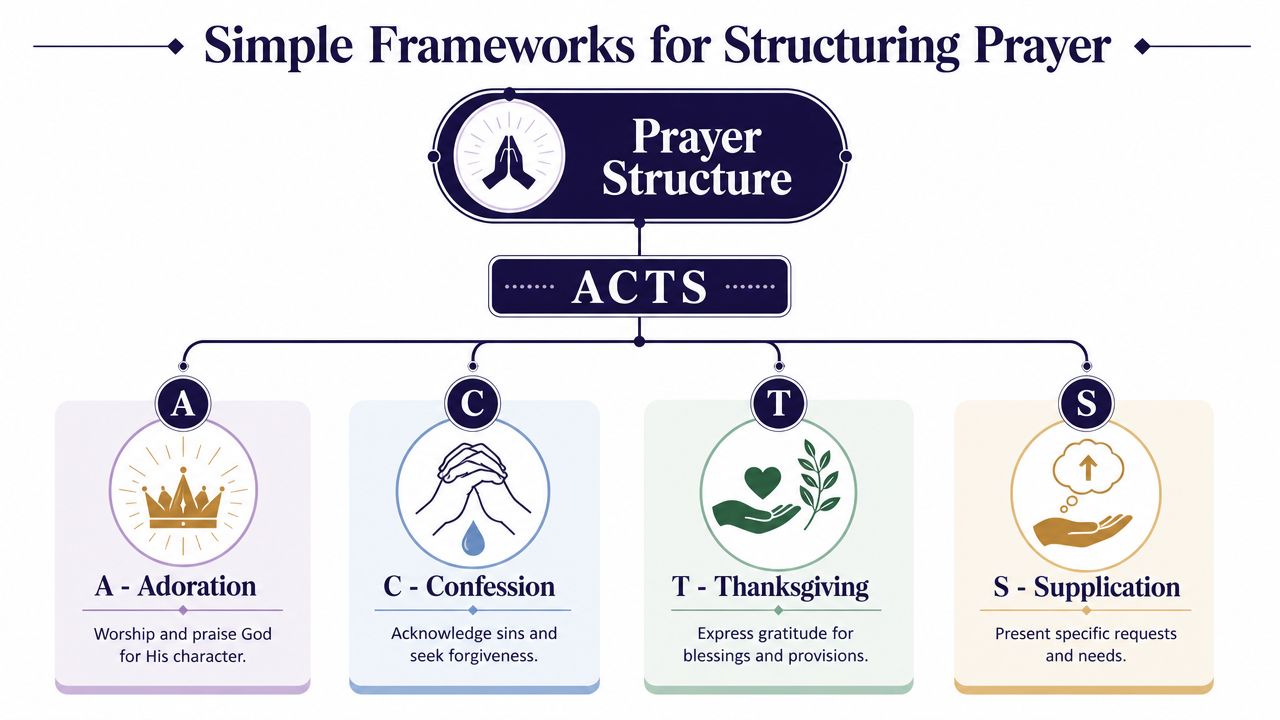
One of the most practical methods for group prayer is using a fixed framework like ACTS and speaking in corporate language like “we,” “us,” and “our,” which helps focus the prayer and keeps it from rambling, as explained in Crossway's guidance on how to lead prayer with clarity and participation.
Use ACTS when you don't know where to begin
ACTS stands for Adoration, Confession, Thanksgiving, and Supplication. You don't need to use every part every time with equal length. The framework keeps your prayer balanced.
| Part | What it does | Sample direction |
|---|---|---|
| Adoration | Starts with God's character | “Lord, You are holy, wise, and kind.” |
| Confession | Names sin and need honestly | “We confess our distraction, pride, and unbelief.” |
| Thanksgiving | Expresses gratitude | “We thank You for Your mercy and daily care.” |
| Supplication | Brings requests | “We ask for help, healing, wisdom, and endurance.” |
Make the language congregational
In this capacity, many volunteers improve quickly. If you're leading a room, don't pray as if no one else is there.
Instead of:
- “I just want to thank You for what You've done in my life.”
- “Help me to trust You more this week.”
Try:
- “We thank You for Your faithfulness to us.”
- “Help us trust You in the week ahead.”
That one adjustment makes the prayer feel shared. It invites participation without requiring everyone to speak.
If you want a biblical model for prayer that is both profoundly personal and profoundly communal, The Bible Seminary's study of John 17 is a helpful resource. John 17 shows how weighty prayer can be without becoming cluttered.
A short example you can adapt
Here's what a simple ACTS prayer might sound like in a service:
Father, we praise You because You are good, steady, and merciful. We confess that we've often been distracted and self-reliant. Thank You for meeting us with grace again today. As we hear Your Word and respond to You, give us soft hearts, clear minds, and willing obedience. Help us care for one another well this week. In Jesus' name, amen.
That prayer is not fancy. It is clear, God-focused, and easy for a congregation to follow.
What doesn't work
A few habits weaken public prayer fast:
- Too many themes. If you mention every ministry need in the church, the room loses focus.
- Explanatory praying. Don't teach the audience while pretending to pray.
- Performative language. If you'd never say it in normal speech, don't say it because a microphone is involved.
- Long introductions. Start praying. Don't circle the runway.
Speaking with Clarity Inclusivity and Authority
The sound of a prayer matters. Not because prayer is a performance, but because people need to understand and follow what you're saying. A clear prayer helps people participate. A muddy one leaves them observing from a distance.
Authority in prayer doesn't come from volume or religious phrasing. It comes from calm conviction. Speak like someone who believes God hears and the room belongs in the conversation.
Choose words ordinary people can carry
Simple language is not shallow language. In most church settings, plain speech is stronger than ornate speech.
A helpful style guide looks like this:
- Use concrete language. Say “comfort those who are grieving” instead of abstract filler.
- Prefer short sentences. They're easier to hear and easier to join.
- Name shared realities. Work, family strain, illness, repentance, fear, hope, mission.
- Avoid insider shorthand. Not everyone in the room knows your theological vocabulary.
- Keep Scripture-shaped language. Biblical themes help anchor the prayer without turning it into a lecture.
If people are mentally editing your phrasing, they're no longer praying with you.
Inclusivity starts with awareness
Inclusive public prayer doesn't mean flattening conviction. It means recognizing who is in the room. Some people are mature believers. Some are new to church. Some are grieving. Some are doubting. Some are carrying private pain no one else can see.
That affects your wording. For example, don't assume every family is thriving, every parent is encouraged, or every holiday is joyful. Broader phrasing often serves people better.
A few helpful swaps:
| Less helpful | More helpful |
|---|---|
| “Thank You that all of us are doing well” | “Meet each person in the place they're carrying need today” |
| “We know this week will be easy because You are with us” | “Be with us in the burdens and responsibilities ahead” |
| “Help those people out there” | “Help us love our neighbors with compassion and courage” |
Brevity is part of pastoral care
Most public prayers should end sooner than the speaker wants. Long prayers often shift from leadership into self-expression.
Keep these trade-offs in mind:
- A short, focused prayer often lands better than a long, wide one.
- A gentle pause can feel reverent. Repeated pauses can feel uncertain.
- A clear ending helps the room say amen together. Drifting endings don't.
If you get emotional, that's not failure. Slow down, breathe, and continue if you can. If you need to stop briefly, stop briefly. People usually receive sincerity with more grace than the person praying expects.
Adapting Your Leadership to Different Contexts
Different settings call for different instincts. The core task stays the same, but the shape changes. A Sunday service opening prayer, a living room prayer circle, and an online prayer moment should not sound identical.
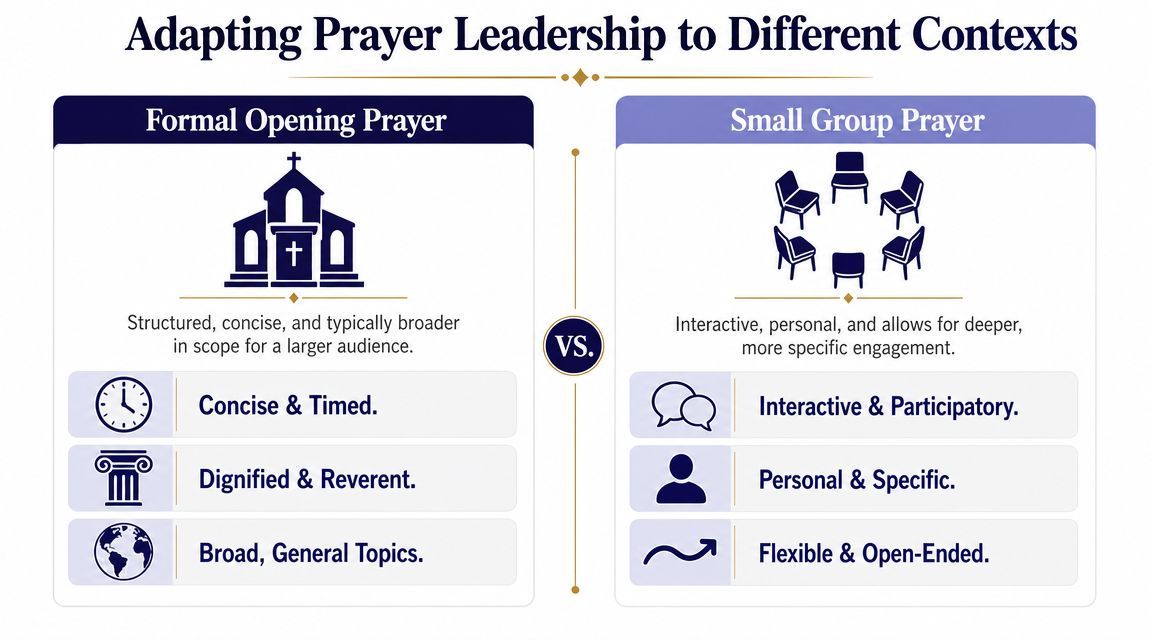
Ministry training on prayer meetings recommends private preparation first, then structured group elements such as Bible-based prayer, silent prayer, or breakout groups, with the leader managing timing and transitions so the gathering stays coherent, as outlined in Cru's guide to planning and leading prayer meetings.
In corporate worship
A formal service prayer should be clear, concise, and broad enough to gather the whole room. You're not trying to cover every concern. You're setting a shared direction.
What works well:
- Name the moment. Opening worship, confession, offering, response, sending.
- Keep the tone steady. Reverent doesn't mean stiff.
- Watch the clock. Services have flow. Respect it.
- Use the microphone well. Speak across the mic, not into it harshly. Test your distance before the service if possible.
What tends to fail:
- Wandering into announcements.
- Preaching another sermon inside the prayer.
- Overexplaining what prayer is about before you start praying.
In a small group
A small group gives you more flexibility, but it also requires more attentiveness. People may share needs awkwardly, hesitate to speak, or dominate the time.
Good leadership here is less about eloquence and more about facilitation.
Try this approach:
- Open with a brief centering prayer.
- Give a clear invitation for people to share needs.
- Name the participation pattern. One person prays at a time, sentence prayers, or leader-led prayer.
- Use silence on purpose. A short quiet moment helps people gather their thoughts.
- Close the loop. End by summarizing key themes before the final amen.
For groups that need conversation starters before prayer, these discussion questions about prayer can help move people from vague updates into meaningful requests.
Online and livestream settings
Online prayer changes one major factor. You don't get much room feedback. No nods. No audible amens. Often no visible faces.
That means you have to lead with extra intentionality.
- Look at the camera when possible. It helps people feel addressed.
- Shorten your phrasing. Audio lag and distraction punish long sentences.
- State transitions clearly. “Let's pray together” matters more online than in a room.
- Check audio first. Bad audio makes even a strong prayer hard to follow.
- Give response cues. Invite people to comment, pause, or pray with family members at home.
Online prayer needs more verbal signposts because people can't read the room with you.
In each setting, adjustment is the skill. Strong prayer leaders don't use one tone everywhere. They read the room, serve the moment, and keep the focus on God.
Keep the Conversation Going with ChurchSocial.ai
A volunteer leads prayer on Sunday with real clarity. By Tuesday, the church has already shifted to announcements, logistics, and next week's prep. The prayer was sincere, but it had no pathway into the rest of the week.
That gap is common. It is also avoidable.
If a church prays around a sermon theme, a season of grief, a missions focus, or a call to repentance, the follow-up should carry the same pastoral direction. People rarely absorb a prayer emphasis in one moment. They need simple prompts they can revisit at home, in small groups, and during the week.

ChurchSocial.ai helps churches turn sermon transcripts and ministry themes into social posts, blogs, and short-form video drafts. It also includes templates, a graphics editor, and a drag-and-drop calendar, which helps a volunteer team keep prayer-related communication organized instead of improvising every post.
That matters more than many churches expect. Strong prayer ministry is not only about what happens at the microphone. It also includes how prayer requests are gathered, how themes are repeated, and how people are invited to respond after the service. For churches building that system, a church prayer request box can help create a clearer intake process for member care.
A workable rhythm can stay simple:
- Sunday afternoon. Share one short takeaway from the prayer focus or sermon.
- Midweek. Post a brief prompt people can use in personal or family prayer.
- Before the next gathering. Reinforce one verse, one need, or one response point.
- Ongoing. Keep prayer requests visible to the right leaders so follow-up does not depend on memory.
The trade-off is real. More follow-up content creates more work for staff and volunteers. But without a simple system, churches often lose pastoral continuity, and prayer becomes something people heard rather than something they kept practicing.
Keep the tone pastoral. Write plainly. Choose language people can pray, not language that only fills a content calendar. If volunteers need help strengthening their own prayer life while they learn public leadership, this guide on how to learn how to pray is a useful companion to steady practice in the local church.
Answers to Common Questions About Leading Prayer
How long should a public prayer be
Long enough to be meaningful, short enough to stay focused. In most settings, shorter is better than longer. If you're unsure, trim.
Is it okay to use notes
Yes. Notes help many volunteers stay clear and calm. Use phrases or a simple outline so you don't sound like you're reading a speech.
What if I get emotional
Slow down. Take a breath. Continue if you can. A brief pause is fine. Honest emotion is not the problem. Losing clarity is the problem.
How do I handle silence
A short silence can help people pray. An unplanned silence can feel uncertain. If you're using quiet intentionally, say so out loud.
What if I don't feel experienced enough
Experience helps, but clarity and humility matter more. If you want to keep growing in personal prayer as well as public prayer, this guide on how to learn how to pray may be useful alongside regular practice in your local church.
What should I avoid every time
Avoid jokes, filler phrases, mini-sermons, and language that centers you instead of the congregation. Pray to God, not at the audience.
Churches that want to carry prayer themes beyond the service can use ChurchSocial.ai to organize sermon-based content, schedule social posts, and keep communication aligned with the church calendar so the conversation continues after the amen.