At its core, multi-channel marketing is simply about using several different, independent platforms to share your church’s message and connect with your community. It means you don’t just post on Facebook. You might also upload sermon clips to YouTube and share beautiful graphics on Instagram, with each channel operating on its own.
The goal is simple: be present where your people already are.
Unpacking Multi Channel Marketing for Your Ministry
Think of your church building for a moment. It has different rooms, each with a specific purpose. You have the sanctuary for worship, a youth room for teens, and a coffee corner for fellowship. Multi-channel marketing takes that same idea and applies it to your online presence. It's about meeting people in the digital "rooms" they already spend their time in.
This approach recognizes a fundamental truth: a one-size-fits-all message just doesn't connect anymore. The way you’d announce a community potluck on Facebook is going to feel very different from how you’d share a powerful, 60-second sermon clip on Instagram Reels. Every platform has its own unique audience, its own style, and its own language.

Why Separate Channels Matter
The real power here is playing to the strengths of each platform to meet a specific ministry need. You're not just mindlessly copying and pasting the same content everywhere; you're tailoring it to make the biggest impact in each space.
- Facebook: This is your digital town square. It’s perfect for building community, sharing event details, and hosting live-streamed services for your established congregation.
- Instagram: Think of this as your church's visual storybook. It’s ideal for powerful images, short video clips, and behind-the-scenes moments that show the heart and soul of your ministry.
- YouTube: This is your digital library. It’s the best home for your full-length sermon archives, worship sessions, and deeper teaching series that people can turn to anytime they need encouragement.
This strategy creates multiple doorways for people to find your church. Someone might stumble upon an inspiring Reel on Instagram, which piques their interest enough to watch a full sermon on YouTube, which then leads them to check your website for service times.
A multi-channel approach is about casting a wider net. By being purposefully present on a few key channels, you dramatically increase your reach and create more opportunities for connection.
Let’s be honest, though. Managing all these separate "digital rooms" can get overwhelming, fast. For already-busy church staff and volunteers, juggling different logins, creating custom content for each platform, and keeping a consistent schedule is a huge undertaking. This is exactly why having a central hub is no longer a luxury—it’s a necessity.
This is where a tool like ChurchSocial.ai changes the game. It allows you to plan and manage all your church social media accounts from a single, simple drag-and-drop calendar. You can create AI-generated reels from your sermons, create AI-generated content like social posts and blogs from the sermon transcript, and use our graphic templates to create and post photos, all in one place. It brings order to the chaos of multi-channel marketing, empowering your ministry to connect with more people without burning out your team.
To help you get a clear picture, here’s a quick breakdown of the core concepts:
Multi Channel Marketing Concepts at a Glance
Ultimately, a well-executed multi-channel strategy doesn't just spread your message farther; it deepens the connection by meeting people in a way that feels natural and relevant to them.
Choosing the Right Channels for Your Church
So you understand what multi-channel marketing is. The next big question is, where do you actually do it? The goal isn't to show up everywhere—that’s a quick recipe for burnout. It’s about being present and effective on the platforms where your community, and the people you hope to reach, are already spending their time.
Think of each platform as a different tool in your ministry's toolbox. You wouldn't use a hammer to saw a board, right? Your website is the foundation of your digital home, while social media channels are the friendly invitations that welcome people inside.
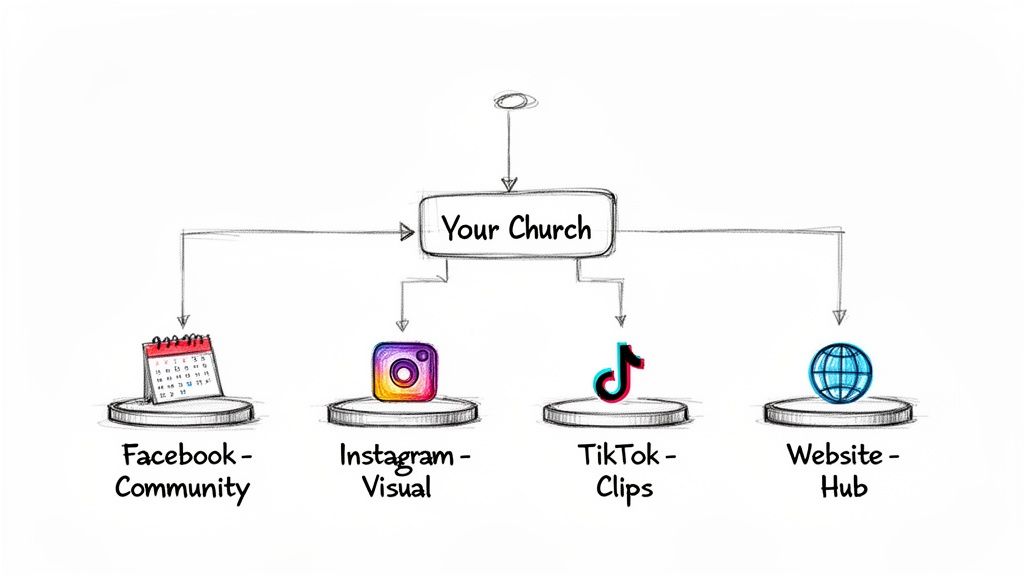
Core Digital Channels for Ministry
To build a solid multi-channel presence, start small. It's far better to master two or three key platforms than to have a weak, inconsistent presence on ten. Let's walk through the primary digital spaces where your church can make a real impact.
- Your Church Website: The Central Hub. Your website is the most important channel you own, period. It’s your digital front door where people find service times, learn about your beliefs, and get a feel for your church family. Every other channel should ultimately point people back here.
- Facebook: The Community Bulletin Board. Facebook is still king for community engagement. It’s the perfect spot for event reminders, photo albums from the last potluck, and streaming your Sunday service. It keeps your existing congregation connected and in the loop.
- Instagram: The Visual Storyteller. Instagram is all about communicating a feeling through visuals. This is where you share powerful quote graphics from Sunday's message, short, uplifting video clips, and behind-the-scenes photos that reveal the heart of your ministry.
- TikTok & YouTube: The Outreach Engines. If you want to reach new people, you need to be on short-form video. TikTok and YouTube (via Shorts) are incredible for sharing powerful, bite-sized moments from your sermons. These clips can grab the attention of a whole new audience who may have never otherwise heard of your church.
Creating Content Without the Burnout
Okay, I know what you’re thinking. Managing all of that sounds like a full-time job. But here’s the secret: you don’t need to create brand-new content for every single platform. The key is to repurpose one core piece of content—your weekly sermon.
This is exactly why we built ChurchSocial.ai. It was designed to solve this very problem.
The question shouldn't be, "How do we create content for four different channels?" The right question is, "How do we turn one sermon into amazing content for four channels?" This mindset shift changes everything.
With ChurchSocial.ai, the whole process becomes surprisingly simple. Just upload a sermon transcript, and our AI instantly brainstorms dozens of content ideas. The AI Sermon Clip Creator finds the most powerful, shareable moments and turns them into ready-to-post AI-generated reels for Instagram and TikTok. Our graphics studio gives you beautiful, on-brand templates and an editor to create and post photos and carousels.
Then, you can schedule everything on one simple drag-and-drop calendar. No more juggling five different logins or realizing you forgot to post. We also integrate with Planning Center and other church calendars to create content for events. It turns multi-channel management from a chore into a joy. You can dive deeper into different approaches in our guide to church content distribution strategies.
Don't Forget Physical Channels
While digital outreach is essential, don't overlook the power of your physical presence. Your church sign, for instance, can be the first handshake a person has with your ministry. Exploring some actionable church sign ideas can be a simple but highly effective way to engage your local community.
By combining strong digital touchpoints with a welcoming physical presence, you create a complete outreach strategy that meets people both online and right in your neighborhood.
How Multi-Channel Marketing Drives Church Growth
A multi-channel marketing strategy does more than just get your church's name out; it actively carves out new pathways for people to find and connect with your ministry. This isn't about vague benefits. We're talking about tangible results, like new families walking through your doors and deeper engagement from the people already in your pews.
Think of it like building multiple digital "front doors" to your church. Each one opens up a unique opportunity for someone to discover your community.
Here’s a scenario I see play out all the time: a young family is scrolling Instagram on a Tuesday night. They stumble upon an inspiring, 60-second Reel from your latest sermon. It hits home, so they tap on your profile and watch a few more clips.
Now they're intrigued. They hop over to your YouTube channel to watch the full sermon, wanting to really understand your church's heart and teaching style. Finally, feeling a genuine connection, they visit your website to find service times and directions for Sunday.
This family just walked through three different digital front doors—Instagram, YouTube, and your website—before ever setting foot in your physical one. If you were only relying on a single channel, you would have missed them completely.
Reaching New People in Your Community
A smart multi-channel presence allows you to meet people right where they are, not just where you hope they’ll find you. Every platform you use extends your reach into different corners of your local community.
- Social Media: Platforms like Facebook, Instagram, and TikTok are incredible for that first point of contact. They let your message get shared organically, reaching friends of friends who might be looking for a church home.
- Search Engines: A well-kept website with a blog helps people find you when they're actively searching for answers or a church in their area.
- Video Platforms: YouTube offers a much deeper dive. It gives potential visitors a real taste of your worship experience and teaching before they ever commit to showing up in person.
This multi-pronged approach makes your ministry visible and accessible, making it easier than ever for newcomers to find you. For more practical steps, check out our guide on how to grow your church.
Deepening Connections with Your Congregation
Multi-channel marketing isn't just for outreach; it’s a powerful tool for discipleship and building community. By putting valuable content on different platforms, you give your members more chances to engage with your church's message all week long.
A sermon quote graphic on Instagram can be a midweek pick-me-up. A Facebook group can keep small group discussions going. A blog post can offer a deeper look at Sunday’s topic. This steady presence keeps your community connected and spiritually fed long after the Sunday service ends. To see if this is really working, it's crucial to look into measuring content marketing ROI to understand the true impact.
Building a Consistent Ministry Brand
Spreading your message across different channels helps build a consistent, recognizable identity for your ministry online. When people see the same logos, colors, and tone of voice on your website, social media, and videos, it builds a sense of trust and familiarity. This consistency makes your church look professional and intentional, reinforcing your mission at every single touchpoint.
But let's be honest—executing this can be tough. In fact, creating a solid multi-channel plan stumps a whopping 53% of marketers. Yet, its power is undeniable, with 30% reporting it as 'very successful' in hitting their goals.
This is exactly why tools like ChurchSocial.ai are so vital for church teams. With social media being credited by 55% of professionals for massive campaign impacts, platforms like Facebook, Instagram, and TikTok—our specialties—are where your message needs to be. Using our simple drag-and-drop calendar and AI content tools, churches can effortlessly manage their presence, ensuring their message is consistent and powerful everywhere they show up.
Building Your Church's Multi-Channel Strategy
Putting together a multi-channel marketing plan can sound intimidating, but it really doesn't have to be. It’s all about breaking it down into a few practical, intentional steps. When you do that, any church can build a strategy that connects with more people without burning out the team.
The goal isn't just to be present online; it's to be present with a purpose. It’s less about doing more and more about making what you already do go much, much further.
Step 1: Define Your Ministry Goals
Before you even think about posting, stop and ask the most important question: "What are we actually trying to accomplish?" A strategy without a clear goal is just noise. Your ministry goals are the compass that will guide every single decision you make about your channels and content.
Are you trying to:
- Increase attendance at Sunday services? If so, your content needs to create a warm, welcoming first impression and make it super easy for someone to plan a visit.
- Boost sign-ups for small groups or volunteer teams? You'll want to focus on sharing stories and info that show the real joy and impact of getting involved.
- Reach younger families in your community? This means your content has to be visual, engaging, and posted on the platforms where they actually spend their time.
Once you lock in one or two clear, measurable goals, your content creation immediately becomes more focused. Every post, video, and email suddenly has a specific job to do.
This journey is how a multi-channel strategy works in the real world—guiding people from that first discovery on social media, to exploring more on your website, and finally, to walking through your doors.

This process really shows why being on multiple channels is so critical. You meet people right where they are, at different stages of their journey toward your church.
Step 2: Understand Your Community
Next up, you have to know who you're talking to. A great message that never reaches the right people is a wasted effort. Take a little time to really think about your current congregation and the community you hope to serve.
Ask some simple questions:
- Where do they spend their time online? Are they scrolling Facebook, watching Instagram Reels, or searching for answers on Google?
- What kind of content do they actually engage with? Do they prefer short, punchy videos, inspiring quote graphics, or detailed event info?
- What are their biggest needs or questions right now? Are they looking for community, parenting advice, or deeper spiritual guidance?
You don’t need to send out a massive formal survey. Just start by listening. Pay attention to the conversations in the church lobby or on local community Facebook pages. These little insights are gold and will help you pick the most effective channels to focus on.
Step 3: Choose Your Core Channels
One of the biggest mistakes I see churches make is trying to be everywhere at once. It’s a recipe for burnout that stretches your team too thin and results in a weak presence on every platform.
Instead, start with just two or three core channels where you know you can show up consistently and do a great job.
A solid starting lineup for most churches is:
- Your Website: This is your home base, the central hub for all information.
- Facebook: Perfect for building community and sharing detailed event information with your congregation.
- Instagram or TikTok: Your outreach engine for sharing visually engaging, short-form content like sermon clips.
By focusing your energy, you can actually master these platforms and build a strong, reliable presence. You can always add more channels down the road as your team gets more comfortable.
Step 4: Plan Your Content by Repurposing
Here's the secret sauce that makes a multi-channel strategy not just possible, but manageable: work smarter, not harder. You don't need to invent brand-new content for every single platform, every single day. The key is to learn how to repurpose what you already have—your weekly sermon.
This is exactly where a tool like ChurchSocial.ai becomes your ministry's command center. It was built from the ground up to make this process simple and achievable for any church.
The big idea is "create once, distribute many times." Your Sunday sermon is the single most valuable piece of content you produce each week. With the right tools, it can fuel your entire online presence for the next seven days.
With ChurchSocial.ai, you can upload your sermon transcript and let our AI transform it into a full week's worth of content. Our platform can generate engaging AI-generated reels and clips for Instagram, pull out powerful quotes for graphic posts using our templates and editor, and even draft blog posts or social posts. For a deep dive on this, check out our guide on how to create a content strategy for your church.
To show you how this works in practice, here is a sample 30-day content plan that takes one sermon and multiplies its impact across your core channels.
Your First 30-Day Multi-Channel Content Plan
This simple rhythm turns a complex strategy into a sustainable workflow. Our simple drag-and-drop calendar lets you plan and schedule everything from one place, giving you back time to focus on what matters most—your people.
Streamlining Your Ministry with ChurchSocial.ai
It’s one thing to understand multi-channel marketing in theory, but it's another thing entirely to actually do it without burning out your team. This is where good intentions often collide with the realities of ministry—things like content creation bottlenecks and the sheer chaos of scheduling. A great strategy is only as good as your ability to sustain it.
This is exactly why we built ChurchSocial.ai. We wanted to create a simple, all-in-one tool designed specifically for churches to plan and manage their social media accounts. Instead of juggling a dozen different logins and scrambling for fresh content ideas, you can run your entire online presence from one central place.
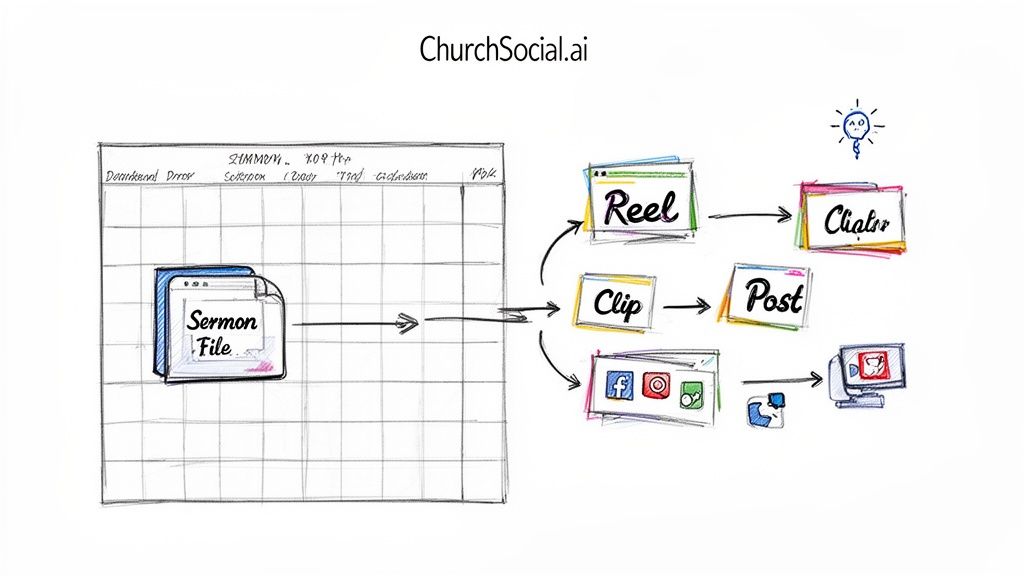
From Sermon to Social Feed in Minutes
Let's be honest, the biggest hurdle for most churches is the relentless demand for new content. Your weekly sermon is a goldmine, but who has the time to manually chop it up into clips and quotes? ChurchSocial.ai turns that time-consuming task into your ministry's biggest advantage.
With ChurchSocial.ai, your Sunday sermon becomes the fuel for your entire week's content. The platform transforms one core message into dozens of posts, graphics, and videos, allowing one person to achieve the impact of a full team.
Our AI Sermon Clip Creator is a total game-changer. Just upload your sermon transcript, and our AI finds the most powerful, shareable moments. It then automatically whips up engaging, AI-generated reels perfect for Instagram, TikTok, and YouTube Shorts. The struggle to produce compelling video for all those platforms? Gone.
This is a huge deal, especially when you consider that the multi-channel marketing industry is on track to hit $28.6 billion by 2030. That growth is being driven by video, which already makes up 63% of all mobile traffic and is expected to climb to 76% by 2025. By turning a 30-minute homily into viral-ready clips, ChurchSocial.ai helps your church connect with people right where they are—on their phones. If you want to dive deeper into the numbers, you can explore more multichannel marketing statistics.
Unifying Your Message and Schedule
Beyond just making videos, keeping a consistent look and feel across all your channels is key to building trust. Our professionally designed graphic templates and simple editor make sure every post—from a quote graphic for Instagram to an event announcement on Facebook—looks polished and on-brand.
It all comes together in our intuitive simple drag-and-drop calendar. This is your command center, ending the frustration of managing a handful of different accounts and passwords. You can plan, create, and schedule everything for every channel, all in one spot.
- Plan Ahead with Ease: Get a bird's-eye view of your entire month's content and easily drag posts around to fit the rhythm of your ministry.
- Automate Event Promotion: We integrate with Planning Center and other church calendars to help you create content for events automatically.
- Generate Content Instantly: It's not just about video. Our AI can pull social post ideas, blogs, and other content straight from your sermon transcript, filling your calendar with meaningful content in seconds.
By bringing content creation and scheduling into a single, seamless system, ChurchSocial.ai makes a sophisticated multi-channel strategy not just possible, but genuinely simple. It gives your church the power to reach more people and deepen your community connections, all without piling more work onto your plate.
Got Questions About Multi-Channel Marketing? We’ve Got Answers.
Jumping into a multi-channel strategy can feel like a big move, and it's totally normal to have questions. This approach is incredibly powerful, but it's crucial to understand how it works within the unique rhythm of ministry. We've pulled together some of the most common questions we hear from church leaders, with straightforward answers to build your confidence and show you this is more doable than you might think.
Each answer will give you clarity and also show how a purpose-built tool like ChurchSocial.ai can make the whole process simpler, turning potential headaches into real growth opportunities.
What’s the Difference Between Multi-Channel and Omnichannel?
This is a fantastic question, and the difference is simpler than it sounds.
Think of it like this: multi-channel marketing is like having separate, meaningful conversations in different rooms. Your Facebook page is one room, your website is another, and your YouTube channel is a third. Each room has its own conversation happening, tailored for the people in it.
Omnichannel marketing, on the other hand, connects all those rooms with hallways, creating one seamless journey. It makes sure a conversation that starts in one room can continue flawlessly in another. For instance, someone might see a small group ad on Instagram, click over to your website to sign up, and then instantly get a welcome text message—all part of a single, connected experience.
For most churches, getting multi-channel marketing right is the perfect place to start. It gets you present and effective where your community hangs out, building a solid foundation for deeper connection.
Focusing on a multi-channel approach first lets you build a strong presence on key platforms without the deep technical work of full omnichannel integration. ChurchSocial.ai helps you plan and manage all your church social media accounts from one simple dashboard, making a powerful strategy feel manageable.
Is This Too Complicated for a Small Church with Volunteers?
This might be the most common—and most important—concern we hear. The answer is a clear no, it's not too complicated, as long as you have the right mindset and the right tools. The goal isn’t to be everywhere at once; it's to be incredibly effective where it really matters for your community.
The trick is to start small. Don't try to launch on five platforms on day one. Just begin with two core channels, like your church website and a Facebook page. Once you find your rhythm, you can add another, maybe Instagram for more visual outreach.
This is exactly why we built ChurchSocial.ai. It was designed from the ground up to empower small teams and even solo volunteers.
- One Central Hub: Instead of juggling a bunch of different apps and passwords, your volunteers can plan and manage all of their church social media from a single, simple drag-and-drop calendar. This slashes complexity and saves a ton of time.
- AI-Powered Content: Our AI can take a single sermon and spin it into a week's worth of AI-generated content—posts, reels, blogs, and graphics. That feature alone allows one volunteer to have the impact of a full communications team, without the burnout.
With the right system in place, multi-channel marketing becomes a force multiplier, not another burden. It helps even the smallest church have a polished, consistent, and impactful presence online.
How Do We Know If Any of This Is Actually Working?
Measurement is critical, but it doesn't need to be some mystifying process that requires a data scientist. The best way to track success is to tie your metrics directly to your ministry goals. You can ignore the "vanity metrics" that don't mean much and focus on numbers that reflect real-world impact.
Start with just a few simple, goal-focused metrics:
- Metric to Track: How many people click from your social media profiles to the "Plan a Visit" or "Directions" page on your website.
- Metric to Track: The number of comments, shares, and direct messages you get. This shows people aren't just scrolling past your content—they're actually engaging with it.
- Metric to Track: Your monthly follower growth and the "reach" of your posts (how many unique people saw them).
You don’t need fancy analytics software to get started. Most social media platforms give you these basic insights for free. By keeping an eye on just a few key numbers each month, you'll get a clear picture of what’s connecting with your audience and where you’re seeing real ministry growth.
How Much New Content Do We Really Need to Create?
This is the question that often stops churches in their tracks, but the answer is incredibly freeing: you need to create far less new content than you imagine. A smart, sustainable multi-channel strategy is all about the principle of "create once, distribute many times." It’s about working smarter, not harder.
Your weekly sermon is the single most valuable piece of content your church produces. It's a goldmine of teaching, inspiration, and stories. The real challenge today isn't creating more content; it's unlocking the full potential of the content you already have.
That is the core mission of ChurchSocial.ai. It’s a content repurposing engine built specifically for ministry.
You don't have to choose between a deep sermon and engaging social media. With the right tools, your sermon becomes the fuel for your social media, creating a cohesive and powerful message that lasts all week long.
Just upload a single sermon transcript or video file. Our platform's AI gets to work, generating dozens of ready-to-use content pieces from it:
- AI-generated reels perfect for Instagram and TikTok.
- Inspiring quote graphics for Facebook and Instagram posts using our templates.
- AI-generated content like social posts and blogs.
- Discussion prompts and questions for your Facebook group.
This approach lets one core message fuel your entire week of content across all your channels. It guarantees consistency, saves countless hours, and turns a weekly sermon into a ministry resource that keeps on giving.
Ready to simplify your church's social media and make a bigger impact online? ChurchSocial.ai gives you all the tools you need—from AI-powered content creation to a simple drag-and-drop calendar—to plan and manage your church social media accounts without the stress. See how easy it can be to connect with your community and reach new people. Get started with ChurchSocial.ai today.