When does your flock scroll? That's the question most church Facebook strategies skip. Teams spend hours polishing graphics, trimming sermon clips, and writing announcements, then publish whenever someone on staff has a spare minute. Good content still matters, but timing decides whether that content meets people in a receptive moment or disappears under everything else in the feed.
The best times to post on Facebook aren't one universal slot for every church, every format, and every audience. Broad platform data gives you a strong starting point, but churches also have rhythms that businesses don't. Sunday services, midweek Bible studies, volunteer coordination, event reminders, and sermon follow-up all create different windows of attention. A sermon clip doesn't behave like a childcare registration post, and a prayer request doesn't behave like a VBS announcement.
That's why this guide focuses on practical posting windows church leaders can use. You'll see where general Facebook engagement patterns point, how those patterns translate to church communication, and where you should test instead of assume. If your team uses ChurchSocial.ai, this gets easier. You can turn sermons into reels, build posts from transcripts, design event graphics, and drop everything into a visual calendar that matches your church's weekly rhythm.
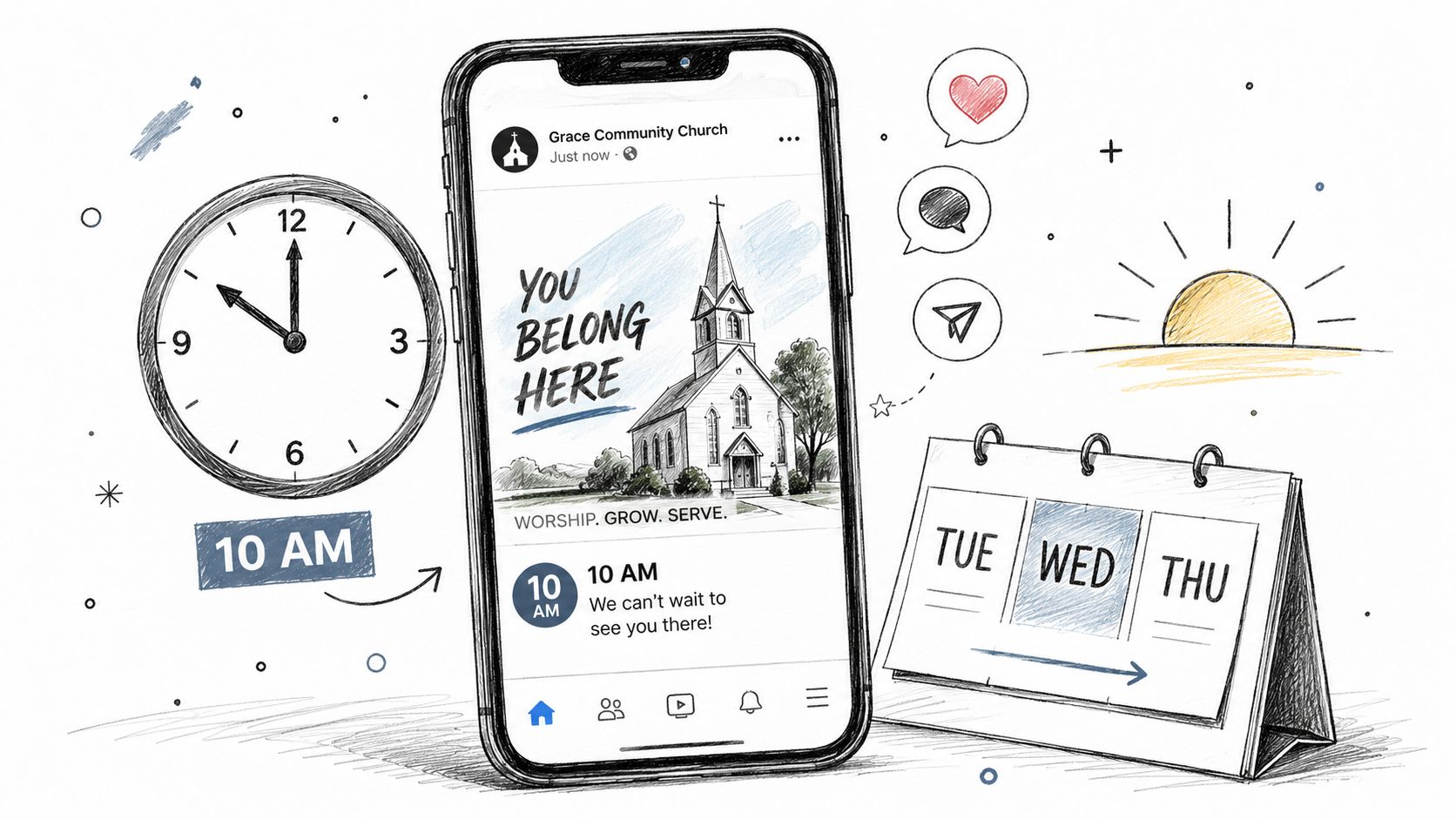
1. Tuesday to Thursday Mid-Morning Posts (9-11 AM)
If you want one starting point for the best times to post on Facebook, start here. Buffer's 2026 analysis of 14 million Facebook posts found that the single best time to post was Thursday at 9 a.m., with Wednesday as the best overall day and Tuesday and Thursday close behind. The same analysis found stronger engagement during the weekday morning window from 6 a.m. to 11 a.m. according to Buffer's Facebook timing analysis.
That lines up well with how churches communicate. Midweek is when people are more open to planning, responding, and taking next steps. If you're posting a women's Bible study reminder, a volunteer signup, a sermon quote graphic, or a youth event announcement, this is often the cleanest window to get attention before the afternoon drop-off.
What churches should publish here
Mid-morning works best for practical, useful content. People are in planning mode, not just passive scrolling mode.
- Event reminders: Post registration links for VBS, small groups, membership classes, and outreach nights.
- Weekly rhythm posts: Share “what's happening this week” graphics or simple carousel updates.
- Sermon follow-up: Clip one strong teaching moment from Sunday and pair it with a clear takeaway.
- Prayer prompts: Invite the congregation to comment or message prayer needs before the week gets busy.
For many churches, this is also the easiest slot to schedule consistently. A volunteer team can prep content on Monday, review it Tuesday morning, and let the week carry the load.
Practical rule: If a post asks people to remember, register, plan, or respond, try midweek mornings before you try anything else.
A common mistake is using this prime window for low-value filler. Don't waste Tuesday through Thursday mornings on vague inspirational graphics with no connection to your church's life. Save your strongest content for these hours. If your team needs help building that cadence, ChurchSocial.ai's church social media posting schedule guide is a useful companion to a consistent weekly plan.
2. Sunday Evening Posts (6-9 PM)
Sunday evening isn't the strongest broad Facebook window on the data side, but it can be one of the most useful church-specific windows because the content is fresh. Recency matters on Facebook, and source material summarized by Backstage notes that the algorithm prioritizes fresh content. It also notes that late-night posts can get buried if they miss the audience's active period, while recommending format-specific timing and A/B testing over 2 to 4 weeks in this Facebook posting timing overview.
That's important for churches. A sermon recap posted while the message is still fresh often has more ministry value than a “technically better” time posted days later. Sunday evening is where you can extend the life of the sermon, keep the conversation going, and help members carry the message into Monday.

Best use cases for Sunday night
This isn't the slot for every type of post. It's especially good for content tied directly to what just happened in the room.
A church communications team might post a short sermon reel at 7 p.m., followed by a caption with one key point and one question for reflection. Another church might publish a photo carousel from service and invite members to share who they brought or what stood out to them. If your church streams online, Sunday evening is also a strong moment to repost a key clip for those who missed the morning service.
What usually doesn't work here is heavy logistics. People may engage with a sermon takeaway on Sunday night, but they're less likely to stop and read a long block of event details unless that event is immediate and relevant.
Fresh beats perfect when the post depends on the moment people just experienced together.
ChurchSocial.ai fits well here because sermon content doesn't have to wait until someone has time on Tuesday. You can turn the transcript into social copy, generate a reel from the message, and queue that content for the same evening while the sermon is still top of mind.
3. Wednesday Lunchtime Posts (12-1 PM)
Some churches assume lunch-hour posting is weak because morning often wins in Facebook studies. That's too simplistic. Sprout Social's 2026 Facebook timing guide identifies Tuesdays and Wednesdays from 12 p.m. to 8 p.m. local time as the overall best posting windows, with Mondays through Thursdays consistently generating the highest engagement. It also says weekends are the weakest days for most industries in Sprout Social's Facebook timing guide.
For churches, Wednesday at lunch can work especially well because it matches a natural ministry moment. Midweek is when people often need encouragement again. Sunday has passed, the week feels real, and evening church activities are approaching.
When lunch-hour posts make sense
Use this window for content people can read, save, or act on before evening.
- Midweek encouragement: A devotional thought pulled from Sunday's sermon transcript can work well here.
- Bible study reminders: If your church meets on Wednesday night, lunchtime is a practical reminder slot.
- Discussion prompts: A thoughtful question can prepare people for small groups or midweek classes.
- Longer captions: Midday can support a bit more reading than a rushed early-morning skim.
This is also a good place to test carousels and short reflective videos. A pastor's one-minute encouragement for the rest of the week often fits lunchtime behavior better than a high-energy promo piece.
Many churches struggle because they post the same style of content at every time slot. Wednesday lunch needs a different tone than Thursday morning. It should feel pastoral, not promotional. If your team needs ideas that go beyond generic quote graphics, ChurchSocial.ai's church Facebook post ideas article can help you build a better midweek mix.
4. Friday Afternoon Posts (2-4 PM)
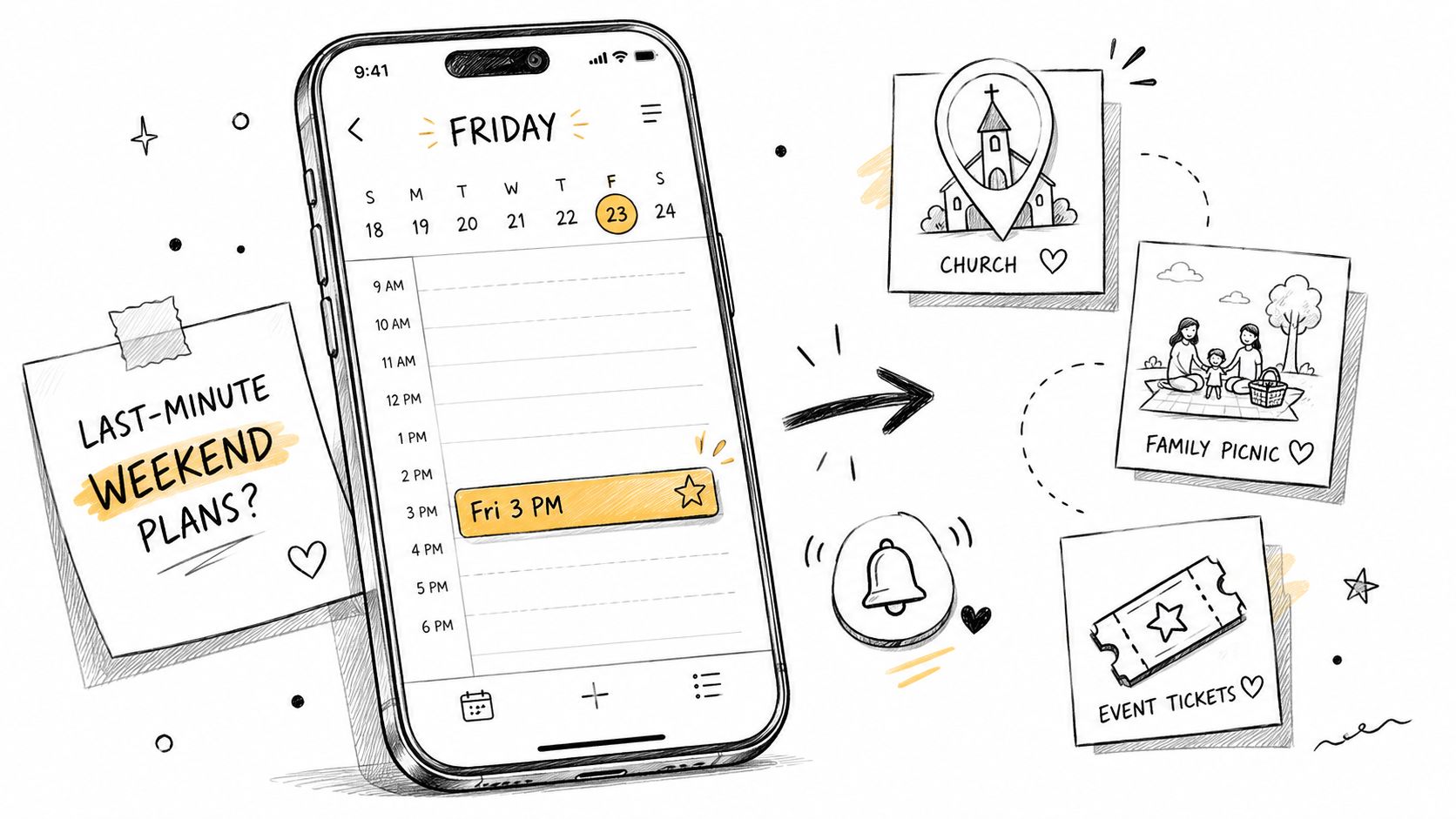
Friday afternoon is not where you should place your most important evergreen content. It is, however, useful for weekend-focused logistics and reminders. Churches often need one final touchpoint before Sunday, especially for service times, special events, and volunteer coordination.
The trade-off is simple. By Friday, many people are shifting mentally into the weekend. That can lower attention for content that requires reflection, but it can help posts tied to immediate plans. If you have a church picnic, student retreat departure, parent night, or Sunday serve-team reminder, Friday afternoon can still earn attention because it matches the audience's planning behavior.
What works, and what usually doesn't
Friday afternoon works when the post answers immediate questions. It struggles when the post asks for deep engagement.
- Works well: Service reminders, event logistics, volunteer notes, parking updates, childcare reminders.
- Works less well: Dense teaching clips, long theological reflections, broad vision posts with no urgent action.
- Works best with visuals: Clear branded graphics, simple text hierarchy, or a strong sermon thumbnail.
- Works poorly with clutter: Long captions, multiple asks, and unclear event details.
A practical example is a Saturday outreach post. On Tuesday, that same event post might help with awareness. On Friday, the post should switch from promotion to clarity. Include the time, location, what to bring, and who to contact.
Field note: Use Friday for clarity, not complexity.
Church teams that rely on organic reach need to think this way every week. Timing matters, but matching timing to intent matters more. If you're trying to improve performance without posting more often, ChurchSocial.ai's guide to increasing organic reach on Facebook is a helpful next step.
5. Saturday Morning Posts (9-11 AM)
Saturday is the tricky one. Many churches want Saturday morning to be a major posting time because Sunday is close. Broad Facebook data says to be careful. Sprout's guide describes Saturdays and Sundays as the weakest days for most industries, and Buffer's analysis also places weekends below midweek overall, with afternoons tending to be weaker than morning periods as noted earlier.
Still, churches have a real reason to post on Saturday morning. People are thinking about the weekend, checking plans, and deciding what Sunday will look like. That makes this a useful slot for previews and last-minute reminders, even if it isn't your highest-engagement day overall.
Use Saturday as a setup day
Saturday morning is best for building anticipation, not for carrying your whole Facebook strategy.
A church might post a sermon teaser from the pastor, a simple “join us tomorrow” graphic, or a short reel tied to the upcoming message theme. Another good use is practical updates for special weekends such as baptism Sunday, mission team commissioning, or holiday services. The post works because it's relevant now, not because Saturday is universally ideal.
What doesn't work is assuming Saturday will rescue weak midweek planning. If your only event post goes out Saturday morning, many people won't see it in time. The better pattern is to treat Saturday as reinforcement for things you already introduced earlier in the week.
- Good Saturday content: Sermon preview, service reminder, prayer focus, final logistics.
- Less effective Saturday content: New announcements, signup-heavy posts, content that needs repeated exposure.
- Strong format choice: Short video or simple visual with one action step.
ChurchSocial.ai can help here because Saturday content is often repetitive in a good way. You can create recurring templates for weekly sermon previews, then swap in the new title, scripture, and clip without rebuilding the post from scratch.
6. Monday Morning Posts (9-11 AM)
Monday mornings are underrated for churches. Buffer's 2026 coverage, as summarized in the provided source material, adds nuance beyond one universal posting slot. It notes that morning hours dominate overall, but also identifies Monday nights, Wednesday early mornings, and Thursday mornings as distinct peaks, while recommending that teams front-load their best content on Tuesday through Thursday mornings and use Monday and Friday for secondary posts. That's a strong church communications principle even if your church eventually finds its own variations.
Monday morning works best for resetting the week. It's not the slot for your biggest campaign, but it is a good place for focus, follow-up, and forward motion.
Strong Monday post types
Churches often have a backlog of meaningful content after Sunday. Monday is a natural place to organize it.
A communications pastor might post a “this week at church” graphic on Monday morning. A discipleship leader might share a key quote from Sunday with a short application point for the week ahead. A volunteer coordinator might post a gratitude note that also prepares people for next Sunday's serving needs.
What usually falls flat on Monday morning is anything too demanding. A long registration post with lots of details is often better midweek. Monday works when the message feels clarifying and encouraging.
- Weekly focus: One scripture, one theme, one clear takeaway.
- Community reinforcement: Thank volunteers, celebrate baptisms, or highlight ministry moments from Sunday.
- Simple planning content: Share the week's ministries, classes, and gatherings in one clean format.
For churches using sermon transcripts as a content source, Monday is an easy day to turn Sunday's message into quote cards, short blogs, or social captions without inventing something new from scratch.
7. Thursday Evening Posts (7-9 PM)
Thursday evening is where many churches can recover lost attention before the weekend. Hootsuite's 2025 benchmark data found a different pattern from the morning-heavy studies. It identified 5 a.m. on Tuesdays as the single best overall time and reported that Facebook activity across the week peaks between 5 a.m. and 8 a.m. Hootsuite also notes that morning posts are especially strong in some industries while afternoon blocks perform better in others in Hootsuite's Facebook benchmark guide.
That difference is useful, not confusing. It tells church leaders not to chase one chart blindly. Thursday evening may not be the dominant pattern across all Facebook activity, but it can still be a strong church-specific reminder window because people are finalizing weekend plans.
Why Thursday night can help churches
Thursday evening is often the last calm planning moment before Friday distractions and weekend movement. That makes it a smart slot for reminders that need action soon.
A youth pastor might post final details for a weekend event. A volunteer coordinator might remind people about arrival times for Sunday. A women's ministry leader might publish a “last call to register” post before a Saturday gathering. These posts work because they serve a need at the moment people are making decisions.
This slot also does well with conversational formats. Polls, simple questions, and short videos can pull more response here than a static flyer-style graphic.
Thursday night is often a commitment window. People decide whether they're attending, serving, bringing a friend, or skipping.
Use it carefully. If you flood Thursday evening with too many posts, they compete with each other. Pick one high-priority message and make it clear.
8. Time Zone-Adjusted Regional Posting (2-3 Sequential Posts)
If your church has multiple campuses, streams to different regions, or serves an audience spread across states, one posting time won't fit everyone. For this reason, time-zone-adjusted scheduling matters.
Sprout's guide says its recommended times are based on local time, and Buffer's analysis also presents timing in a way intended to be locally applicable. For churches, that means an 8 a.m. or 10 a.m. slot should usually be scheduled for the audience's local morning, not your headquarters time. A single national post can still work, but a church with several active regional audiences often gets better alignment by staggering the same content.
How to handle multi-region church audiences
The simplest version is three coordinated publishes for the same content: one for Eastern, one for Central, and one for Pacific time. You don't need to overcomplicate it.
A multi-site church might schedule the weekend service invite separately for each region so nobody gets a “good morning” post in the middle of the workday. A network office might also adapt the caption slightly for each campus while keeping the core creative identical. That protects consistency without forcing every congregation into the same online rhythm.
- Map your audience first: Look at where your campuses and online viewers are.
- Stagger core announcements: Publish the same message in each region's useful local window.
- Adjust event details: Regional captions should reflect the right campus, service time, or sign-up link.
- Track per-location response: One region may respond better to mornings, another to midday.
ChurchSocial.ai is built for this kind of workflow. A team can plan content on a drag-and-drop calendar, manage repeating posts, and coordinate announcements across locations without rebuilding every asset by hand. That matters when one ministry team is serving several campuses with a small staff.
8-Point Facebook Posting Time Comparison
| Posting Window | Implementation Complexity 🔄 | Resource Requirements ⚡ | Expected Outcomes ⭐📊 | Ideal Use Cases | Key Advantages + Tip 💡 |
|---|---|---|---|---|---|
| Tuesday–Thursday Mid‑Morning (9–11 AM) | Low, simple recurring schedule | Low, basic scheduling & monitoring | Very high, peak engagement and CTR | Weekly announcements, event promos, inspirational posts | Broad reach during work breaks; tip: schedule at 10 AM for consistency |
| Sunday Evening (6–9 PM) | Low, once‑weekly timing | Low–Moderate, sermon clip editing often useful | High, quality, thoughtful comments and shares | Sermon highlights, recaps, small group signups | Captures post‑worship reflection; tip: post within 30 min after service |
| Wednesday Lunchtime (12–1 PM) | Low, single midweek slot | Low, longer text/devotional prep | Moderate–High, good for longer engagement | Devotionals, Bible study prompts, prayer requests | Less crowded than mornings; tip: pair with discussion questions |
| Friday Afternoon (2–4 PM) | Low, routine weekly posting | Low–Moderate, weekend promo assets | Moderate–High, boosts weekend planning engagement | Weekend service reminders, family events, volunteer recruitment | Taps into weekend planning mindset; tip: include registration links |
| Saturday Morning (9–11 AM) | Low, simple weekend slot | Low, teaser graphics or clips | Moderate–High, intentional, relaxed engagement | Sermon previews, last‑minute event details, testimonies | Reaches relaxed weekend audience; tip: post at 10 AM for previews |
| Monday Morning (9–11 AM) | Low–Medium, competes with work content | Low, motivational content creation | Moderate, strong for weekly planning and shares | Weekly calendars, ministry launches, motivational posts | Harnesses fresh‑week mindset; tip: share weekly focus at 9–10 AM |
| Thursday Evening (7–9 PM) | Low, secondary evening window | Low–Moderate, last‑call logistics prep | Moderate, effective for confirmations and reminders | Final event reminders, volunteer confirmations, logistics | Good for finalizing plans; tip: post 7–8 PM for max responses |
| Time Zone‑Adjusted Regional Posting (staggered 2–3 posts) | High, multi‑region coordination | High, scheduling tools, regional customization | High, maximizes reach across time zones | Multi‑site announcements, network campaigns, unified messaging | Ensures local-appropriate timing; tip: map regions and stagger posts (use calendar tools) |
Automate Your Schedule, Amplify Your Message
Finding the best times to post on Facebook isn't about chasing a magic slot. It's about pairing good timing with the right kind of content for the right ministry goal. The broad pattern is clear. Weekdays usually outperform weekends, and midweek often gives churches the strongest starting point. But the practical lesson is more specific than that.
Tuesday through Thursday mornings are strong places to begin for announcements, sermon follow-up, and registration-driven posts. Wednesday lunch can work well for reflective midweek content. Thursday evening can help with final reminders. Sunday evening can extend the life of the sermon when freshness matters more than a generic benchmark. Saturday and Monday still have value, but they work better as support windows than as the center of your strategy.
Church leaders should also resist one common mistake. Don't test posting times by changing everything at once. Keep the content type as consistent as possible while you test time slots. A sermon clip posted on Tuesday morning should be compared with another sermon clip, not with an event graphic or a volunteer request. Run that comparison for a few weeks, watch which posts get comments, shares, clicks, and meaningful replies, then adjust your calendar around real audience behavior.
That's where a tool can save your team a lot of friction. ChurchSocial.ai gives churches a practical way to do this without building a complicated system. You can create reels from sermons, generate social copy from transcripts, use templates for graphics and carousels, and schedule everything in a drag-and-drop calendar. If your church already plans events in Planning Center or another church calendar, those integrations can also help your content schedule stay connected to actual ministry activity.
The best Facebook schedule for your church won't look exactly like another church's schedule. Different congregations have different ages, routines, service times, and ministry emphases. Start with the strongest known windows. Match each slot to a purpose. Keep what works. Drop what doesn't. Over time, your Facebook page stops being a bulletin board and starts becoming a real extension of pastoral communication.
If your church wants a simpler way to turn sermons, events, and weekly ministry rhythms into scheduled Facebook content, ChurchSocial.ai gives you one place to create, plan, and publish with less guesswork.