A lot of church leaders are sitting in the same meeting right now. The roof needs work. The kids' area feels cramped. A ministry opportunity is in front of the church, but the budget doesn't stretch far enough to meet it. Staff members feel the pressure, volunteers are already carrying a lot, and nobody wants the congregation to feel like they're being hit with one more ask.
That tension is real. It doesn't mean your church should avoid fundraising. It means your church needs a better way to approach it.
The strongest church fundraising campaigns don't feel like financial emergencies dressed up in church language. They feel like a congregation being invited into a clear, shared act of stewardship. They connect vision, discipleship, trust, and execution. They also use modern communication well, because a good message that only reaches part of the church won't carry the campaign.
Church leaders who want to strengthen that side of communication can learn a lot from broader nonprofit promotion strategy. This guide to non-profit advertising success is useful because it shows how message clarity and channel discipline work together. For churches that want to think more specifically about outreach in a ministry context, this look at digital marketing for nonprofits is also a practical place to start.
From Vision to Victory The Modern Fundraising Mindset
A fundraising campaign usually starts long before the first donation comes in. It starts when leaders realize that the mission is growing faster than the current systems, space, or budget can support.
I've seen churches stall because they treated fundraising like a short-term money problem. The message became functional and flat. "We need repairs." "We need to reduce debt." "We need more room." Those statements may be true, but they rarely inspire generosity on their own. People don't rally around a spreadsheet. They rally around what that sacrifice makes possible.
What changes the tone
The mindset shift is simple. Stop framing the campaign as paying for a problem. Start framing it as funding ministry.
A roof isn't just a roof if it protects a worship space, counseling rooms, and children's ministry classrooms. A renovation isn't just construction if it removes barriers to hospitality. A debt reduction effort isn't just cleanup if it frees future dollars for outreach, staffing, and discipleship.
Church fundraising campaigns work best when the congregation can answer one question in a sentence: "What will change because we do this together?"
During this critical period, many churches either gain momentum or lose it. If leaders speak with conviction and specificity, generosity often follows. If leaders sound hesitant, vague, or internally divided, the congregation picks that up immediately.
Old stewardship principles still matter
Modern tools haven't replaced biblical stewardship. They've changed how clearly and consistently churches can communicate it.
That matters because churches aren't only managing money. They're guiding people through a spiritual response. Some members need a personal conversation. Some need time to pray. Some won't engage fully until they see the story repeated through sermons, email, testimony, social posts, and follow-up updates.
The modern fundraising mindset holds both truths at once:
- Generosity is pastoral. It requires prayer, trust, and careful shepherding.
- Communication is operational. It requires planning, message discipline, and repeatable systems.
Churches that respect both sides usually run healthier campaigns. They don't just ask better. They lead better.
Laying the Foundation for Generosity
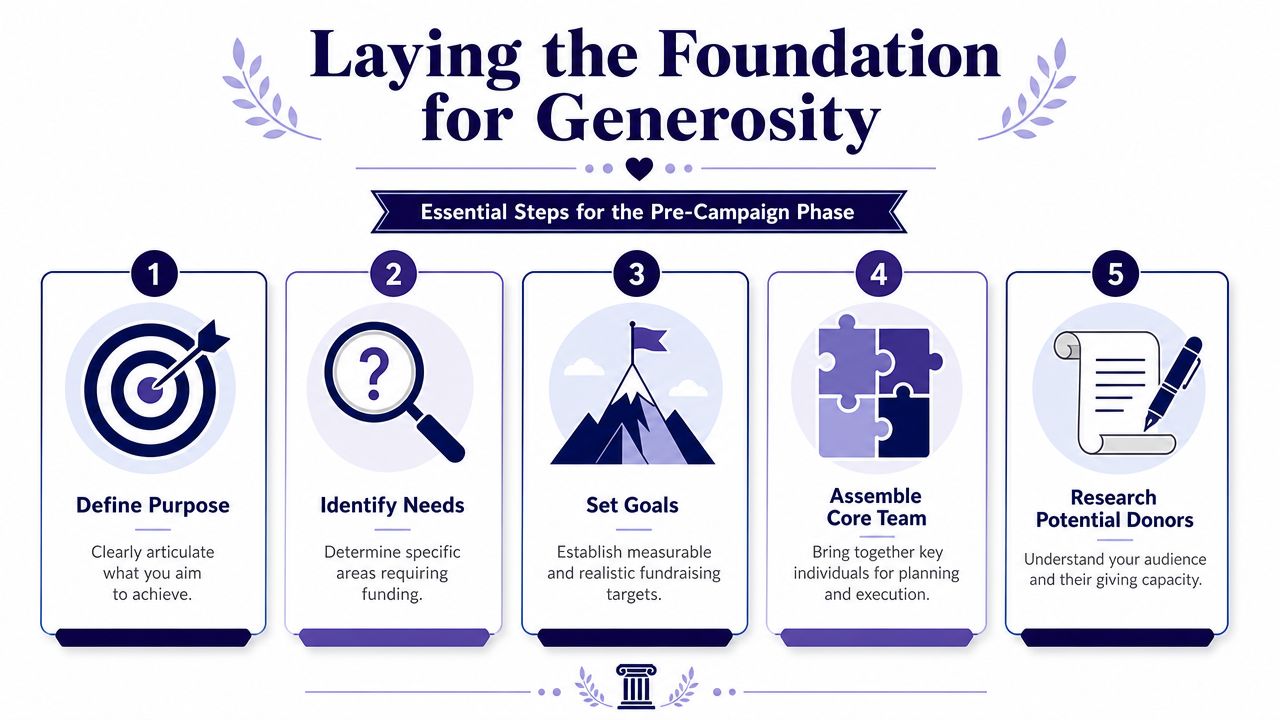
Church fundraising campaigns rise or fall in the planning stage. If the goal is fuzzy, if leadership isn't aligned, or if the church hasn't tested readiness, the public phase gets much harder than it needs to be.
One church fundraising expert recommends beginning with a feasibility study and SMART goals, and suggests using a consultant when the target is more than 20 to 40% of annual giving. The same guidance stresses that personal lead-gift asks should happen before the public launch, because cultivating those gifts takes the most time (church campaign planning guidance).
Start with a defined ministry outcome
The phrase "we need to raise money" is too broad to guide a campaign.
A usable goal sounds more like this: fund a facility repair tied to safety and ministry continuity, equip a student space so midweek discipleship can expand, or retire a burden that's limiting future ministry flexibility. Specificity helps leaders make decisions and helps donors understand the ask.
A SMART goal gives that vision guardrails:
- Specific. Name the project and what the funds will cover.
- Measurable. State the fundraising target and what completion looks like.
- Achievable. Base the goal on your church's actual giving culture, not wishful thinking.
- Relevant. Tie it to the church's mission, not just maintenance.
- Time-bound. Put dates on quiet phase planning, public launch, pledge commitments, and follow-up.
When a goal isn't concrete, campaign language drifts. Staff members improvise. Volunteers tell different versions of the story. Donors start filling in gaps with their own assumptions.
Run a real feasibility check
A feasibility study doesn't have to feel corporate. At its best, it is pastoral honesty combined with strategic listening.
Look at questions like these:
- Is leadership unified? If elders, finance leaders, pastors, and ministry heads aren't speaking with one voice, pause.
- Is the project understandable? If someone hears it for the first time on Sunday, can they quickly grasp the need and the impact?
- Is the timing wise? Major transitions, conflict, or fatigue can weaken a campaign before it starts.
- Are the likely lead givers identified? Not for pressure, but for early conversation and discernment.
- Does the church trust the process? If members suspect hidden information or moving targets, enthusiasm drops fast.
Practical rule: Don't publicly launch what leadership hasn't privately clarified.
For smaller churches, the feasibility process may begin with interviews, a review of prior giving patterns, and honest internal discussion. For larger or more ambitious efforts, outside guidance can help leaders hear hard truths sooner and structure the campaign more effectively.
Build the core team before the message goes wide
Too many churches announce first and organize later. That creates avoidable confusion.
A healthier sequence looks like this:
| Role | What they own |
|---|---|
| Senior pastor or lead pastor | Spiritual framing, key asks, congregational trust |
| Finance or executive leader | Budget clarity, reporting process, campaign administration |
| Campaign chair or lay leader | Volunteer credibility, peer leadership, relational follow-up |
| Communications lead | Message consistency across every channel |
| Operations support | Event setup, pledge tracking, scheduling, materials |
Not every church has these as paid roles. That's fine. The function matters more than the title.
Decide early when to get help
Some campaigns can be managed internally. Others shouldn't be.
If your church is pursuing a large goal relative to annual giving, if leadership lacks campaign experience, or if nobody has time to coordinate meetings, donor communication, and tracking, outside support can save more than it costs. It can prevent rushed messaging, weak sequencing, and leadership drift.
What doesn't work is pretending a major campaign is just a bigger Sunday announcement with a nicer brochure. Churches usually pay for that later with fatigue, confusion, and missed momentum.
Structuring Your Campaign and Timeline
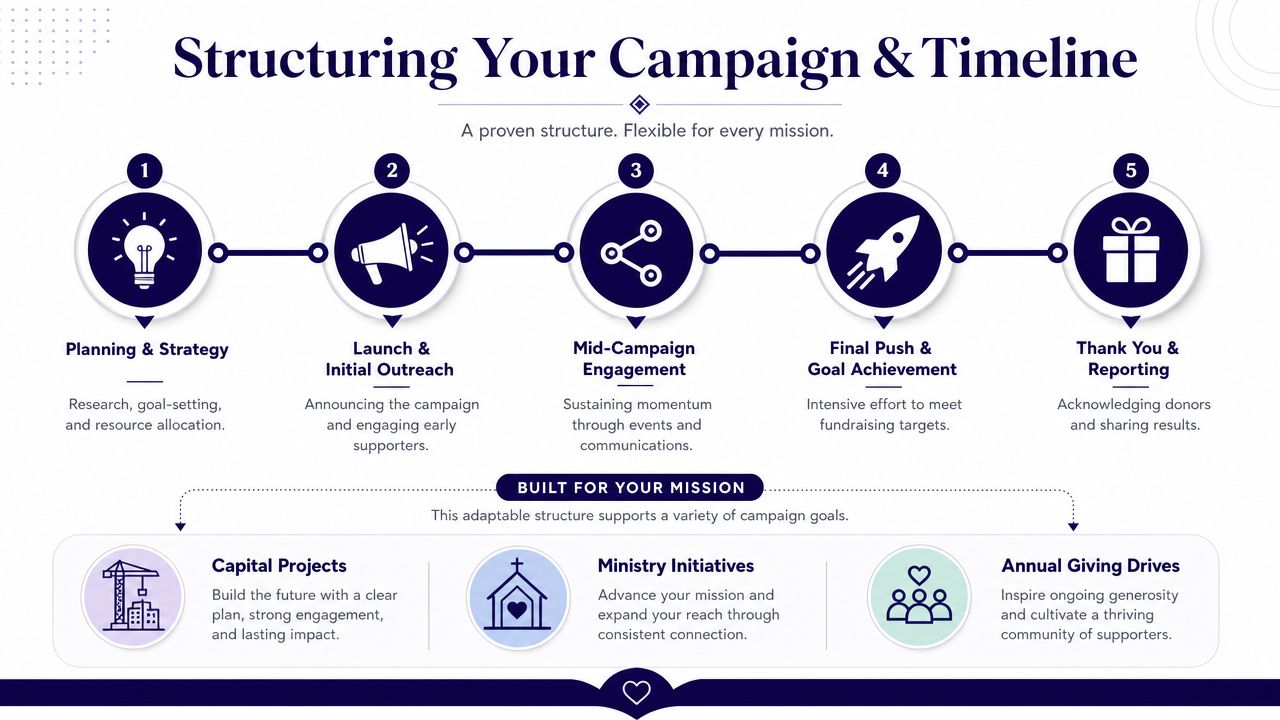
Not every fundraising need calls for the same kind of campaign. Churches often get into trouble when they use a capital-campaign process for a smaller ministry project, or when they treat a large capital need like a casual annual appeal.
Research into church capital campaigns indicates that over 80% of funds raised in a typical campaign come from roughly 20% of donors, which shows how much major gifts matter at the top of the giving pyramid (church capital campaign evaluation findings).
Choose the right campaign model
Here is a practical way to think about the most common options.
| Campaign type | Best fit | Common mistake |
|---|---|---|
| Capital campaign | Building projects, major renovations, debt-related goals, long-horizon needs | Going public before lead gifts are in motion |
| Targeted ministry initiative | New outreach effort, equipment, classroom refresh, local mission expansion | Making it feel too small to matter or too vague to trust |
| Annual giving drive | Budget support, year-end generosity, recurring stewardship emphasis | Treating it like a one-time event instead of a rhythm |
If the need changes the future shape of the church, a campaign should be structured and deliberate. If the need is narrower, the process can be lighter, but the story still has to be clear.
Build around phases, not one big launch
A good campaign has movement. It doesn't depend on a single kickoff Sunday.
A typical structure looks like this:
- Quiet phase. Leadership alignment, lead-gift conversations, messaging prep, materials, testimony collection.
- Public launch. Main announcement, sermon connection, printed and digital materials, first wave of broad participation.
- Momentum phase. Updates, testimonies, milestone celebration, volunteer follow-up, event support.
- Commitment and close. Clear giving windows, final asks, prayerful invitation, response tracking.
- Celebration and reporting. Thank-yous, progress communication, visible stewardship.
Churches that skip the quiet phase often force the congregation to carry all the early momentum. That's backwards. The broad base should be invited into something that already has prayer, clarity, and leadership commitment behind it.
Use a gift-range chart without overcomplicating it
A gift-range chart helps leaders match the fundraising goal to realistic giving conversations. Since campaign giving is often concentrated among a smaller share of donors, this tool keeps planning grounded in how campaigns work.
You don't need a fancy consultant binder to use the concept well. You need to answer practical questions:
- Which gifts would meaningfully move the campaign early?
- Who has the relationship and credibility to make those asks?
- How many households need a personal conversation?
- What kind of broad participation will support the culture of shared sacrifice?
A church that knows where lead gifts may come from can build a stronger timeline, a clearer communications plan, and a less frantic public launch.
For churches coordinating campaign events alongside ministry programming, it also helps to keep scheduling in one place. This guide to church event management software is useful if your team is trying to avoid calendar collisions, duplicated announcements, and volunteer confusion during the campaign season.
Crafting a Story That Inspires Giving
The campaign story is not decoration. It is the campaign.
If your church can't explain why this project matters in human terms, people will hear the numbers but miss the need. That's one reason some church fundraising campaigns feel heavy while others feel hopeful. The hopeful ones connect dollars to discipleship, mission, belonging, and changed lives.
In 2024, giving to religion totaled $146.5 billion. At the same time, a 2026 report found that 57% of Protestant churches reported an increase in digital giving, and digital channels now account for about 41% of total donations. That combination tells churches something important. generosity is still substantial, and communication now has to work in both traditional and digital environments (religious giving and church digital giving statistics).

The story has to answer three questions
Every strong campaign narrative answers these questions quickly:
- Why now
- Why this
- Why us together
"Why now" gives urgency without panic. Maybe a facility issue is limiting ministry. Maybe an outreach opportunity is open now but not forever. Maybe the church has reached a point where waiting costs more than acting.
"Why this" names the actual ministry outcome. Not just "improvements," but what those improvements enable.
"Why us together" turns the message from institutional need into shared calling. In this context, stewardship language matters. The church isn't watching leaders solve a budget problem. The church is being invited to participate.
Move from project language to ministry language
Here is the difference.
Project language says, "We need to renovate the lobby."
Ministry language says, "We want to create a welcoming first space for families, guests, and people who are trying church again after a hard season."
Project language says, "We need to update classrooms."
Ministry language says, "We want children and students to learn in spaces that reflect the care we say they matter with."
Neither version is dishonest. One reaches the heart faster.
If the campaign sentence only makes sense to the building committee, it isn't ready yet.
Use real church voices
The most persuasive campaign stories usually don't come from polished slogans. They come from recognizable people.
Use testimony from a parent, a volunteer, a ministry leader, or a long-time member who can connect the project to lived ministry. Keep it plain. Keep it concrete. A short story about hospitality, prayer, safety, discipleship, or community impact will often do more than a page of campaign copy.
A useful internal exercise is to ask five people from different ministries to finish this sentence: "If this campaign succeeds, our church will be able to..." Their answers often reveal the language that resonates.
Build the story in layers
Different people need different levels of detail. Give them multiple entry points.
- One sentence for announcements and hallway conversation
- One paragraph for email and website copy
- One testimony for worship or video
- One fuller case statement for serious questions and donor meetings
That layered structure keeps the story consistent even when many people are sharing it.
What doesn't work is making the congregation dig for the point. If people leave a campaign meeting still unsure what the church is asking and why, the message wasn't finished.
A Multichannel Plan to Amplify Your Message
A campaign can have a strong vision and still underperform if the message only shows up in one format. Sunday morning matters. It just isn't enough on its own.
People need repetition, but not random repetition. They need a coordinated message they can encounter in worship, email, social media, printed materials, events, and personal conversation. The churches that handle this well don't necessarily have bigger teams. They usually have tighter systems.

Build one message map before you make content
Start with a message map, not a pile of disconnected graphics.
Your message map should include:
- Core campaign statement. One clear sentence everyone can repeat.
- Three supporting themes. For example, ministry impact, congregational participation, and faithful stewardship.
- Key objections or concerns. Questions about timing, cost, transparency, or priorities.
- Primary actions. Pray, attend, give, share, ask questions.
Once that map is set, every channel has a job. Email can carry fuller updates. Sunday slides can reinforce milestones. Social can repeat testimony, progress, and event reminders. Print pieces can support households that don't track everything online.
Match channels to behavior
A practical multichannel plan usually looks like this:
| Channel | Best use |
|---|---|
| Sunday platform | Vision casting, testimony, milestone celebration |
| Detailed updates, FAQs, direct calls to respond | |
| Social media | Repetition, reminders, story snippets, visual progress |
| Website landing page | Permanent home for details, giving path, timeline |
| Printed handouts | Take-home clarity for households and older members |
| Personal meetings | Lead gifts, major concerns, deeper trust-building |
Churches often waste energy by trying to say everything everywhere. That's not the goal. The goal is consistency with the right level of depth in each place.
For teams trying to think more intentionally about that coordination, this overview of multi-channel marketing is a helpful framework.
Keep campaign content simple enough to sustain
The best communications plans are usually the ones volunteers can keep up with.
Use repeatable categories instead of reinventing the wheel each week:
- Monday update. Short progress note or prayer point.
- Midweek story. A testimony, ministry highlight, or behind-the-scenes look.
- Friday reminder. Event reminder, Sunday focus, or giving invitation.
- Sunday recap. Key message from the service plus next step.
That pattern reduces decision fatigue. It also helps your congregation know what to expect.
For physical event promotion, practical support pieces still matter. If your church is running outdoor gatherings, community nights, or seasonal campaign events, branded handouts can reinforce the message without feeling overproduced. Items like these source bulk church fans can fit naturally in hospitality and event settings when they're tied to a real communication need.
Watch the legal and operational edge cases
One of the biggest blind spots in church fundraising campaigns isn't creativity. It's compliance.
Mainstream fundraising advice often focuses on tactics and enthusiasm, but it rarely answers practical questions about whether raffles, games of chance, food sales, sponsorships, or peer-to-peer events trigger local permits, reporting duties, or tax issues. Churches should check local requirements and keep clean records before promoting those activities broadly (church fundraising compliance considerations).
Before you market a fundraising event, verify that the event is legally and operationally viable in your local context.
Once the church has announced an idea publicly, backing up gets harder. This situation can create confusion and frustration, which stem from planning challenges rather than a lack of generosity.
Don't let promotion outrun administration
I've watched churches create polished campaigns with weak follow-through. The graphics looked sharp, but donor questions sat unanswered, event details changed, and nobody updated the progress language. That disconnect erodes trust.
Your communications plan should be tied to a real internal workflow:
- Someone approves message changes.
- Someone confirms dates and event details.
- Someone tracks questions coming in.
- Someone updates progress language.
- Someone owns donor acknowledgment timing.
If those responsibilities aren't assigned, the campaign starts sounding less credible over time.
Stewarding Donors and Sustaining Momentum
A campaign doesn't end when the commitment cards are collected or when the online giving page spikes. The trust you build after the ask determines whether the campaign strengthens your culture of generosity or drains it.
Many churches lose ground when they work hard to launch, then go quiet too soon. Donors gave sacrificially. Volunteers invested time. The congregation prayed and responded. If the church disappears after that, people notice.
Data from the Association of Fundraising Professionals found that 79% of organizations said annual funds stayed the same or increased during the campaign year, and only 9% reported a decrease after the campaign ended. That undercuts the common fear that a campaign automatically harms regular giving (capital campaign impact on annual funds).
Stewardship after the gift
Thank-you language should be timely, specific, and human. Not generic. Not delayed until someone "has time."
A good stewardship rhythm includes:
- Prompt acknowledgment. Send a thank-you quickly enough that the donor feels seen.
- Pastoral gratitude. Use language that reflects ministry, not transaction.
- Visible progress. Show what the church is doing with the trust it received.
- Consistent reporting. Keep the congregation informed even after the excitement dips.
A handwritten note from a pastor or lay leader still carries unusual weight. So does a short personal message after a major milestone. Public appreciation matters too, but it doesn't replace direct gratitude.
Keep the congregation in the story
People don't only want to know whether the church hit a number. They want to know what their generosity is accomplishing.
Use updates that answer practical questions:
| Update type | What it communicates |
|---|---|
| Milestone reached | The campaign is moving and the church is responding |
| Funds deployed | Leaders are stewarding resources responsibly |
| Ministry impact | The project is serving real people, not just checking boxes |
| Next steps | The church still has a clear path forward |
Momentum lasts longer when the church reports progress with the same care it used to make the ask.
That doesn't mean constant hype. It means disciplined visibility. Even a short monthly update can maintain trust if it's clear and honest.
Guard against donor fatigue the right way
Donor fatigue is often blamed on asking too much. Sometimes that's true. More often, the deeper problem is asking without enough clarity, reporting, or purpose.
Churches reduce fatigue when they do a few things well:
- They connect every ask to mission.
- They don't surprise people with shifting goals.
- They tell the truth about progress and setbacks.
- They keep annual stewardship and campaign stewardship aligned.
When people understand how the campaign fits into the larger financial life of the church, the effort feels coherent instead of competitive.
Build a culture, not just a campaign
Some of the healthiest long-term results come from churches that treat the campaign as a discipleship moment, not a standalone project.
That means leaders keep talking about generosity after the public phase. They celebrate participation, not just large gifts. They report clearly. They thank people well. They keep tying ministry outcomes back to congregational faithfulness.
Church fundraising campaigns can create strain if they are rushed, vague, or leader-heavy. They can also deepen unity when the church experiences shared sacrifice, honest communication, and visible fruit.
The goal isn't to finish the campaign. The goal is to help the church come out of it stronger, more trusting, and more ready for the next season of ministry.
Churches don't need more content chaos during a fundraising push. They need a simple way to turn sermons into campaign-ready posts, create reels from key moments, design on-brand graphics, organize everything in a drag-and-drop calendar, and keep event promotion aligned with the church schedule. ChurchSocial.ai helps churches do exactly that, with AI tools built for ministry teams and volunteers who need to communicate clearly without adding another full-time job to the week.