Think of a digital prayer board as the modern evolution of the classic corkboard in the church hallway. It’s an online, 24/7 space where your congregation can post prayer requests, share good news about answered prayers, and minister to one another no matter where they are.
Why Your Church Needs a Digital Prayer Board
Let's be honest, community doesn't just happen on Sunday mornings anymore. An online prayer board isn't some complex tech project; it's about meeting your people right where they are—on their phones and laptops, day in and day out. It’s a vital tool for modern pastoral care.
The biggest win here is accessibility. Members who can't physically make it to church, whether they're homebound, traveling, or just have a crazy week, can stay plugged into the spiritual life of the church. This empowers them not just to ask for prayer, but to actively pray for others, keeping them connected and involved. It makes prayer an immediate and inclusive act for your entire church family.
Extending Your Ministry Beyond Church Walls
A digital prayer board takes a static, printed list and turns it into a living, breathing conversation. It allows your ministry to be a constant presence in the daily lives of your members, offering real support the moment it’s needed.
It fundamentally expands your reach:
- 24/7 Availability: Life happens at all hours, and so do prayer needs. An online board is a constant source of support, day or night.
- Wider Community Reach: For someone new to faith or just checking out your church, seeing a community that genuinely cares for one another can be a powerful invitation.
- Fosters Deeper Connection: When people see prayer requests followed by praise reports, it builds incredible faith and reinforces the power of a supportive church family. We talk more about these principles in our guide to building community online.
A digital prayer board is a powerful testament to a church’s commitment to carry one another’s burdens. It shows that pastoral care isn't confined to the church building but extends into the everyday moments of life.
And don't worry, this doesn't have to become another major task for your already busy staff. With ChurchSocial.ai, you can easily manage and update all of your church social media accounts. You can use our graphic templates and editor to create and post a beautiful "Praise Report" or an anonymous "Prayer Request" directly to your social feeds. Our simple drag-and-drop calendar makes it easy to keep a consistent prayer focus, turning a great idea into a sustainable ministry practice. Prayer boards are just one example; exploring various church use cases can spark even more ideas for using digital tools to serve your community.
Choosing the Right Platform for Your Community
Deciding where your digital prayer board will "live" is a huge first step. It’s easy to get overwhelmed by all the options out there, but the best choice really comes down to your church’s unique size and how comfortable your community is with technology.
For some, a simple, private page on the church website is perfect. It’s a centralized space you have complete control over. If your congregation is already all-in on Facebook, a private Group can be a fantastic, no-cost way to get started. You're meeting people right where they already are. Tech-savvy communities might even prefer a dedicated channel in an app like Slack or Discord, which encourages more of a real-time, chat-style connection.
This flowchart can help you visualize the initial fork in the road—whether to stick with a traditional paper list or move into the digital space.
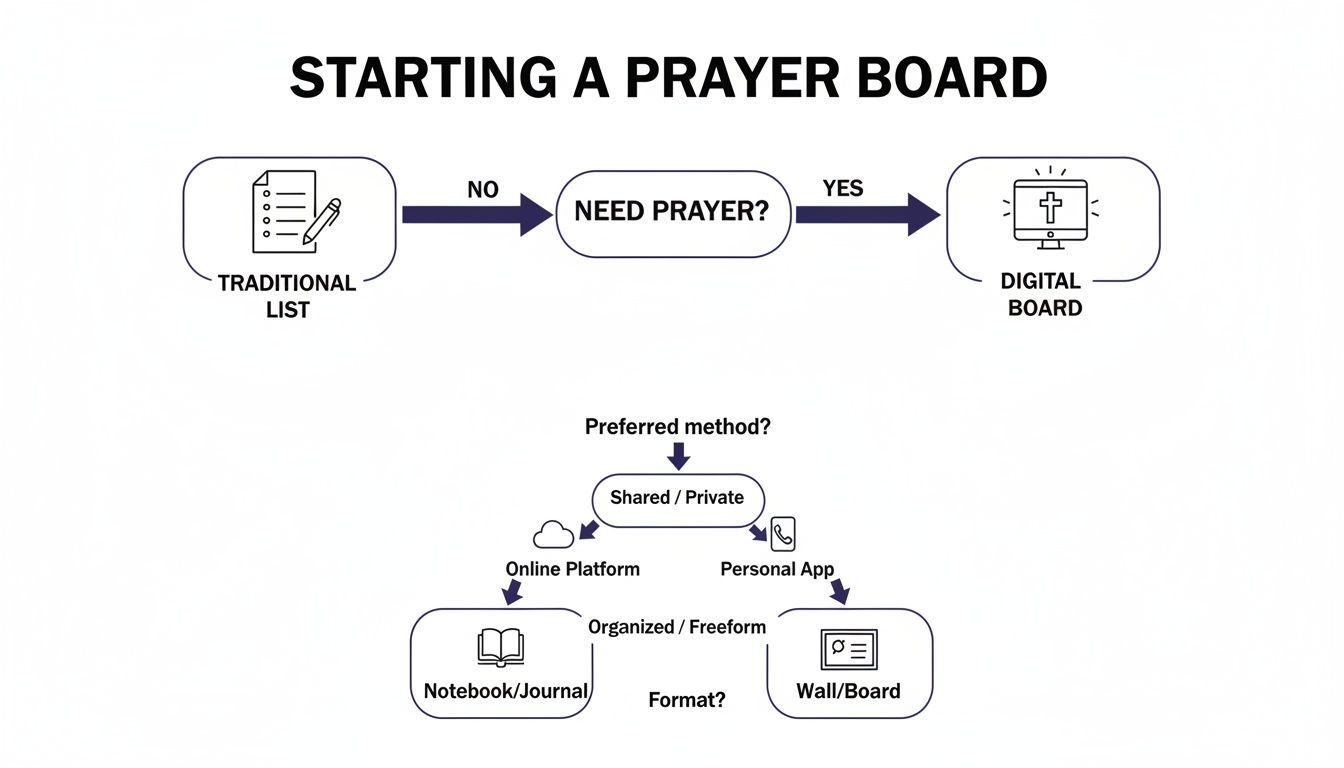
As you can see, when a need arises, going digital opens up a much more dynamic path for prayer than a static list ever could.
To help you weigh the pros and cons, here’s a quick breakdown of the most common platforms.
Platform Comparison for Your Digital Prayer Board
Choosing the right platform is the first step, but the real magic happens when you integrate it into a cohesive strategy.
Integrating Your Strategy with a Central Hub
No matter which platform you pick, a social media management tool like ChurchSocial.ai can act as the command center for your entire prayer ministry. This changes the game from just collecting prayer requests to actively sharing them in a powerful, unified way.
For example, you could use a private form on your website to gather requests confidentially. From there, your team can use ChurchSocial.ai to:
- Turn those requests into anonymized prayer posts or inspiring praise reports using professional graphic templates and our built-in editor.
- Schedule all this content to go out across your channels—like Facebook and Instagram—from a single drag-and-drop calendar.
- Use our AI to create generated reels from your sermons, turning a powerful moment from a message on prayer into a shareable video that points people to your prayer board.
This kind of integrated system makes sure your prayer ministry isn't just a side project but a living, breathing part of your church’s online life. If you're exploring how different tools can work together, you might want to read our thoughts on the best church software for small churches. And if you're ambitious enough to consider a custom app, understanding app development costs is essential.
The most effective digital prayer board isn't just a place to post requests; it's an integrated system that connects prayer needs with the broader life of the church community across all your digital channels.
Ultimately, you want to build a sustainable workflow. By centralizing your content creation and scheduling with a tool like ChurchSocial.ai, you empower your staff and volunteers to run a powerful prayer ministry without getting bogged down. It frees them from the hamster wheel of manual posting, giving them more time for what really matters: genuine pastoral care and connection.
Setting Up Your Digital Prayer Board
Alright, let's get practical. Taking your prayer board from a great idea to a living, breathing part of your ministry is easier than you might think. The key is to start simple and build a process you can actually stick with. It all begins with creating a safe, private space for people to share what’s on their hearts.
The easiest way to get the ball rolling is by setting up a straightforward submission channel. Don't overcomplicate it. A dedicated email address like prayer@yourchurch.com or even a free Google Form linked on your website works perfectly. The goal here is to establish a confidential starting point. When people know their vulnerability will be handled with care, you build the trust that will become the foundation of your prayer ministry.
Designing Your Prayer Content
Once those requests start coming in, you’ll need to think about how you'll share them. When it comes to social media, visual consistency helps your posts stand out in a busy feed. This is where a tool like ChurchSocial.ai can be a game-changer.
Instead of staring at a blank canvas for every single post, your church can use our pre-designed graphic templates and editor to create and post beautiful, on-brand photos and carousels in just a few minutes. I've found it's best to have two core content types ready to go:
- Prayer Request Images: These are simple, anonymous graphics that communicate the heart of a need without ever revealing private or identifying details.
- Praise Report Graphics: When a prayer is answered, shout it from the rooftops! Visually appealing graphics celebrating God's faithfulness are incredibly encouraging for the whole community.
Using templates ensures your prayer board feels professional and becomes a familiar, comforting part of your congregation's online experience. You’re not just posting words; you're creating a visual touchpoint for ministry.
Establishing a Content Rhythm
To keep your prayer board from feeling like an afterthought, you need to create a consistent rhythm. A predictable schedule helps your church family know when to check in for new requests and, just as importantly, when to share their own praise reports. You're building a habit of community prayer.
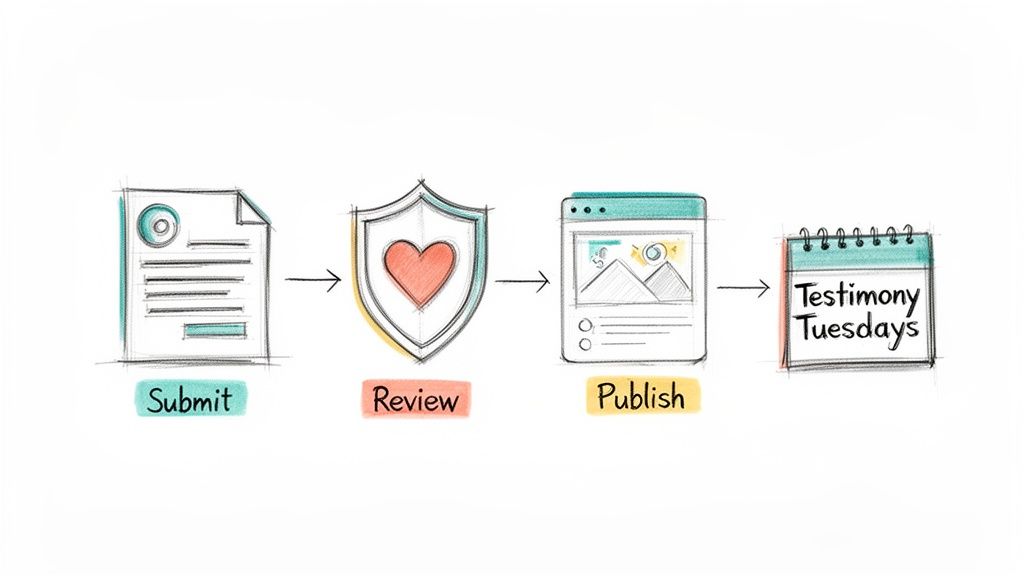
This can be as simple as theming your days, like "Testimony Tuesdays" or "Faithful Fridays." Little hooks like these create anticipation and give people a regular opportunity to see and celebrate how God is at work.
A consistent content rhythm does more than fill a calendar; it cultivates a culture of prayer and gratitude. It transforms your social media feed from a series of announcements into a space for active ministry.
The simple drag-and-drop calendar in ChurchSocial.ai makes it easy for churches to manage and update all of their social media. You can plan and schedule out your "Prayer Request" and "Praise Report" posts for weeks or even months. This turns what could feel like an overwhelming daily task into a sustainable ministry, freeing you up to focus on the people behind the prayers.
This kind of structured approach is meeting people right where they are. A 2023 Pew Research study found that 37% of U.S. adults already use apps or websites for prayer, with 8% using them daily. Discover more insights about how people use technology for faith on pewresearch.org. By creating a clear, consistent system, you're stepping into a space where your community is already looking for connection.
Fostering a Safe and Supportive Prayer Culture
A digital prayer board is built on a foundation of trust. Before people will share their deepest needs and vulnerabilities, they need to feel certain that their requests will be handled with care and confidentiality. This isn't just a tech issue—it's about creating a sacred space online.
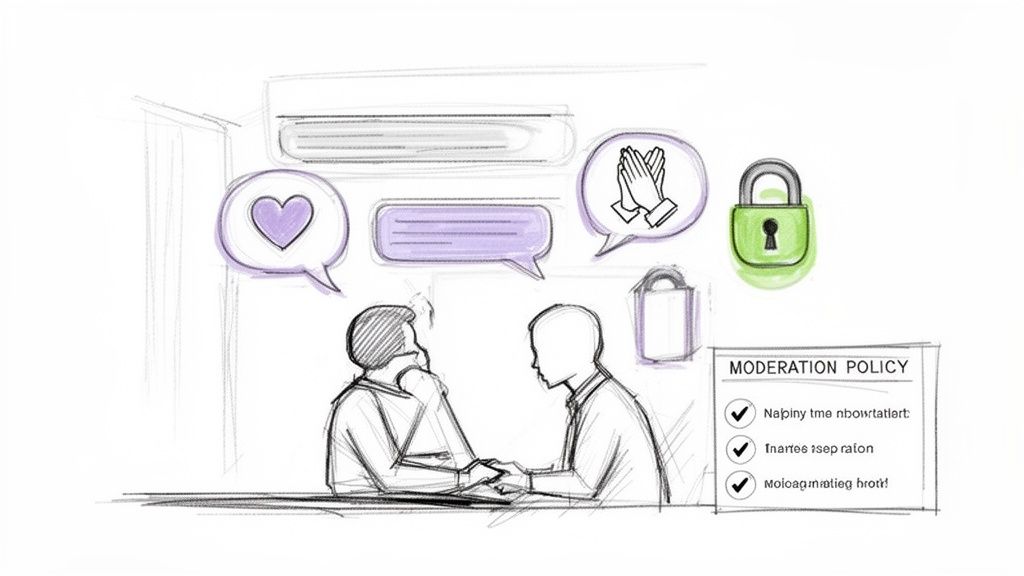
It all starts with a clear and simple moderation policy. This doesn’t have to be some stuffy, legalistic document. Think of it more as a short, grace-filled guide that sets expectations. How will you handle sensitive requests? What’s the plan for protecting confidentiality? What kind of comments are welcome to ensure the space remains Christ-like and supportive?
Empowering Your Moderation Team
You don't need a huge staff to make this work. In fact, a small, trusted team of dedicated volunteers or pastoral staff is often more effective. Their role is twofold: keep the space safe, and just as importantly, engage thoughtfully with every single request. A timely, compassionate acknowledgment can make all the difference to someone in need.
This is where a tool like ChurchSocial.ai can really support your church's social media management. Keeping a consistent, caring tone across multiple volunteers isn't always easy. ChurchSocial.ai helps unify that voice.
Your team can use its AI to help draft compassionate replies, or even generate entire social posts from a sermon transcript. This ensures every prayer request gets a grace-filled acknowledgment right away. For more tips on building a healthy digital space, check out our guide on community engagement best practices.
Establishing Your Moderation Policy
Your moderation policy should be easy to find and even easier to understand. Consider basing it on these core principles:
- Confidentiality First: All private requests will remain confidential. We will only share anonymized or general versions publicly if we have explicit permission.
- Supportive Comments Only: We expect all comments to be encouraging and prayerful. Any comments that are judgmental, offer unsolicited advice, or are otherwise uncharitable will be removed.
- No Soliciting: This is a space for spiritual support, not for fundraising, GoFundMe links, or business promotions.
- Pastoral Follow-Up: For requests of a highly sensitive nature, a member of our pastoral care team may reach out privately to offer additional support.
This digital approach to prayer has incredible potential for outreach, too. Barna Group research found that 68% of Christians are open to praying during online church services. This willingness even extends to those who aren't regularly attending—about 20% of non-practicing Christians engage in digital prayer every month. That’s a huge opportunity for reconnection.
A well-moderated digital prayer board doesn't just manage content; it models the heart of your church. It shows a real commitment to care, safety, and unwavering support for every person who shares a piece of their life with you.
By pairing clear guidelines with smart tools, you can create a prayer culture that is both deeply personal and safely public. You're building a space where people feel truly seen, heard, and carried by their church community, no matter where they are.
How to Promote Your Prayer Board and Boost Engagement
So you've built your digital prayer board. That's a huge win, but now comes the real work: turning it into a living, breathing part of your church's ministry. The goal isn't just to launch a tool; it's to weave prayer into the daily fabric of your community.
This all starts with a gentle, consistent nudge to get people there.
Your most powerful platform is, without a doubt, your Sunday service. A quick, heartfelt mention from the pastor can do more than a dozen emails ever could. Simply invite your congregation to visit the board, not just to post their own needs, but to intentionally pray for others. Frame it as what it is—an extension of how you already care for one another.
Creating a Multi-Channel Promotion Strategy
To really build momentum, you need to show up where your people already are. Think about every communication channel you have and make the prayer board a natural part of the conversation.
- Email Newsletters: Don't just bury a link. Dedicate a small, recurring section in your weekly email to the prayer board. You could feature an anonymized request or share a recent praise report to show the real-world impact.
- Social Media Announcements: Use your church's social media accounts to regularly point people toward the prayer board. This is where a tool like ChurchSocial.ai can be a game-changer.
- Website Banners: Make it impossible to miss. Place a clear, inviting banner or button right on your church website’s homepage.
Imagine this: you use ChurchSocial.ai to create AI generated reels from your sermons, grabbing a powerful 60-second clip from Sunday’s message about the power of prayer. You can instantly turn that into an engaging Reel for Instagram, then add a caption with a direct link to your new prayer board. Just like that, you've connected the "why" (the sermon) with the "how" (the prayer board) in a single, compelling post.
Driving Long-Term Engagement
The initial buzz is great, but keeping the prayer board active for the long haul is what matters. People will keep coming back when they see it's a place where prayers are actually being shared and answered.
This isn’t just theory. Research on the popular prayer app Pray.com showed that features driving long-term use include daily reminders (cited by 52.18% of users) and shareable content. What’s truly telling is that 59.94% of their users remained active for at least a year. It's proof that when a digital tool consistently meets a real spiritual need, people stick with it. You can read the full study to learn more about sustained app engagement.
A successful prayer board isn't about the launch party; it's about cultivating an ongoing culture of prayer. Consistent promotion and visible activity are what turn a new tool into an indispensable ministry.
This is where scheduling and consistency become your best friends. Using ChurchSocial.ai, your church can set up recurring posts that keep the prayer board top-of-mind. Use our built-in graphic templates and editor to design a "Praise Report Wednesday" or "Pray for Our Community Friday" series.
Even better, ChurchSocial.ai integrates with Planning Center and other church calendars to create content for events. This means you can schedule your prayer board promotions right alongside your other church events, ensuring it remains a visible and vital part of your community's life.
Common Questions About Digital Prayer Boards
Even with the best plan, starting something as personal as a digital prayer board can bring up a few questions. That's perfectly normal. Let's walk through some of the most common concerns we hear from church leaders so you can move forward with confidence.
How Do We Handle Very Personal or Sensitive Prayer Requests?
Privacy is everything. The key is to offer different ways for people to submit requests, protecting them every step of the way.
If you're using a more public space, like a social media feed, your moderation policy needs to be crystal clear. Make sure everyone knows that all prayers are reviewed for privacy. This often means rephrasing a request to be more general—for instance, changing a specific post to "Please pray for a family member undergoing a medical procedure" to protect names and private health details.
For those deeply sensitive situations, you absolutely need a private, secure channel. This could be a dedicated email address or a secure form on your church website that sends requests directly to the pastoral team. Never post sensitive details publicly without explicit, written permission.
We Are a Small Church with No Budget for New Software
You don't need a big budget to get this ministry off the ground. In fact, you can start for free.
A private Facebook Group is a fantastic, no-cost option that most of your congregation is probably already familiar with. You can also use free tools like Google Forms to collect the requests and then share them in a simple email newsletter.
The goal is to start small and show how valuable this is. Once you're ready to expand, you’ll find that platforms like ChurchSocial.ai are designed to be affordable. The time you save on creating and scheduling content often provides a return that easily covers the small cost.
How Can We Encourage Praise Reports and Not Just Requests?
Building a culture of gratitude means you have to be intentional. Don't just wait for praise reports to trickle in—actively look for them and make a big deal out of them when they arrive.
Regularly share answered prayers, whether they come from your staff or (with permission) from your community. This is where creating great visuals can make all the difference.
"A thriving prayer ministry isn't just about sharing burdens; it's about celebrating victories. When your community sees God at work, it builds tremendous faith and encourages more people to share."
Your church can use the graphic templates and editor inside ChurchSocial.ai to create beautiful "Praise Report!" or "Answered Prayer!" posts in just a few minutes. Try adding a recurring feature like "Testimony Thursday" or "Faithful Friday" to your content calendar. It’s a simple way to consistently remind your church to share the good things God is doing.
How Much Time Does Managing a Digital Prayer Board Take?
The time it takes really depends on the system you have in place.
If you're doing everything by hand—creating graphics from scratch, writing captions, and posting to different platforms one by one—it can easily eat up several hours every week. This is where burnout can sneak in.
With a platform like ChurchSocial.ai, however, you can streamline the entire workflow. Your church can create AI generated content from sermon transcripts like social posts and blogs, use our graphic templates, and schedule all your posts in advance from a simple drag-and-drop calendar. This can shrink your management time down to just 1-2 hours per week. This frees up your team to do what really matters: focusing on pastoral care and connecting with people.
Ready to unify your prayer ministry and transform your church's social media? With ChurchSocial.ai, you can turn sermon clips into engaging Reels, create stunning graphics with easy-to-use templates, and schedule all your content from a simple drag-and-drop calendar. Stop spending hours on social media and start building a more connected community today. Learn more and get started at ChurchSocial.ai.