Almost nine out of ten Norwegian Christian churches posted on Facebook at least monthly, and 71% posted weekly or more often, according to a 2021 church social media benchmark study. That finding changes the question for busy pastors and volunteers. The issue isn't whether a church should appear online. It's whether the church has a dependable rhythm that helps people find, remember, and respond to its ministry.
Introduction Why Church Social Media Statistics Matter Now
Church social media statistics are useful because they replace guesswork with practical decisions. A volunteer may wonder whether a post reached enough people, while a pastor may wonder whether creating another video is worth the effort. Benchmarks can't tell you exactly what your congregation will do, but they can show how other churches organize their limited time and where digital ministry has become routine.
A church's social presence works more like a weekly noticeboard than a one-time advertisement. A single announcement may be helpful, but a predictable stream of encouragement, teaching, community updates, and invitations gives people more opportunities to connect. The Norwegian data suggests that churches had already normalized regular Facebook publishing by the early 2020s, which makes consistency a more useful starting point than chasing a viral post.
Statistics also help churches practice stewardship. Your team may have only a few volunteer hours, limited video skills, and no dedicated designer. Platform adoption data can help you decide where to focus first. Content and engagement data can help you determine whether your effort is producing conversation, attendance interest, video viewing, or useful next steps.
Practical rule: Treat statistics as a compass, not a report card. They point toward a sensible direction, but your church's mission and community determine the route.
The current picture is broader than Facebook alone. A 2025 Church Media Effectiveness Survey reported YouTube at 61.7%, Facebook at 49.8%, and Instagram at 38.1% among respondents. Those figures point toward a mixed ecosystem, with long-form video, community communication, and visual mobile content working together.
The most useful path is progressive. First, understand where churches are active. Then compare each platform's ministry role, interpret cadence and content benchmarks carefully, and build a workflow that a small team can sustain.
How Churches Use Social Media Today
Church social media has moved from a single-network habit toward a connected platform mix. Facebook often serves as the church bulletin board, YouTube acts as a searchable teaching library, Instagram provides a visual window into church life, and short-form video platforms can help a message travel beyond the existing congregation.
That doesn't mean every church needs to publish everywhere immediately. Presence, cadence, and performance are different measures. Presence means an account exists. Cadence means the account receives content regularly. Performance asks whether people watch, respond, share, save, click, or take another meaningful step.
The distinction matters because an abandoned account can create less confidence than a focused, active one. A small church may serve its community better with a reliable presence on two platforms than with neglected accounts across every network.

One feed can serve several ministry purposes
A UK church social-media study identified four broad uses for church social channels: building a brand, building church community, outreach, and developing spiritual mission. That combination explains why a church feed can contain an event invitation beside a prayer prompt, a sermon clip, a volunteer story, or a practical message of encouragement.
Facebook's historical role shows how quickly routine communication can become embedded in church operations. LifeWay Research reported that Facebook use in churches grew from 57% in 2011 to 70% in 2013, and later reporting said 84% of churches had a Facebook page by 2017 in a Baptist Press analysis. The same report identified upcoming-event information, congregation interaction, and interaction with outsiders as common purposes.
A dependable social system also supports the practical work behind ministry. For example, churches reviewing volunteer roles may need a clear church volunteer background check resource when preparing people to serve safely at events, with children, or in other ministry settings. Social media can communicate the opportunity, while responsible administration protects the people involved.
The multi-platform church needs a shared message
A unified message doesn't require identical posts. The same sermon can become a reflective caption on Facebook, a vertical clip on Instagram, a teaching excerpt on YouTube, and a concise invitation on another short-form channel. Each version should respect the platform's audience and format while preserving the church's voice.
This is why churches should think in terms of a content ecosystem. One source can support several useful expressions, reducing the pressure on volunteers to invent something new for every account.
Platform Breakdown for Facebook Instagram TikTok and YouTube
The platform question becomes easier when you connect each network to a ministry goal. Facebook is generally suited to recurring community communication and events. Instagram rewards visual storytelling and mobile-friendly formats. YouTube supports discoverable teaching and sermon archives. TikTok can function as a short-form reach channel when the church has content that works in brief, native clips.
The 2025 survey cited earlier placed YouTube at 61.7%, Facebook at 49.8%, and Instagram at 38.1% among respondents. Those figures describe platform use within that survey, not a universal formula for every congregation. A rural church, a city church, and a multi-site network may make different choices based on volunteer capacity and audience habits.
Facebook as the community and events hub
Facebook's strength is continuity. Churches can use it for event details, schedule changes, community conversation, sermon links, and reminders that people can find later. The Norwegian benchmark found that almost nine out of ten churches posted there at least monthly, while 71% posted weekly, according to published research on Norwegian Christian churches.
That cadence gives a church more than visibility. It creates a repeatable place where people can check what is happening and respond to the church's current life.
Instagram as the visual layer
Instagram works well for sermon excerpts, carousel teaching, event graphics, prayer prompts, and simple visual reminders. The same Norwegian research found that only close to one in five churches posted on Instagram monthly, which suggests a gap between Facebook's established operational use and Instagram's less mature adoption in that setting. Churches shouldn't read that as a reason to ignore Instagram. They should read it as a reminder that a visual strategy requires intentional design and content preparation.
YouTube as the teaching archive
YouTube's leading position in the 2025 survey reflects the value of video-first distribution. Sermon recordings, livestream archives, interviews, Bible teaching, and short clips can remain discoverable after the original service ends. A church doesn't need every video to be polished like a broadcast. Clear audio, a useful title, readable thumbnails, and a consistent publishing habit often matter more than elaborate production.
TikTok and the challenge of live video
Short-form channels can introduce a sermon idea or ministry perspective to people who don't already follow the church. The Nigerian church study reported WhatsApp adoption at 100%, Facebook at 87.5%, and YouTube at 62.5%, while Instagram Live was used by 6.25% and YouTube Live by 18.75% among surveyed churches, as summarized by ReachRight's church social media research. The contrast suggests that uploading and messaging are easier to establish than real-time video workflows.
| Platform | Primary Role | Best Content Types | Effort Level |
|---|---|---|---|
| Community and events | Announcements, discussions, invitations, links | Low to moderate | |
| Visual storytelling | Reels, carousels, clean graphics, stories | Moderate | |
| TikTok | Short-form discovery | Brief sermon ideas, accessible encouragement, vertical clips | Moderate |
| YouTube | Long-form teaching | Sermons, archives, interviews, teaching videos | Moderate to high |
Choose the platform that matches the goal and the people available to maintain it. Churches that want to inspect short-form results can use the TikTok analytics guide to understand what viewers watch and how they respond.
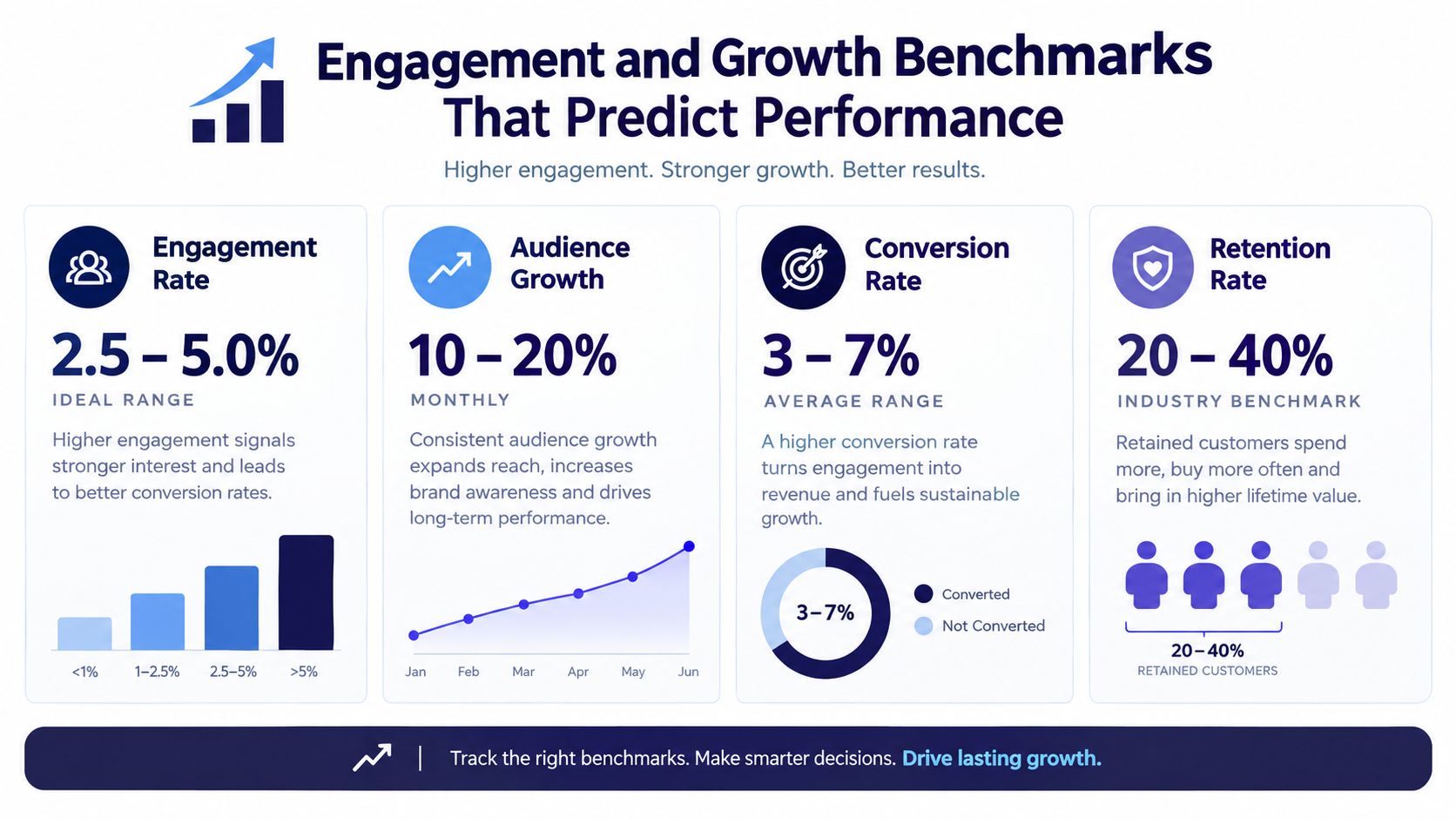
Engagement and Growth Benchmarks That Predict Performance
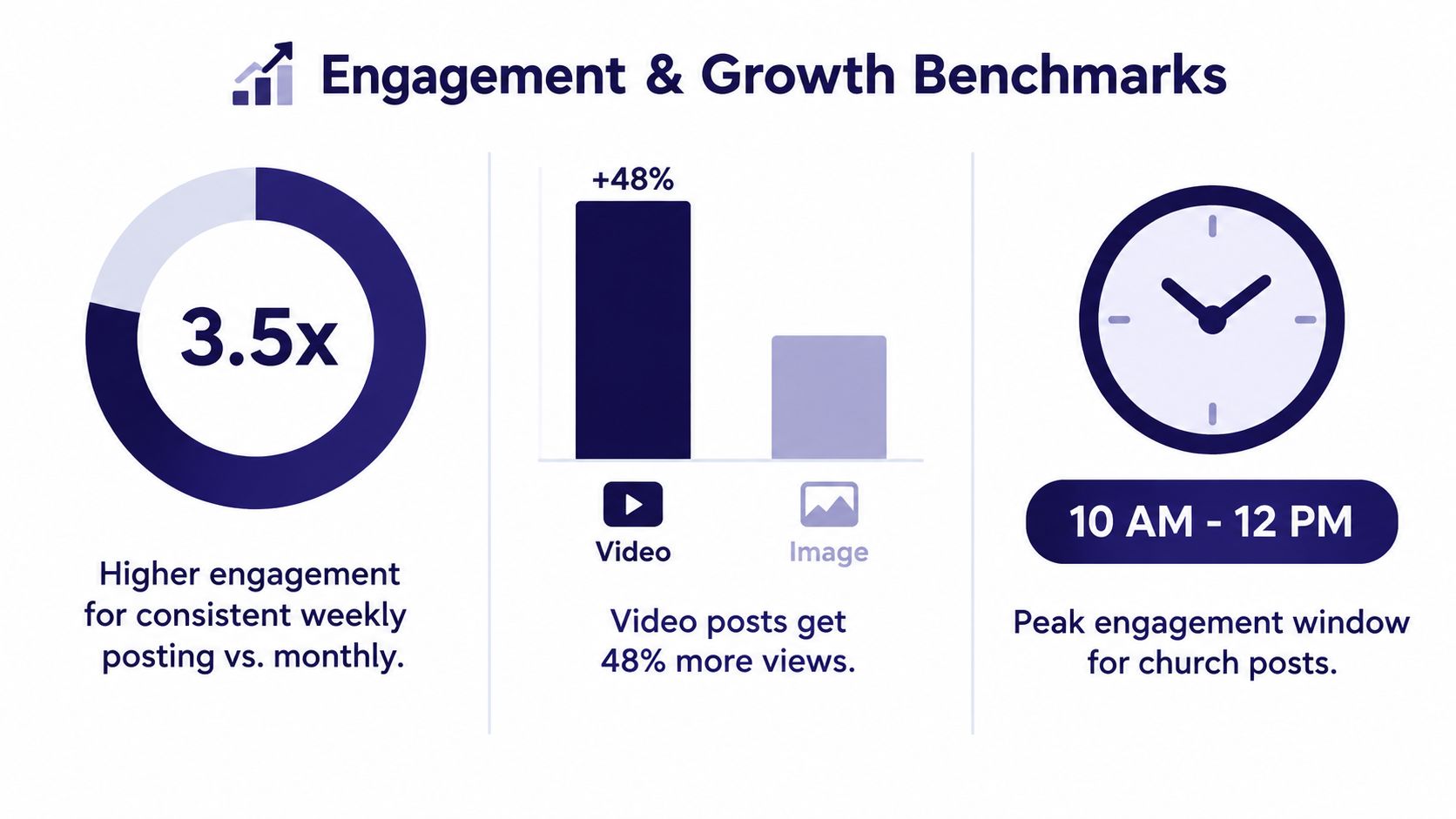
A church can have an account on every major platform and still struggle if publishing is irregular or content is difficult to consume. The strongest benchmark pattern is operational: churches that post consistently give their audience more predictable opportunities to encounter the message.
The Norwegian study's 71% weekly posting figure, alongside its monthly adoption finding, illustrates the difference between having a page and maintaining a communication rhythm. Weekly publishing also gives a volunteer team more feedback. If one post receives comments and another receives shares, the team has something concrete to review rather than relying on a single occasional result.
Measure responses, not just exposure
Reach can show how many people encountered a post, but it doesn't explain whether the post helped them. Engagement gives more context, especially when you separate passive reactions from actions that signal interest.
A useful review asks:
- Conversation: Did people comment, reply, or ask a question?
- Sharing: Did someone pass the message to another person?
- Saving: Did the content seem useful enough to revisit?
- Viewing: Did people watch the video long enough to understand its point?
- Next step: Did anyone click, register, message the church, or visit an event page?
A guide for content creators can help volunteers understand engagement as a set of audience actions rather than a single score. For churches, the most meaningful signal depends on the post's purpose. An event post may aim for registrations, while a devotional may aim for saves or thoughtful replies.
Repurpose before adding production complexity
The Nigerian adoption pattern also highlights a sensible order of operations. Churches often establish messaging and uploaded content before live streaming because live video requires bandwidth, equipment, coordination, and someone who can respond when something fails.
That doesn't make live video unimportant. It means a small team can first extract useful clips from existing sermons, add captions, and publish them in platform-native formats. Once the workflow is dependable, the church can decide whether live production deserves more investment.
Use a simple monthly review rather than a complicated dashboard. Compare the formats and purposes that performed best, note which posts created meaningful action, and choose one adjustment for the next cycle. ChurchSocial.ai's guide to tracking content performance provides a practical reference for organizing that review.
Audience Insights and Content Purposes That Shape Strategy
Statistics become useful only after a church connects them to people. A post for a first-time visitor shouldn't sound like a scheduling memo for an established member. A prayer prompt, a service reminder, and a sermon clip can all belong to the same ministry, but each one should answer a different audience need.
The UK study's four purposes offer a helpful lens:
- Brand: Show the church's tone, values, and identity through consistent language and design.
- Community: Help people see how members connect, serve, learn, and care for one another.
- Outreach: Explain invitations and events in language that makes sense to someone unfamiliar with church routines.
- Spiritual mission: Offer Scripture, prayer, teaching, and encouragement that can serve people beyond Sunday attendance.
Match purpose to format
An event invitation may need a clean graphic, date, location, and clear next step. A community post may work better as a short story or a behind-the-scenes image. A spiritual mission post could use a sermon excerpt, a written reflection, or a carousel that develops one idea across several panels.
Design affects whether people can understand the message. Shutterstock guidance recommends using photos with built-in white space, avoiding busy or complex images, and limiting text to places where it fits naturally. WCAG-based readability guidance recommends a minimum 4.5:1 contrast ratio for legible text, especially on social graphics, according to church visual-design and text-overlay guidance.

Adapt without losing the church's voice
Urban and rural context can also affect content choices. The Norwegian research found that urban churches were nearly twice as likely as rural churches to post videos online somewhat regularly, 22% compared with 12%, in the study of church social media use. That difference doesn't establish a universal rule. It does show why teams should compare their own context rather than copying another church's schedule.
Keep the visual system recognizable, but don't force every post into the same template. Whenever possible, choose images without people if the message can stand on its own, and place text only where it naturally belongs, such as on a paper, whiteboard, sign, or a deliberate post-production overlay. Clear design helps people understand the invitation before they decide whether to engage.
Turning Statistics Into a Simple Weekly Workflow
A sustainable workflow starts with one source of truth, usually the sermon, teaching outline, or church calendar. Instead of asking a volunteer to create unrelated posts from scratch, the team can identify several small pieces of content that serve different purposes and platforms.
ChurchSocial.ai can generate sermon-based reels, create social posts and blog drafts from a sermon transcript, provide graphic templates and an editor for photos and carousels, and organize publishing through a drag-and-drop calendar. Its integrations with Planning Center and other church calendars can also help turn scheduled events into planned content.
Build the week from one message
Start with the sermon transcript or recording. Mark a clear teaching idea, a memorable explanation, a practical application, and a question that invites reflection. Then assign each piece a format.
- Teaching clip: Create a short vertical reel from one complete thought, with captions and a concise description.
- Reflection post: Turn the sermon transcript into a short written encouragement for Facebook or Instagram.
- Carousel: Break one explanation into a sequence of readable slides with generous white space.
- Long-form resource: Expand the central idea into a blog post or YouTube description.
- Invitation: Connect the teaching to an upcoming group, service, or event from the church calendar.
This process preserves the pastor's voice while reducing repeated work. A volunteer still reviews every draft for theology, tone, names, dates, and accessibility before publication.
Keep the calendar manageable
Use a visual calendar to see whether the week contains a healthy mix of teaching, community, outreach, and spiritual mission. Schedule the approved versions for each platform rather than copying one caption everywhere. Build a small library of reusable templates, but change the image, opening line, and call to action so the feed doesn't feel mechanical.
Before expanding into live video, make sure the team can reliably publish clips from existing recordings. A dependable repurposing system gives you more opportunities to test topics and formats without adding another production burden.
For teams deciding how to evaluate their workflow, the church social media analytics tools guide offers a starting point for reviewing reach, engagement, clicks, messages, saves, and watch time. Those measures become more useful when the team connects each one to a specific ministry purpose.
Conclusion Your Next Steps to Improve Performance
Church social media statistics point to a clear decision framework. Start with a platform your team can maintain, build a predictable publishing rhythm, repurpose sermon content into video and visual formats, and give each post a defined purpose. Facebook's established weekly cadence, YouTube's strong position in the 2025 survey, and the broader multi-platform pattern all suggest that churches shouldn't rely on one occasional announcement or one network alone.
A simple audit can reveal your next move:
- Review your cadence: Identify whether your pages receive regular attention or only occasional bursts.
- Map your platforms: Write down the ministry role each account serves.
- Label your content: Mark recent posts as community, outreach, brand, or spiritual mission.
- Check readability: Look for cluttered backgrounds, small text, and weak contrast.
- Study meaningful actions: Review comments, shares, saves, viewing behavior, clicks, and messages.
- Choose one improvement: Make the next publishing cycle more consistent rather than trying to fix everything at once.
Small teams don't need to imitate a large production department. They need a repeatable system that turns the work they already do into useful communication. ChurchSocial.ai supports that approach by helping churches create sermon reels, draft transcript-based content, design graphics and carousels, schedule posts, and manage events through a shared calendar.
Measure progress by whether your church communicates more clearly, serves people throughout the week, and creates easier paths toward meaningful connection. The goal isn't to win a platform contest. It's to steward attention well and make the church's message easier for people to encounter.
ChurchSocial.ai helps churches turn sermons and church-calendar events into reels, social posts, blogs, graphics, and scheduled content managed from one visual calendar. Visit ChurchSocial.ai to plan and manage your church's social media with a workflow built for pastors, staff, and volunteers.