It’s Tuesday morning. The notes file is open, the week is already full, and Sunday will not wait.
That moment is familiar to pastors in every kind of church. Hospital visits, staff questions, counseling, budget decisions, volunteer follow-up, family responsibilities, and surprise problems all compete with sermon work. Good pastors do not need more guilt at that point. They need trustworthy help, sound judgment, and a process that saves time without flattening their voice.
Free sermons for pastors can serve that purpose well. The right resource can help you find a clearer structure, test your interpretation, tighten application, or get unstuck when the blank page is winning. The wrong resource creates a different problem. It gives you generic material, shaky theology, or polished wording that does not fit your people.
That is why this list does more than collect websites. It sorts sermon resources by what they do well. Some are better for full ministry packages. Some are strongest in expository depth. Some work best as idea libraries that still require careful pastoral work. Wise use starts with matching the tool to the task.
It also requires ethics. Borrowed material should be adapted with honesty, shaped by your church’s context, and preached with conviction that comes from your own study. If you need a clearer process for building a faithful message from study to outline, this guide on how to prepare a sermon step by step is a useful companion.
The bigger opportunity comes after the sermon is preached.
A strong message can serve your church all week if you plan for it. One sermon can become short clips, quote graphics, small group prompts, a devotional email, a follow-up post for guests, and content for ministries that need alignment across the week. Tools like ChurchSocial.ai help pastors turn one finished sermon into a practical digital ministry workflow instead of letting it disappear by Sunday afternoon.
What follows is a curated list of sermon resources I would hand to a busy pastor who needs reliable material, clear trade-offs, and a better system for preaching and week-long ministry content.
1. Life.Church Open Network

If your church needs more than a manuscript, start with Life.Church Open Network.
This is one of the strongest places to find free sermons for pastors when the problem isn’t just sermon ideas. It’s the whole Sunday system. Open Network is useful when you need sermon notes, design assets, calendars, and ministry alignment across age groups.
Where it helps most
Some free sermon libraries give you a draft and leave you to build everything else. Open Network doesn’t work that way. It gives churches a fuller package, which matters if you’re preaching, planning slides, coordinating social posts, and trying to give volunteers something usable by midweek.
You’ll find:
- Series packages: Complete themes that are designed to be reused and adapted.
- Editable assets: Graphics and support material that help small teams move faster.
- Ministry alignment: Adult series often connect with kids and youth resources.
- Planning support: Helpful when you’re trying to see more than one Sunday ahead.
That makes it especially valuable for pastors in smaller churches or for staff teams that don’t have an in-house designer.
Practical rule: Use Open Network for structure and support material, not as a substitute for local application. The stronger the package, the more intentional you need to be about making it sound like your church.
The trade-off
The quality is usually steady, and the intent is clearly church reuse. That’s a major advantage. The trade-off is style. A lot of the content reflects Life.Church’s tone, pacing, and topical framing. If your preaching style is more text-driven or more liturgical, you’ll need to adapt heavily.
You also need an account to download resources. That’s not a major burden, but it is one more step.
For pastors who need a better weekly process before they need another sermon archive, pair this kind of resource with a disciplined prep flow. This guide on how to prepare a sermon is a good complement because it helps you use a resource library without letting the library preach the sermon for you.
2. SermonCentral

SermonCentral is the big warehouse. When pastors say they’re looking for free sermons for pastors, this is often one of the first names that comes up.
Its real strength is volume. The platform is broad enough that if you’re preaching on a specific text, theme, or holiday, you can usually find multiple approaches fast.
Best use of SermonCentral
Use this site for comparison, not blind adoption.
The platform is helpful when you need to answer questions like these:
- How have other pastors structured this passage?
- What illustrations keep showing up around this theme?
- What angles am I missing?
- Is my outline clear, or am I making the sermon harder than it needs to be?
The search options make that process easier. You can sort by topic, Scripture, and contributor, which is useful when the clock is working against you.
One background challenge in this category is that search results around free sermon content often don’t help pastors evaluate fit very well. The available sermon pages tend to be heavy on listings and light on comparison guidance, denominational alignment, and practical adaptation advice (analysis of the gap in how pastors evaluate free sermon content). That’s exactly why SermonCentral works best when you already know what kind of preaching voice and theology you’re trying to preserve.
What works and what doesn’t
What works is idea mining. What doesn’t work is assuming a large library equals consistent quality.
Some entries are strong. Some are thin. Some are solid outlines with weak application. Others are illustration-heavy and text-light. That range is the price of an open contributor model.
A few practical cautions:
- Check theological fit: Don’t assume agreement because the title sounds familiar.
- Watch the date and tone: Some sermon language ages poorly.
- Don’t lift application wholesale: Application has to fit your people, not the original contributor’s audience.
After you’ve adapted a sermon framework, the next wise move is to extend it into weekday ministry. This article on how to repurpose content is useful if you want to turn one message into posts, clips, and follow-up content instead of letting it disappear by Monday.
3. The Gospel Coalition Sermons
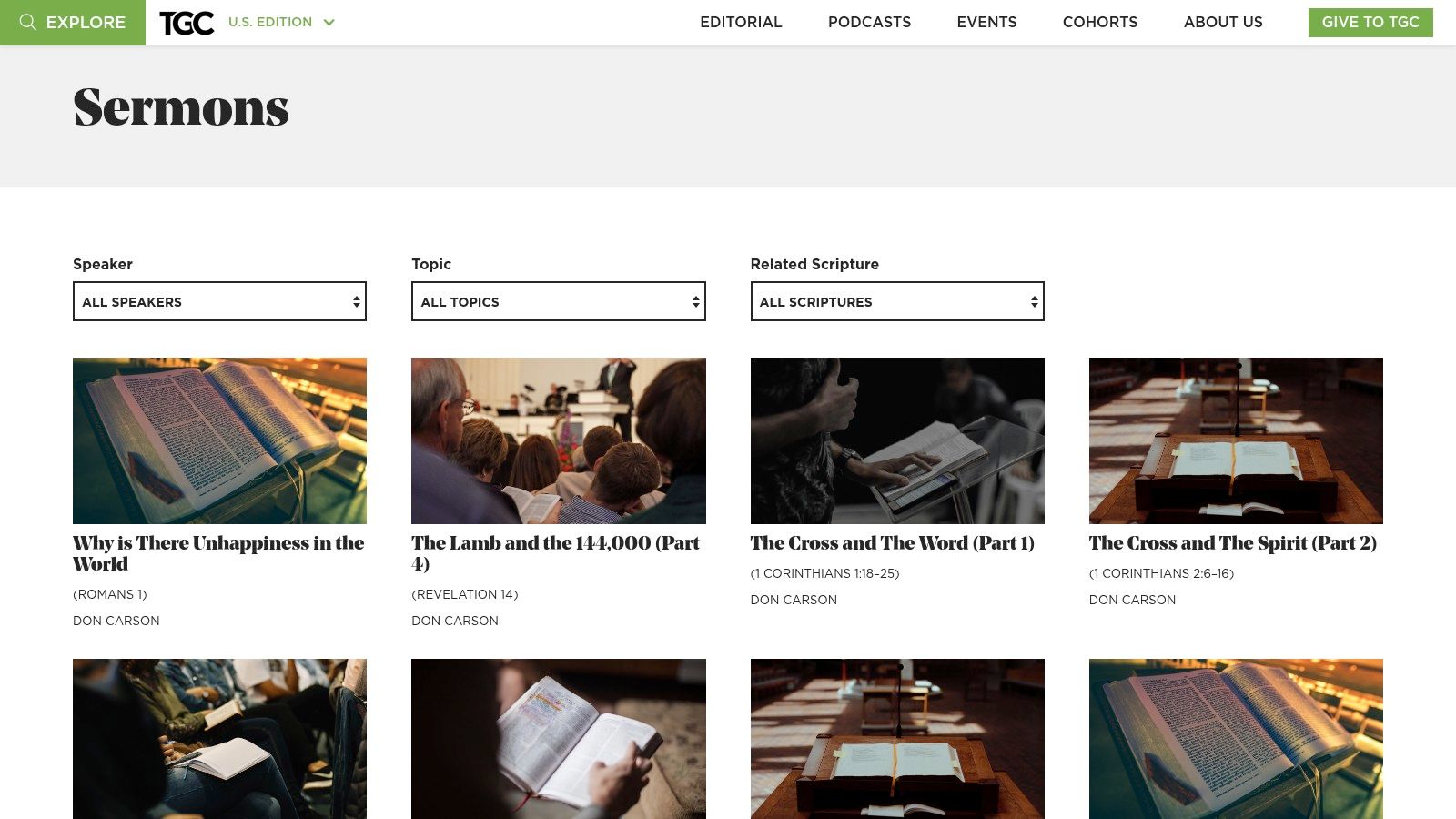
If your default instinct is expository preaching, The Gospel Coalition’s sermon archive is worth searching early.
This is not the place I’d send a pastor who wants an all-in-one plug-and-play package. It is the place I’d send someone who wants to pressure-test interpretation, structure, and doctrinal framing.
Why pastors keep returning to it
TGC’s archive is useful because it tends to stay close to the text. You can search by speaker, topic, Scripture, and chapter, which helps when you’re working through a biblical book or trying to see how different preachers handled a difficult section.
The site is especially useful for:
- Cross-checking interpretation: Helpful before you settle your outline.
- Studying sermon movement: Many messages show how a preacher got from observation to exhortation.
- Finding theological clarity: Good for sharpening categories and language.
That makes it a better research shelf than a sermon kit.
A strong sermon archive doesn’t save time by replacing study. It saves time by helping you avoid weak turns in study.
The trade-off you need to notice
TGC leans broadly Reformed evangelical. For some churches, that’s a strength. For others, it means you’ll need to translate categories, tone, or assumptions before anything reaches the pulpit.
It also doesn’t come with the practical extras many churches now need. No bundled graphics. No easy sermon calendar. No ready-made curriculum tie-in.
That’s not a flaw. It just means you need another layer in your workflow if you want the message to carry beyond the room. One of the easiest ways to do that is by building clean sermon visuals and post-service assets around your message. This guide to church sermon graphics is useful if your team wants the message to look as thoughtful online as it sounded in the room.
4. Desiring God Messages

Desiring God Messages is where I’d go when a passage feels dense, doctrinally loaded, or easy to mishandle.
John Piper’s style is distinctive, and that matters. You’re not browsing a neutral sermon warehouse. You’re stepping into a library shaped by a clear theological voice. Used wisely, that’s a strength.
When this archive is especially helpful
Some sites are best for finding a quick angle. Desiring God is better when you need depth.
The archive is strong for:
- Exegetical help: Especially on passages that need patient handling.
- Doctrinal precision: Useful when your sermon turns on exact wording or concepts.
- Transcript access: Helpful if you think better by reading than listening.
You can search by topic, series, and Scripture. That makes it practical when you want to trace a theme over time rather than just find one sermon on one text.
Why it’s not for every week
The same focused voice that makes the archive powerful can also make it limiting. If you rely on it too heavily, your preaching can start borrowing another preacher’s rhythms.
That’s a problem with any single-voice library. The issue isn’t quality. The issue is overexposure. Your church needs your pastoral instincts, your local applications, your tone in the room.
So I’d treat Desiring God like a trusted commentary shelf with a strong preaching instinct attached. Pull it in when you need help untangling a text or clarifying a doctrinal center. Don’t let it set every sermonic habit you have.
A practical way to use it is this: read or listen after you’ve already built your basic structure. That lets the archive sharpen your sermon without swallowing your voice.
5. Grace to You Sermon Archive

If you preach verse by verse and want to see what long-haul exposition looks like, Grace to You’s sermon archive is one of the clearest examples online.
This library is especially helpful for pastors who are working through a New Testament book and need to see how another expositor handled sequence, pacing, and textual detail over time.
What stands out
The site is well organized. You can browse by Scripture, title, date, and series. The Smart Transcript feature is especially useful because it helps you move between audio and text without losing your place.
That matters when you’re trying to do one of two things:
- Follow an expository chain: How does one sermon set up the next?
- Study structure: How does a preacher move from detailed observation to clear proclamation?
For pastors who feel pressure to keep reinventing sermon form every week, this archive is a steady corrective. It reminds you that clarity and faithfulness often matter more than novelty.
Know the limits before you lean on it
This is a single-primary-voice archive with a specific theological posture. That can be clarifying, but it can also narrow your range if you use it uncritically.
Some older recordings also vary in audio quality, which may matter if you prefer listening instead of reading.
What I like most about Grace to You is that it rewards patient pastors. If you’re looking for sermon kits, this isn’t the site. If you want to study disciplined exposition, it’s a very useful archive.
Use it when your main need is structure under the text, not packaging around the sermon.
6. Ligonier Ministries Sermons
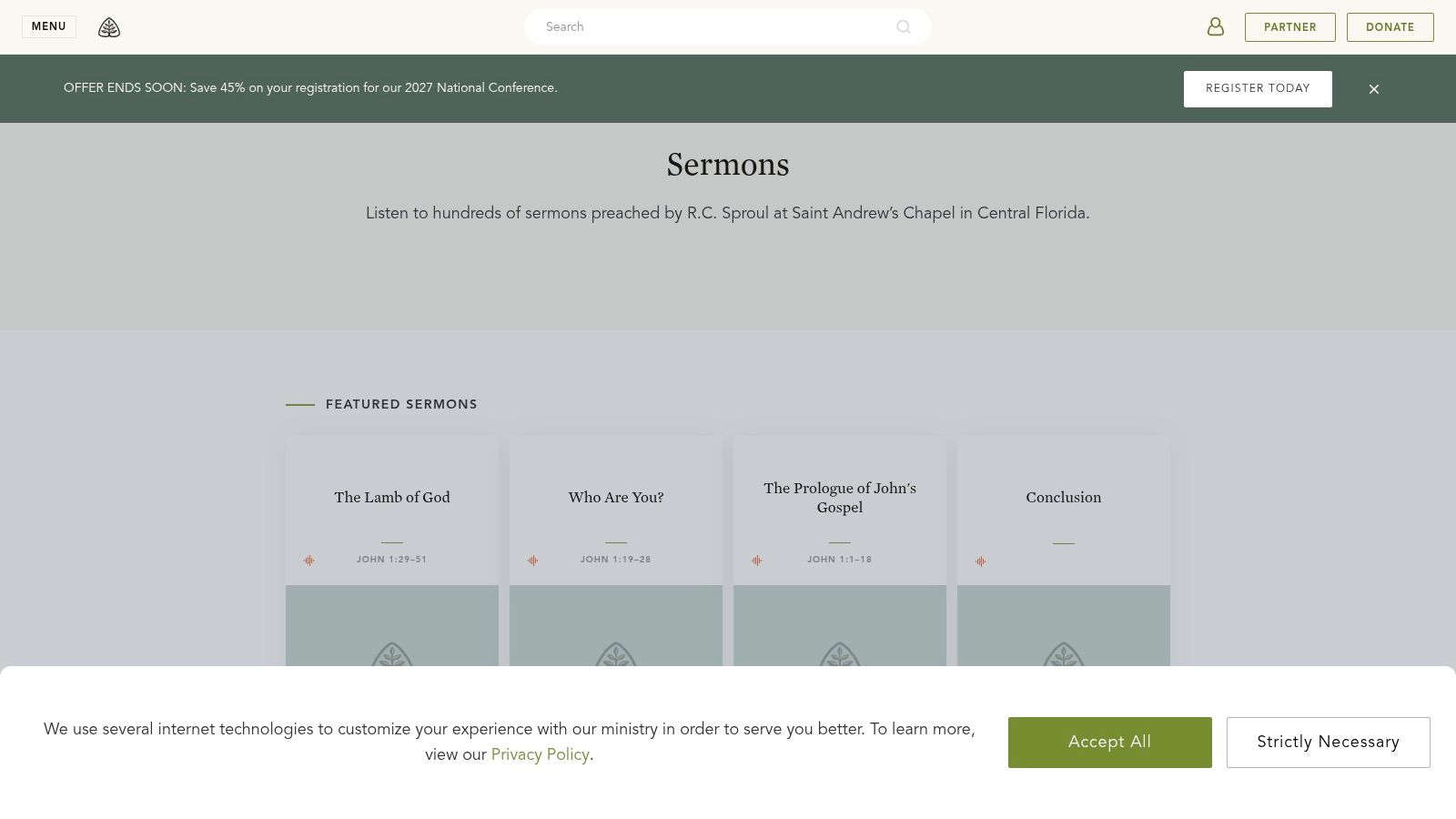
Ligonier Ministries Sermons is a strong resource when your message needs doctrinal backbone.
Not every sermon prep week breaks down because you can’t find a text. Sometimes the issue is that the message feels thin. The outline may be clear, but the theological center isn’t carrying enough weight. Ligonier helps there.
Where it earns its place
This archive is useful for pastors who want to strengthen:
- Doctrinal summaries
- Historical theological framing
- Memorable definitions and formulations
- Supporting insight from trusted teachers
The production quality is strong, and the app access makes it easy to listen while driving, walking, or moving through hospital visits and errands. That’s not a small benefit. A lot of sermon prep happens away from the desk.
Ministry shortcut: Use Ligonier to deepen your sermon’s theology, then write your own local application from scratch. That keeps the sermon grounded in both truth and people.
The caution
Ligonier is not built as a church-ready sermon packaging platform. You won’t find the same kind of editable graphics or all-in-one weekly bundles that some churches want.
Also, not all Ligonier teaching is freely available. Some material is gated. So it’s best approached as a strong free sermon supplement, not a guarantee that every related series will be open.
If your church draws from a Reformed stream, Ligonier may feel immediately natural. If not, it can still serve you well, but you’ll need to translate some categories and emphasis.
I’ve found it especially valuable when preparing doctrinal series or when a sermon needs a cleaner theological center before you start shaping illustrations and response.
7. Logos Sermons

Logos Sermons is one of the better options for pastors who already live inside the Logos ecosystem, but it’s still useful even if you don’t.
The value here is searchability plus variety. It can help you find sermon outlines, manuscripts, and series ideas from a wide range of contributors.
How to use it well
This is a flexible tool, not a tightly curated library. That’s both the appeal and the risk.
It works well when you need to:
- Search a passage quickly
- Find multiple sermon structures on the same text
- Browse contributor ideas without committing to one stream
- Pull sermon thinking closer to your study workflow if you use Logos
For pastors doing a lot of passage-based prep, that integration can be convenient. You’re able to move between study tools and sermon examples without jumping across a dozen disconnected windows.
What doesn’t work
Because the contributors are varied, the quality is varied. The same goes for theological alignment.
That means Logos Sermons is best treated like a sketchbook wall. You’re there to collect possibilities, test structures, and identify useful turns of phrase or major movements. You’re not there to assume every result is pulpit-ready.
Another caution is that some advanced value depends on the broader Logos environment. If you don’t use Logos software at all, the platform still has value, but not all of its ecosystem advantages will matter to you.
Still, for pastors who want free sermons for pastors without being locked into one ministry voice, Logos Sermons is a solid option for early-stage research.
8. SermonAudio
SermonAudio is the broadest river on this list.
If you want massive range, this platform gives it to you. That can be helpful. It can also bury you if you don’t arrive with a plan.
Why it matters right now
A notable shift in ministry life is how many pastors are already working with digital tools in sermon development. 64% of pastors who preach now integrate AI into their sermon development workflow, and only 6% of ministries report having formal AI policies, while 73% report having no policies at all (nationwide survey on pastors adopting AI and the church policy gap). In that environment, a platform like SermonAudio is a reminder that abundance isn’t the same thing as discernment.
The site offers a huge pool of audio and video sermons from churches and ministries around the world. That makes it strong for finding parallel passages, comparing traditions within conservative evangelicalism, and hearing how others approached a theme.
The real-world trade-off
SermonAudio is excellent for breadth. It is not excellent for curation in the way a narrower ministry archive is.
That means your process matters more than the platform:
- Start with your text first
- Use filters aggressively
- Compare several contributors before trusting one
- Take notes on what to keep, what to reject, and what to restudy
More sermons available doesn’t automatically mean less prep work. On open platforms, it often means more pastoral judgment.
If you’re the kind of pastor who thinks best by listening, SermonAudio can be especially useful. Just don’t let endless browsing replace sermon building. This site rewards disciplined searching and punishes aimless scrolling.
9. SermonIndex

SermonIndex is different from most of the list because it shines through older voices.
If you want contemporary packaging, go elsewhere first. If you want historic depth, conviction, and language that still cuts, SermonIndex is worth your time.
What it gives modern pastors
This archive is useful for bringing older voices into present preaching. Think Spurgeon, Tozer, Ravenhill, and others in that stream.
That helps in a few specific ways:
- Historic quotations: Useful when you want to widen your sermon’s perspective.
- Devotional depth: Older sermons often carry unusual spiritual seriousness.
- Revival emphasis: Helpful for messages on prayer, repentance, holiness, and awakening.
This kind of resource can rescue a sermon from sounding overly current. Sometimes a historic voice adds weight that modern examples can’t.
But use it carefully
Older preaching often assumes a different listening culture. The cadence, references, and structure may not transfer cleanly into a modern local church.
That means SermonIndex is usually strongest as a seasoning resource, not a sermon source you mirror line by line. Pull a quotation. Study an appeal. Notice how an older preacher pressed truth into conscience. Then rewrite with your people in mind.
Also, because this site includes archived material and distribution concerns can vary, check permissions before broad reuse or reposting. That’s especially important if you plan to adapt old sermon material into digital assets, clips, or downloadable documents for your church.
10. Monergism Sermon Archive
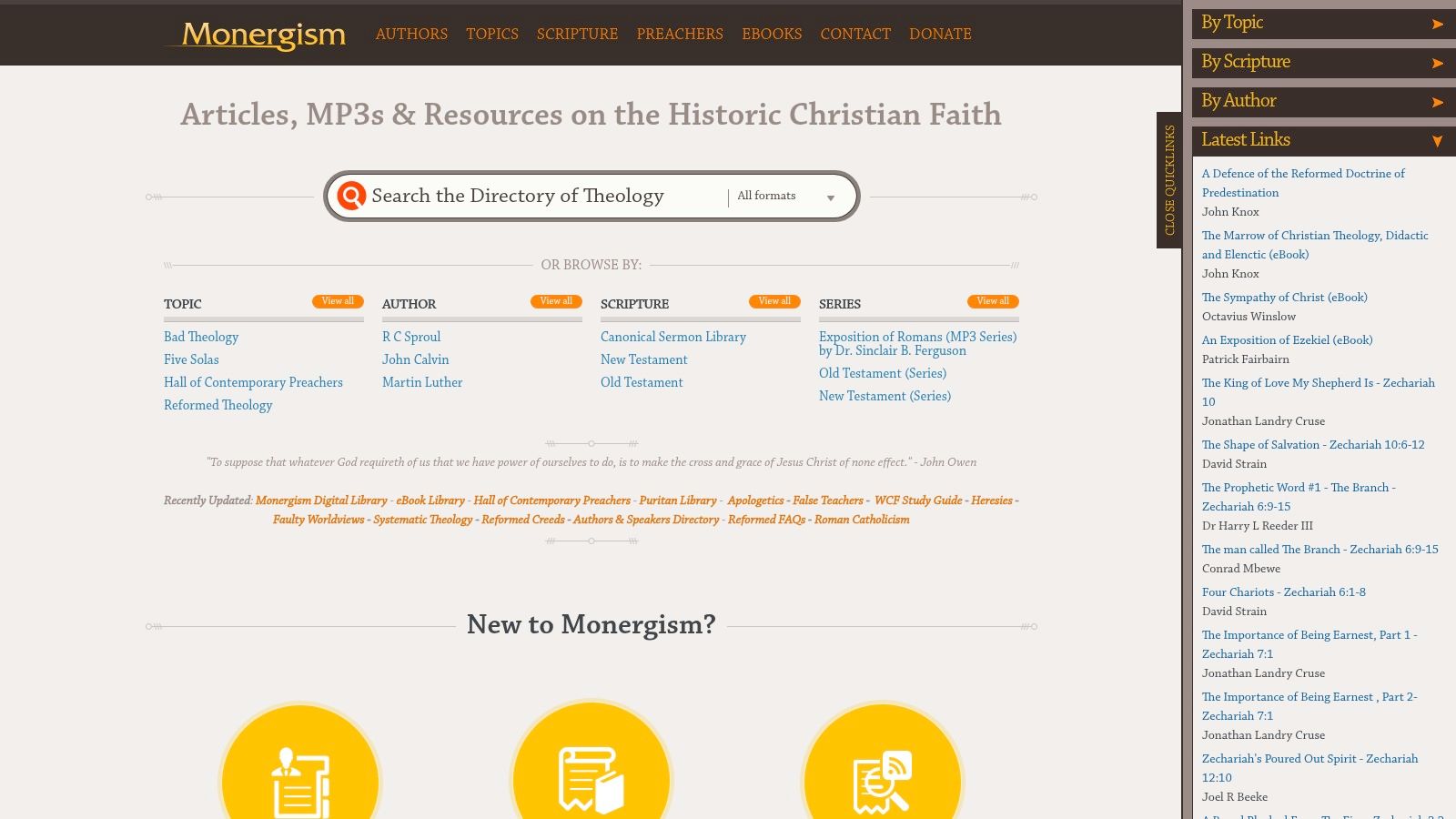
Monergism is less a single sermon vault and more a curated theological library with sermon material threaded through it.
That distinction matters. If you expect one clean archive with a single format, you may find it a bit uneven. If you want a doctrinally filtered research environment, it can be very useful.
Why some pastors love it
Monergism is strong when you’re building doctrinal series or working through topics where bad curation can waste hours. Its organization by topic, Scripture, and author helps you move toward trusted material quickly.
It’s especially helpful for:
- Doctrinal research
- Finding Reformed sermon material
- Tracing a theme across multiple teachers
- Collecting supporting resources beyond the sermon itself
That broader library feel is part of the appeal. Sometimes the best help for a sermon isn’t another manuscript. It’s an article, audio talk, excerpt, or theological treatment that clarifies your center.
Where frustration can show up
Because Monergism often points outward, some links take you off-site. That means the experience isn’t always as smooth as a native archive.
Its Reformed theological slant is also clear. For pastors in that tradition, that’s a feature. For others, it may still be helpful, but it won’t always be a direct fit.
Still, when free sermons for pastors need to be more than generic inspiration, and when doctrinal reliability matters more than glossy presentation, Monergism earns a place on the shortlist.
Top 10 Free Sermon Resources Comparison
| Resource | Core Offering | Formats & Packaging | Quality (★) | Unique Strength (🏆 / ✨) | Target (👥) | Cost (💰) |
|---|---|---|---|---|---|---|
| Life.Church Open Network | Complete plug‑and‑preach sermon series | Videos, editable graphics, sermon notes, kids/youth kits | ★★★★☆ | 🏆 ✨ Turnkey series + visual assets | 👥 Churches needing ready‑made weekend series | 💰 Free |
| SermonCentral | Massive searchable sermon manuscript library | 160k+ sermons, outlines, illustrations, filters | ★★★☆☆ | ✨ Breadth for quick inspiration | 👥 Pastors hunting manuscript ideas | 💰 Free + PRO |
| The Gospel Coalition (TGC) – Sermons | Expository, Bible‑centered sermons archive | Search by speaker/topic/passage; indexed sermons | ★★★★☆ | ✨ Strong expository depth & consistency | 👥 Text‑driven preachers & theologians | 💰 Free |
| Desiring God – Messages | John Piper messages & transcripts | Audio, video, full manuscripts, searchable | ★★★★☆ | ✨ Deep exegesis & doctrinal clarity | 👥 Those wanting Piper‑style exposition | 💰 Free |
| Grace to You – Sermon Archive | Verse‑by‑verse expository sermons (MacArthur) | Smart Transcripts, streaming, organized series | ★★★★☆ | ✨ Smart transcripts + comprehensive NT coverage | 👥 Expositors & doctrinal series planners | 💰 Free |
| Ligonier Ministries – Sermons | Doctrinally rich teaching & sermons | Audio/text, high production, mobile app | ★★★★☆ | ✨ Trusted teachers; high production value | 👥 Users seeking theological clarity | 💰 Freemium (some paywalled) |
| Logos Sermons | Repository integrated with Logos tools | Search by passage/topic; varied contributor formats | ★★★☆☆ | ✨ Logos integration for study workflows | 👥 Logos users & study‑focused pastors | 💰 Free (advanced features via Logos) |
| SermonAudio | Global aggregator of audio/video sermons | 2.9M+ sermons, filters, mobile/TV apps | ★★★☆☆ | 🏆 ✨ Enormous audio/video breadth | 👥 Listeners and researchers seeking parallels | 💰 Free |
| SermonIndex | Archive of classic & revival sermons | Historic sermons, apps, podcast feeds | ★★★★☆ | ✨ Timeless revival classics & quotations | 👥 Preachers wanting historic depth & illustrations | 💰 Free (check reuse permissions) |
| Monergism – Sermon Archive | Curated Reformed theology library | Audio, articles, ebooks; topic/author organization | ★★★★☆ | ✨ Curated, reliable Reformed resources | 👥 Reformed pastors & doctrinal researchers | 💰 Free |
Preach with Confidence, Reach with Strategy
It is Thursday afternoon. The hospital visit ran long, two pastoral emails still need an answer, and Sunday is coming fast. In that moment, a free sermon resource is not a shortcut around prayer and study. It is a time-saving tool that can help a pastor get traction without starting from a blank page.
As noted earlier, many pastors are carrying several ministry roles at once. That is why the best use of free sermon content is practical and disciplined. Use it to gather structure, sharpen exegesis, confirm doctrine, or spark a better illustration. Do not use it to borrow someone else’s voice and call it your own.
That is the core difference between preaching with confidence and preaching under pressure. Confidence grows when the resource matches the need.
If the need is a ready-to-build series with graphics and coordinated church support, Life.Church Open Network stands out. If the need is speed, breadth, and searchable ideas, SermonCentral and Logos Sermons are useful starting points. If the need is doctrinal clarity and text-driven depth, The Gospel Coalition, Desiring God, Grace to You, Ligonier, and Monergism each serve a different kind of pastor well. If sermon prep often starts with listening, SermonAudio gives a wide field to search. If historic voices help sharpen present faithfulness, SermonIndex still earns a place in the rotation.
The mistake is assuming every free sermon site does the same job.
Some platforms function like sermon kits. Others work better as research libraries, archives, or theological filters. A pastor usually saves more time by asking one question first: Do I need a framework, a parallel passage treatment, a doctrinal check, a strong illustration, or content my whole team can build around?
That last part matters more than many churches realize. The sermon should not disappear after the closing prayer.
YouVersion reported more than 3 million Bible plan subscriptions on January 1, 2025, an all-time peak and an 18% increase over January 1, 2024. The same report noted that physical Bible sales rose 22% through October 2024 compared with the prior year (digital and physical Bible engagement trends for 2025). People are engaging biblical content across multiple formats. Churches should plan for that reality instead of posting reactively all week.
ChurchSocial.ai helps a church carry one sermon into a full week of ministry content. A pastor can turn a finished message into short video clips, social captions, blog drafts, carousels, and branded graphics, then schedule it all in one calendar. That changes the workflow. Instead of asking the team to invent six new ideas after Sunday, the church keeps developing one faithful message for the people who heard it in person and the people who will encounter it online first.
There is also an ethical benefit to this approach. Pastors can use free sermons as study tools, write their own message for their own people, and then reuse their own sermon output throughout the week. That keeps the voice local, the application pastoral, and the content pipeline realistic for a busy staff or volunteer team.
Use free sermons for pastors as reference material, not replacement material. Study carefully. Adapt. Preach in your own voice. Then use the sermon again on purpose.
If you’re also building video around your message, this guide on how to write a YouTube video script can help you shape sermon-based content for a different platform and audience.
Churches don’t need more disconnected tools. ChurchSocial.ai gives pastors, staff, and volunteers one place to turn sermons into clips, posts, blogs, graphics, and scheduled content for the whole week. If you’re already spending serious time preparing the message, use ChurchSocial.ai to help that message keep working after Sunday across Facebook, Instagram, TikTok, YouTube, and beyond.