Want your membership drive to produce more than a brief spike in attention?
A church does not grow from scattered promotion. It grows from a clear system that guides people from first impression to first visit, then from visit to real belonging. Announcement slides, a pulpit mention, and a few social posts can support that system, but they cannot replace it.
The churches that grow treat a membership drive like a coordinated outreach campaign. They set a goal, define the next step for every audience, and follow up on purpose. They track what leads to connection, not just what gets seen. A full room means less if guests leave without a conversation, a return visit, or a path into community.
That is why this guide focuses on execution, not theory. Each strategy is paired with the specific tools inside ChurchSocial.ai so your team can carry it out. You can turn sermons into clips and posts, create graphics without starting from scratch, organize campaigns in one calendar, and keep promotion aligned with Planning Center and church events.
If you need a stronger foundation before building campaigns, start with a practical church social media strategy for churches.
ChurchSocial.ai helps churches run membership drives with the kind of consistency that larger teams usually have. That matters. Consistency is what turns good ideas into steady growth.
1. Social Media Content Marketing & Engagement Strategy

What if your membership drive stopped depending on last-minute posts and started running on a repeatable system every week?
Social media should do more than announce service times. It should show people what your church teaches, what your people care about, and what a first visit will feel like. The churches that gain steady momentum do this with a content plan built from what already happens each week: sermons, testimonies, ministry moments, prayer requests, volunteer stories, and upcoming next steps.
ChurchSocial.ai turns that into an actual workflow. Upload a sermon transcript, generate captions, clips, carousel ideas, and blog drafts, then schedule the week from one calendar. That gives a small team a real publishing system instead of a scramble.
Build a social rhythm your team can repeat
Start with four content lanes and keep them consistent.
- Sermon clips: Share one clear idea that stands on its own and gives people a reason to hear more.
- Member stories: Feature real people talking about belonging, healing, service, or growth.
- Church life posts: Show baptisms, kids ministry, volunteers, outreach, and the culture people will step into.
- Direct invitations: Tell people what is happening this Sunday, who it is for, and how to plan a visit.
That mix works because it answers the questions guests already have. What does this church believe? What kind of people are there? What should I do next?
If your team needs structure, keep a monthly calendar tied to sermon series, ministry priorities, and major dates. Churches planning summer outreach or family programming can also pull ideas from this guide for church VBS leaders. For the scheduling side, a church using connected tools for content and events will save time and stay more consistent. This matters even more if you are already comparing options for church event management software.
Use ChurchSocial.ai as the production layer
This is the practical difference in this strategy. Generic advice tells churches to post more often. ChurchSocial.ai helps your team produce better content from work you already did.
A sermon becomes a short video clip, a quote graphic, a devotional post, and a follow-up caption. A testimony can become a reel, a carousel, and a welcome post for newcomers. Templates keep branding consistent, and one calendar keeps ministries from posting disconnected messages.
If you need a framework for planning that rhythm, use this church social media strategy guide as your starting point.
Treat engagement like follow-up
Posting is only half the job. Reply to comments. Answer direct messages. Thank people for prayer requests. Ask a simple next-step question when someone engages with an invitation post.
Many churches often lose momentum at this stage. A guest comments on a reel, asks about kids ministry, or responds to a story, and no one follows up until days later. Treat those interactions like front-door conversations. ChurchSocial.ai helps teams stay organized so content creation, scheduling, and response do not live in separate places.
Watch for patterns in what leads to real connection. If testimony videos start conversations and generic graphics do not, post more testimonies. If sermon clips get saved and shared, make them a weekly standard. A strong membership drive strategy is not more content. It is clearer content, published consistently, followed by real conversation.
2. Event-Based Recruitment & Invitation Campaigns
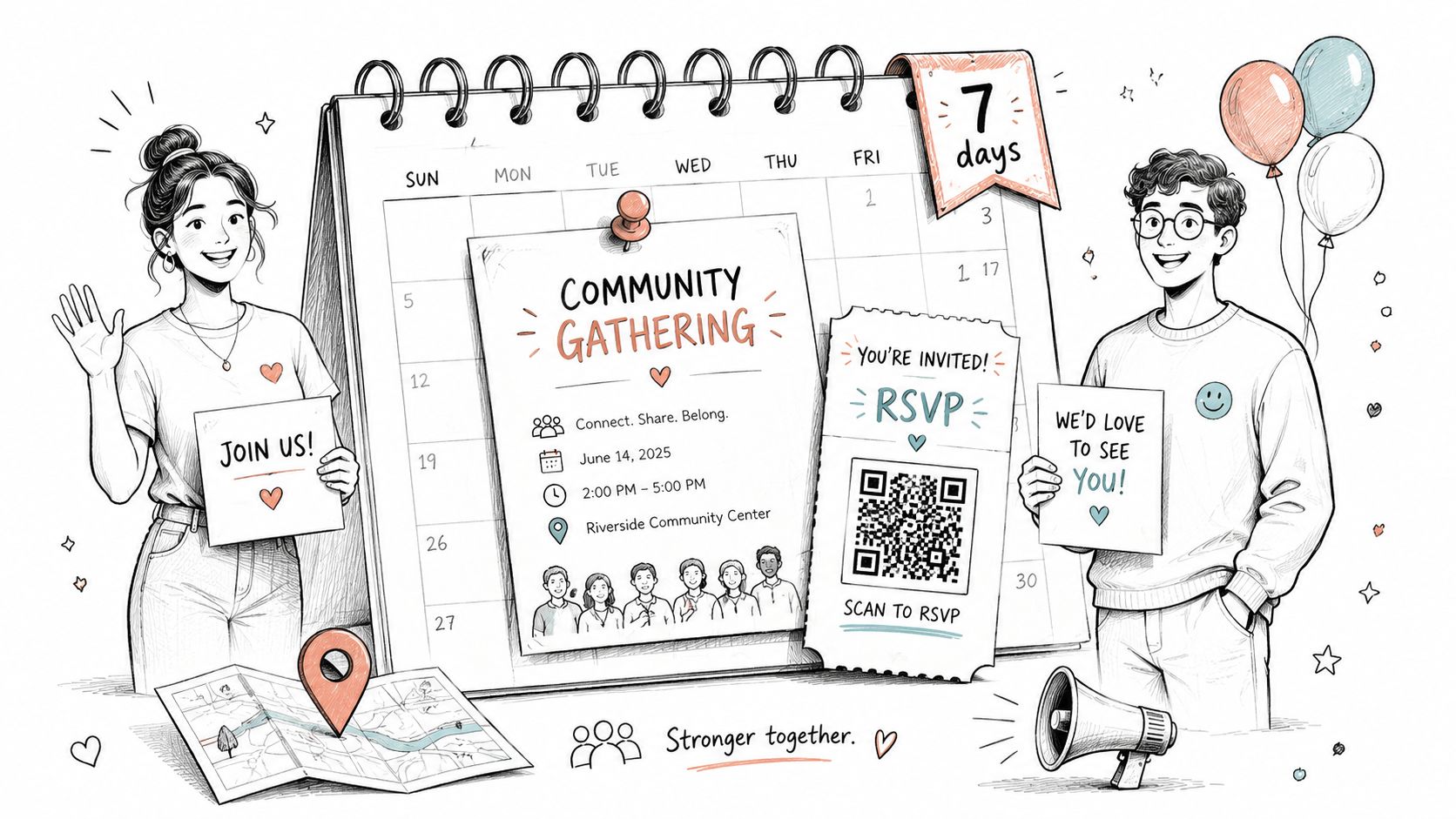
What gets a first-time guest to show up. A generic promise or a real event with a clear reason to attend?
Events win because they lower the relational risk. A family may ignore a broad invitation to Sunday service, but they will consider a holiday program, parenting night, VBS, service project, newcomer lunch, or neighborhood cookout. Good event strategy gives people a timely reason to say yes.
The mistake is treating the event announcement like the campaign. One post is not a campaign. Repeating the date a few times is not a campaign either. Build a sequence that answers three questions every time: who this is for, what will happen, and what to do next.
ChurchSocial.ai turns that plan into a working system. Your team can create invite graphics, short pastor videos, countdown posts, story reminders, registration prompts, and recap content from one place. That matters because event promotion usually breaks down in execution, not ideas. If you want a better process for planning and promotion, review this church event management software overview. If you are planning a family outreach, this guide for church VBS leaders is also useful.
Build the campaign in phases
Start with awareness. Then add proof. Then press for response.
A strong event campaign usually includes:
- Announcement content: State the event, audience, date, and benefit in plain language.
- Interest-building content: Share a short testimony, a pastor invitation, volunteer prep, or a preview of what families can expect.
- Decision-stage content: Post reminders close to the event with service times, registration links, parking details, or childcare information.
- After-event content: Share photos, short recap clips, and one invitation to come back.
ChurchSocial.ai is practical, not theoretical. You can repurpose one event into multiple assets without asking volunteers to reinvent the message every week. That gives your church a repeatable invitation engine instead of a last-minute scramble.
Treat the event as the first step, not the goal
The event creates the introduction. The follow-up builds the relationship.
Send a thank-you message while the experience is still fresh. Post photos or a short recap. Invite guests to one specific next step, not five. Sunday worship, a newcomer coffee, and a beginner small group are strong options. Pick one based on the event and audience.
Churches grow faster when events connect to a clear next move. ChurchSocial.ai helps teams keep that path organized, from invitation content to post-event follow-up, so guests do not disappear after a good first experience.
3. Referral & Word-of-Mouth Amplification Program
What gets more visitors through the door than a polished post or a paid ad? A trusted invitation from someone they already know.
Churches that grow through referrals do not leave invitations to personality or chance. They build a system. That means giving members clear content to share, asking every guest how they heard about the church, and following up based on that answer. As noted earlier, referral strategy works best when the message feels personal and the follow-up fits the relationship.
Give members share-ready invitations
Your members should not have to invent the message. Hand them content they can post in seconds.
ChurchSocial.ai helps your team turn one sermon, testimony, or upcoming church moment into practical referral assets. Create short invitation clips, family-focused graphics, newcomer event promos, and simple posts that members can text, repost, or drop into group chats. That makes word-of-mouth measurable and repeatable.
A strong monthly referral rhythm might include:
- One story of life change: Show what God is doing in a real person.
- One clear invite post: Promote a specific Sunday, sermon series, or newcomer gathering.
- One pastor video: Offer a short, warm invitation with a direct next step.
- One audience-specific asset: Give parents, students, or small group leaders something specific to the people they know.
Keep the ask simple. "Invite one person this month" works. So does equipping group leaders with localized graphics and a short caption they can send without editing.
Track the source, then tailor the follow-up
If you do not ask, you cannot learn. Add a referral field to your connection card, event registration, or check-in form and review it every week.
That one field tells you which members are actively inviting, which ministries are creating momentum, and which messages are spreading through relationships. It also tells you how to respond. A guest who came because a friend invited them needs relational reinforcement. A guest who found your church through a shared clip may need more orientation, context, and reassurance.
Churches grow faster when members treat invitation as part of discipleship.
Do not make referral encouragement feel transactional. Public appreciation, a handwritten thank-you, leader recognition, or a simple celebration meal will reinforce the habit without cheapening it. The goal is not a prize. The goal is a church culture where inviting people is normal, expected, and easy to act on.
4. Targeted Paid Social Media Advertising
Organic reach is useful. Paid reach gives you control. If your church wants to reach new residents, young families, college students, or people searching for a fresh start, paid social deserves a place in your membership drive strategies.
The mistake isn't running ads. The mistake is boosting random posts without a message, audience, or landing page. Churches should advertise specific offers: Easter services, a new sermon series, grief support, marriage workshops, student ministry launch nights, or newcomer gatherings.
Promote one clear promise
Budget works better when the message is narrow. A general ad saying "Join us this Sunday" is easy to ignore. A local ad inviting parents to a family service with clear kids ministry information is stronger. So is a sermon series ad that speaks directly to anxiety, relationships, or purpose.
ChurchSocial.ai helps on the creative side. Use sermon transcripts to generate ad copy variations. Turn a sermon or testimony into a short vertical video. Build matching graphics in the template editor, then keep your social content and ad creative visually aligned.
Marketing General's association summary notes that organizations that intentionally increased their budgets saw the greatest direct impact on membership growth, but only 53% of surveyed associations said their value proposition was compelling or very compelling (membership growth budget and value proposition research). That lesson applies directly to churches. Spend supports growth when the invitation is clear. Spend can't rescue a vague message.
Match the ad to the next step
Your ad should send people somewhere specific. Don't dump them on a cluttered homepage and hope they figure it out. Send them to a focused page for the campaign, or to an RSVP flow for the event.
Use different creatives for different audiences. A church near a growing subdivision might run one campaign for new movers and another for parents looking for community. A church in a university town might test student-focused reels against faith-question clips.
Paid social isn't a replacement for organic presence. It's the accelerator that pushes your best invitations beyond your existing circle.
5. Google Business Profile & Local SEO Optimization
What shows up when someone nearby searches for a church this week?
For many churches, it is not the homepage. It is the Google Business Profile. That profile often decides whether a family clicks, calls, asks a question, or keeps scrolling. If you want a membership drive strategy that captures existing local intent, fix your local search presence.
Start with accuracy. Your church name, address, phone number, website, service times, office hours, and holiday updates must match everywhere they appear. Add current photos that reduce uncertainty. Show the entrance, sanctuary, kids check-in area, parking, signage, and accessibility features. People visit churches more confidently when they already know what to expect.
ChurchSocial.ai makes this easier to maintain because your team can turn weekly ministry content into Google updates, not just social posts. A sermon series graphic can become a profile post. A visitor FAQ can become a local update. An event announcement can be reformatted and published without creating a second workflow from scratch. That is the difference between setting up a profile once and using it as a growth channel.
Use your profile posts with clear intent:
- Answer visitor questions: parking, childcare, dress, accessibility, service length
- Promote timely moments: Easter, Christmas, sermon series launches, newcomer lunches
- Show active ministry: outreach events, prayer nights, support groups, volunteer opportunities
- Reinforce trust: recent photos, staff responses, and accurate weekly information
Reviews matter here. They are public reassurance. Ask members and recent guests to leave honest reviews that mention specific experiences such as welcome, children's ministry, worship style, or helpful staff. Then respond promptly. A warm, specific reply to a question about parking or kids check-in can influence the next visitor more than a polished ad campaign.
Local SEO also depends on consistency beyond Google. Your website should repeat the same core details, and your contact forms should work properly. If your visitor follow-up emails never arrive, you waste the traffic your local search work produces. Use a tool like test email deliverability to make sure those next-step messages reach inboxes.
Churches often spend too much energy chasing attention and too little on being easy to find. Correct that. A polished Google Business Profile, updated regularly with help from ChurchSocial.ai, turns local search into a practical, repeatable path from discovery to first visit.
6. Email Marketing & Newsletter Strategy
Email still matters because it reaches people directly. Social media creates discovery. Email builds familiarity. If someone visits once, downloads a guide, signs up for VBS, or fills out a connection card, email gives you a way to continue the conversation without waiting for an algorithm.
The strongest church newsletters don't feel like bulletin dumps. They feel personal, clear, and helpful. One main message, one or two next steps, and one reason to come back.
Build a simple nurture sequence
Your first-time visitor shouldn't get the same email as a longtime member. Segment the list. Newcomers need welcome emails, what-to-expect information, pastor introductions, and a clear path to their next visit or group connection.
A practical church sequence might look like this:
- Welcome email: Thank them for visiting and share the sermon link.
- Story email: Introduce the church's mission and community life.
- Invitation email: Offer a newcomer lunch, class, or next-step event.
- Connection email: Point them toward a small group or ministry fit.
ChurchSocial.ai supports this strategy indirectly but powerfully. When your team uses the platform to generate blog posts, sermon summaries, graphics, and clips from each week's message, your email content gets easier to produce. You stop scrambling for material and start sending stronger follow-up.
Write for clarity, not volume
Keep the design clean. Use one clear button. Make sure the subject line reflects the actual value inside the email. If your church has multiple ministries, segment by interest whenever possible so families, young adults, and volunteers get the most relevant invitations.
If your team is troubleshooting inbox placement, use a tool that can test email deliverability. But don't reduce email performance to technical setup alone. Better segmentation and stronger relevance usually matter just as much.
A strong email strategy gives your church a durable follow-up channel. That matters because many people need several touches before they return.
7. Community Outreach & Partnership Strategy
Some membership drive strategies start with an invitation to attend. Others start with visible service. Churches grow when neighbors experience them as present, useful, and trustworthy.
Community outreach does that. Food distribution, school partnerships, counseling referrals, neighborhood cleanup days, grief support, foster care support, and nonprofit collaboration all create real contact points with people who may never respond to a standard church ad.
Serve in ways your community will notice
Choose needs your church can meet consistently. One annual service day is good. Ongoing presence is better. A church that partners monthly with a local shelter or school becomes known for something tangible.
Document that work well. ChurchSocial.ai helps churches turn service days into reels, recap posts, event promotions, volunteer spotlights, and blog recaps. That doesn't cheapen the ministry. It helps your community see what your church is already doing and invites them to participate.
Use outreach content with care:
- Show the work respectfully: Focus on dignity, not spectacle.
- Highlight local partnerships: Name the mission, not just your church.
- Invite people to serve: Give an easy next step.
- Celebrate volunteers: Reinforce a culture of outward focus.
Turn service into connection
A service project creates a natural bridge to membership when the follow-up is thoughtful. Invite participants to a meal, testimony night, prayer gathering, or Sunday service built around the same mission heartbeat.
One overlooked issue in many membership guides is retention-quality recruitment. Broader membership guidance notes that organizations should compare one-off campaigns with seasonal approaches and interview members about what is and isn't working so they can improve long-term value, not just sign-up volume (retention-focused membership guidance). Churches should do the same. The best outreach strategy doesn't just attract attenders. It attracts people who are likely to stay engaged.
When outreach and follow-up work together, your church doesn't just become more visible. It becomes more believable.
8. Website & Lead Generation Landing Pages
Your website shouldn't act like a digital brochure. It should act like a host. If someone clicks from Instagram, Google, an email, or an ad, the page needs to help them take one next step quickly.
That means strong membership drive strategies need dedicated landing pages. One for Easter. One for newcomers. One for students. One for parents. One for small groups. The clearer the path, the more likely people are to follow it.
Remove friction from the first visit
Service times should be easy to find. So should parking info, kids ministry details, contact information, and a clear "Plan Your Visit" or "I'm New" action. If someone has to hunt for basics, they'll leave.
Use campaign-specific pages instead of funneling every visitor to your homepage. A sermon series ad should go to a sermon series page. A VBS post should go to a VBS page. A newcomer reel should go to a visitor page with expectations, welcome video, and a simple form.
ChurchSocial.ai supports this by feeding those pages with content. A sermon transcript can become a blog post. A sermon clip can become page media. Event graphics built in the platform can stay consistent across social and web. That consistency builds trust.
Capture interest and route it well
Ask only for the information your team will use. Then decide where that lead goes. A first-time parent should get different follow-up than someone asking about membership classes. A person interested in grief support needs a more pastoral response than someone asking for service times.
Use forms to sort interest by category:
- New here
- Need prayer
- Interested in groups
- Want to serve
- Have kids or students
- Need pastoral care
A church website doesn't need to impress a designer. It needs to reduce uncertainty. If your site does that well, it becomes one of the most dependable conversion tools in your system.
9. Sermon Series Promotion & Clip Strategy
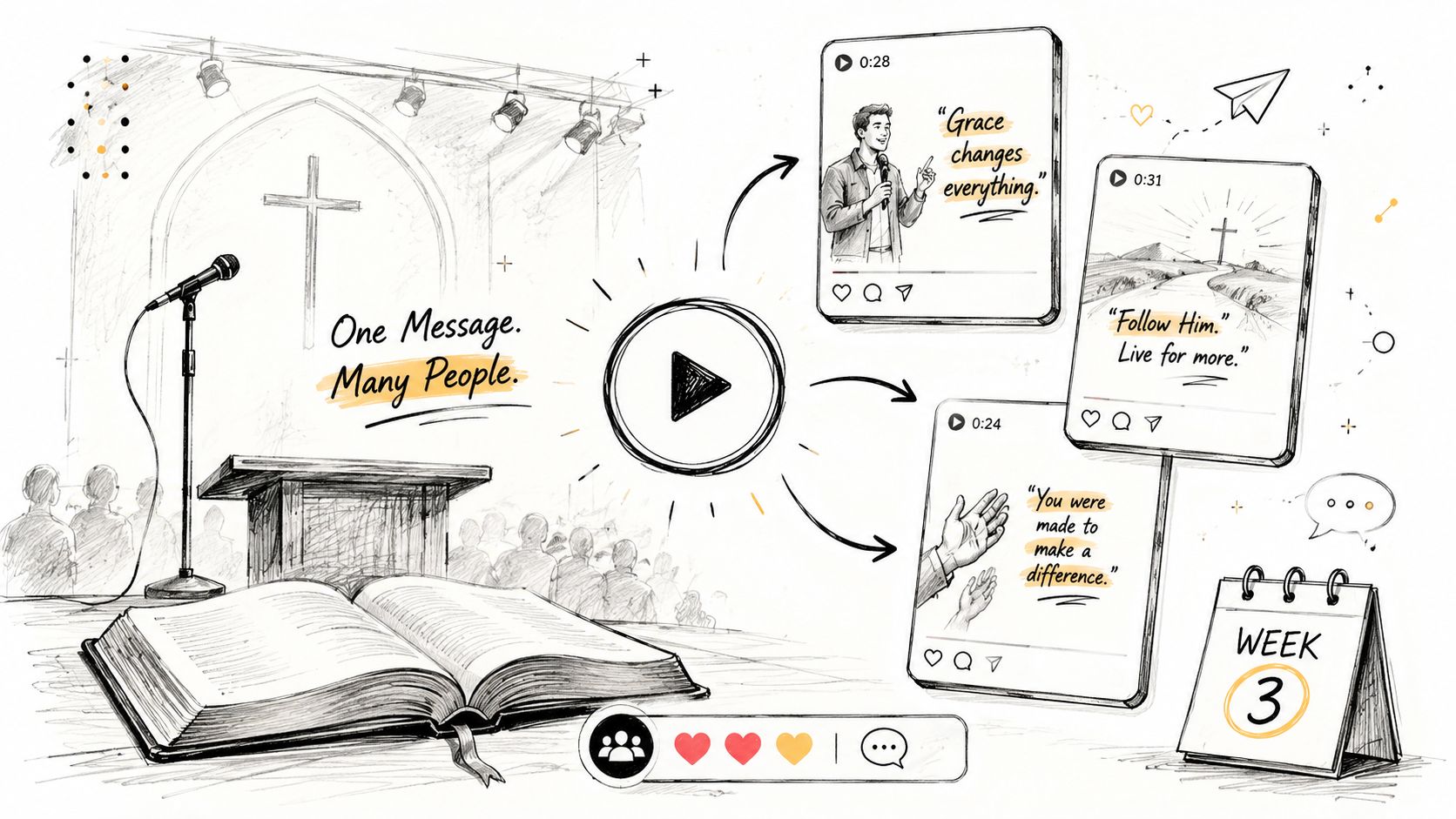
Sunday's message shouldn't disappear by Monday morning. Sermons are one of the richest outreach assets your church already has, and they belong near the center of your membership drive strategies.
A strong sermon series gives people a reason to return. A strong clip strategy gives people a reason to discover your church in the first place. That's especially true for churches trying to reach younger audiences who spend more time with short-form video than long-form teaching.
Turn one sermon into a week of outreach
ChurchSocial.ai is built for this exact workflow. Its Sermon Clip Creator can help your team pull short videos from a full message, and its AI tools can turn the transcript into captions, discussion prompts, blogs, and post ideas. Instead of one Sunday asset, you get a week of usable content.
A practical weekly pattern could include:
- A short invitation clip on Monday
- A quote graphic on Tuesday
- A testimony or application post on Wednesday
- A discussion question on Thursday
- A weekend invitation reel on Friday
If your team wants more ideas for extending one piece of content across channels, review these content repurposing approaches for churches. If you're pairing clips with broadcast ministry, these church live stream best practices can help tighten the full experience.
A sermon clip works best when it feels complete on its own and compelling enough to make someone curious about the full message.
Promote the series, not just the service
Series branding helps people remember what they're being invited to. A church may struggle to get traction with "Join us Sunday," but gain attention with a series focused on grief, marriage, purpose, prayer, or rebuilding faith.
Use clips to answer felt needs, not just advertise schedules. That's how sermon promotion shifts from internal communication to public outreach.
10. Small Group & Visitor Follow-Up Conversion Strategy
What happens after a guest walks through your doors for the first time?
That answer determines whether your membership drive produces real growth or a growing list of forgotten contact cards. Churches gain members by giving people a clear next step into relationships, care, and belonging. A visitor who attends once and hears nothing personal from your church will usually disappear. A visitor who gets guided into a conversation, a group, and a place to serve has a real chance to stay.
Build the path before you need it.
The strongest follow-up system is simple, visible, and repeated often enough that guests can understand it right away:
- Visit a service
- Receive a personal follow-up
- Attend a newcomer gathering
- Join a small group
- Find a place to serve
Small groups should sit near the center of that process. They give people a setting where names are learned, questions are welcomed, and friendships can start before formal membership ever does. If your church treats groups as an optional side ministry, your follow-up will stall.
ChurchSocial.ai helps your team keep that path in front of people all week. Use it to create newcomer event posts, testimony clips, group leader spotlights, and short invitations that explain the next step plainly. That turns follow-up from a private admin task into a public, repeatable growth system.
Follow up like a host, not a database
Generic messages get ignored. Personal contact gets responses.
Send the email quickly. Text the guest by name. Make the phone call if they asked for care. If they mentioned children, point them to the right ministry. If they showed interest in community, connect them to a group leader, not a general inbox. Strong follow-up feels specific because it is specific.
ChurchSocial.ai makes that execution easier for churches that do not have a full communications staff. Your team can use its AI tools to write personalized follow-up drafts for different guest types, create clear invitations for newcomer events, and produce social content that answers the question every visitor is asking: “Where do I fit here?”
Assign ownership as well. One volunteer team can follow up with families. Another can handle students and young adults. Pastoral care requests should go to a pastor or care leader. Group interest should go straight to the person responsible for placement. Clear lanes prevent slow responses, and slow responses lose people.
People rarely become members because they received more information. They become members because someone remembered their name, answered their question, and showed them where they belong.
10-Point Membership Drive Strategy Comparison
| Strategy | Implementation Complexity 🔄 | Resource Requirements ⚡ | Expected Outcomes 📊 | Ideal Use Cases 💡 | Key Advantages ⭐ |
|---|---|---|---|---|---|
| Social Media Content Marketing & Engagement Strategy | Medium, consistent scheduling, platform learning | Moderate, volunteer time + ChurchSocial.ai tools, low ad spend | Increased awareness and engagement; membership growth typically 3–6 months | Ongoing brand building, reaching younger audiences and seekers | Cost-effective, scalable shareable content; strong discovery potential |
| Event-Based Recruitment & Invitation Campaigns | High, multi-week planning and logistics | High, staff time, volunteers, event costs | Short-term attendance spikes; measurable RSVPs; conversion requires follow-up | Holidays, community outreach, newcomer-friendly entry events | Creates urgency and large one-time visibility gains |
| Referral & Word-of-Mouth Amplification Program | Low–Medium, culture change and simple systems | Low, shareable assets, recognition incentives | High conversion and retention over time; slow but sustainable growth | Churches with engaged membership wanting organic growth | Most cost-effective; leverages trust and personal networks |
| Targeted Paid Social Media Advertising | Medium, ad platform learning and optimization | Moderate–High, ongoing budget ($300+/mo), creative assets | Fast, measurable reach and visitor acquisition; immediate results when optimized | Targeting new residents, specific demographics, event promotion | Precise targeting, scalable, clear ROI and tracking |
| Google Business Profile & Local SEO Optimization | Low, initial setup; ongoing maintenance | Low, time to maintain, photo updates | High-intent discovery; steady local traffic growth over months | Local searchers, mobile users, visitors seeking directions/infos | Free visibility for searchers actively looking for a church |
| Email Marketing & Newsletter Strategy | Medium, content cadence and segmentation | Low–Moderate, platform fees, content creation time | Strong nurturing channel; high ROI and measurable conversions | Converting visitors, retention, segmented communications | Direct, personalized, highly trackable communication channel |
| Community Outreach & Partnership Strategy | High, sustained coordination and partnerships | High, ongoing volunteer time, program resources | Long-term reputation and trust; indirect membership growth | Churches aiming for service-oriented identity and local impact | Builds authentic goodwill, attracts mission-minded people |
| Website & Lead Generation Landing Pages | Medium–High, design and UX work, analytics setup | Moderate–High, initial dev cost + maintenance | Improved conversions and centralized lead capture; supports campaigns | Driving paid/social traffic, newcomer info, campaign CTAs | Central hub for conversion, SEO benefits, measurable funnels |
| Sermon Series Promotion & Clip Strategy | Medium, content planning and clip workflow | Low–Moderate, editing tools (automated helps), scheduling time | High reach via short clips; boosts weekly engagement and discovery | Churches with strong preaching and reusable sermon content | Extends sermon lifespan; high shareability and reach |
| Small Group & Visitor Follow-Up Conversion Strategy | High, coordination, CRM, trained volunteers | High, staff/volunteer time, tracking systems | Highest impact on retention and membership conversion long-term | Prioritizing discipleship, assimilation, and long-term growth | Strongest retention engine; creates belonging and leadership pipeline |
Unify Your Growth Strategy with ChurchSocial.ai
What happens when your church runs strong events, posts good content, sends follow-up emails, and still sees inconsistent growth? The problem is usually not effort. It is fragmentation.
A membership drive works when every part supports the next step. Social posts should point people to events. Events should feed visitor follow-up. Follow-up should move people into groups, serving, and membership conversations. If those pieces live in separate tools, separate spreadsheets, or one volunteer's memory, your church loses momentum and misses people who were ready to respond.
The fix is a connected system with clear tracking. As noted earlier, the right metrics are simple and practical: visits, sign-ups, return attendance, group interest, replies, and membership decisions. In a church setting, the useful questions are direct. Which sermon clips brought first-time guests? Which event invitations led to return visits? Which email sequence moved people into a small group? Which follow-up message led to an actual conversation?
ChurchSocial.ai helps churches run that system without adding another layer of work. You can turn one sermon into short clips, captions, blog content, and discussion prompts. You can build graphics from templates instead of starting over each week. You can schedule content in one visual calendar, keep event promotion tied to your ministry schedule, and keep Google Business updates in the same workflow. Small churches get structure without hiring a full communications team. Larger churches get alignment across staff, volunteers, and ministries.
Consistency wins.
Churches grow when people hear a clear invitation, see a clear next step, and receive clear follow-up. ChurchSocial.ai makes that repeatable. Instead of posting randomly, you can build a campaign around a sermon series, newcomer event, holiday service, or membership class, then track what led people forward.
Start with one campaign window. Define the audience. Build the content sequence. Publish across the right channels. Track responses. Follow up personally. Move interested people into groups and conversations. Then run the next campaign with better information than you had before.
That is how outreach becomes organized, measurable, and sustainable. It is also how ChurchSocial.ai shifts from being a content tool to being the operating system behind your membership drive.
If your church wants one place to plan social content, turn sermons into clips, design graphics, schedule posts, and stay organized around events and outreach, explore ChurchSocial.ai.