You posted a sermon clip, added a heartfelt caption, and expected it to reach people in your city who needed it. Instead, it got a handful of views and disappeared. That happens to a lot of churches on TikTok, not because the message was weak, but because the post wasn't easy for TikTok to understand.
That's where hashtags help.
If you're trying to learn how to use hashtags on TikTok for church content, think of them less like internet slang and more like labels on a bulletin board. They help TikTok sort your video, connect it to the right audience, and place it in searches and feeds where people are already looking for faith content, local community, encouragement, and answers.
Why Hashtags Matter for Your Church Mission
A church can create strong short-form content and still get buried. TikTok moves fast, and the platform needs clear signals about what a video is about. Hashtags are one of those signals.
TikTok hashtags act like part of the platform's SEO system. They tell the algorithm what your content covers and improve the odds that the right people will see it. One reason that matters so much is scale. TikTok had over 1.58 billion monthly active users worldwide as of June 2026, which means discovery is a major part of how people find new voices and communities (learn more in this church TikTok guide).

Think of hashtags as digital signposts
When someone opens TikTok and searches for a topic, they're often not looking for polished branding. They're looking for something relevant. A short prayer. A sermon clip. A church near them. A word of hope.
If your caption says “Great Sunday today” and your hashtags are broad or random, TikTok has to guess. If your caption and hashtags clearly point to the topic, the platform has a much better chance of placing that video in front of people who care.
Practical rule: A hashtag should help TikTok categorize your post and help a real person decide, “Yes, this is for me.”
Why this matters for ministry
Church social media isn't only about keeping members informed. It's also about being discoverable to people who may never visit your website first. Hashtags can help a sermon clip reach someone searching for Christian encouragement. They can help an event video surface for people nearby. They can help your youth content find students and parents who already follow faith-based topics.
That's the bigger reason to take hashtags seriously. They're small, but they support outreach in a very practical way.
Finding the Right Hashtags for Your Ministry Content
Good hashtag strategy starts with observation, not guesswork. You don't need a giant spreadsheet or a trend agency. You need a repeatable way to see what TikTok is already rewarding.
A strong church workflow usually uses three sources. TikTok search, TikTok trends, and similar ministry or creator accounts.

Start with TikTok search
Type phrases your audience might use. Don't only search for “church.” Search for specific ministry angles such as prayer, Bible study, worship, parenting, youth night, Christian encouragement, or your city name plus church.
Look at the suggestions TikTok gives you. Then open the top videos and study the tags they use. You're not trying to copy blindly. You're looking for patterns.
A few examples:
- For sermon clips: Search terms around preaching, encouragement, faith, and scripture-based topics.
- For local outreach: Search your city plus church, worship, or community event.
- For youth content: Search youth ministry themes, student faith topics, or Christian teen content.
Use the Creative Center for trend checks
TikTok's Creative Center is one of the best places to spot what's rising right now. It helps churches make smarter decisions instead of chasing hashtags that were popular last month.
Churches should also use popular hashtags and participate in trending challenges when the content fits their values, because that can improve discoverability and reach according to this church-focused TikTok article from ResourceUMC.
That doesn't mean every trend belongs on a church account. Some trends will fit a youth event recap, volunteer appreciation reel, or behind-the-scenes baptism setup. Others won't. Alignment matters more than novelty.
If a trend helps you communicate the message more clearly, use it. If it distracts from the message, skip it.
If you want another practical overview of research workflows, MicroPoster's hashtag tool guide is useful for seeing how different hashtag discovery approaches work.
Study accounts that serve a similar audience
Find churches, Christian creators, campus ministries, worship leaders, or local nonprofits that consistently get engagement. Pay attention to the kind of content they pair with certain tags.
A simple review helps:
| What to check | What to look for |
|---|---|
| Content format | Sermon clips, testimonies, event promos, worship moments |
| Hashtag style | Broad faith tags, local tags, youth-specific tags, branded tags |
| Relevance | Whether the hashtags clearly match the video topic |
| Repeatability | Whether the account uses a consistent structure across posts |
You'll usually notice that effective posts don't use random viral tags. They use tags that reinforce the subject.
Build a shortlist by content type
Create a small library of hashtags for each ministry category.
- Weekend sermons: Keep tags related to preaching, scripture, worship, and your church name.
- Events: Add local and event-specific tags.
- Youth ministry: Use student-focused and ministry-relevant tags.
- Community stories: Use tags tied to service, testimony, outreach, or local impact.
If you want ideas for stronger short-form structure before you choose hashtags, this guide on how churches can make TikTok videos is a helpful companion.
Building the Perfect Hashtag Mix for Maximum Reach
The mistake most churches make is thinking hashtags are all-or-nothing. Either they paste a giant block of tags into every post, or they use one generic tag and hope for the best. Neither approach works well.
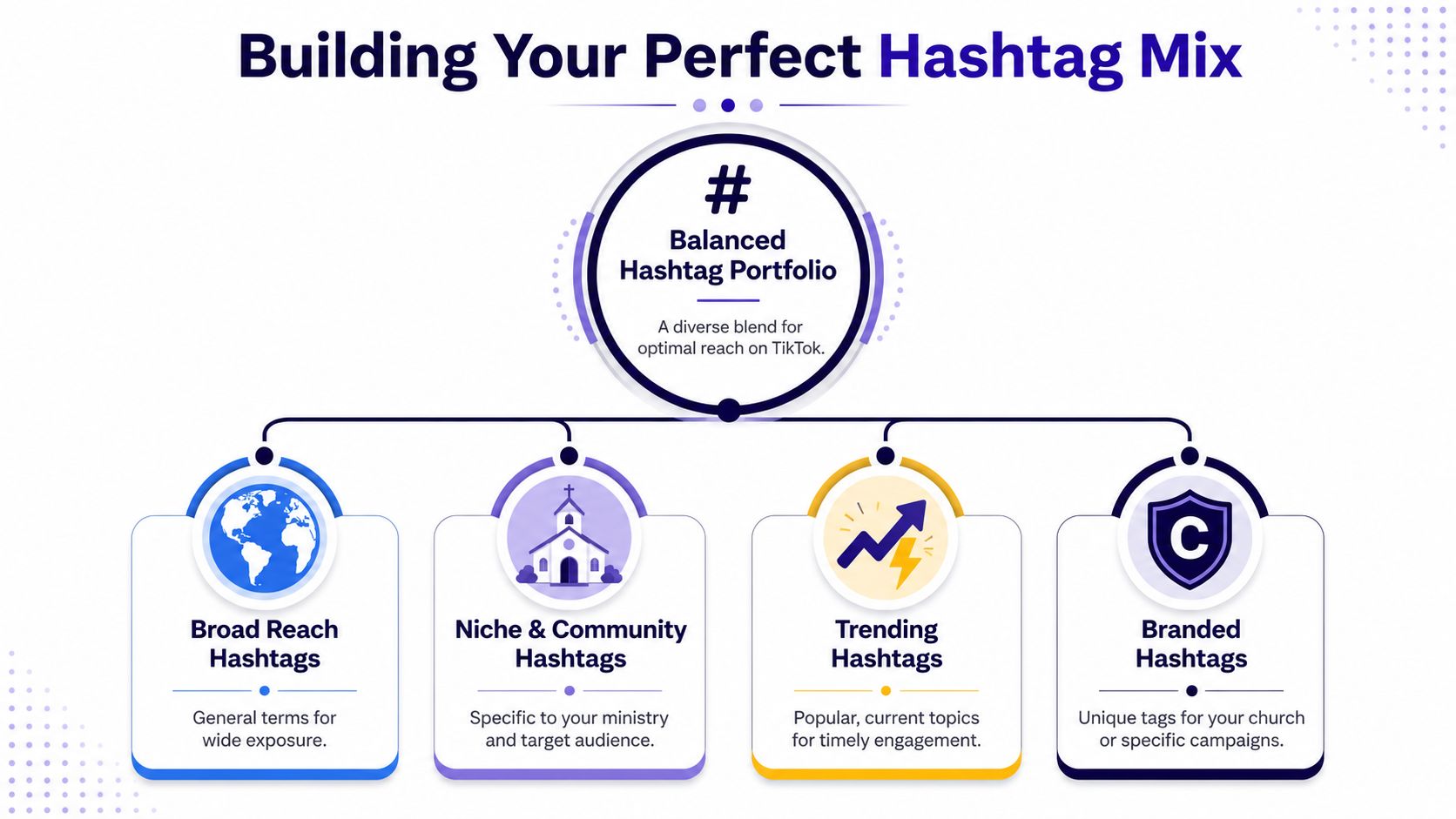
A better approach is a hashtag portfolio. Each tag plays a role.
Use a balanced mix
Research and industry data for 2026 indicate that 3 to 6 focused, relevant hashtags work best, because too many unrelated tags reduce clarity and visibility. The same guidance notes that the strongest visibility often comes from a strategic mix rather than stuffing a caption with every trending tag you can find. In practice, tags with fewer than 1 million associated videos can also be valuable because competition is lower and discoverability is often stronger in niche spaces.
That's why I recommend thinking in categories instead of chasing one “perfect” list.
What your mix should include
| Hashtag type | Role in the post | Church example style |
|---|---|---|
| Broad faith tag | Gives the algorithm a wider category | Christian or worship-related tags |
| Niche ministry tag | Clarifies the exact topic | Sermon clip, prayer, youth, Bible study |
| Local tag | Helps with nearby discovery | City plus church or local ministry terms |
| Branded tag | Builds recognition around your church | Your church name or campaign tag |
| Trend tag | Adds timeliness if the content genuinely fits | Relevant challenge or current topic |
The portfolio idea works like fishing with different nets. One net reaches a bigger area. Another catches the exact audience you want. If you only use broad tags, your post gets lost in a crowded stream. If you only use tiny niche tags, you may limit your reach too much.
A strong hashtag set helps TikTok understand your video at more than one level. Faith category, specific topic, local relevance, and community identity.
A simple formula churches can repeat
For most posts, use a small set like this:
- One broader tag that matches the general faith category.
- Two or three niche tags tied directly to the content.
- One local or branded tag if it supports the goal.
- One trend tag only when it naturally fits.
If you're also working on the video itself, Get Up Productions' video strategy has useful thinking on short-form content structure that pairs well with better hashtag choices.
The point isn't to make every caption look smart. The point is to make every post easier to classify, easier to discover, and easier to connect with the right people.
Using Branded Hashtags to Build Your Church Community
Most churches think of branded hashtags as a marketing extra. They're more useful than that. A branded hashtag gives your church a consistent place for people to gather around your content on TikTok.
That's valuable because TikTok moves quickly. Videos come and go. A branded hashtag helps create continuity between posts, sermon series, events, testimonies, and congregation-shared clips.
What a branded hashtag does well
A good branded hashtag can organize your ministry content in a way that feels simple to followers.
It can help you:
- Group sermon series content under one searchable label
- Support event promotion for retreats, VBS, Easter, Christmas, or youth nights
- Encourage member participation when people post their own clips or photos tied to church life
- Create an archive of recurring themes like worship, outreach, baptism, or prayer nights
According to Legiit's TikTok hashtag guidance, the best-performing TikTok posts often use exactly 3 to 5 high-quality, relevant hashtags, usually with 1 to 2 mid-range trending tags and 2 to 3 niche-specific tags. The same source notes that branded hashtags created for church campaigns can increase community repetition and clip sharing by 30% when used consistently across sermon clips and discussion posts.
Make it easy to remember
The best branded hashtags are short, clear, and specific to your church or campaign.
Examples of a solid direction:
- Church name plus online
- Church name plus youth
- Church name plus worship
- Sermon series title
- Annual event name
Avoid long, awkward phrases that no one will type correctly. If your congregation can't remember it after hearing it once, it's probably too complicated.
Use it consistently, not everywhere
Branded hashtags work best when they have a job. Don't force your church tag into every post if it weakens clarity. Use it where it supports identity, participation, or organization.
A simple pattern works well:
- Sermon clips get your sermon or church tag
- Event promos get the event tag
- Youth content gets the youth ministry tag
- Congregation participation posts repeat the same community tag
That consistency is what turns a hashtag into a gathering place instead of just another label.
Common TikTok Hashtag Mistakes to Avoid
A lot of church teams hear advice that sounds clever but doesn't hold up on TikTok. The platform is pretty good at spotting when hashtags don't match the content.
The biggest problems usually come from trying to game the algorithm instead of helping it understand the post.
Mistake one using broad tags that say almost nothing
Tags like #viral or #fyp look attractive because they're common. The problem is that they don't tell TikTok much about your content. They also don't tell viewers why they should care.
According to Buffer's TikTok hashtag research, using irrelevant or overly broad tags such as #viral or #fyp correlates with a 15 to 25% drop in engagement rates because of audience mismatch and algorithmic misclassification. The same research notes that churches can improve local discoverability by 35% when they combine location-based tags such as #ChicagoChurch with faith-specific tags such as #YouthMinistry.
That's a useful correction. Broad tags often weaken targeting. Local and relevant tags sharpen it.
Mistake two copying the same block into every post
Some volunteers build one hashtag set and paste it into everything for months. It saves time, but it usually leads to weaker categorization.
A baptism testimony, a youth game night recap, and a sermon quote clip are not the same kind of post. They shouldn't carry the exact same hashtag block.
Try this instead:
- Match tags to the topic: Let the post determine the set.
- Swap local references as needed: Event content may need different city or campus terms.
- Refresh regularly: Watch for patterns, then keep what's working.
If every post uses the same hashtags, TikTok gets a less accurate picture of what each video is actually about.
Mistake three chasing trends that don't fit church content
A trending hashtag only helps when the content belongs there. If you attach a random trend tag to a sermon clip, viewers may scroll immediately because the expectation and the video don't match.
That hurts twice. The wrong audience sees the clip, and the right audience may never get the signal.
Mistake four forgetting basic formatting
Hashtags only work when they're formatted correctly. You need the # symbol followed immediately by the word or phrase, with no spaces. Shift Worship's best-practices article gives examples like #Church, #Service, and #Faith.
That sounds simple, but it matters. If the format breaks, the hashtag stops functioning as a hashtag.
Measure Success and Simplify Your Social Media Workflow
A hashtag strategy isn't complete until you check what worked. TikTok will usually show you pretty quickly whether your tags helped the video reach the right audience.
You don't need a complicated reporting system to begin. Start by checking your TikTok analytics and comparing post performance across content types.
What to review each week
Look for patterns, not perfection.
- Reach: Which sermon clips or event videos reached more unique users?
- Engagement: Which hashtag sets appeared on videos with stronger likes, comments, shares, or views?
- Relevance: Which posts attracted the kind of responses you want, such as prayer requests, local questions, or event interest?
- Timing: Which tags seemed to work better for timely church events versus evergreen encouragement clips?
A practical review rhythm matters. TikTok trend data also supports tracking reach, engagement, and sentiment over time, along with using the Creative Center for current hashtag signals. That's how teams spot seasonality and adjust before a content pattern goes stale.
Keep the workflow realistic
Most church social media teams don't fail because they lack ideas. They fail because the process becomes too manual.
A normal week can involve:
- pulling clips from the sermon,
- writing captions,
- choosing hashtags,
- designing announcement graphics,
- promoting events,
- scheduling everything across platforms.
That's a lot for one volunteer or a small communications team.
If you're comparing tools for short-form editing and publishing, Satura AI's TikTok app review is a helpful outside look at the field. For churches, though, the bigger win is having planning, creation, and scheduling work together in one place.
Build a system you can sustain
A healthy workflow usually includes these pieces:
| Workflow step | What helps |
|---|---|
| Sermon repurposing | Turning one message into several short clips |
| Caption prep | Writing platform-specific copy quickly |
| Event promotion | Pulling dates and details from the church calendar |
| Design | Using templates for announcements, photos, and carousels |
| Scheduling | Posting from a visual calendar instead of scattered notes |
That's also why it helps to review your social metrics consistently. If you need a framework for that side of the process, this guide on measuring social media engagement for churches is worth bookmarking.
TikTok rewards clarity and consistency. Your church doesn't need to master every trend. It needs a repeatable system that helps each post say what it is, reach the right people, and support real ministry outcomes.
If your church wants an easier way to manage all of this, ChurchSocial.ai brings the workflow into one place. You can create AI-generated reels from sermons, turn sermon transcripts into social posts and blogs, build photos and carousels with graphic templates and an editor, and manage everything in a simple drag-and-drop calendar. It also integrates with Planning Center and other church calendars, which makes event promotion much easier for busy church teams.