If you're a church leader, you know that creating deep, authentic community is one of your biggest—and most important—challenges. Online small groups aren't just a temporary solution or a pandemic holdover; they're a powerful, permanent shift in how we do ministry.
Why Online Small Groups Are Your Next Great Ministry Opportunity
Let's face it. People's lives are crammed full. Between demanding jobs, long commutes, and family commitments, showing up for a mid-week, in-person group often feels impossible for many. Online small groups effectively remove those barriers.
This isn't about offering a watered-down version of in-person fellowship. It's about expanding our very idea of what church community can be. For a growing number of people, a digital group is the only accessible way to get connected.
Reaching Beyond Your Four Walls
Online small groups are a fantastic tool for engaging people who might never make it into your building on a Sunday morning. Think about who you can reach:
- Professionals with unpredictable schedules who need the flexibility to join a group from home or even a hotel room.
- Parents of young children who can finally participate after the kids are asleep, no babysitter required.
- Those with health issues or limited mobility who can't physically get to a regular meeting.
- The spiritually curious who aren't quite ready for a full-on in-person church event but are open to exploring faith.
These groups tear down the geographical and logistical walls, making discipleship accessible to absolutely everyone. Your focus shifts from a physical location to a shared journey of growing together. We've written more on this idea in our guide on how to build an online community for your church.
Online small groups provide a crucial platform for connection and support. They are a powerful tool for ministry, helping individuals navigate life's challenges, including the pervasive issue of overcoming loneliness through shared faith and mutual encouragement.
When done right, you can foster vibrant, life-changing communities that are every bit as impactful as an in-person gathering.
The connections formed in these groups don't just stay on the screen. This is how genuine church growth happens—not by filling more seats, but by nurturing more disciples. By thinking digitally first, you meet people right where they are, offering them a true sense of belonging in their day-to-day lives.
Building a Solid Foundation for Your Digital Groups
Before you hit "go" on your first online small group, it's worth taking a moment to set a solid foundation. This isn't about creating rigid rules; it’s about having a clear, repeatable plan. A strong start ensures your groups are more than just a one-off event—they become a sustainable ministry that fosters real connection and spiritual growth.
It all begins with a simple question: why? The answer to "Why are we doing this?" will shape every decision you make, from the group's topic to how you promote it. A group meant for digging into the Sunday sermon will look and feel very different from one built around a shared hobby or a need for support.
Defining Your Group's "Why"
Think about the different needs bubbling up in your congregation and the wider community. Offering a few different kinds of groups means more people can find a place where they truly belong.
- Sermon Discussion Groups: These are a perfect extension of your Sunday service. They give people a space to unpack the message and figure out how it applies to their Monday-through-Saturday lives.
- Topical or Book Studies: You can center a group around a specific book of the Bible, a popular Christian living book, or even a topic that's buzzing in the culture right now.
- Shared Interest Groups: Sometimes the best connections start with common ground. Groups for cooking, hiking, or crafting build relationships on a foundation of shared passions.
- Support & Care Groups: These groups provide a safe harbor for people navigating specific life challenges, like new parents, those experiencing grief, or individuals in a job transition.
Getting clear on the "why" helps you find the right leaders, pick the best materials, and get the word out to the people who need it most.
Choosing the Right Technology
Once your purpose is clear, it's time to pick the digital "room" where your group will meet. There are tons of options out there, but for most churches, it comes down to three things: ease of use, security, and cost. Platforms like Zoom and Google Meet are excellent, familiar starting points for most online small groups.
But why are people even looking for online options? It’s not just about convenience.
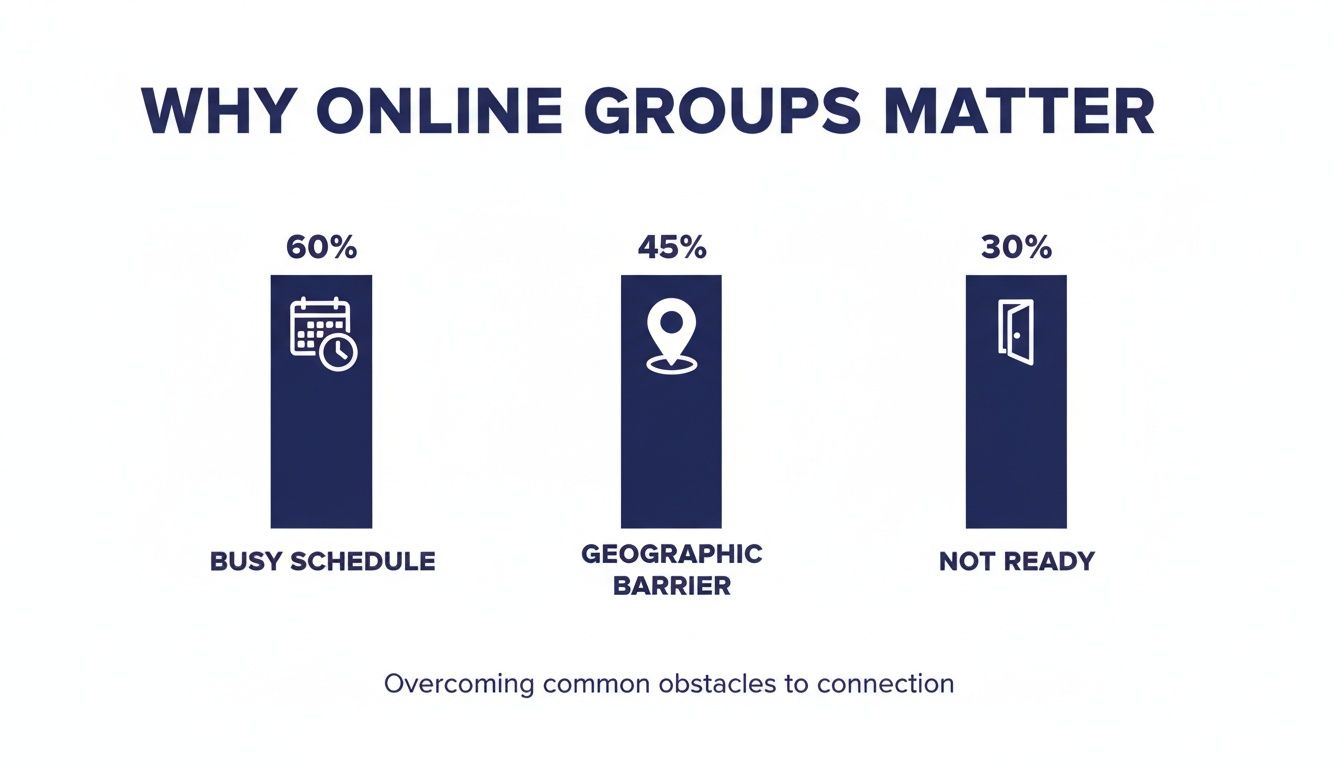
This data shows that digital ministry is a vital bridge for people who would otherwise be left out. Crazy schedules, living far from the church building, or just not feeling ready for an in-person gathering are real barriers that online groups can overcome.
To help you decide, here’s a quick comparison of the most popular platforms.
Online Group Platform Comparison
This table breaks down the features of top video platforms to help you choose the best fit for your church's small groups.
While the free versions are a great way to start, keep an eye on those time limits. For groups that need more time for deep discussion and prayer, investing in a paid plan might be worthwhile. The key is to find a tool that doesn't get in the way of connection.
We've learned from a lot of experience—both in ministry and in the broader world of online focus groups—that meaningful discussion thrives when you keep the group size between 6 and 10 participants. That's the sweet spot for building intimacy and trust.
Creating a Safe and Secure Digital Space
After you’ve picked your platform, you need to set up your virtual meeting room. Creating a secure environment right from the start is absolutely critical for building trust.
A safe digital space is the bedrock of authentic community. When people feel secure, they are more willing to be open and vulnerable, which is where true spiritual transformation happens.
Here are a few non-negotiable settings you should have in place for every single meeting:
- Enable the Waiting Room: This feature is your digital bouncer. It gives the host total control over who enters the meeting, preventing any unwelcome surprises.
- Use a Unique Meeting ID and Password: Never use your personal meeting ID. Always generate a unique link and password for each group and only share it privately with confirmed members.
- Establish Clear Community Guidelines: Before the first meeting, send out a simple set of expectations. This can include things like respecting different opinions, keeping what's shared in the group confidential, and making sure everyone gets a chance to speak.
For more ideas on setting these expectations and sparking great conversations, see how a community church builder app can streamline the process.
Taking these foundational steps doesn't require a tech genius. It just requires being intentional. By defining your purpose, choosing user-friendly tech, and making security a priority, you'll build a welcoming framework where your online small groups can truly flourish.
How to Find and Equip Your Best Online Leaders
Let’s be honest: your online small groups will only ever be as strong as their leaders. You can have the best tech and a perfectly crafted curriculum, but without a confident, caring person steering the ship, the group will never become a true community.
Finding and training leaders for this digital space is different. It’s less about finding your most tech-savvy people and more about identifying your “digital shepherds.” The best leaders might not be your IT pros. Instead, look for people with the spiritual gifts of hospitality and facilitation. You need someone who can make people feel seen, heard, and valued—even through a screen.
Identifying Potential Digital Shepherds
So, who are these people in your church? Think about the person who always lingers in the lobby to welcome new faces or the one who naturally pulls others into a conversation after service. These are the individuals with an innate gift for creating belonging, a skill that translates beautifully to an online group.
As you look for potential leaders, keep an eye out for these qualities:
- Empathetic Listeners: They don't just wait for their turn to talk; they listen to understand and ask thoughtful follow-up questions.
- Natural Connectors: They have a knack for remembering names and details about people's lives, effortlessly bridging gaps between individuals.
- Humble Facilitators: They guide conversations without dominating them. Their goal is to make sure every voice is heard and valued.
- Spiritually Mature: They have a consistent walk with Christ and a genuine desire to see others grow in their faith.
Once you have a few people in mind, approach them personally. Explain exactly why you see these gifts in them and cast a vision for how they could make a massive impact online.
The Right Questions for the Right Role
An application or even just an informal chat is a great way for both you and the potential leader to figure out if this is the right fit. Don’t get bogged down asking about their technical skills. Instead, ask questions that get to the heart of their ministry mindset.
Here are a few questions I’ve found incredibly helpful for vetting online leaders:
- How would you make someone feel truly welcome in their very first online group meeting?
- Imagine a group member is quiet and seems disengaged. How would you gently try to draw them into the conversation?
- Can you tell me about a time you helped guide a difficult conversation? What did you learn from it?
- What are some ways you might create a sense of community that extends beyond the weekly video call?
- How do you plan to manage potential distractions (like notifications or family interruptions) during an online meeting to stay present with your group?
These questions shift the focus from "Can you use Zoom?" to "Can you shepherd a group of people online?" Their answers will give you a deep sense of their pastoral instincts.
A Training Checklist for Confident Leadership
Finding the right people is only half the battle. Equipping them is just as critical. Your training needs to be practical and confidence-boosting, making sure they feel ready to handle both the tech and the people.
Empowering your leaders isn't just about teaching them software; it's about commissioning them as digital ministers. When they feel supported and confident, they can focus on what truly matters—caring for their people.
A simple checklist can ensure you cover all the essentials in your training. Make sure it includes:
- Technical Mastery: Don't just talk about the platform—give them hands-on practice. Show them how to manage a waiting room, use breakout rooms effectively, and troubleshoot the most common audio or video hiccups.
- Facilitation Skills: Role-play is your friend here. Practice navigating common scenarios, like how to handle a dominant talker or respond to a sensitive prayer request. Teach them how to spark real conversation, not just deliver a lecture.
- Community Building Tactics: Brainstorm practical ways to foster connection outside the scheduled meeting. This could be a group chat for prayer requests, a shared document for notes, or even just sending midweek encouragement.
- Pastoral Care Online: This is where you equip them to be a true “digital shepherd.” Talk about how to notice when someone is struggling, when to follow up with a private message or call, and what it looks like to provide consistent, intentional care from a distance.
By investing well in finding and equipping these leaders, you’re doing more than just launching groups. You're building a new team of ministers who can extend your church's discipleship and care into the digital spaces where people spend their lives every day.
A Smarter Way to Promote Your Groups and Fill Every Spot
You’ve built a solid foundation and equipped your leaders. Now comes the exciting part: getting the word out and inviting people into your new online small groups. This is where a smart, consistent promotional strategy can mean the difference between an empty Zoom room and a thriving digital community.
But let's be honest, promoting groups can feel like another full-time job. Juggling different social media platforms, creating graphics, and writing compelling copy can quickly overwhelm even the most dedicated church staff and volunteers.
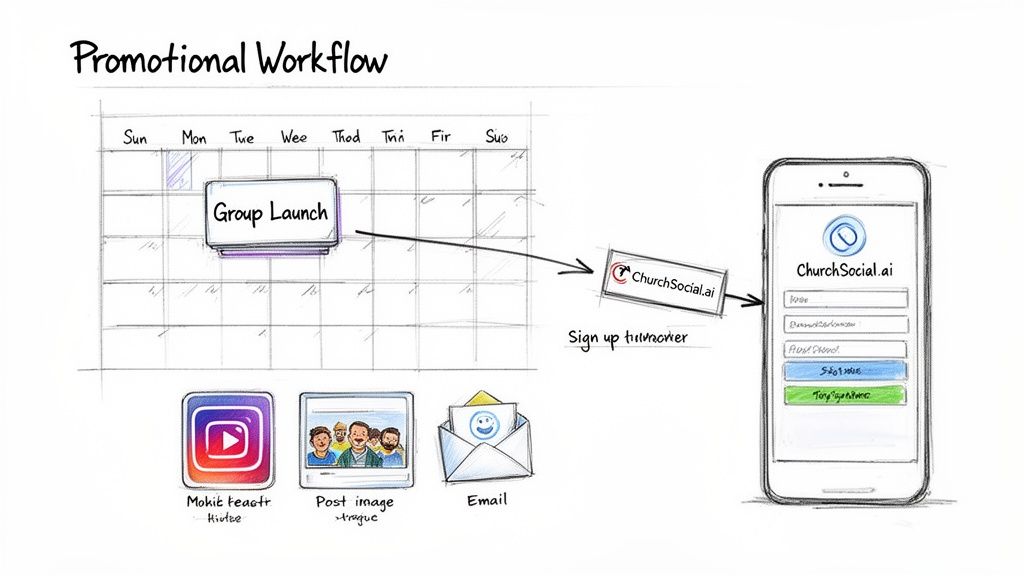
This is precisely where ChurchSocial.ai changes the game for churches, turning hours of chaotic work into just a few minutes of focused effort.
Automate Your Social Media Content Creation
Picture this: your pastor preaches a powerful sermon on the importance of community. The message resonates deeply, and it’s the perfect moment to invite people into a small group. Instead of starting from scratch, what if you could instantly multiply that message?
With a tool like ChurchSocial.ai, you can upload the sermon transcript and let our AI get to work. In minutes, you’ll have a whole suite of content ready to go:
- AI-Generated Reels: The most moving clips from the sermon are automatically identified and turned into short, engaging videos perfect for Instagram and TikTok.
- Social Media Posts: The AI crafts compelling captions for Facebook and Instagram, pulling key quotes and pairing them with a clear call to action to join a group.
- Blog Posts & Email Blurbs: A summary of the sermon, complete with discussion questions, can be generated for your church blog or weekly e-newsletter.
This isn’t just about saving time; it's about creating a cohesive, powerful message that echoes across all your communication channels.
When your promotional content is directly tied to the messages being shared from the pulpit, it creates a seamless journey for your congregation. They hear the "why" on Sunday and immediately see the "how" on their social feeds.
Design Beautifully, Schedule Easily
Consistent, professional-looking graphics build trust and capture attention. But you don't need to be a graphic designer to create them. That's why ChurchSocial.ai provides churches with a library of graphic templates and a simple editor.
Just pick a template for your group launch, add your church’s logo and colors, and drop in your details. You can create a full campaign of matching graphics for Instagram posts, carousels, Facebook events, and website banners all in one place.
Once your content is ready, scheduling it shouldn't be a headache. The simple drag-and-drop calendar in ChurchSocial.ai allows churches to easily manage and update all of their social media. You can see everything at a glance and ensure a steady drumbeat of communication leading up to your sign-up deadline.
Connect With Your Audience Where They Are
Knowing where to focus your promotional energy is key. For many churches we work with, Instagram has become an indispensable platform for community engagement. It boasts 3 billion monthly active users globally, and with 92 percent of users under the age of 45, it's a direct line to younger generations who are actively seeking spiritual community. The platform's visual focus is perfect for sharing powerful testimonies and vibrant images that communicate the heart of your small groups. You can dive deeper into these numbers by reviewing these comprehensive marketing statistics on hubspot.com.
A smart promotion strategy also removes friction from your processes. ChurchSocial.ai integrates with Planning Center and other church calendars. This integration can automatically create promotional content for events you've already scheduled, like a "Small Group Kickoff Night." It pulls the event details and helps you generate posts to drive RSVPs, completely streamlining your workflow.
This approach transforms promotion from a tedious chore into a powerful ministry tool. By creating compelling content that truly connects, you can move people from passive observers to active participants, filling every spot in your online small groups and fostering the community your church is called to build.
Facilitating Meetings That People Actually Look Forward To
We've all been there: the awkward silences, the forced participation, the feeling that this is just another meeting on the calendar. But what if your online small groups could be different? The goal here isn't just to get through another video call. It’s to create the best hour of someone's week—an experience they genuinely can't wait to be a part of.
This doesn't happen by accident. Turning a simple video call into a space for real connection is an art, but it’s one you can absolutely master. It all comes down to being intentional, right from the planning stage.
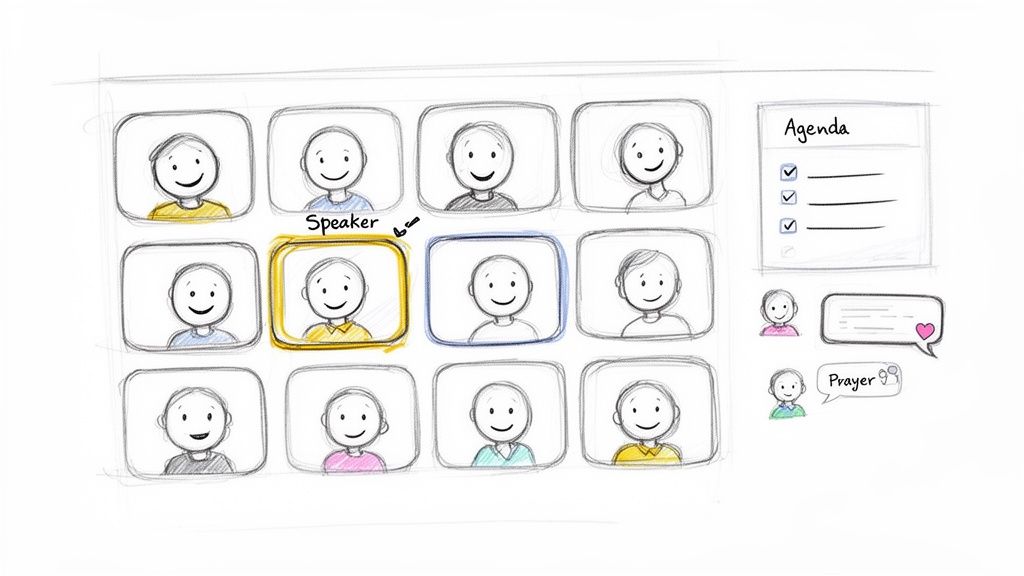
Crafting a Consistent and Engaging Agenda
Predictability is your friend in an online setting. When people know the general flow of your meeting, they feel safer and more comfortable. They can relax into the conversation instead of nervously wondering what’s coming next. A simple, repeatable agenda is the secret sauce.
I've seen this flow work wonders:
- Welcome & Icebreaker (10 mins): Jump right in on time. Kick things off with a light, easy question that gets everyone talking from the get-go. This sets the tone that everyone's voice is welcome.
- Anchor Point (5 mins): Briefly share a scripture verse or revisit the group's shared vision. This little moment roots the meeting in its spiritual purpose before you dive deep.
- Discussion (30-35 mins): This is the core of your time together. Focus on open-ended questions that invite people to share stories, not just "yes" or "no" answers.
- Prayer & Praise (10-15 mins): Create a dedicated space for prayer requests and, just as importantly, to celebrate wins and answered prayers from the week.
- Closing & Look-Ahead (5 mins): Always, always end on time. Wrap up by mentioning next week's topic and reminding everyone how to connect between meetings.
This rhythm provides a sturdy container for the beautiful, unpredictable work of building real community.
The Art of the Virtual Icebreaker
Online icebreakers have to be screen-friendly. The goal is to lower everyone's guard and warm up the virtual "room" for a deeper conversation. Skip the questions that feel like a pop quiz.
Here are a few that always seem to land well:
- Two Roses and a Thorn: Each person shares two good things from their week (roses) and one small challenge (a thorn). It’s simple, personal, and real.
- Virtual Show and Tell: Ask everyone to grab the nearest object that holds a special meaning and share its story in 30 seconds. You'll be amazed at what you learn.
- Desert Island Picks: A fun classic: "You're on a desert island. What one book (besides the Bible), one snack, and one song are you bringing?"
Remember, the point isn't just to fill time. It's to get every single person to unmute, share a piece of themselves, and feel comfortable participating.
Reading the Virtual Room
This is probably the trickiest skill to develop as an online leader. You can't rely on the same body language cues you get in person, so you have to tune your attention to different signals.
Look for the little things. Did someone unmute but then stay quiet? They probably want to jump in but are looking for a gap. Did someone's facial expression change, or did they lean into their camera? That's a sign of engagement.
A great facilitator is like a great host. They don't just put out the food; they make sure everyone has a seat at the table and feels included in the conversation. Your job is to gently draw people in, not put them on the spot.
A simple phrase like, "Sarah, it looked like you had a thought there a moment ago. Anything you'd like to add?" can be a powerful invitation that makes someone feel seen and valued.
Sparking Genuine Discussion
Your questions will make or break the meeting. Avoid questions with simple, factual answers. Instead, ask questions that invite reflection, experience, and storytelling. If you need a jumpstart, our guide on small church group discussion topics is packed with ideas.
To ensure your conversations are engaging and meaningful, it's wise to explore a variety of methods and creative topics for group discussion that can be easily adapted to fit the unique personality of your church group.
Building Community Beyond the Call
Let's be honest: true community isn't built in one hour a week. The real magic happens in the moments in between. This is where you can use a simple tool to keep the connection going all week long.
A private WhatsApp chat or a dedicated Facebook Group can become the group's digital home. It’s the perfect spot for:
- Sharing last-minute prayer requests.
- Celebrating personal wins and answered prayers.
- Asking for advice on a tough situation.
- Dropping a funny meme or an encouraging Bible verse.
This ongoing conversation is what transforms a weekly meeting into a spiritual family. It’s where people start doing life together, creating online groups that people don't just attend—they truly belong to.
Alright, let's get your online small groups thriving for the long haul. Launching them is a massive win, but what comes next is what truly builds a ministry that lasts. We need to figure out what’s clicking with people and what isn't, so we can build on the good stuff.
This isn't about chasing numbers for the sake of numbers. It’s about being good stewards of the ministry God has given you and making sure your online groups are genuinely creating life-changing community.
What to Measure (Beyond Just Attendance)
Seeing how many faces pop up on a video call is a start, but it doesn't tell you the whole story. To really get a feel for the health of your groups, we need to look a little deeper at what’s actually happening.
I’ve found it’s best to keep an eye on three specific areas:
- Member Retention: What percentage of people who join a group stick around for the whole session? When people stay, it’s a huge sign that they're finding real value and connection.
- Leader Development: This is the big one. Are you seeing potential new leaders emerge from within your groups? A ministry that raises up new leaders is a ministry that’s built to multiply.
- Active Engagement: Are group members talking or praying for each other outside of the scheduled meeting? That's when you know you've moved past just a weekly event and are building a real community.
How to Get Honest Feedback
The only way to truly know how things are going is to ask. A quick, anonymous survey for both members and leaders after a group session wraps up can give you gold.
Feel free to use or adapt these questions. I've found they get to the heart of the experience:
- On a scale of 1-10, how connected did you feel to others in your group?
- What was one thing from your group experience that really stuck with you?
- What's one thing we could do to make the online group experience even better?
- Would you want to join another online group? Why or why not?
The goal of feedback isn't to find fault; it's to find opportunities. Honest input is a gift that allows you to make your ministry better, stronger, and more effective for everyone.
Adapting and Planning Your Next Move
Once you have that feedback, it's time to put it to work. The data and stories you collect should be the compass for your next steps. Maybe you find out there’s a huge desire for a group for young married couples, or perhaps your leaders are asking for more training on navigating tough conversations. Listen to that.
This is also where your promotional strategy gets a lot smarter. If you see that your sermon-based groups are consistently full, you can double down on promoting them. This is where a tool like ChurchSocial.ai can be a game-changer for scaling up. Imagine taking a sermon transcript and instantly generating a handful of social media posts or even AI Reels that highlight the core message, all designed to get people signed up for a related small group.
The digital world isn't just a trend; it's where people live. As of October 2025, there are a staggering 5.66 billion active social media identities globally—that’s 68.7 percent of the entire world's population. These platforms are the new town square, and your church has an incredible chance to meet people right where they are. Having a strong, engaging presence isn't just an option anymore; it's essential for reaching your community. You can dive deeper into the numbers and learn more about these global digital trends.
By measuring what truly matters, listening to your people, and being willing to adapt, you'll build an online small group system that creates deep discipleship and real community for years to come.
Ready to streamline your church's social media and effectively promote your online small groups? With ChurchSocial.ai, you can turn sermons into social content, create stunning graphics in minutes, and manage your entire content calendar with ease. Stop feeling overwhelmed and start reaching more people. Discover how we can help at https://churchsocial.ai.