A pastor can preach a strong message, the band can lead with excellence, and the room can still feel flat if the platform is dark, patchy, or full of shadows. People in the room notice it. Online viewers notice it even faster. If your sermon clips look dim and your event photos feel muddy, the problem often isn’t your camera first. It’s the light.
That’s why church stage lighting on a budget matters more than many teams realize. Good lighting helps people see faces, read emotion, stay engaged, and focus on the message instead of fighting visual distractions. It serves the room. It also serves every livestream, sermon replay, social post, and ministry update you publish later.
A lot of churches assume professional-looking lighting is out of reach. It isn’t. Small churches can make meaningful progress without turning the sanctuary into a concert venue and without buying gear that volunteers dread using. The best budget systems are simple, repeatable, and built around a few priorities that change what people see.
Illuminate Your Message Beyond the Stage
Most churches don’t need flashy effects first. They need clear, consistent light on the people leading the service. That one shift changes the in-room experience and the online experience at the same time.
When a pastor’s face is hidden in shadows, people work harder to stay visually connected. When a worship leader is lit unevenly, your livestream looks less polished even if the audio is solid. A lot of churches try to solve this with backdrop color, projection, or decor updates. Those can help, but they don’t replace usable front light.
A better approach starts with communication. Light is part of how a church communicates. It helps the congregation see the person teaching, and it helps your camera capture something worth sharing later.
Practical rule: If people can’t see faces clearly, the rest of the lighting plan is secondary.
This doesn’t mean every church needs moving fixtures, haze, or a complex lighting console. In fact, most budget-friendly wins come from restraint. A modest setup, aimed well, usually beats a bigger pile of poorly placed fixtures.
That’s also why lighting should be thought of alongside your platform design. If you’re reworking your background, colors, or visual focal points, it helps to think about how those elements interact with light. Some of the strongest ideas pair simple lighting with intentional staging, like the concepts in these church stage decor ideas.
What good budget lighting actually does
A solid starter system should help you do three things well:
- Light faces evenly so preaching and worship leadership feel clear and personal.
- Reduce distractions like eye sockets in shadow, bright hotspots, or washed-out backgrounds.
- Support digital ministry by making your videos and photos usable without heavy editing.
If you keep those goals in front of you, you’ll make better decisions and spend less money on gear that looks exciting in a catalog but doesn’t help your weekly ministry.
Assess Your Needs Before You Spend a Dime
Churches waste money when they shop before they diagnose. The sentence “we need stage lighting” is too broad to guide a smart purchase. You need to know what problem you’re solving.
Some churches need better sermon visibility. Others need worship coverage across a wider platform. Some mainly need cleaner video for sermon archives, livestreams, and social content. Those are different needs, and they lead to different fixture choices and placement decisions.

Start with ministry goals
Before you compare brands or fixture specs, answer these questions with your team:
- What must improve first: Is the biggest problem the sermon area, the worship team, or the background behind them?
- What content do you capture weekly: Full sermons, clips, announcements, event photos, or all of the above?
- Who runs the system: A trained tech director, a rotating volunteer team, or whoever shows up early on Sunday?
- What stays constant: Does your platform layout change often, or is it mostly fixed week to week?
Write the answers down. That simple step keeps the project grounded.
Measure the room, not your wish list
A budget system works best when it’s matched to the space you have. Measure the platform width and depth. Note ceiling height. Check where you already have safe mounting options. Look at power locations and cable paths. If your church is portable, note where stands can go without becoming a hazard.
Effective fixture placement is key. A general guide on sizing and installing light fixtures can help teams think through scale, spacing, and placement logic before buying hardware.
Here’s the reality many churches run into. Stage lighting gets cut during a project, then the church rents gear every year for major services. According to CTS AVL, churches often end up relying on annual rentals costing $20,000 to $40,000 for special events, even though many small churches only need 4 to 8 front wash fixtures to achieve a professional look through ownership instead of recurring rentals, as summarized in their church budget lighting guidance.
Renting can solve this Easter. It rarely solves the next three years.
Build a simple assessment checklist
Use this checklist during a walk-through:
Speaker position
Stand where the pastor usually teaches. Mark that spot. This is your first lighting priority.Worship coverage
Identify the full area used by vocalists and musicians, not just the center mic stand.Background surfaces
Look at walls, curtains, wood slats, or decor pieces that could benefit from subtle accent light later.Camera view
Pull up your livestream angle or record a quick phone test from the back of the room. What looks dark on camera often looks darker online.Mounting reality
List what’s available now. Ceiling pipes, front-of-house positions, wall mounts, or portable stands.
Know the difference between need and want
Need is clear speaker illumination. Need is safe mounting. Need is a control method volunteers can handle.
Want is usually motion, effects, or dramatic color changes. Those can come later. Budget churches do well when they solve the plain problems first. Once the stage is visible, you can decide whether atmosphere upgrades belong in the next phase.
Create Your Core Lighting Plan with Key Zones
A good plan doesn’t start with fixture models. It starts with zones. That’s how you stretch a small budget and still get a polished result.

Zone 1 for the speaker
If your budget is limited, this is the first place to spend. Experts recommend that churches working with a $2,000 to $5,000 budget prioritize front lighting for clear facial visibility because it delivers 80 to 90% of the desired visual impact, with a suggested budget split of 60 to 70% for fixtures, 15 to 20% for a DMX controller, and 15 to 20% for accessories, and they advise mounting front lights at a 45° angle to reduce hotspots in this budget church lighting guide.
That front-light-first principle is one of the few ideas that consistently works in small churches. It isn’t glamorous, but it fixes the thing people notice most.
For the sermon area, think in plain terms:
- Put light in front of the speaker, not directly overhead.
- Spread coverage evenly across the area where the pastor moves.
- Avoid aiming fixtures so steeply that they create deep eye shadows.
- Don’t blast one center spot and leave the edges dim.
Zone 2 for the worship team
The worship zone usually needs broader coverage. Singers move. Musicians spread out. A tight pool of light won’t hold up well.
This area benefits from a gentle wash rather than a hard spotlight feel. If the worship team shares space with the sermon area, your front-light strategy may overlap. That’s fine. In many small churches, the smartest plan is to let a few well-placed front fixtures do double duty.
Front light doesn’t have to be dramatic. It has to be dependable.
Zone 3 for the background
Background lighting comes after people are clearly visible. Churches often get tempted to start with background lighting first because colored walls look exciting in photos. But background light without usable face light gives you pretty walls and weak video.
That said, even a little accent on the back wall can help. It adds separation and keeps the stage from looking flat. If you have room in the budget after covering the speaker and worship team, this is the place to add subtle character.
A simple version of three-point lighting
You don’t need film-school language to use the concept well. Consider it this way:
| Part | Job | Budget-friendly use |
|---|---|---|
| Key light | Main light on the person | Your primary front wash on the sermon area |
| Fill light | Softens harsh shadows | Additional front coverage from another angle |
| Back light | Adds separation from background | A restrained light from behind or above, if your room allows |
In many small churches, you may only build the first two parts at the beginning. That’s still a strong win.
A practical placement map
If you’re sketching this out on paper or a whiteboard, mark these in order:
- Primary speaking area first
- Left and right worship coverage second
- Background accents third
- Walkways and cable routes last, before installation
The biggest mistake is treating every part of the platform as equally important. It isn’t. If your budget only covers a few fixtures, place them where they support faces and communication first. That’s the core of church stage lighting on a budget.
Choose the Right Affordable Lighting Fixtures
Once the zones are clear, gear choices get easier. You’re no longer shopping for “cool lights.” You’re shopping for tools that solve specific visibility problems.
For most small churches, LED PAR fixtures are the workhorse. They’re versatile, relatively affordable, and useful in more than one role. A PAR can handle front wash, side fill, or basic accent duties depending on where you place it and how you aim it.
What the specs actually mean
A lot of churches get stuck in spec-sheet language. Here’s the plain-English version.
- Lumens tell you how much light the fixture outputs. More isn’t automatically better. Too much output in the wrong place creates glare and hotspots.
- CRI matters because it affects how natural faces look. A higher CRI usually helps skin tones look more believable on camera and in the room.
- Beam angle affects spread. Wider beams cover more area. Narrower beams are more focused.
- Dimming matters because church services change mood and function. You want fixtures that can fade smoothly.
If you’re comparing old-school options to modern LED fixtures, it helps to understand the everyday trade-offs. This overview of the benefits of LED vs halogen is useful for teams weighing heat, efficiency, maintenance, and practicality.
Which fixture type fits which job
Here’s a practical comparison for budget-minded churches:
| Fixture type | Best use | Strength | Weak point |
|---|---|---|---|
| LED PAR | Front wash, side wash, basic stage coverage | Flexible and affordable | Can create uneven results if aimed poorly |
| LED bar | Wall wash, backdrop color, scenic accents | Covers background surfaces well | Usually not the best first choice for faces |
| Ellipsoidal or profile fixture | Focused lighting on lectern or specific areas | Precise beam control | Often a later upgrade for tighter budgets |
For many churches, the first purchase should lean heavily toward LED PARs because they can handle the most urgent jobs. LED bars are great for adding depth to a blank back wall later. Profile fixtures make sense when you want tighter control over the sermon area and have room to upgrade.
Sample Budget Breakdown for a Small Church Stage
| Item | Starter Budget ($1,000) | Standard Budget ($2,500) | Advanced Budget ($5,000) |
|---|---|---|---|
| Front wash fixtures | Most of budget | Primary investment | Strong primary investment |
| Background or accent fixtures | Minimal or delayed | Some room for basic accents | More room for layered background lighting |
| Controller | Basic option | Better volunteer-friendly option | More flexible control option |
| Mounts, cables, safety gear | Essential only | Proper supporting gear | Full supporting package |
This table is intentionally broad. The point isn’t to force one shopping list. The point is to keep your spending priorities in order.
Buying used without buying trouble
Used fixtures can be a smart move, especially for churches building phase one. They can also become a repair ministry nobody asked for.
Check these before buying used gear:
- Test dimming behavior so you don’t inherit flicker or erratic response.
- Inspect connectors and housing for damage, loose inputs, or bent mounting points.
- Confirm control compatibility with the controller you plan to use.
- Match fixture families when possible so volunteers aren’t operating a Frankenstein system.
Buy fewer fixtures you can trust before you buy more fixtures you have to fight every week.
If your budget is very lean, save the DIY creativity for background accent pieces, not for your main speaker lighting. The lights that carry the sermon should be dependable.
Master Simple Controls and Safe Installation
A budget rig fails when it’s too hard to run. Churches don’t need a lighting system that only one tech-savvy person understands. They need a setup a volunteer can operate without panic.
Make DMX feel simple
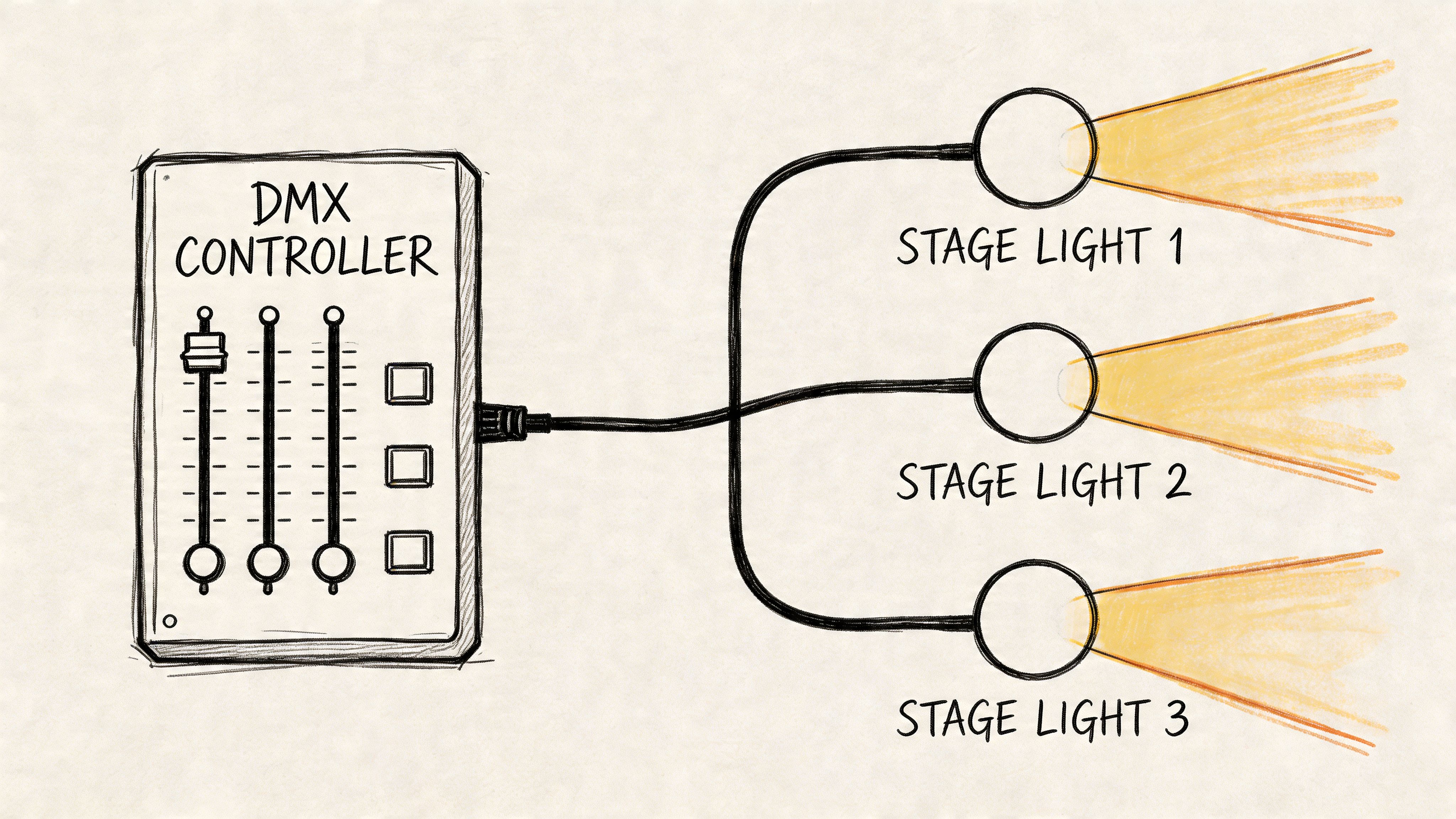
DMX is just the language the controller uses to tell lights what to do. The easiest analogy is a road system. Each fixture gets an address, and the controller sends instructions down the line so the right light responds at the right time.
That sounds technical at first, but in practice, most churches only need a few repeatable looks. You don’t need to build a theater show. You need a handful of dependable scenes.
Build scenes volunteers can recall fast
Think in terms of ministry moments:
- Welcome scene for pre-service and announcements
- Sermon scene with clear front light and minimal distraction
- Worship scene with the same visibility plus any accent looks you use
- Prayer or response scene with softer intensity if that fits your service style
If your church tech area is crowded or improvised, it helps to think about the full operator workflow too. A cleaner setup in the booth often leads to more consistent lighting execution, especially in volunteer-driven environments. This look at the church tech booth is a helpful reference for organizing the people and gear behind the scenes.
Safety is not the place to cut corners
A light that’s cheap but mounted poorly is not a budget win. It’s a risk.
Use these essential elements:
- Attach safety cables to every overhead fixture.
- Secure stands properly and keep them out of traffic paths.
- Dress power and data cables so people don’t trip and volunteers can troubleshoot quickly.
- Label scenes and controls clearly so nobody guesses during a live service.
- Test from audience view and camera view before Sunday.
Keep the control surface boring on purpose
The best volunteer lighting interfaces are simple. Label the most-used buttons. Remove clutter. Create a Sunday workflow that doesn’t require live programming.
If a volunteer can press one button for “sermon” and get a clean result every time, you’ve built a better ministry tool than a complicated rig with endless options.
That kind of simplicity pays off every week. It also keeps your lighting consistent, which matters a lot once your church starts recording more content regularly.
Leverage Your New Lighting for Digital Outreach
Once your stage is lit well, your church gains more than a better-looking room. You gain a better content source.
Clear lighting improves sermon clips, announcement videos, event photos, baptism recaps, and volunteer spotlights. It helps the camera capture expressions without fighting shadows. It makes social posts feel more trustworthy and more inviting because people can see what’s happening.
Better light creates more usable content
A lot of churches struggle with online content because the source footage starts weak. Editing can help. Captions can help. Graphics can help. But if the original video is dark, uneven, or flat, you’re asking every later step to compensate.
That’s why lighting should be treated as part of your communications pipeline. Good stage light doesn’t stay on the stage. It carries into your website, your livestream archive, your sermon snippets, and your weekly social feed.
If your team is also evaluating camera-side improvements, this guide to find the best streaming lighting can help frame the relationship between subject lighting and video quality.
Think beyond Sunday in the room
A well-lit sermon can become:
- Short clips for Instagram Reels, TikTok, or YouTube Shorts
- Clean still frames for quote graphics and event promotions
- Better archive thumbnails for sermon libraries
- Stronger ministry updates that feel current instead of improvised
If your church is planning bigger media upgrades over time, it also helps to think about lighting as one part of a broader production chain. This article on video systems for churches gives useful context for how cameras, switching, and presentation tools work alongside stage visibility.
The main takeaway is simple. Lighting isn’t vanity. It’s infrastructure for communication. In a church that preaches in the room and publishes online, that matters every single week.
A strong lighting setup helps your message look as clear online as it sounds in the room. When you’re ready to turn those better sermon videos and photos into consistent outreach, ChurchSocial.ai gives churches one place to create sermon clips, turn transcripts into social posts and blogs, design graphics with templates, and schedule everything on a drag-and-drop calendar. It’s a practical next step for churches that want their Sunday content to keep working all week.