Before you even think about an outline, the real work of sermon prep begins. It’s not about finding a topic; it’s about laying a spiritual and strategic foundation that gives your message purpose and power.
A sermon that truly connects doesn't start with three points and a poem. It starts with listening.
Building Your Sermon on a Solid Foundation
The challenge for pastors today is enormous. You stand up to preach, knowing that for the first time in 80 years, US church attendance has dipped below 50%. That’s a heavy weight. Gallup's research from 2020 paints a sobering picture, a stark contrast to the steady churchgoing culture many of us grew up in.
But there's hope in that data. Nondenominational churches actually grew between 2010 and 2020, adding 4,000 congregations and 6.5 million new faces. What does that tell us? Dynamic, relevant preaching still draws people in. Your preparation is the bridge.
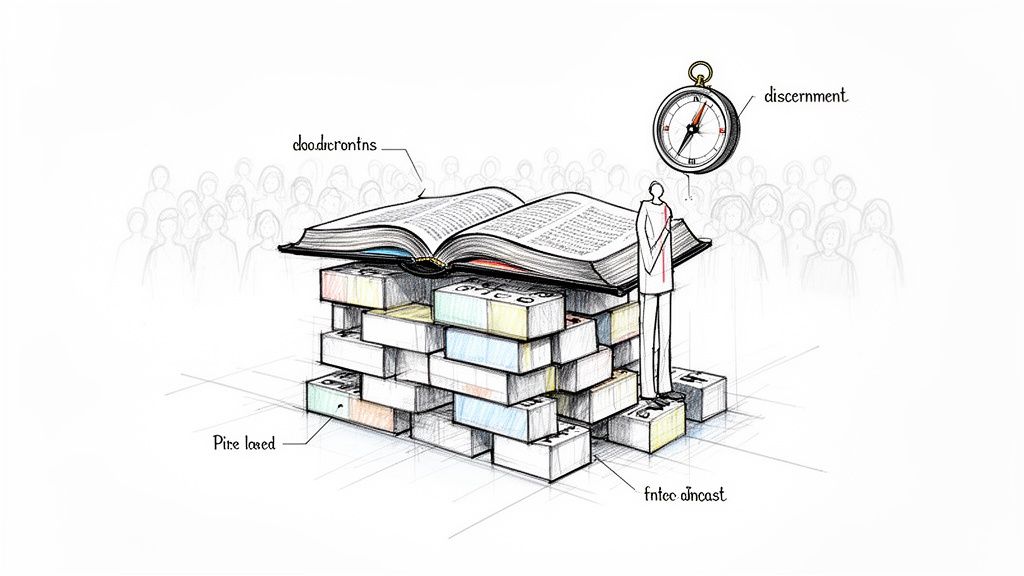
Discerning God's Direction for Your Congregation
The first move is always prayer. It's the discipline that keeps you from just "cranking out a sermon" because Sunday is coming. As Psalm 1:2 puts it, the blessed person’s "delight is in the law of the Lord, and in His law he meditates day and night."
This isn't a passive waiting game. It's an active wrestling match with Scripture and the Spirit, asking pointed questions:
- What is God saying to our people in this season?
- What specific sins need confronting? What deep hurts need comforting?
- What’s the one burden on my heart for my flock this week?
I’ve found that journaling through this process is a game-changer. Writing forces you to get specific. It helps you move from a vague feeling about a passage to a concrete, Spirit-led direction.
Identifying the Core 'Big Idea'
With a sense of direction, your next job is to boil it all down to a single, memorable sentence. Call it the "big idea," the thesis, or the main point—whatever you call it, it's your sermon's North Star.
A sermon without a central, driving point is just a collection of nice thoughts. It might be interesting, but it won't be transformative. The big idea is the filter for everything that follows.
For instance, don't just preach on "faith." Your big idea could be: "True faith isn't the absence of doubt, but the choice to trust God right in the middle of it."
Now you have a powerful tool. Does this story I want to tell actually clarify that idea? Does this exegetical point support it? If not, it gets cut. No matter how good it is.
Understanding Your Audience's Deepest Questions
Finally, a solid foundation means knowing who you're talking to. A message on giving will sound very different in a community struggling with unemployment versus one experiencing prosperity. You have to know their world.
Think about the unspoken questions people carry into the sanctuary every Sunday morning:
- "How does this ancient book have anything to say about my soul-crushing job?"
- "Is what I did last night actually forgivable?"
- "Where is God while my family is falling apart?"
When you prepare with these questions echoing in your mind, you stop just proclaiming truth and start connecting truth to their real lives. You're building a bridge from the world of the Bible to their world today.
For a deeper look at balancing the text and the context, our guide on expository sermon preparation is a great next step.
Here’s a quick checklist to help you lock in these foundational elements before you start writing.
Sermon Foundation Checklist
This simple table can serve as your guide to ensure you've covered the essentials before moving into the writing phase.
By focusing on these three areas first, you ensure that the sermon you eventually write is not just biblically sound, but also deeply relevant and life-changing for the people you've been called to serve.
From Scripture to Structure: Building Your Sermon's Framework
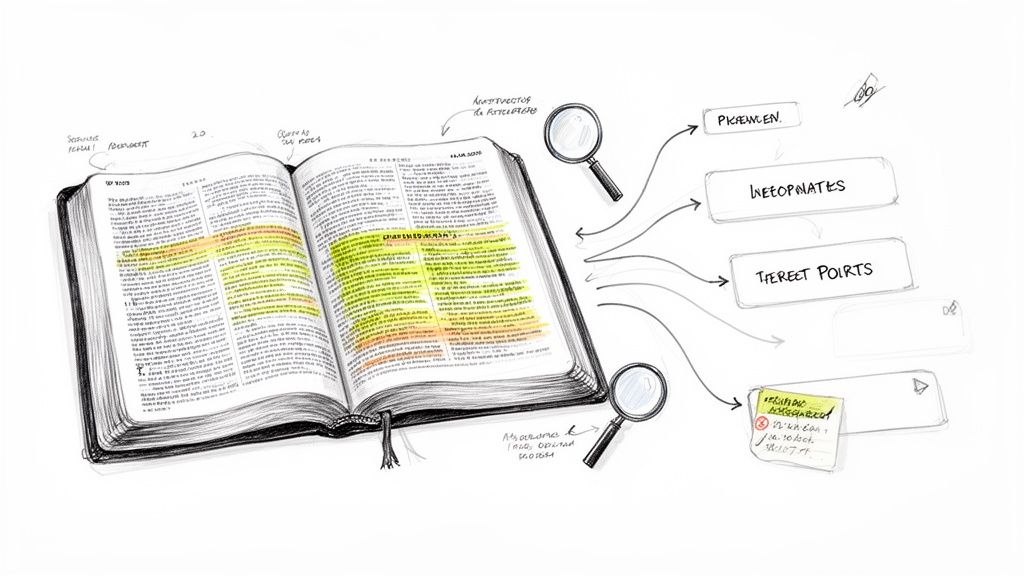
Alright, you’ve wrestled with the text and have a Spirit-led "big idea." Now comes the architectural work: transforming those foundational insights into a message your congregation can actually follow. This is where prayerful study gets its legs and becomes a tangible sermon outline.
The goal isn't just to download information. It’s to build a logical, compelling structure that honors the Scripture’s original intent and guides your listeners on a journey. Rushing this part is a classic mistake. If you jump straight to an outline without doing the deep exegetical work, you risk using the Bible as a launchpad for your own ideas instead of letting the message flow directly from the Word itself.
From Deep Study to a Working Outline
First things first: you have to live in the passage for a while. This means more than a quick skim. Read it over and over, maybe in a few different translations, to catch the nuances you might have missed on the first pass.
For me, and for many pastors I know, journaling through this phase is non-negotiable. There's an old saying: "You don't know what you think until you write it." Writing forces you to really grapple with the text.
As you study, ask yourself some hard questions and jot down the answers:
- Context: What was going on historically and culturally? Who was the author writing to, and why?
- Keywords: Which words or phrases keep popping up? What are the core theological concepts at play here?
- Tension: What’s the central problem or conflict in this passage? And, most importantly, where is the good news of the gospel in the middle of it?
This deep dive is what grounds your authority as a preacher. It’s not about your own cleverness; it's about faithfully handling the Scriptures. You have to be able to show your listeners, point by point, how your message comes directly out of the passage. Never assume they see the connection—your job is to make it crystal clear.
Choosing the Right Sermon Structure
With your study notes in hand, you can start organizing your findings into a coherent structure. There’s no single "right" way to do this. The best structure is simply the one that best communicates the truth of your specific passage.
Here are three tried-and-true sermon outlines you can lean on:
No matter which structure you land on, remember that "big idea" from the first stage? That’s the glue that holds everything together. Every point, illustration, and application should serve to clarify and reinforce that single, central truth.
Preparing Your Message for a Digital Age
As you put the finishing touches on your outline, start thinking beyond Sunday morning. A well-structured sermon is a goldmine for social media content that can minister to your community all week long. The trick is to build your message with shareable moments in mind from the get-go.
A sermon outline with clear, distinct points makes it incredibly easy to create content later. Each main point can become a separate social media post, a discussion question, or even a short video clip.
This is where a tool like ChurchSocial.ai can become a natural extension of your sermon prep. Once you have your manuscript or even a detailed outline, you're already halfway to creating a week's worth of solid content.
With ChurchSocial.ai, you can upload your sermon transcript to create AI-generated reels from your most powerful moments, generate content like social posts and blog articles, and use our graphic templates and editor to create and post photos and carousels. It turns your outline into a roadmap for your church's entire digital discipleship strategy for the week.
This isn't about adding another task to your already full plate. It’s about multiplying the hard work you’ve already invested to prepare a sermon. That clear structure can reach people far beyond the walls of your church with just a few clicks.
Writing and Illustrating for Genuine Connection
Once your outline is locked in, it’s time for the real magic: turning that skeleton into a message that actually connects with people. This is where you move from structure to story, from points on a page to a conversation that can stir someone’s heart.
The goal here isn't to sound like a theology professor. You're aiming for authenticity. Think of it like you're talking with a friend over coffee, not delivering a formal lecture. A great way to check yourself is to simply read your sermon out loud as you write it. If it feels clunky or awkward coming out of your own mouth, you can bet it will land that way on Sunday.
The Power of Compelling Storytelling
Let's be honest, facts and data inform the head, but it's stories that change the heart. A personal story or a well-chosen illustration can take a big, abstract theological idea and make it real, tangible, and unforgettable. It’s the difference between saying "God provides" and sharing that one specific story of how He came through for you when you least expected it.
Jesus was the master of this. He didn't just lecture about the Kingdom of God; He told stories about farmers, fishermen, and families to make profound truths stick. We need to do the same.
To make your illustrations land with impact:
- Get Specific: Don't just talk about "patience." Tell the story of losing it in the DMV line last Tuesday. Details make it real.
- Be Real: Share your own struggles and wins. Your vulnerability is what builds a bridge of trust with the people listening.
- Stay on Point: Make sure every story actually serves to drive home your main point, not just wander off on a tangent.
Finding the right story can be tough. Look for inspiration in current events, history, or even pop culture. If you're looking for ideas on using visual media, we have a whole guide on using movie clips to enhance sermons.
Weaving in a Clear Call to Action
A sermon should always ask for a response. As you write, keep asking yourself the "so what?" question. What do you want people to do, think, or feel differently after hearing this message?
A sermon without a clear call to action is like a journey without a destination. It might be an interesting ride, but it doesn't lead anywhere meaningful. The application is where the truth of the message intersects with the reality of daily life.
A pro tip is to sprinkle application throughout your sermon, not just save it for the last two minutes. When you explain a biblical truth, immediately follow it up with what that looks like at work on Monday, at home with the kids, or in your friendships.
Writing for Today’s Listener
You have to know who you're talking to, and the data shows a pretty interesting shift happening in our pews. Believe it or not, Gen Z and Millennial men are coming to church in growing numbers. A recent study found that 55% of Millennial men and 46% of Gen Z men now attend church weekly. Millennial attendance alone jumped from 21% in 2019 to 39% in 2022.
This youth-driven trend changes things. It means your sermon needs to resonate on Sunday and provide content for digital engagement all week long. The short, memorable, and quotable lines you write into your message are the exact clips that will grab their attention online.
This is where your sermon prep starts to overlap with your social media strategy.
And that's where a tool like ChurchSocial.ai can be a game-changer. As you write, you're creating the source material for your entire week of digital outreach. After the service, just upload your sermon transcript. Our platform helps you pull AI-generated reels from your most powerful moments, draft social media captions from key quotes, and even expand your points into blog posts. You can't beat it for making sure the work you put into your message keeps making an impact long after Sunday is over.
Turning Your Sermon into a Digital Outreach Tool
The sermon is prepped, you've prayed over it, and the final 'Amen' echoes through the sanctuary. So, what's next?
In a world where people spend hours a day glued to their phones, a sermon’s life shouldn't end when the service does. That message you poured your heart into has the power to become a digital outreach tool, ministering to your community all week long.
This isn't about piling more work onto your already full plate. It’s about working smarter—extending the reach of the ministry you’re already doing. It’s about taking the truth you’ve prepared and placing it right where your people are living their lives online.
From Sunday Pulpit to Digital Discipleship
Let's be honest about the landscape. While many churches are struggling, there's also incredible resilience and growth, especially in smaller, non-denominational contexts. This new reality demands new strategies.
Sermon clips and social media posts aren't just trendy add-ons anymore. They're essential for reaching a world where Gen Z is actually leading a quiet resurgence in church attendance, showing up an average of 1.9 services per month. Your message has to connect with them in the pews and on their screens.
This is where a tool like ChurchSocial.ai can completely change your workflow. It integrates your sermon prep directly into your digital strategy. You've already done the hard work of exegesis and writing; now it's time to multiply that effort.
Your sermon manuscript isn't just a preaching tool; it's a content goldmine. Every main point, powerful quote, and compelling story is a potential piece of digital ministry waiting to happen.
Simply upload your sermon transcript or audio file into ChurchSocial.ai, and you can generate a whole suite of content in minutes. The platform’s AI instantly creates:
- AI-Generated Reels from your sermon video.
- Social Media Posts that are ready to schedule.
- Small Group Discussion Questions to help your people apply the message.
- A full Blog Post that dives deeper into your sermon's main ideas.
This simple shift turns one hour of preaching into a week-long conversation with your community. The key is to start with a sermon built on authenticity, great illustrations, and a clear call to action—these are the ingredients that make for shareable content.
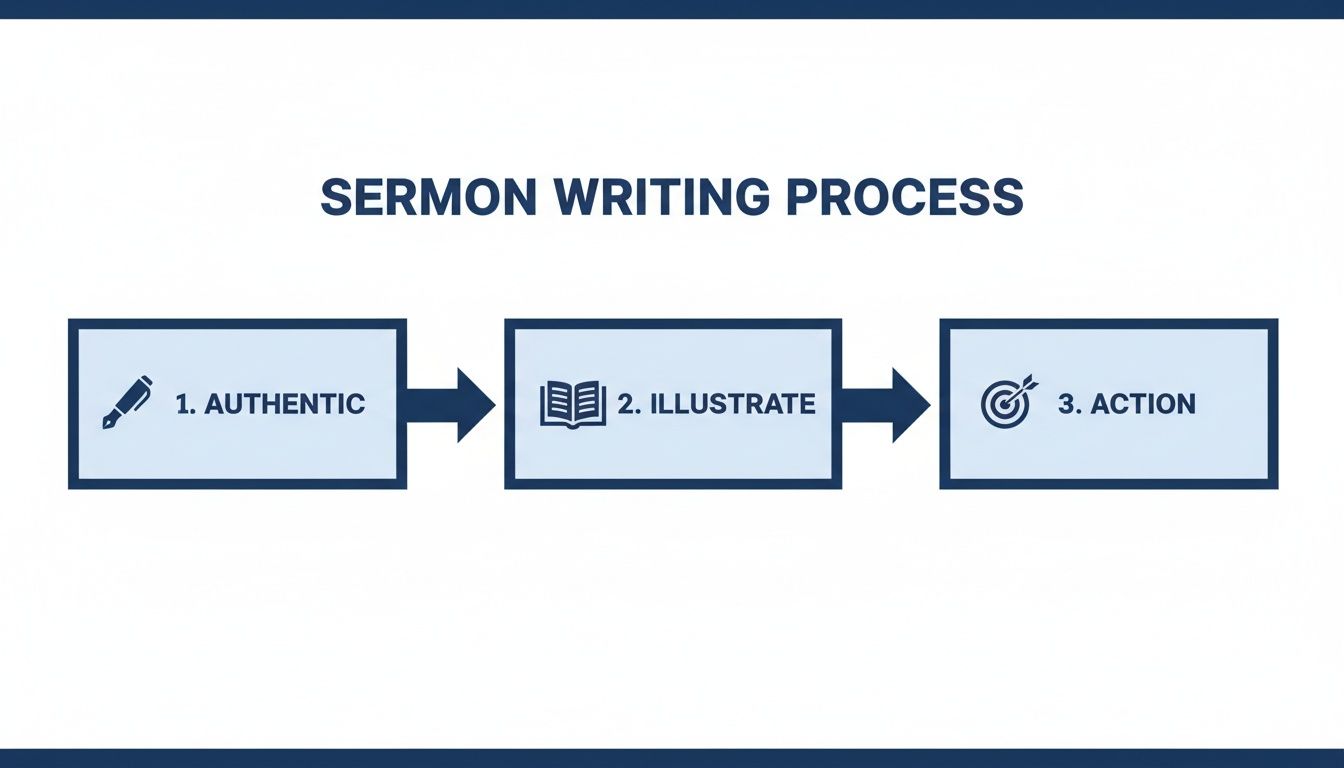
As you can see, a well-crafted sermon naturally produces actionable content, making the jump from the pulpit to social media feel seamless and effective.
Creating Shareable Sermon Clips Effortlessly
Video is the undisputed king of social media, especially on platforms like Instagram Reels and TikTok. Short, powerful video clips are one of the best ways to reach new people and keep your members engaged. But who has the time to become a video editor on top of everything else?
The AI-powered Sermon Clip Creator inside ChurchSocial.ai was built to solve exactly this problem. It scans your sermon video to pinpoint the most potent, shareable moments—those killer one-liners, moving stories, or crucial teaching points.
From there, it automatically generates vertical, captioned video clips perfectly formatted for phones. You don't need any editing skills. Just review the clips, make a few tweaks if you want, and hit schedule. It’s a total game-changer for busy pastors and church volunteers trying to make a big impact without a big budget.
Maximizing Your Reach and Efficiency
This whole idea hinges on smart content repurposing strategies. This is the heartbeat of modern church communication. Instead of trying to dream up new content for every platform every day, you use your core sermon as the wellspring for everything else.
This approach keeps your online presence perfectly aligned with your Sunday teaching, creating a consistent discipleship journey for your congregation. The effort you put in to prepare a sermon no longer just feeds the flock for an hour on Sunday. It becomes a powerful engine for digital outreach that runs all week, helping your church connect and grow.
Streamlining Your Church Social Media Calendar
You've done the hard work of turning your sermon into a week's worth of amazing content. Now what? The last thing you want is for all those clips, graphics, and posts to become another source of stress. Juggling it all can feel like a second job.
This is where you need a simple, central hub to bring it all together. The goal is to shift from that frantic, last-minute posting scramble to a calm, purposeful online presence. A clear plan doesn't just reduce stress for your team; it ensures the message from Sunday's pulpit actually echoes throughout the entire week online.
Finally, a Calendar That Makes Sense
Let's be honest, complicated spreadsheets and logging into five different social media accounts are a recipe for burnout. That’s why our simple drag-and-drop calendar allows churches to easily manage and update all of their social media. It’s designed to give you a bird's-eye view of your entire week or month.
Your whole team can see exactly what’s going out and when. Need to move a post? Just drag it. See a gap in the schedule? Fill it in. It brings a level of clarity that’s absolutely essential for busy staff and volunteers who need to stay on track without feeling overwhelmed.
- Schedule your sermon clips: Drag your newly created reels right onto the calendar for Instagram, TikTok, or YouTube Shorts.
- Plan out your posts: Drop in those AI-generated captions and discussion questions for Facebook.
- Organize your graphics: Visually map out when you'll share the graphics you made in the design studio.
This unified view is a lifesaver. It prevents you from accidentally posting the same thing twice and makes sure your message is consistently reinforced everywhere.
Automate Your Event Promotions
How many times have you found yourself manually re-typing event details for a social media post that are already listed on your church website or in Planning Center? It’s a classic time-waster.
That's why ChurchSocial.ai integrates with Planning Center and other church calendars to create content for events. Our platform automatically pulls event information, eliminating that tedious duplicate work. You can create promotional content for your youth group, small group sign-ups, or that upcoming outreach event without ever leaving your social media planner. It’s a direct line from your church’s operations to its online outreach, saving you a ton of time and preventing typos.
A streamlined calendar isn't just about efficiency; it's about stewardship. By saving time on administrative tasks, your team can invest more energy into genuine online engagement and ministry.
Design Stunning Sermon Graphics in Minutes
A great sermon series deserves great visuals. But let’s face it, not every church has a graphic designer on staff. That’s why our built-in graphic templates and editor is such a game-changer.
You don't need any design experience. We’ve packed it with professionally pre-designed templates made specifically for churches. You can create beautiful, eye-catching graphics for your sermon series, announcements, or quote cards in just a few clicks. Pick a template, type in your text, tweak the colors to match your church’s branding, and you’re ready to create and post photos and carousels.
To keep your church's digital presence consistent and engaging, a structured approach is key. A resource like a good TikTok content calendar template can be incredibly helpful for streamlining your posting schedule on specific platforms. When you pair great tools together, you make sure your message looks as powerful as it sounds.
If you want to go a little deeper on this, check out our guide on how to create your church social media content calendar for more tips on planning with purpose. At the end of the day, when you prepare a sermon, you're also laying the foundation for an entire week of impactful digital ministry.
We Hear You: Common Questions About This Whole Sermon Prep + Social Media Thing
Whenever you start talking about blending traditional sermon prep with a digital strategy, questions pop up. It's only natural. Pastors and church leaders are often wondering about the real-world impact on their time, whether the tech is actually usable, and if it all feels… well, a little less human.
Let's dive into some of the most common questions we hear.
How Can a Solo Pastor Actually Manage Sermon Prep and Social Media?
This is probably the biggest one, especially for those in smaller churches where you're not just the pastor but also the IT guy, the janitor, and the coffee maker. The feeling of being stretched thin is real, and the thought of adding "social media manager" to the list can feel impossible.
Here’s where we need to shift our thinking. Stop looking at sermon prep and social media as two completely different jobs. They're not.
Your sermon is the powerhouse that can fuel your entire week of digital content. The hours you already pour into study and prayer are creating the raw material for your outreach. The whole game is about creating once and then publishing it in many different ways.
This is exactly why we built tools like ChurchSocial.ai. You can take your finished sermon transcript, upload it, and let our AI Sermon Studio help you pull out a week's worth of content in just a few minutes.
- Shareable video clips
- Powerful, ready-to-post quotes
- Discussion questions that spark conversation
- A blog post to build on your message
What used to take hours of extra work can now be handled in a focused 30-minute session. It’s not about piling more on your plate; it’s about making what you already do go further.
My Church Isn't Very Tech-Savvy. Is This Hard to Get Started?
Not at all. We specifically designed ChurchSocial.ai for the church world because we know most ministries are run by dedicated people who are experts in ministry, not necessarily in tech. The whole platform is built to be straightforward.
Honestly, if you can upload a file to an email or type in a Word document, you've got all the tech skills you need.
The point of technology in ministry should always be to remove barriers, not build new ones. The focus has to stay on the message, not the software.
Take the Sermon Clip Creator, for instance. It uses AI to pinpoint the most powerful moments in your sermon for you, so you don't need to know a thing about video editing. The graphic templates are already designed; you just drop in your text. We've made the process intuitive so you can stay focused on what really matters: your ministry's impact.
Won't Using AI Feel Impersonal or Robotic?
This is such a valid and important question. The last thing any of us wants is for our message to lose its heart. The key is to think of AI as your creative assistant, not your replacement. It’s a tool that’s there to serve your voice.
The AI generates a first draft based on your authentic words from your prayerfully prepared sermon. You always have 100% final say to edit, tweak, and personalize every single piece of content so it perfectly matches your church’s tone.
All the AI does is handle the grunt work—like transcribing audio, finding key points, and formatting posts for different platforms. This frees you up to do what only you can: add that human touch, reply to comments, and build real relationships with people online. The result is content that’s still deeply rooted in your original message, just strategically shaped to connect with people where they spend their time every day.
Ready to see your sermon’s impact multiply without multiplying your workload? With ChurchSocial.ai, you can turn one Sunday message into a week of ministry. Generate reels, social posts, and graphics in minutes and manage it all with a simple drag-and-drop calendar. Start your free trial and see how easy it is to extend your reach.