A social media audit is basically a health checkup for your church’s online voice. It’s where you purposefully step back and review everything you’re doing on platforms like Facebook, Instagram, and YouTube.
The whole point is to see what’s actually connecting with people, what’s falling flat, and how you can be a better steward of your resources to share the Gospel more effectively. With tools like ChurchSocial.ai, you can take the insights from your audit and easily manage and plan your church's social media.
Why an Audit Matters for Your Ministry
Think of your church's social media as its digital front porch. For many families and people in your community, it’s the very first place they’ll ever interact with your ministry.
A social media audit isn’t about chasing vanity metrics or corporate goals. It’s about making sure this digital doorway is welcoming, clear, and truly reflects the heart of your church. This is how you move from just posting content to intentionally building a community.
An audit brings the clarity you need to make your limited time, budget, and energy count. Instead of just guessing what might work, you can make decisions backed by real data—decisions that lead to actual ministry impact, like more people signing up for a small group or showing up to your next outreach event.
Here's a quick look at why this process is so important for your church's digital outreach.
Why Your Church Needs a Social Media Audit at a Glance
This table breaks down the core benefits of an audit and translates them into tangible outcomes for your church's ministry. It shows how a simple review process can lead to significant, real-world results.
Ultimately, an audit is a practical tool that helps you focus your efforts where they will have the greatest impact for the Kingdom.
Aligning Your Digital Voice with Your Mission
The main goal of an audit is to make sure what you’re doing online is perfectly aligned with your church's real-world mission. It forces you to answer critical questions that directly impact how effective your ministry is online.
- Is our message clear and consistent? An audit checks that your profile info, branding, and tone are the same everywhere you have a presence. No confusion.
- Are we reaching the right people? You’ll find out who is actually engaging with your content—is it your congregation, or are you connecting with the local community you’re trying to serve?
- Are we building relationships? It reveals whether you’re creating genuine conversations or just broadcasting announcements into the digital void.
Answering these questions helps you sharpen your approach to better serve your people. It’s a foundational step in building a powerful digital outreach plan. If you want to dig deeper, you can learn more about crafting a social media strategy for your church in our detailed guide.
A social media audit is essentially a process of stewardship. It’s about taking a faithful look at the tools God has given you and asking, "How can we use these more effectively to build His kingdom?"
Making Smarter Decisions with Clear Data
A good audit gives you a clear snapshot of your digital health. We know that 72.3% of people now research organizations—and that includes churches—on social media before ever stepping foot in the door. Having a consistent and engaging presence isn’t just a nice-to-have anymore; it's crucial.
A thorough review helps you connect your posts to specific ministry goals, making sure your effort is actually bearing fruit. When you can see which sermon clips get the most shares or which event announcements drive the most clicks, you can put your energy into what truly resonates with people.
This data-driven approach takes the guesswork out of managing your social media.
The Five Pillars of a Healthy Digital Ministry Audit
Trying to audit your church's social media can feel like drinking from a firehose. There's so much data, so many platforms. Where do you even start?
The best way to tackle it is to break the process down into manageable pieces. I like to think of it in terms of five core pillars. This framework helps turn a daunting task into a series of focused, intentional conversations about the real health of your church's digital presence.
It’s all about looking past the vanity metrics and seeing your social media through the lens of actual ministry impact.
1. Profile Health
Think of your social media profile as the digital front door to your church. When a potential visitor lands there for the first time, what do they see? Is it open, welcoming, and easy to figure out? Getting your profile health right is all about making a great first impression.
During your audit, ask these simple questions:
- Is our church's name, address, and service time information accurate and consistent across every single platform?
- Do our profile pictures and cover photos actually look like our church and feel welcoming?
- Is our bio clear and concise? Does it immediately tell someone who we are and who we exist to serve?
2. Content Performance
Okay, so your front door is in order. Now, what are you actually saying? This pillar dives into the stuff you’re sharing week in and week out. Your content is the message you're sending to your community, and the goal here is to figure out if that message is truly connecting.
You don't need a Ph.D. in data science for this. Just look at your posts from the last 90 days and see what people responded to. Was it the AI-generated reel from last Sunday's sermon? Or was it the simple, unpolished carousel of photos from the youth group's service project? Knowing what works helps you do more of it. With ChurchSocial.ai, you can easily create AI-generated content from your sermon transcript, like social posts, reels, and blogs.
3. Community Engagement
Let’s be honest: social media for a church should be about building relationships, not just broadcasting announcements. This pillar is where you measure whether you're fostering a genuine community or just talking at people. High engagement is almost always a sign of a healthy, connected congregation.
An audit reveals if you’re creating conversations or just contributing to the noise. The goal is to build a two-way street where your community feels seen, heard, and valued.
Are you actually responding to comments and direct messages in a timely way? Are you asking questions that invite people into the conversation? This is where your digital ministry stops being a platform and starts getting personal.
This little diagram shows how a quick health check on your community and message really forms the foundation of a worthwhile audit.
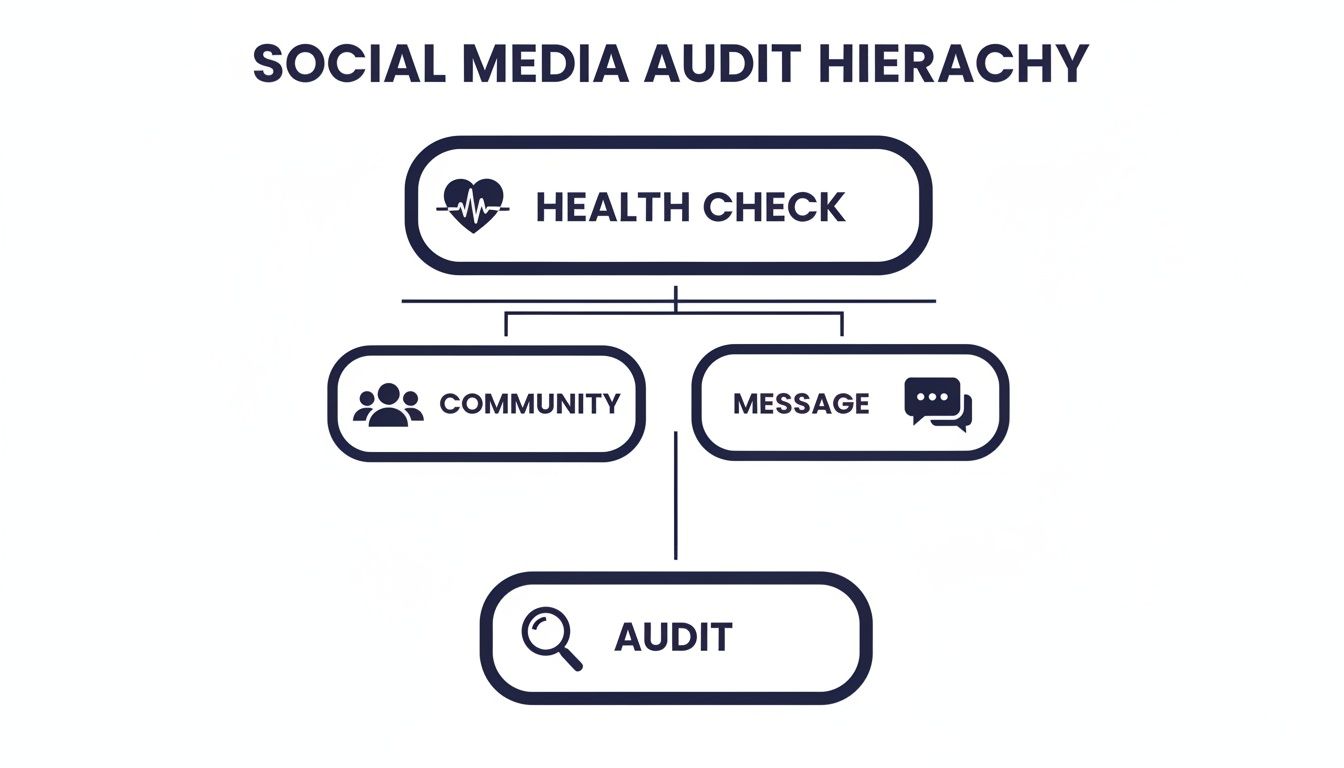
As you can see, a true audit isn't just a technical review; it's a ministry-focused look at how well you're caring for your people and communicating your message online.
4. Ministry Goal Alignment
Every single post should have a purpose, and that purpose needs to connect back to your church's mission. This pillar is the gut check. Are your social media efforts directly supporting your real-world ministry goals? Are you trying to get people to Sunday service, sign up for small groups, or give to the upcoming outreach?
Look at your best-performing posts. Did they actually drive registrations for that event you promoted with your Planning Center calendar? Did a sermon clip lead to more full sermon views on your YouTube channel? Connecting the dots between online activity and real-world ministry outcomes is the ultimate win.
5. Workflow Stewardship
Finally, a good audit is an act of stewardship. Not just of money, but of your team's precious time and energy. This pillar is all about your process. Are your volunteers spending hours trying to design graphics from scratch? Is someone manually posting the same thing to five different platforms every day?
This is where you can spot the bottlenecks. Maybe you need a simpler tool. For example, platforms like ChurchSocial.ai offer easy-to-use graphic templates and a simple drag-and-drop calendar to manage everything in one spot. We even integrate with Planning Center and other church calendars to create content for events. An audit helps you find these pain points so you can build a more sustainable, life-giving workflow for your staff and volunteers.
Focusing on Metrics That Truly Matter for Your Church
When you first open up your social media analytics, the wall of numbers can feel like a tidal wave. It's so easy to get pulled under by what we call "vanity metrics"—things like follower counts or page likes that look great on the surface but don't really say much about your church's health.
A big follower count is nice, sure. But it doesn't automatically mean you're building a connected, thriving community.
For a church, the goal isn't just to be popular online; it's to help people take their next step in faith. This is where we need to pivot our thinking from vanity metrics to what I call "ministry metrics." These are the numbers that show you’re actually building relationships and making a real spiritual impact.
From Vanity to Ministry Impact
Ministry metrics tell the story behind the numbers. A high engagement rate on a sermon clip isn't just a statistic; it shows how many people were genuinely moved or challenged by the message. A high click-through rate on your VBS registration post means you’re successfully bridging the gap from online interest to in-person connection.
Here’s how you can start reframing those common metrics for ministry:
- Reach: Instead of just looking at how many people saw your post, ask, "How many new people in our local community were introduced to our church's message this week?"
- Engagement (Likes, Comments, Shares): Don't just count them up. Dig deeper and ask, "Are these comments sparking real conversations, or are people just double-tapping and scrolling on?"
- Click-Throughs: This one is huge. It measures how many people actually took the action you asked them to, whether that's visiting your website, signing up for a small group, or registering for an event.
Some AI tools can help you analyze social media comments with AI, giving you a clearer picture of the conversations happening around your content. And if you want to get more comfortable with the numbers themselves, check out our guide on understanding social media analytics for your church.
A ministry metric answers the question: "Did this post help someone get closer to Christ or our church community?" If the answer is yes, you're on the right track.
Vanity Metrics vs Ministry Metrics
It's easy to chase the numbers that make us feel good, but a successful social media strategy for a church goes deeper. This table breaks down the difference between the stats that just look impressive and the ones that truly reflect ministry happening.
Focusing on ministry metrics helps you see what's truly working, allowing you to invest your limited time and resources where they'll make the biggest difference for your community.
This focus on actionable data is what turns a routine check-up into a game-changing audit. For example, some organizations that regularly audit their social media see 107% higher comment growth on platforms like X.
I heard about one large church team that discovered that while Facebook took up 70% of their effort, it only drove 8% of their website traffic. Meanwhile, their simple Instagram sermon clips converted 25% better. By reallocating their energy based on what the audit revealed, they lifted their overall conversions by 19%. That’s the power of focusing on the right numbers.
How to Conduct Your First Audit in Four Simple Steps
Alright, ready to dive in? A "social media audit" might sound like something a big corporation does, but for the church, it's really just a prayerful process of listening. It's about seeing where God is already at work and how we can join Him there.
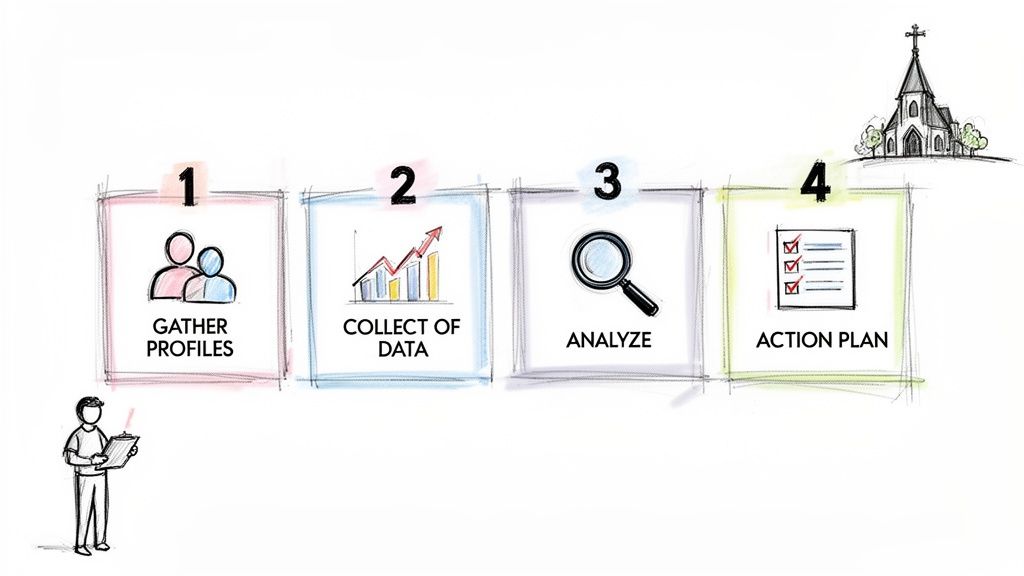
This guide is designed for busy church leaders and volunteers. We’ll follow a simple four-step framework. To make it real, let's imagine a volunteer named Sarah is tackling this for the first time. She loves her church, isn't a social media expert, and only has a few hours a week. This process is for her—and for you.
Step 1: Gather Your Profiles
First things first, let's get organized. You can't improve what you don't know you have. Sarah starts by opening up a simple spreadsheet to list all of her church's online accounts.
This is your digital inventory. You need to track down every single place your church has a presence online, even those you might have forgotten about.
- List all active accounts: Think Facebook Page, Instagram, YouTube channel, TikTok, etc.
- Include login details: Jot down who has access to each account. This is huge for security and makes handoffs between volunteers way smoother.
- Hunt for old or rogue accounts: Do a quick search for your church’s name. Sarah found an old, inactive student ministry page from five years ago. It’s crucial to either update or delete these so new visitors don't get confused.
Step 2: Collect Key Data
Next, we need to grab some basic numbers to see what's actually been happening. Don't let this part scare you; you're just looking for clues. To keep things relevant, focus on the last 90 days.
Sarah goes into each platform's built-in analytics (like Facebook Insights or Instagram Analytics) and notes a few key "ministry metrics" for her church’s top five posts on each channel:
- Engagement: How many comments, shares, and saves did a post get? These are signs of real connection.
- Reach: How many unique people actually saw your content?
- Clicks: How many people clicked a link to visit the church website, sign up for an event, or watch a sermon?
You don't need to go overboard here. The goal is to collect just enough data to spot a few clear patterns in the next step.
Step 3: Analyze for Insights
This is where the fun begins. With her data in one place, Sarah can now step back and look for the story behind the numbers. The most important question to ask is simply, "Why?"
Why did that sermon clip get shared so many times? What was it about the post on the food drive that sparked dozens of heartfelt comments? This isn't about spreadsheets; it's about understanding people.
A social media audit is less about finding flaws and more about discovering grace—finding those moments where God was clearly working through your content to connect with people.
For instance, Sarah noticed that the AI-generated reels from their pastor’s sermons had three times more shares than any other content. She also saw that simple posts asking a question, like "What was your favorite worship song this Sunday?", started the most meaningful conversations.
Step 4: Create an Action Plan
Finally, we turn those discoveries into a plan. An audit is only helpful if it leads to change. Based on what she found, Sarah creates a simple, achievable action plan with just three items.
- Do More of What Works: She decides to post two AI-generated sermon reels each week instead of just one. A tool like ChurchSocial.ai makes this quick and easy by generating reels directly from a sermon transcript.
- Stop What Doesn’t: The generic "Happy Monday" graphics were getting almost zero engagement. She decides to scrap them and reclaim that time.
- Test Something New: Based on her analysis, she plans to post one engaging question each week to create more two-way conversation.
This simple plan is totally manageable and directly tied to what she learned. For any church, this process is the key to stewarding your online ministry well, ensuring your efforts are truly helping people connect with Christ and your community.
Turning Your Audit Insights Into a Smarter Content Plan
An audit's real power isn't found in the data you collect; it's unlocked when you use that data to shape your future content. A spreadsheet full of numbers is just noise until you translate it into a smarter, more intentional plan for your ministry. This is where the real work—and the real reward—begins.
The insights from your audit act like a roadmap, showing you exactly what your community responds to. Suddenly, you have a clear direction for building a content calendar that stewards your time well and genuinely connects with people. This means you can confidently double down on what works and gracefully stop doing what doesn't.
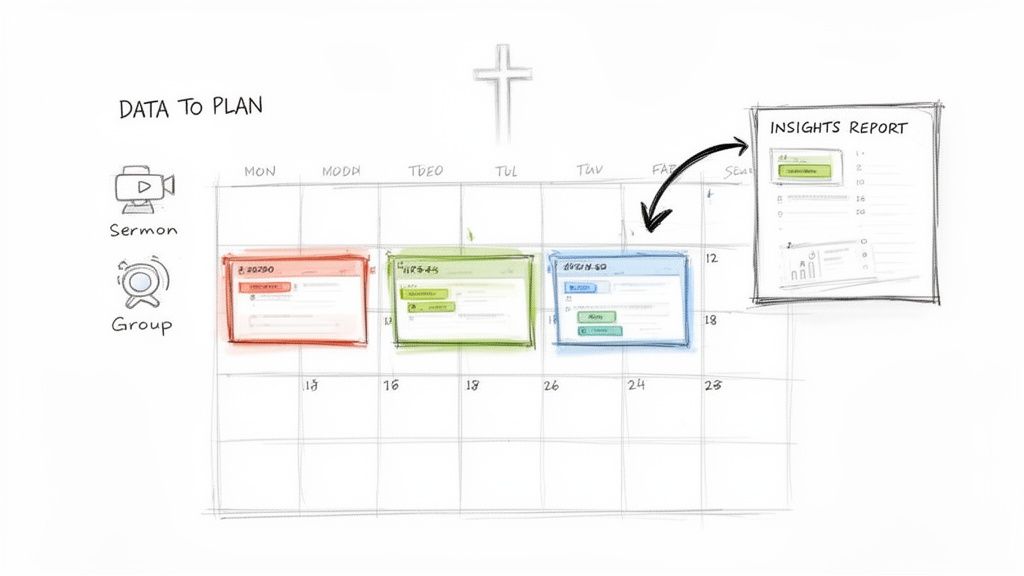
From Data Points to a Content Calendar
Let’s get practical. Say your audit revealed that AI-generated reels from your sermons consistently get the most shares. That's a huge win. Instead of just guessing, you now know that short, impactful video clips from Sunday's message are one of the most effective ways to spread the Gospel beyond your church walls. Your action plan is simple: make more of them.
On the flip side, maybe you discovered that generic stock photo announcements receive almost no engagement. The decision is just as clear. You can stop spending time creating content that isn't bearing fruit and reinvest that energy where it actually matters.
Your audit findings should be the foundation of your content calendar. Every post should have a purpose rooted in what you've learned about your community's needs and interests.
This data-informed approach takes the weekly stress out of figuring out what to post. It transforms your social media management from a reactive chore into a proactive ministry strategy.
Streamlining Your New Strategy
Putting these insights into practice shouldn't feel like adding more work to your plate. This is where having the right tools makes all the difference. For churches, a platform like ChurchSocial.ai is built to help you act on your audit findings with less effort.
Imagine this simplified workflow:
- Create What Works: You know sermon clips are a hit, so you use the sermon transcript to instantly create AI-generated reels and social posts.
- Design with Ease: Instead of wrestling with complex software, you use professionally designed graphic templates and an easy editor to create beautiful photos and carousels for events.
- Plan and Schedule: You can then use a simple drag-and-drop calendar to plan out your new, smarter content mix for the entire month.
By integrating with tools like Planning Center, it can even help you create timely content for upcoming church events. The goal is to make executing your data-informed plan as simple as possible. For more guidance on this, you can learn more about how to create a social media plan that builds on your audit's discoveries.
Your Questions Answered: Church Social Media Audits
Diving into your first social media audit can feel a little intimidating, and it’s normal to have a few questions bubble up. Let's tackle some of the most common ones we hear from church leaders and volunteers, so you can move forward with confidence.
How Often Should Our Church Do a Social Media Audit?
For most churches, a quarterly audit—that’s once every 3 months—is the sweet spot. Think of it as a regular check-in for your online ministry, just like a leadership meeting. It’s frequent enough to let you adapt to new trends and tweak your strategy before you get too far off track, but not so often that it feels overwhelming.
If you have a smaller team or are just starting out, even doing an audit twice a year (every 6 months) is a huge win and will give you plenty of actionable insights.
Is This Too Complicated for a Small Volunteer Team?
Absolutely not. In fact, a social media audit is one of the best tools a volunteer can have. It helps you be a good steward of your most precious resource: your time. The whole point is to figure out what’s actually working so you can focus your energy there.
You don't need to produce some massive, 50-page report. The real goal is to find just one or two key takeaways that will make your work more fruitful and your outreach more effective.
The purpose of an audit isn't to create more work. It's to make the work you're already doing more effective and life-giving for your team and your community.
What’s the Biggest Mistake Churches Make with Audits?
The most common trap is doing all the work to collect the data… and then doing nothing with it. An audit is useless if it doesn't lead to action. Its entire purpose is to spark changes that strengthen your ministry, so make sure you walk away with a simple, concrete plan.
The second biggest mistake is getting lost in the numbers and forgetting the mission. As you look at the data, keep asking, "How does this help us connect people to Jesus and to our church family?" That question will keep your audit focused on what really matters.
A social media audit is one of the most powerful things you can do to make sure your church’s online voice is clear, effective, and truly reflects your mission. When you’re ready to turn what you’ve learned into a simple, sustainable content plan, ChurchSocial.ai is here to help. From creating AI-generated reels from your sermons to managing your entire calendar with a simple drag-and-drop interface, we make it easy to act on your insights.
Start stewarding your online ministry more effectively today.