Audience segmentation is the practice of dividing your congregation and community into smaller, distinct groups based on shared characteristics so you can communicate with each group more personally and effectively. In plain terms, it means stopping the habit of sending one church message to everyone and starting to match the right message to the right people.
If you manage church communication, you've probably felt this tension already. You post about youth night, and your senior adults scroll past. You share a volunteer training reminder, and first-time guests have no idea what it means. You promote a family event, but your online-only viewers don't know whether it applies to them at all.
That doesn't mean your message is bad. It usually means your audience is broader than your message.
Churches are full of different people at different stages. New visitors need reassurance. Long-time members need next steps. Parents need clarity. Students need relevance. Small group leaders need tools. When we treat all those needs as if they're the same, people start tuning out.
That's why learning what audience segmentation is can help ministry teams communicate with more care. It's a marketing term, yes, but the heart behind it is pastoral. You're learning your people well enough to serve them better. And if your church is already trying to show up across email, social, announcements, and events, it also helps to think alongside a broader multi-channel marketing approach for churches.
From One Message to Many Ministries
A church can have one mission and still need many messages.
That's the part that often feels strange at first. Ministry leaders hear “segmentation” and think it sounds cold or corporate. But most churches already do this naturally in person. You don't talk to a new guest the same way you talk to your elders. You don't hand the same discipleship material to a middle school student and a premarital couple.
Digital communication works the same way.
Why one-size-fits-all communication falls short
Think about a simple Instagram post that says, “Don't miss what God is doing this week at church.” That sounds warm, but it's vague. A member may ignore it because they already know the schedule. A first-time visitor may not know where to start. A volunteer may need a reminder about setup time, not a general invitation.
The issue isn't effort. The issue is fit.
When churches rely on generic messaging, they often end up with communication that is broad enough for everyone but specific enough for no one. Audience segmentation fixes that by helping you ask better questions:
- Who is this for: Is this aimed at guests, members, leaders, parents, students, or online viewers?
- What do they need right now: Information, encouragement, a next step, or a reminder?
- What action makes sense for them: Attend, register, respond, share, pray, or serve?
Practical rule: If two groups need different wording, different timing, or a different call to action, they probably shouldn't receive exactly the same message.
A ministry-minded definition
Audience segmentation involves dividing a broad audience into smaller groups based on shared traits, behaviors, or needs. In church life, that could mean grouping people by life stage, ministry involvement, spiritual questions, attendance habits, or how they connect with your church online and offline.
That's not manipulation. It's attentiveness.
A children's ministry update belongs in front of parents. A baptism invitation may connect powerfully with newer believers. A serving opportunity for experienced leaders may need very different language than a welcome post for first-time guests. Segmentation helps your church move from broadcasting to shepherding.
Why Segmentation Matters for Modern Ministry
Ministry communication isn't just about getting content out. It's about helping people take the next faithful step.
That's why segmentation matters. It gives your church a way to speak more directly to what people are already carrying. A guest may be wondering, “Will I belong here?” A parent may be thinking, “What do I need to know before Sunday?” A small group leader may be asking, “What am I responsible for this week?” Those are different questions, and they deserve different answers.
The numbers behind the idea
The case for segmentation isn't only theoretical. In a roundup of customer segmentation research, segmented campaigns produced 14.31% higher open rates and 101% more clicks than non-segmented campaigns, and businesses using advanced segmentation often see 2–3x higher conversion rates compared with generic messaging. Some sector-specific analyses also report an 87% increase in overall ROI from hyper-personalized campaigns, according to customer segmentation statistics compiled by Salesgenie.
Those are business metrics, but the ministry parallel is easy to see. Better opens mean more people notice the message. More clicks mean more people act on it. Higher conversion rates, in a church setting, can look like more event signups, more volunteer responses, more newcomers filling out a connect form, or more members taking a next step you invited them into.
What this looks like in church life
A church doesn't need to think in cold funnels to benefit from this. It only needs to recognize that relevance helps people respond.
Here are a few ministry examples:
- For new visitors: A welcome message with parking info, service times, and what to expect will land better than a post about member meeting details.
- For active volunteers: A reminder about rehearsal time or classroom setup is more useful than a generic “see you Sunday.”
- For online viewers: A sermon clip, recap post, or discussion question may serve them better than a stage announcement photo.
When people feel like a message was meant for them, they're more likely to pay attention to it.
Segmentation also improves measurement. If your church wants to know what's working, broad communication makes that hard to see. Narrower audience groups make your church social media analytics more meaningful because you can compare response patterns by ministry need, not just by platform.
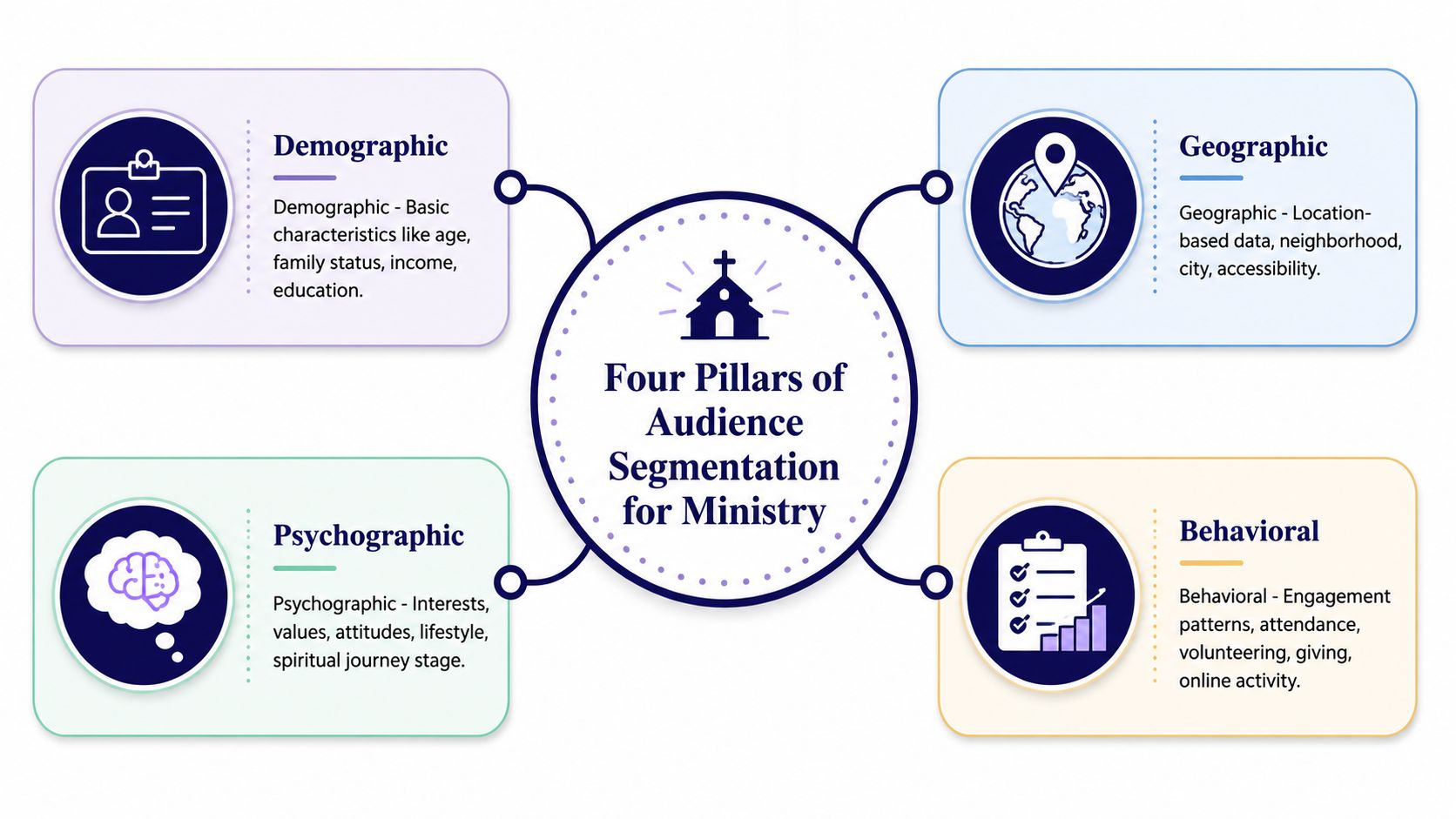
Four Common Ways to Segment Your Church Audience
Many church leaders assume segmentation is complicated because the language around it gets technical fast. It doesn't have to start that way.
In modern marketing, segmentation can include demographic, behavioral, psychographic, geographic, transactional, contextual, lifecycle, and predictive signals. It has also shifted from simple age-and-location categories to richer models built from interaction and engagement data, as explained in this overview of audience segmentation analysis. For churches, the easiest place to begin is with four practical lenses.
Demographic segmentation
This is the simplest form. It groups people by observable life details.
In a church, that might include age range, family stage, marital status, or whether someone is a student, parent, or retiree. If your women's Bible study is intended for moms with young children, you already understand the value of demographic thinking. The point isn't to stereotype people. It's to avoid sending irrelevant information to everyone.
A church newsletter might separate content like this:
- Students and young adults: Camp deadlines, small group invites, worship night reminders
- Parents: Check-in details, kids ministry events, family discipleship resources
- Older adults: Pastoral care updates, weekday gatherings, accessibility information
Behavioral segmentation
This lens focuses on what people do.
For churches, that could mean worship attendance patterns, volunteer involvement, sermon viewing habits, event registration history, or whether someone regularly engages with your posts. Two members may be the same age and live in the same neighborhood, but one serves every week while the other only watches online. They don't need the same communication.
Behavior often gives a clearer picture than labels do.
A member who watches the sermon online every week is telling you something with that pattern. Your communication should listen.
Psychographic segmentation
This one sounds abstract, but it's often the most pastoral. It looks at values, interests, concerns, and motivations.
In church life, psychographic segmentation may show up as spiritual stage, ministry interests, or what kind of support someone is seeking. A person exploring faith needs a different invitation than someone ready for deeper theological training. A church member passionate about local outreach may respond to mission-focused stories more readily than to general announcements.
This also matters for content style. Churches exploring video strategy sometimes learn from creators who build high-potential faceless channels, especially when the message itself matters more than putting a personality on screen.
Engagement segmentation
This category looks at how people connect with your church's communication itself.
Some people respond to email. Some watch reels. Some never miss a carousel post. Some click registration links quickly. Others need repeated reminders across several channels before they act. Engagement segmentation helps you notice those patterns so you can adjust format and timing.
A few examples make this practical:
- Low-engagement group: Short, clear posts with one action step
- Highly engaged members: Deeper teaching clips, ministry updates, volunteer asks
- Event responders: Registration posts timed around ministry calendars
- Online-first audience: Sermon clips, quote graphics, recap content, livestream reminders
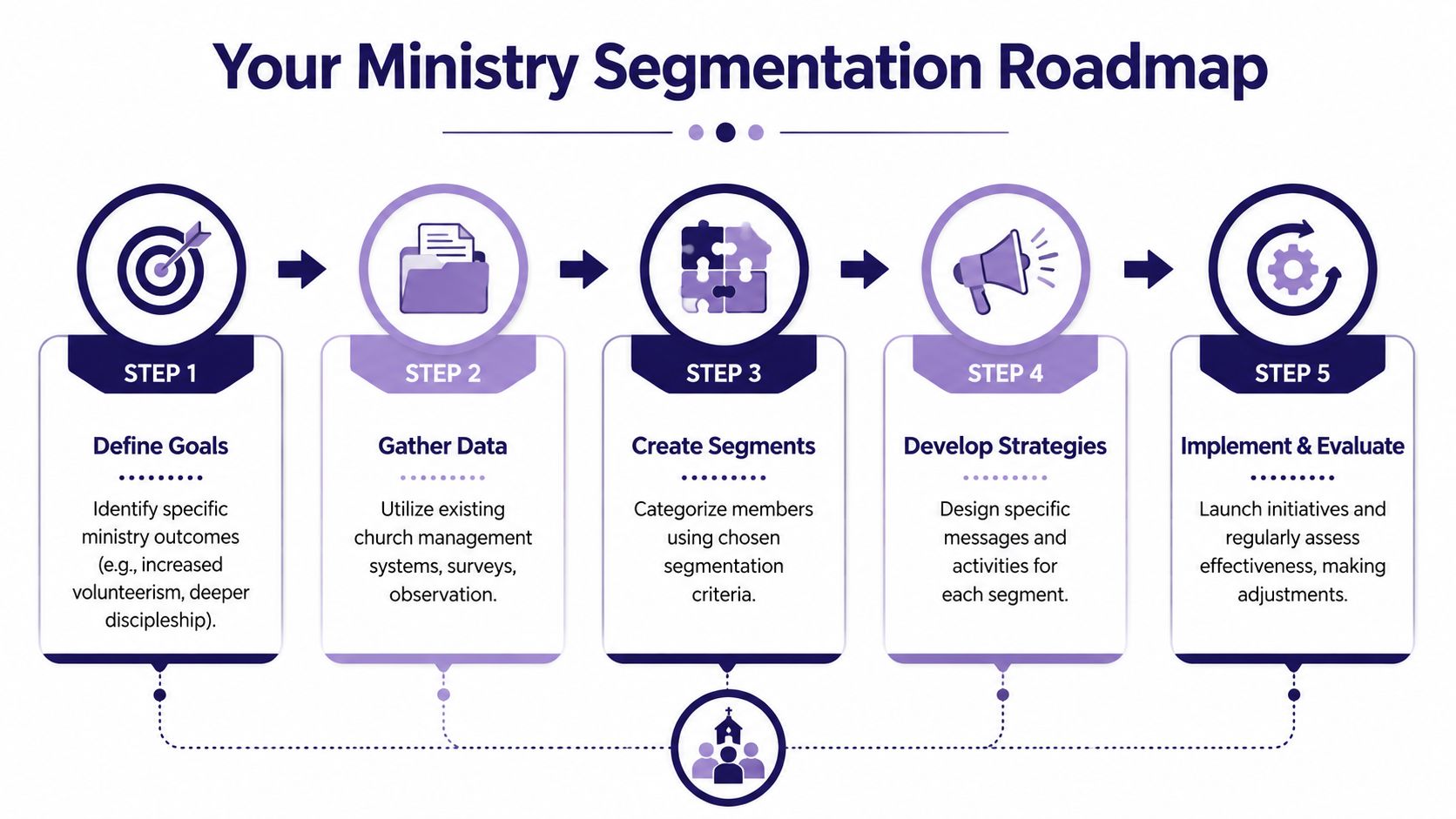
How to Begin Segmenting Your Congregation
Most churches don't begin with a clean database and a strategy team. They begin with a spreadsheet, a church management system that hasn't been cleaned up in a while, and a volunteer trying to remember which list is current.
That's normal.
A practical guide from The Compass for SBC on audience segmentation highlights two issues that are especially important for churches. First, teams should decide whether segmentation is necessary at all. Second, they should avoid creating segments unless a subgroup is different enough to need a different message or approach. That matters because over-segmentation adds complexity fast, especially when your data is limited or messy.
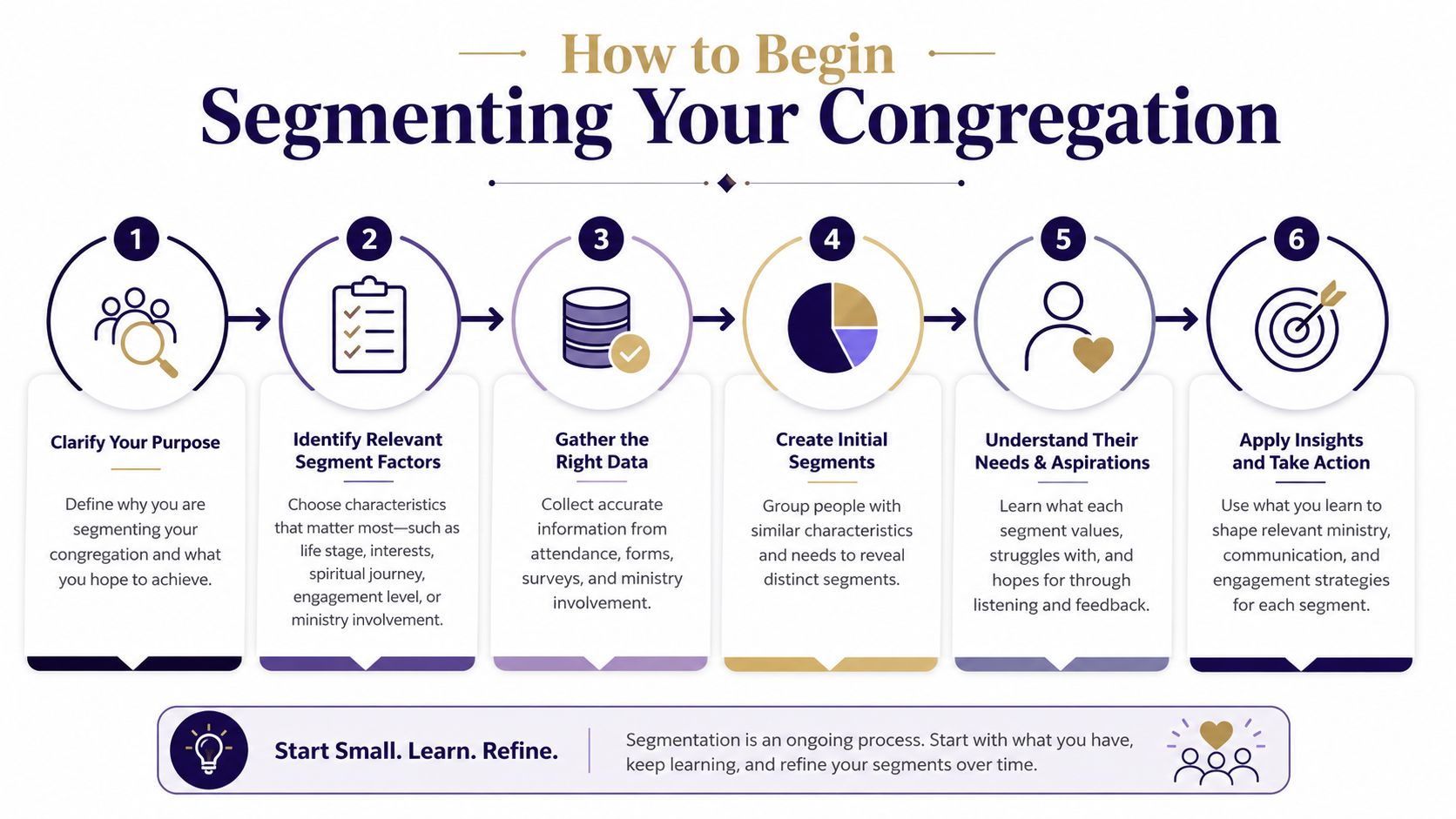
Start with one ministry problem
Don't begin by trying to map your whole church.
Begin with a communication problem you already feel. Maybe guests aren't returning. Maybe volunteers miss reminders. Maybe parents don't seem to know what's happening in kids ministry. Segmentation works best when it solves a real ministry need.
Ask one question: which group clearly needs a different message than everyone else?
That answer becomes your first segment.
Use the data you already have
Churches often think they don't have enough data to segment. Usually they have more than they realize, just not in one neat place.
Look in places like these:
- Church management records: Household status, ministry involvement, attendance notes
- Social media patterns: Which posts get saves, shares, comments, or link clicks
- Event tools and calendars: Registration history, recurring ministry participation, follow-up needs
- Pastoral observation: Common questions from guests, parents, volunteers, and members
Messy data doesn't make segmentation impossible. It means you should keep the first version simple.
Keep your first segment obvious
Your first segment should be easy to identify without complicated filters.
Good starting examples include:
- First-time guests
- Parents of children in ministry
- Small group leaders
- Online-only viewers
- Current volunteers
These groups usually need distinct information, which makes the value of segmentation easier to see.
Ministry shortcut: If you can describe the group in one plain sentence, you can probably build content for it.
Decide when not to segment
This step saves a lot of frustration.
If a message applies to the whole church and doesn't need different wording, don't split it apart. A Sunday service time change, a church-wide prayer night, or an urgent weather cancellation may need broad distribution. Segmentation is a tool, not a rule.
You also shouldn't create tiny audience groups just because you can. If your communications team can't maintain separate content well, too many segments will create confusion.
A simple checkpoint helps:
| Question | If yes | If no |
|---|---|---|
| Does this group need a different message? | Create a segment | Keep it broad |
| Does this group need a different timing or platform? | Adapt delivery | Use the same channel |
| Can your team maintain this consistently? | Move forward | Simplify first |
Build a repeatable workflow
Once your first segment is clear, create a simple routine for it. This is where tools matter. Some churches pair their planning with checklists, content calendars, and even a template for social care SLAs to clarify who responds, who posts, and how quickly follow-up happens.
Your workflow might look like this:
- Choose one segment: For example, new visitors
- Name one goal: Help them know what to expect on Sunday
- Create a few content types: Welcome reel, parking graphic, FAQ carousel, follow-up email
- Schedule them consistently: Before and after weekend services
- Review response: Notice questions, clicks, comments, and attendance patterns
If your church is also organizing email sequences or follow-up pathways, it helps to understand how email marketing automation tools for churches can support the same segmented approach across more than one channel.
Putting It All into Practice with Church Examples
Segmentation starts making sense when you can picture real people.
A church audience isn't an abstract dataset. It's the couple who visited last Sunday. It's the parent trying to remember the check-in time. It's the member who never misses the livestream. It's the small group leader who needs this week's discussion prompt before Thursday night.
Here's what that can look like in everyday church communication.
Church audience segment examples
| Audience Segment | Communication Goal | Content Idea with ChurchSocial.ai |
|---|---|---|
| New Visitors | Reduce uncertainty and help them take a next step | Turn a recent sermon transcript into a short welcome blog post or follow-up social caption that explains what your church values and what a first visit feels like |
| Young Families | Make church life easier to navigate during busy weeks | Create event graphics and carousel posts for kids ministry, family nights, or VBS using templates and schedule them around ministry dates pulled from Planning Center or another church calendar |
| Online-Only Viewers | Keep remote attenders connected to teaching and community | Create AI-generated reels from the sermon, then post discussion prompts or recap content for people who engage mainly through digital channels |
| Small Group Leaders | Equip leaders with practical content they can use quickly | Repurpose the sermon transcript into leader discussion questions, summary posts, or a short devotional-style blog leaders can share with their groups |
Matching content to ministry need
The important shift is this. You're no longer asking, “What should we post this week?” You're asking, “Who are we trying to serve, and what would help them?”
That one question changes everything.
A new visitor often needs clarity and warmth. A family usually needs logistics. An online viewer may need a digital on-ramp to belonging. A leader needs reusable tools. Once the segment is clear, the content format becomes easier to choose.
Church teams that want fresh ideas for formats may also benefit from broader guides on how to grow your brand with content, then adapt those content types to ministry rather than commerce.
A simple way to think about it
Try this sentence pattern when planning:
- This group is: new visitors
- They likely need: reassurance and clear next steps
- So we should create: a short video, a welcome post, and a simple follow-up message
That planning habit keeps your content grounded in people, not just platforms.
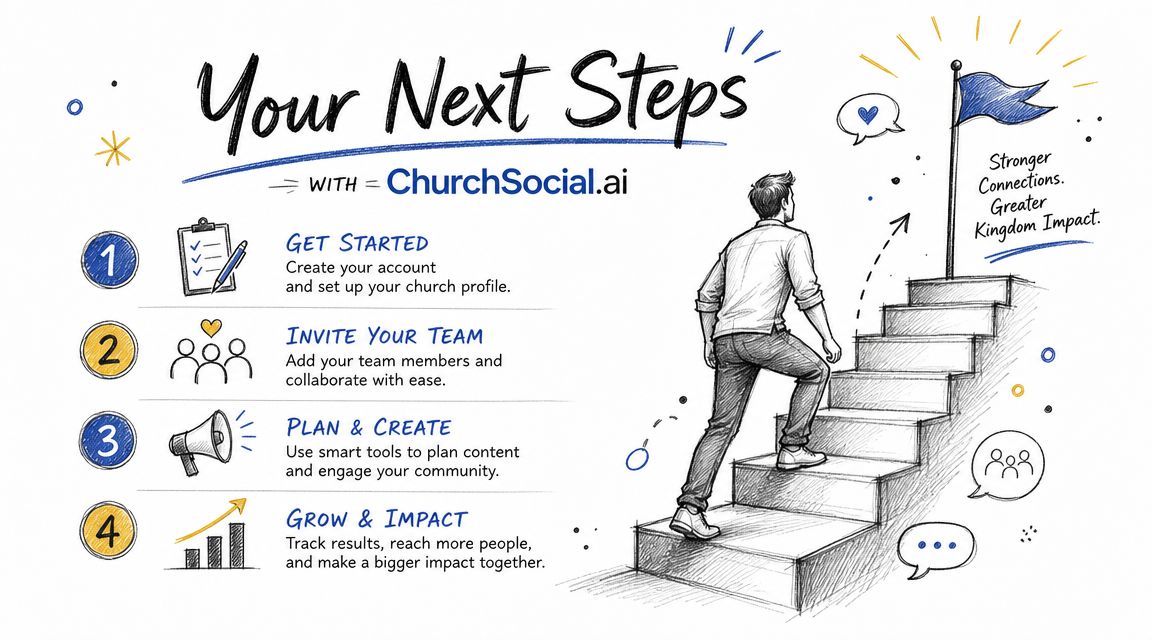
Your Next Steps with ChurchSocial.ai
You don't need a giant strategy document to start using audience segmentation well. You need one group, one goal, and one piece of content that fits that group.
That's the good news for busy church teams. Segmentation doesn't require a data analyst. It requires attention. Pick one audience your church already knows well, such as guests, families, volunteers, or online viewers. Then create one message that serves them better than a generic announcement would.
A practical starting point is to take your latest sermon and ask who should hear part of it in a more targeted way. Maybe guests need a welcoming clip. Maybe parents need a quick encouragement post. Maybe small group leaders need discussion questions. Planning content around real segments makes your calendar feel less random and more pastoral.
If your church wants a simple way to do that, start small. Use the calendar to plan one week of content for one audience. Repurpose one sermon into one reel, one post, or one blog aimed at that group. Build the habit first. Refinement can come later.
If you're ready to try segmented church communication without adding a complicated workflow, ChurchSocial.ai gives you a practical place to start. You can turn sermon transcripts into social posts, blogs, and reels, create graphics with templates, organize content in a drag-and-drop calendar, and plan around events through Planning Center and other church calendar integrations.