Brand consistency means your church presents one clear, recognizable identity everywhere people encounter it, from the Sunday bulletin to Instagram to the welcome slide on Sunday morning. It matters because 68% of businesses said brand consistency was a major contributor to revenue growth of 10% or more, while 32% said consistent messaging led to revenue increases above 20%, and consistent presentation across platforms can raise revenue by up to 23%.
If you're serving on a church staff or helping as a volunteer, you've probably seen the opposite. The church website uses one logo. The youth ministry Instagram uses another. Event flyers look like they came from three different churches. The email newsletter sounds warm and pastoral, but social captions feel rushed and generic.
That kind of inconsistency doesn't just look messy. It makes people work harder to figure out who you are, what you value, and whether they can trust what they're seeing.
For a church, that matters because communication is ministry. A clear, familiar identity helps people recognize your church quickly, understand your message, and feel more at ease taking a next step. If your church is still clarifying how it wants to be known, it helps to start with your purpose first. This guide on how to write a church mission statement is a useful companion to the branding work.
From Chaos to Clarity Your Church Brand
A lot of churches don't have a branding problem because they lack passion. They have one because many good people are creating content at the same time.
The worship team needs slides. Kids ministry needs a check-in graphic. Someone designs a flyer for the food pantry. A volunteer posts a Reel on Saturday night. Each person is trying to help. But without shared standards, the church starts appearing differently in every place it shows up.
What brand consistency actually means
What is brand consistency? In plain language, it means your church looks, sounds, and feels like the same church across every touchpoint.
That includes things like:
- Visual identity such as your logo, colors, fonts, and graphic style
- Written voice such as whether your captions feel warm, formal, hopeful, direct, or conversational
- Core message such as the truths and values you repeat consistently
- Audience experience such as whether a first-time guest gets the same impression online that they get in person
Brand consistency isn't about making everything identical. It's about making everything recognizable.
A church with brand consistency doesn't need every ministry to look carbon copied. The student ministry can still feel younger. The women's ministry can still feel distinct. But people should still be able to tell, instantly, that it all belongs to the same church family.
Why churches get stuck
Churches often assume branding is a corporate concern, or that it only matters for large congregations. In practice, smaller churches often need consistency even more because volunteers are juggling many roles and content gets created quickly.
A few common signs of drift show up fast:
| Situation | What people experience |
|---|---|
| Different logos across ministries | Uncertainty about what is official |
| Mixed colors and fonts | A scattered, less memorable identity |
| Different tones on different channels | Confusion about your church's personality |
| Last-minute event graphics | Lower clarity and weaker recognition |
Brand consistency gives order to all that activity. It creates clarity so your outreach feels intentional instead of improvised.
Why Brand Consistency Matters for Your Ministry
A church doesn't build trust only through sermons. It also builds trust through repetition, familiarity, and clarity.
When people hear a shepherd's voice often enough, they learn to recognize it. Church communication works in a similar way. If your website, emails, signs, sermon graphics, and social posts all feel connected, people begin to recognize your church without effort. That recognition lowers hesitation.

Trust grows when people know it's you
A first-time visitor may encounter your church several times before attending. They might see an Instagram post, then search your website, then notice an event graphic shared by a friend. If each touchpoint feels disconnected, that person may wonder whether they found the right church, whether the event is current, or whether your ministry is organized.
A consistent presence removes that friction.
Research summarized by Made By Shape on the power of branding notes that consistent brand presentation can increase growth and engagement by over 20%. For a church, that means a more recognizable and trusted presence in the community.
Consistency supports outreach, not vanity
Some pastors hear the word brand and think of polish for polish's sake. But in ministry, consistency is stewardship.
It helps people answer simple but important questions:
- Is this really from your church
- Is this event current and trustworthy
- Will the in-person experience match what I saw online
- Can I recommend this church to a friend with confidence
Practical rule: If your online presence feels disconnected from your Sunday experience, newcomers will notice before members do.
This is especially important for churches serving families, new residents, or people returning to church after a long time away. Familiarity creates safety. Clear communication makes it easier to say yes to attending, volunteering, or asking for prayer.
It also makes internal ministry healthier
Brand consistency doesn't only help outsiders. It helps your team work together.
When staff and volunteers know what fits the church's identity, they spend less time debating design choices and rewriting captions from scratch. Ministry leaders can focus on people instead of fixing mismatched materials.
A consistent brand says, in effect, “We know who we are, and we want to communicate that clearly so people can connect with the gospel and with this church community.”
The Pillars of a Consistent Church Brand
The idea becomes manageable when you break it into parts. Most churches need to keep four areas aligned: visuals, messaging, experience, and digital presence.

Visuals that people recognize quickly
Your visual identity is the part people notice first. It includes your logo, color palette, fonts, layout style, and image treatment.
If one sermon series uses elegant serif fonts, another uses neon block lettering, and your events page uses unrelated colors, people don't build recognition. They just see separate pieces.
A simple church visual system often includes:
- One primary logo with rules for how to size and place it
- A small color palette used across slides, flyers, social graphics, and email headers
- A limited font set so everything feels related
- A repeatable template style for sermon series, events, and announcements
For churches that need examples of what to document, these social media branding guidelines for churches are a practical starting point.
Messaging that sounds like one church
Words shape identity just as much as design. If your website says, “You belong here,” but your event posts sound stiff and transactional, your church voice isn't aligned.
A healthy messaging system answers questions like:
| Element | Example for a church |
|---|---|
| Core promise | A welcoming church rooted in Scripture and community |
| Tone | Warm, hopeful, clear |
| Repeated phrases | Join us Sunday, prayer matters, there's a place for you |
| Writing style | Short sentences, plain language, encouraging calls to action |
If you want a broader explanation of how strategy shapes messaging before design choices even begin, Bulby's brand strategy guide is helpful background reading.
A church brand becomes stronger when people hear the same heart behind the message, even when the format changes.
Experience and digital presence that match real life
People don't separate your brand from your ministry experience. They experience both at once.
If your church feels calm, welcoming, and thoughtful in person, your online presence should reflect that. If your Sunday service is joyful and community-driven, your digital communication should echo that same spirit.
Guidance summarized by MediaValet on brand consistency frames this as a system-wide effort across every touchpoint, with centralized standards for visuals and messaging to reduce channel drift. That's especially relevant for churches where multiple staff members and volunteers publish content.
One practical way to support that system is to keep approved templates, sermon-based content, and scheduling in one workflow. ChurchSocial.ai includes sermon clip creation, transcript-based post generation, graphic templates, and a drag-and-drop calendar, which can help churches keep those assets and publishing rhythms more aligned.
Common Branding Pitfalls for Churches
Churches rarely struggle because they don't care. They struggle because content moves faster than coordination.
One week, someone makes a great Easter graphic. The next week, another volunteer starts from a completely different template. Then the youth ministry posts something that fits the platform but no longer feels connected to the church. None of this is malicious. It's just what happens without guardrails.
Design by committee
When every graphic needs approval from six people, branding often gets weaker, not stronger. One person wants a more modern font. Another prefers a different shade of blue. Someone else wants extra wording. The final piece becomes crowded and diluted.
Clear guidelines help teams make decisions before feedback spirals. Not every post needs a meeting. Most posts need a system.
A healthier approach is to decide a few things once:
- What must stay fixed such as logo treatment and core colors
- What can be adapted such as photo choice or caption length
- Who gives final approval for major campaigns and recurring content
Confusing consistency with sameness
Many churches swing between two extremes. They either post random, disconnected content, or they try to make every channel look exactly the same.
That second mistake matters more than people expect. Brand consistency doesn't mean copying your website announcement into an Instagram Reel word for word.
Frontify's guidance on brand consistency highlights the core challenge: deciding which elements stay fixed, like logo and colors, and which elements flex, like tone and format, depending on the platform. Too much rigidity feels out of place. Too much freedom erodes recognition.
Your church can sound more conversational on Instagram than in a policy email and still remain consistent.
Letting ministries drift into separate identities
Children's ministry, students, men's ministry, and outreach often develop their own habits. Over time, they can start looking like separate organizations.
That's a problem when a parent follows your main church account, then lands on the kids page and doesn't recognize the same church. Shared standards don't erase ministry personality. They keep every ministry connected to the same mission.
A simple fix is to create a short brand checklist every ministry leader can use before publishing:
- Does this use the approved logo or template
- Does this sound like our church
- Would a newcomer recognize this as part of our church family
How to Measure Your Brand's Impact
Brand consistency can feel subjective until you measure it. Once you audit your content, patterns become visible.
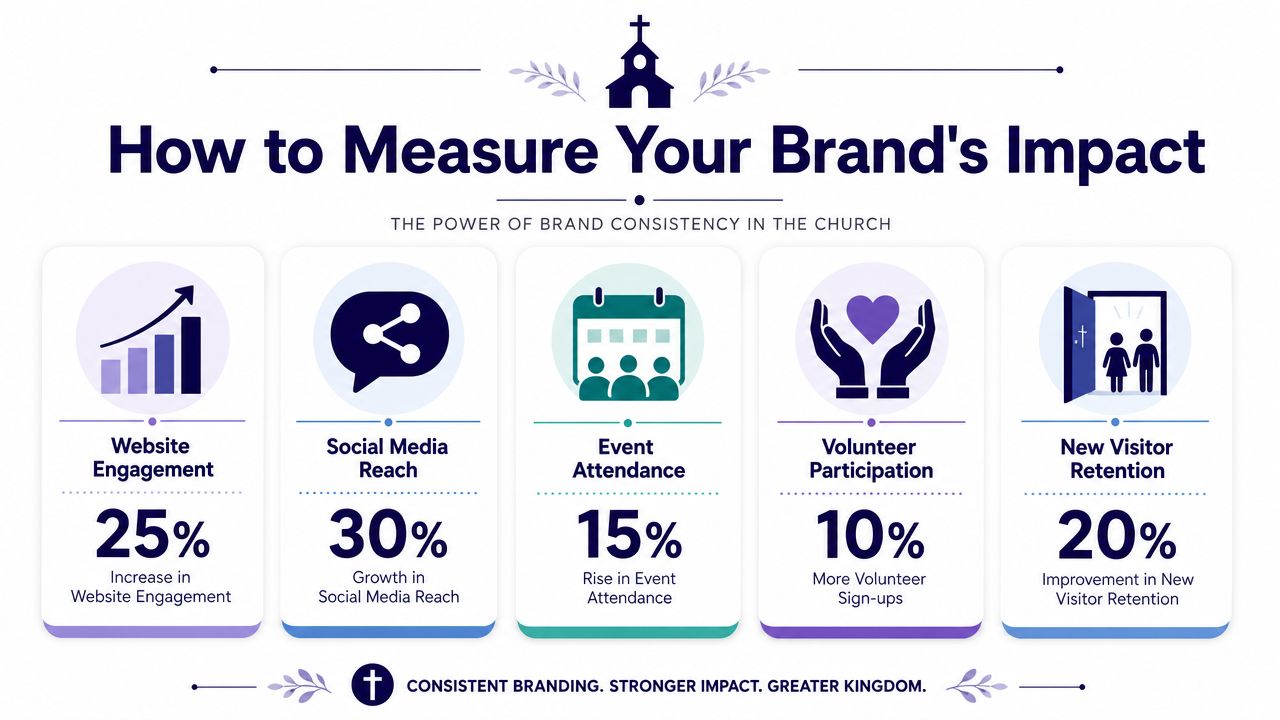
The cleanest starting point comes from Siteimprove's explanation of measuring brand consistency. It recommends a content audit and an alignment score calculated by dividing the number of posts, emails, and pages that match your brand guidelines by the total number you audit.
Start with an audit, not a guess
Choose a manageable sample. Review recent sermon graphics, event posts, email newsletters, website pages, and printed materials.
Check each item against a short list:
| Audit question | What you're checking |
|---|---|
| Does it use approved visuals | Correct logo, colors, fonts, templates |
| Does it match your tone | Same level of warmth, clarity, and voice |
| Does it reinforce your message | Similar values and key phrases |
| Does it feel connected to your church | Not generic, not borrowed, not off-brand |
Then calculate your alignment score. That turns a fuzzy idea into a KPI your team can improve over time.
Pair compliance with ministry signals
An audit shows whether your content follows your standards. It doesn't tell the whole story, though. Churches should also watch for signs that consistency is helping people connect.
Look for feedback like this:
- Visitor comments about the church feeling like what they expected from online
- Volunteer experience where content creation becomes easier because templates are clear
- Member response where event promotion feels easier to follow
- Channel clarity where fewer posts need rewrites or corrections
If your church wants a broader framework for evaluating social performance alongside branding, this guide on how to measure social media ROI for churches can help.
When your brand is consistent, measurement gets easier because your team is comparing like with like instead of a dozen disconnected styles.
Your Action Plan for Brand Consistency
You don't need a full rebrand to get this under control. Most churches can make real progress by simplifying, documenting, and reviewing what they already have.
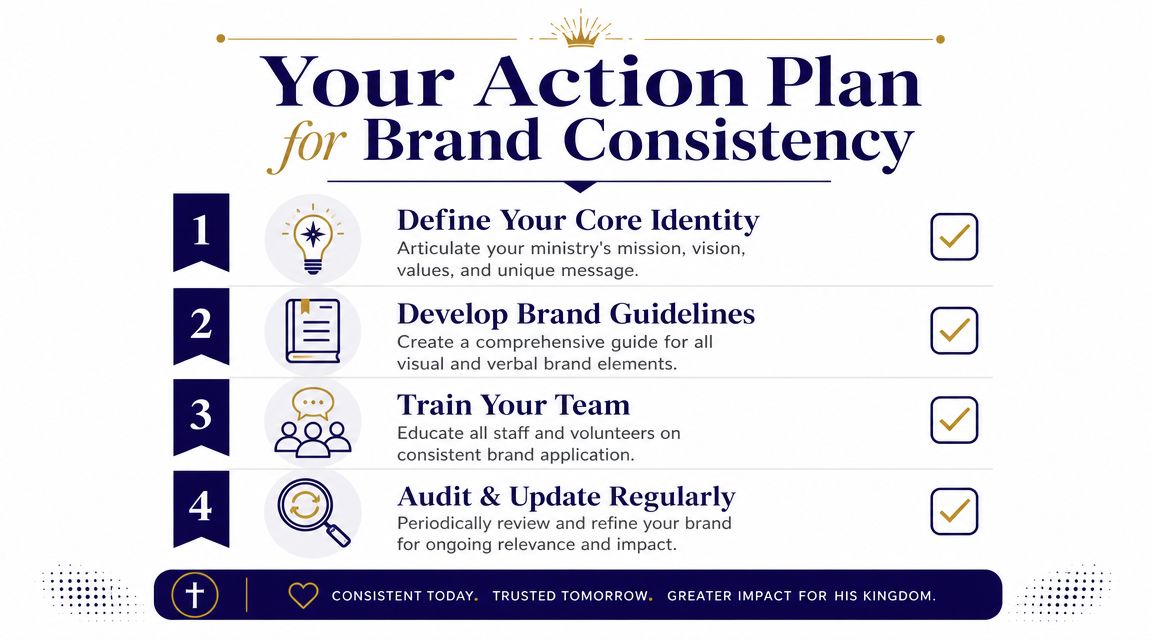
Four steps your church can take this month
Define your core identity
Write down your mission, values, audience, and the feeling you want people to have when they encounter your church. Keep it plain and usable.Build simple guidelines
Create one shared document with your approved logo files, colors, fonts, voice notes, and template examples. It doesn't need to be fancy. It needs to be accessible.Train the people who publish
Walk staff and volunteers through the guidelines. Show examples of what fits and what doesn't. Answer questions early so they don't guess later.Audit and adjust regularly
Review your channels, check alignment, and update standards when needed. Churches change. Ministries grow. Your guidelines should stay current without losing your core identity.
Keep the mission in view
Brand consistency isn't about trying to look impressive. It's about helping people recognize your church, trust what they see, and take a next step into community.
When your communication becomes clearer, your outreach becomes easier to follow. When your identity becomes more recognizable, your invitation becomes easier to accept. And when your team shares one voice and one set of tools, you free up energy for the work that matters most: people, discipleship, and presence in your community.
If your church wants one place to plan and manage social media with more consistency, ChurchSocial.ai can support that workflow. It lets churches turn sermons into reels and posts, use reusable graphic templates, manage a visual content calendar, and pull event information from tools like Planning Center so communication stays organized across channels.