Sunday is coming. You've got a passage, a burden, a half-built outline, and a clock that keeps reminding you the service won't pause so you can add one more illustration. That's where a lot of pastors and church communicators live every week.
The pressure usually sounds spiritual, but the problem is often practical. You're not asking whether God's Word has enough depth. You're asking how to preach it faithfully, clearly, and memorably in a format your congregation can absorb.
A good 30 minute sermon isn't a compromise. It's a discipline. It forces you to decide what the text is saying, what your people need to hear, and what can wait for another message, a class, a conversation, or a post-service follow-up.
Why the 30 Minute Sermon Is a Ministry Superpower
Some pastors feel guilty about aiming for 30 minutes, as if brevity signals shallowness. In practice, the opposite is often true. Tight sermons usually require more prayer, more editing, and more pastoral care than long ones.
A congregation can forgive many things. They usually won't forget confusion. When a sermon has a clear center, people carry it into the parking lot, the lunch table, and the week ahead.

Shorter isn't less biblical
Church leaders sometimes talk as if there were one ancient template for sermon length. History doesn't support that assumption. The Sermon on the Mount appears in Matthew's Gospel, which is commonly dated to the mid-80s CE, roughly 55–60 years after the events it describes, and historians often treat it as a structured literary presentation rather than a verbatim transcript, as Bart Ehrman discusses in his analysis of the Sermon on the Mount.
That matters for a modern preacher. Christian preaching has always involved arrangement, emphasis, and teaching choices shaped for memory and formation. The sermon wasn't handed down to us as a stopwatch-controlled transcript. It came to us through faithful presentation.
Practical rule: Don't treat the 30 minute sermon as a theological downgrade. Treat it as a communication form that demands clarity.
The format fits the way people actually listen
People arrive on Sunday carrying work stress, family concerns, phone habits, and fragmented attention. They need depth, but they also need help tracking the message. A focused sermon gives them a fighting chance to stay with you from text to application.
That doesn't mean every sermon must be exactly the same length. It means 30 minutes is long enough to teach something meaningful and short enough to preserve momentum. In many churches, that's a strong ministry sweet spot.
A concise sermon also serves the whole ministry week better. When the message has one clear burden instead of five competing ones, your team can reinforce it in small groups, emails, social content, and follow-up conversations without guessing what the sermon was really about.
Architecting Your Sermon for Maximum Impact
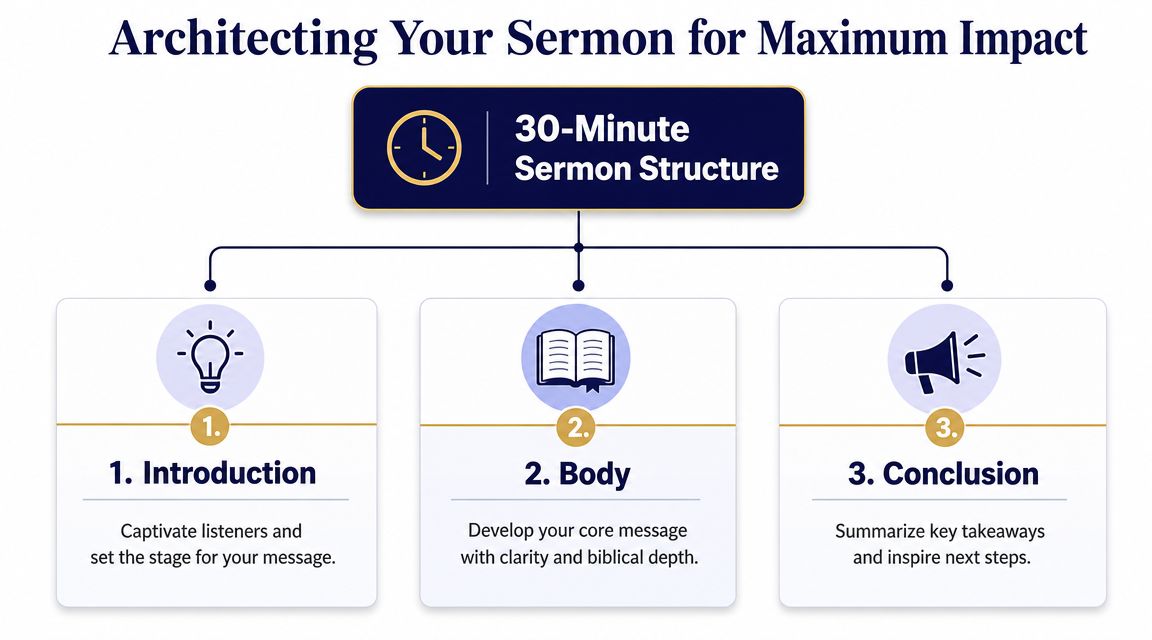
Structure does a lot of the heavy lifting in a 30 minute sermon. If the framework is weak, the preacher ends up using extra time to explain what should've already been obvious. If the framework is clear, the congregation can follow the message without strain.
Experienced sermon-prep guides commonly recommend a three-part architecture of introduction, main points, and conclusion. For newer preachers, a three-point outline is often the simplest way to stay organized, and one common pattern is to move each point through observation, interpretation, illustration, and application, as shown in this step-by-step sermon preparation guide.
A helpful companion to that process is this guide on how to develop a sermon outline.
A simple time map that actually works
Most pastors don't struggle because they lack content. They struggle because they don't allocate time. The introduction runs long, the middle gets crowded, and the conclusion becomes a rushed landing.
Here's a practical template.
| Sermon Section | Time Allocation (Minutes) | Core Purpose |
|---|---|---|
| Introduction | 4–5 | Create interest, state the burden, and orient the listener to the text |
| Main Point 1 | 6–7 | Establish the first movement of the passage with explanation and application |
| Main Point 2 | 6–7 | Develop the next movement without repeating the first point |
| Main Point 3 | 6–7 | Bring the sermon toward resolution and pastoral weight |
| Conclusion | 3–4 | Summarize the takeaway and call for a response |
This isn't a rigid law. It's a pacing tool. Some texts need two major movements instead of three. Some narrative sermons need a slightly longer setup and a shorter formal conclusion. But if you don't know where the minutes are going, the sermon will decide for you.
What each section must accomplish
The introduction should do less than many preachers think. It doesn't need to prove everything. It needs to open the door. Raise the question, expose the tension, or name the pastoral need that the text addresses.
The body should carry the actual weight of the sermon. That means each point needs a job. One point may clarify the meaning of the text. Another may expose the heart. Another may press toward obedience, comfort, repentance, or hope.
The conclusion should not be a second sermon. It should gather the message into one clean pastoral appeal.
If listeners can't tell what changed between your opening and your conclusion, the sermon probably had motion but not direction.
Choose a model that fits the text
Different sermon forms can all work inside 30 minutes.
- Expository model: Best when the passage has a visible structure. Follow the text's movements and keep your points tied to the passage.
- Point-driven model: Useful when the text supports one central proposition with a few clear implications.
- Narrative model: Strong for storytelling passages, but it only works if you resist explaining every detail along the way.
- Pastoral problem-solution model: Helpful when preaching into fear, conflict, grief, or confusion. Name the issue plainly, then let the text answer it.
What doesn't work is mixing all four models in one sermon. That creates drift. Pick a lane early and build around it.
Crafting the Message From Scripture to Script
The hardest part of sermon writing usually isn't studying. It's selecting. Most pastors can find more material than they can preach. The challenge is deciding what belongs in this sermon and what belongs somewhere else.
That's why every strong 30 minute sermon needs one controlling idea. Not a general topic. Not a vague feeling. A sentence you could say out loud in plain language.
Find the one burden of the text
Start with the passage and ask a few direct questions:
- What is the text saying?
- Why is it saying it here?
- What does this require of the listener?
- What truth must people remember by tomorrow?
If you can't answer those questions clearly, you're probably still in study mode and not yet in sermon mode. The sermon begins when the fog clears.
A useful test is this. If a church member asked after service, “What was today's message about?” could they answer in one sentence without your notes? That sentence is the center you're trying to build.
Write long first, then cut hard
One expositional guide suggests 5–8 pages of notes for a 40–45 minute sermon, which implies a 30-minute message needs even tighter trimming, and it warns that over-explaining context can reduce listener retention. That same preparation approach recommends manuscripting first, then cutting down to brief preaching notes and rehearsing aloud, as outlined in this guide to expositional sermon preparation.
That approach works because writing exposes clutter. You can't edit what you haven't made visible.
Here's what usually needs to be cut:
- Background that doesn't serve the point: Historical context matters, but not every detail belongs in the sermon.
- Duplicate explanations: If point two sounds like point one with different wording, remove one of them.
- Illustrations that entertain without clarifying: A memorable story is only useful if it carries the text.
- Application lists that keep growing: Pick the clearest response. Don't offer every possible one.
Editing lens: Every paragraph in the sermon should answer one question, move one idea forward, or call for one response.
Build transitions people can follow
Listeners rarely get lost because a truth is too deep. They get lost because the preacher changes direction without warning. That's why transitions matter so much in a 30 minute sermon.
Use short verbal signposts. “The text first shows us…” “That leads to a second issue…” “Now notice the shift…” Those small phrases keep the room with you.
A clear sermon script also protects your conclusion. If the sermon has been moving logically, you won't need a dramatic rescue at the end. You can gather what the text has already built and press it home.
Mastering Rehearsal and Delivery
Two sermons can have the same outline and say the same true things. One will feel alive. The other will feel heavy and overpacked. The difference is often rehearsal.
A preacher who only reviews the sermon in their head usually discovers timing problems in the pulpit. A preacher who rehearses out loud catches them while there's still time to fix them.

Practice out loud, not just on paper
When you speak the sermon aloud, weak spots become obvious. Transitions sound abrupt. Long sentences collapse under their own weight. Jokes that seemed fine in the study don't survive the air.
That's why many pastors benefit from hearing other speakers discuss what improved their communication over time. Testimonial's 10 week speaking reviews are useful for seeing recurring patterns in delivery, confidence, pacing, and clarity across different communicators.
For more practical help on pulpit preparation, this article on how to preach a sermon effectively is worth keeping in your prep folder.
Manuscript or outline
A full manuscript helps when you need precision, especially for doctrinal sermons or emotionally sensitive moments. It protects wording. It also tempts some preachers to read instead of preach.
A brief outline creates freedom and eye contact. It also exposes weak preparation fast. If the sermon isn't internalized, an outline can leave you wandering or repeating yourself.
Most preachers do well with a hybrid approach:
- Draft a full manuscript so the thinking is clear.
- Reduce it to short notes for delivery.
- Mark transitions and key phrases you don't want to lose.
- Circle your ending line so you land cleanly.
A sermon usually sounds more conversational when the preacher has prepared more thoroughly, not less.
What listeners notice immediately
They notice pace. They notice whether you seem present. They notice whether your tone matches the text.
If you rush, they feel hurried. If you stay flat, they work harder than they should. If you bury your face in notes, they disconnect. A 30 minute sermon gives you room to vary your voice, pause after a hard truth, and let application breathe.
Delivery doesn't need theatrics. It needs control, warmth, and conviction.
Amplify Your Sermon All Week with Social Media
The sermon shouldn't disappear after the benediction. In many churches, Sunday's message is the strongest piece of content you produce all week, yet it's often treated as if its only job is to fill one live slot in one service.
That's a waste of pastoral work. A well-built 30 minute sermon is ideal source material for digital follow-up because it already has a clear theme, a manageable length, and several quotable moments.

Why the format works online
Churches are preaching inside a broader attention economy. In 2024, YouTube said viewers watched over 70 billion daily short-form video views globally, and viewing of short-form video on TV screens rose more than 100% year over year, according to YouTube's update on short-form viewing. That doesn't mean the church should mimic everything in digital culture. It does mean people are increasingly used to concise, high-retention content.
A 30 minute sermon helps because it's already compressed enough to mine effectively. You don't have to dig through endless repetition to find the core message. The best clips, quotes, and discussion prompts are usually easier to identify when the sermon itself is disciplined.
Turn one sermon into a week of ministry touchpoints
A practical sermon repurposing workflow looks like this:
- Pull one or two short video clips: Choose moments with a complete thought, not a fragment.
- Create quote graphics or carousels: Use one clear line from the sermon and pair it with a simple visual.
- Write a midweek recap post: Summarize the main takeaway in plain language.
- Generate small group questions: Focus on response, not just recall.
- Draft a blog article or email devotion: Expand one application point for people who need another touchpoint.
If you want a broader non-church perspective on this workflow, this guide for creators on content repurposing is a useful reference.
Another practical resource is this article on how to repurpose content for church communications.
Keep the workflow light enough to repeat
Most churches don't fail at social media because they lack ideas. They fail because the process requires too many tools and too much manual effort. The better approach is to treat the sermon as the source asset and build simple, repeatable outputs around it.
One option churches use is ChurchSocial.ai, which can take a sermon transcript or recording and generate reels, social posts, blog-style content, and graphics, then place that content into a drag-and-drop calendar. It also includes templates and calendar integrations that help teams plan event-related posts without rebuilding the week from scratch.
That kind of workflow matters most for small staffs and volunteer-led teams. If the pastor has to preach, edit clips, write captions, and schedule every post manually, consistency usually collapses. But if the sermon is prepared with a strong central idea and a clear structure, the digital team has material worth reusing.
The most useful social media strategy for a church is often the one that asks the team to do less from scratch.
What to post after Sunday
Don't post random leftovers. Post material that extends the sermon's pastoral purpose.
A simple weekly rhythm might include:
| Day | Content Type | Purpose |
|---|---|---|
| Sunday | Short sermon clip | Reinforce the core message |
| Monday | Quote graphic or carousel | Give people a line to remember |
| Wednesday | Discussion question post | Move from hearing to reflection |
| Friday | Invitation tied to the sermon theme | Reconnect people before the weekend |
The point isn't volume for its own sake. The point is reinforcement. A strong 30 minute sermon can keep serving your people long after the live delivery ends.
Conclusion From 30 Minutes to Lasting Impact
A powerful 30 minute sermon doesn't happen by accident. It comes from choosing a clear structure, finding the central burden of the text, cutting what doesn't serve the message, and rehearsing until the delivery feels natural.
That discipline pays off twice. It helps the congregation hear the Word with greater clarity on Sunday, and it gives your church a stronger base for communication throughout the week. The sermon becomes more than a one-time event. It becomes a ministry asset.
Church leaders don't need more pressure added to sermon prep. They need a repeatable approach that respects time, serves listeners, and supports the rest of the church's communication work. That's what the 30 minute sermon can do when it's built with intention.
In a distracted world, a focused sermon often carries farther than a sprawling one. Say one thing clearly. Say it faithfully. Then let that message keep working in the room, in conversations, and online.
If your church wants to turn each week's sermon into clips, social posts, graphics, blog content, and a manageable publishing plan, ChurchSocial.ai gives staff and volunteers one place to create, schedule, and reuse sermon-based content without building the whole workflow by hand.