Sunday bulletin prep usually breaks down the same way. The sermon title changes late Saturday. A volunteer asks whether the youth announcement is still running. Someone notices the communion note is missing. Then, on Sunday morning, a stack of papers becomes the church's main communication piece for the week.
That's why people keep searching for church bulletins for sale. They aren't looking for paper alone. They're trying to find a format that fits real ministry life, with limited staff time, volunteer help, changing plans, and a congregation that still expects clear weekly communication.
Bulletins still matter because they sit right at the intersection of worship, announcements, participation, and follow-up. The right bulletin doesn't just look nice. It reduces confusion, helps guests track the service, gives members one place to find what's happening, and gives your team a repeatable rhythm instead of a weekly scramble.
Your Guide to Modern Church Bulletins
Saturday afternoon often looks the same in a church office. Someone is fixing a last-minute announcement, the worship order has changed, and a volunteer is asking which version is final. In that moment, the bulletin is more than a printed handout. It is the one piece that has to be clear, accurate, and ready on time.
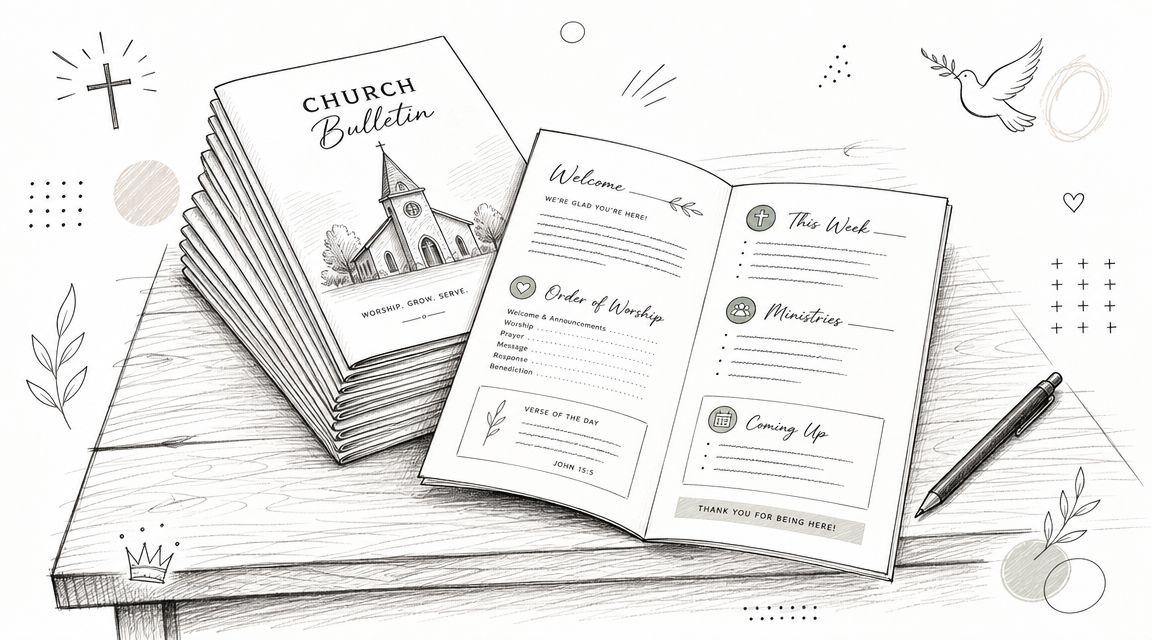
Churches still buy bulletins because they solve a weekly coordination problem. They give guests a guide to the service, help members track events and next steps, and give staff one approved version of what needs to be communicated on Sunday. In many churches, that printed piece still sets the communication agenda for the week.
That matters even more if the team wants consistency across print and digital channels. A well-built bulletin gives you content for Sunday morning, but it can also supply the raw material for your email, website updates, and weekday posts. That is where the process usually breaks down. Teams create the bulletin, then start over for social media.
A better system uses the bulletin as the source document. If the announcements, sermon notes, event details, and kids ministry reminders are already organized there, they can be reused without extra writing. Churches that also need family-friendly communication often build that into the same rhythm with tools like church bulletins for kids, so parents and children get clear next steps without adding another disconnected workflow.
Why churches still buy bulletins
The search for church bulletins for sale usually starts after a church hits one of these pressure points:
- The weekly file is hard to manage. Too many people edit it, and no one owns the final version.
- The format no longer fits the church. The design may feel dated, cluttered, or hard for guests to follow.
- The team needs a repeatable process. A stable template, pre-printed stock, or a cleaner production routine saves time every week.
Church size also affects how a bulletin functions. Smaller churches can sometimes handle communication informally. As attendance grows, the need for one reliable reference point usually grows with it. A bulletin helps reduce missed details, duplicate announcements, and Sunday-morning confusion.
What a smarter workflow looks like
The churches that handle bulletins well usually make three practical decisions.
- They keep the format stable. Familiar layout saves editing time and makes the bulletin easier to scan.
- They assign one final approver. Too many last-minute editors create mistakes.
- They reuse bulletin content across channels. The same material should support print, email, web, and social.
That third point is where modern church communication gets more efficient. Instead of treating the bulletin and social media as separate jobs, use the bulletin as the starting point and repurpose it. ChurchSocial.ai helps churches turn bulletin content into social posts without asking the team to rewrite everything from scratch. That saves volunteer time, keeps messaging consistent, and helps the church's message reach people who never pick up the printed copy.
Choosing Your Bulletin Format
When you compare church bulletins for sale, most options land in three buckets. Pre-printed shells give you a designed outer sheet and space to print your own inside content. Custom bulletins are built around your church's branding and needs. Downloadable templates give you a file to edit and print yourself.
The best choice depends less on taste and more on workflow. A church with reliable office volunteers may do well with templates. A church with frequent holiday emphasis may prefer stock shells. A church that wants strong visual consistency across ministries may lean custom.

Bulletin Buying Options Compared
| Feature | Pre-Printed Shells | Custom Bulletins | Downloadable Templates |
|---|---|---|---|
| Setup time | Fast once ordered | Slower upfront | Fast if someone can edit |
| Design control | Limited to supplier catalog | High | Moderate to high |
| Weekly flexibility | Good if inside is self-printed | Depends on print method | Strong |
| Volunteer friendliness | Strong | Moderate | Depends on software comfort |
| Seasonal variety | Strong | Depends on your design capacity | Depends on your template library |
| Brand alignment | Limited | Strong | Good if templates are customized |
What works well for each option
Pre-printed shells work best when your team wants consistency without having to design from scratch. Vendors often structure these as recurring seasonal inventory around weekly services, holidays, communion, and special events. Some suppliers also bundle related print items, and at least one supplier offers free shipping over $49 through Concordia Supply's bulletin catalog, which can matter for smaller churches trying to keep ordering simple.
Custom bulletins work best when your church has a defined visual identity and enough lead time to plan. They're useful for churches that want every printed piece to feel aligned with the same brand standards used on screens, signage, and event materials.
Downloadable templates work best when speed matters more than premium print finishing. They also help churches that make changes late in the week and don't want to wait on shipping.
For ministries serving children separately, the bulletin format may need to flex by audience. A church that runs both sanctuary bulletins and age-specific handouts can benefit from ideas like these church bulletins for kids, especially when the goal is to keep families engaged without creating a second full design process.
A bulletin format is only “affordable” if your team can actually sustain it week after week.
Content and Design That Connects
By Friday afternoon, the bulletin usually becomes a decision tool. A volunteer is asking what has to stay, what can move to email, and whether the sermon notes still fit after one more announcement came in. Good bulletin content answers those questions before the page gets crowded.
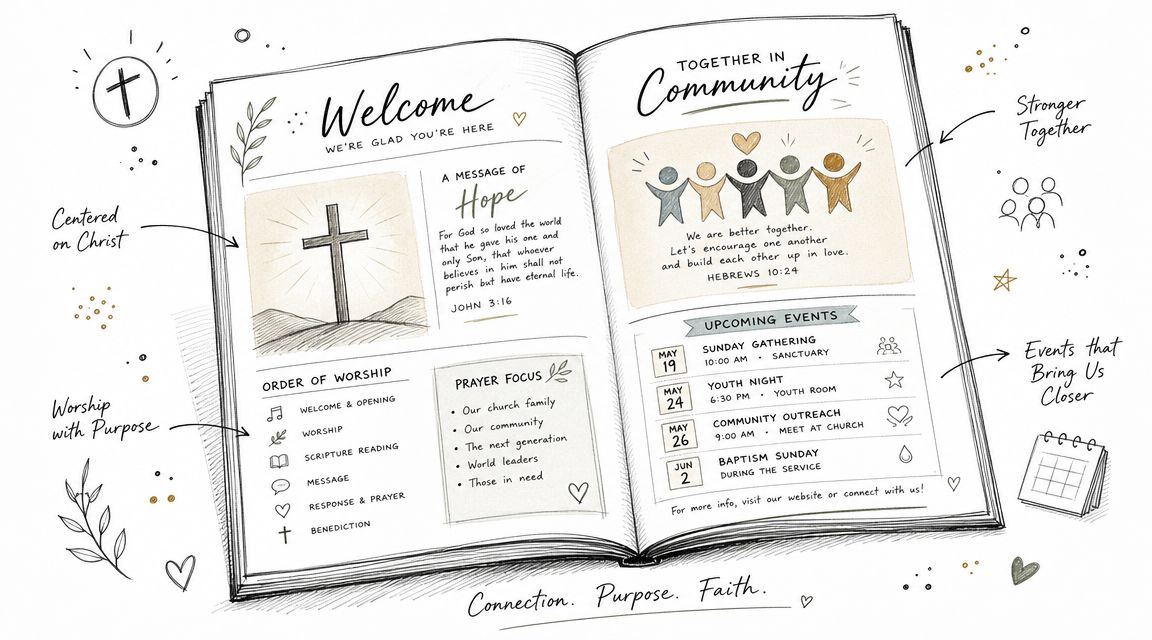
A useful bulletin gives people direction during the service and one or two clear next steps after it. It can hold the order of worship, space for notes, and a short list of churchwide announcements. That mix matters because a bulletin is not just something people read. People write on it, carry it home, and use it to stay oriented in the room.
What to include every week
Start with the pieces people need while the service is happening:
- Order of worship: Make it clear enough that a guest can follow along without asking what comes next.
- Sermon notes space: Even a simple notes block signals that participation matters.
- Primary announcements: Reserve this area for updates that affect a broad part of the church, not every ministry detail.
- Next-step information: Give people one obvious action, such as signing up for a class, joining an event, or contacting the church.
If the page feels crowded, cut content before you shrink the type. Tiny text saves space and loses readers.
Design choices that help people read
Good bulletin design is mostly about hierarchy. People should know at a glance what belongs to the service, what belongs to announcements, and where they can respond or take notes. Clear spacing does more ministry work than decorative clutter.
Use these checks before printing:
- Keep headline styles consistent. Consistent headings help readers scan quickly.
- Leave white space. Empty space makes the page easier to use and easier to trust.
- Limit font choices. Two type styles are usually enough for a clean layout.
- Protect note-taking space. If sermon engagement matters, the design should show it.
If a first-time guest cannot tell where the service order ends and the announcements begin, the bulletin is making Sunday harder than it needs to be.
A small graphics system often works better than redesigning the bulletin every week. Reusable covers, announcement blocks, and note sections give volunteers a repeatable process and keep the bulletin aligned with the church's other communication channels. These church bulletin graphics ideas show the kind of simple visual framework that saves time without making the page feel generic.
That same discipline helps your digital communication too. When bulletin sections stay clear and repeatable, the content is easier to repurpose for email, website updates, and social posts. ChurchSocial.ai fits well here because it can turn bulletin content into social media assets without asking your team to build every post from scratch. That gives the printed bulletin a second life and helps the church message reach people who never held the paper copy.
Navigating Pricing and Production
The operational side of bulletins is where most frustration shows up. Not in design meetings. In the office printer. In the shipping window. In the late Saturday text that says the announcement changed again.
That's why format matters as much as appearance. Suppliers commonly offer 8.5 x 11 inch full-color bulletin shells printed on one side, which lets churches print changing inside content themselves. That setup supports late updates without forcing a full reprint, as described in Church Supplier's bulletin format options.
Production details that affect your week
A one-sided shell solves several practical problems at once:
- Late edits stay manageable. You can update the inside content close to the service.
- Volunteer printing gets easier. Fewer design variables usually means fewer mistakes.
- Write-in space stays usable. Prayer notes, sermon notes, or response prompts don't fight with heavy background design.
Suppliers may also separate stock covers from custom bulletins, and they may offer different paper and bleed or no-bleed options. Those details affect how polished the final piece feels, but they also affect how much setup attention your team needs to give the file.
What many churches overlook
The core question isn't only “What does this bulletin cost?” It's “What does this process cost us in time, errors, and stress?”
A church with frequent service edits should be cautious about fully locked bulletin workflows. The more your ministries change week to week, the more valuable flexible formatting becomes. For many teams, the most stable process is a reusable outside shell with updateable inside pages.
Here's a simple way to pressure-test your bulletin system:
- Can someone make a final content change quickly?
- Can a volunteer print it without calling three people for help?
- Can the church reuse the same framework for holidays and regular Sundays?
- Does the setup leave room for inserts when needed?
Churches that are refining physical distribution also need to think through placement and handling, not just print files. If you're reviewing lobby flow, sanctuary entry points, or welcome center organization, these notes on church bulletin holders can help connect the print choice to the in-building experience.
From Bulletin Content to Social Media Buzz
Most church teams already create more content than they realize. The weekly bulletin includes sermon themes, event details, ministry reminders, and often language that's ready to be reused. The problem isn't lack of material. It's that the material stays trapped in a printed workflow.
That's one reason the market has shifted toward hybrid distribution. FlippingBook notes that printed and digital are now the two main bulletin formats, and that digital bulletins can significantly cut printing costs over time while allowing instant sharing by link, QR code, or website embed in its guide to church bulletin ideas.
Repurpose what you already wrote
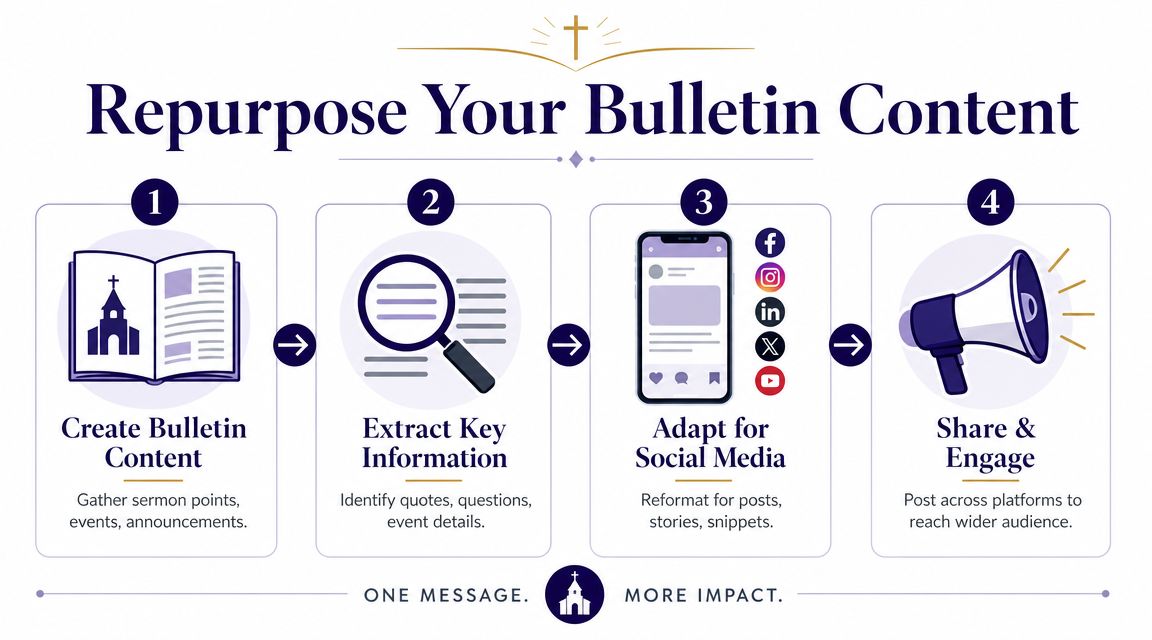
A practical bulletin-to-social workflow looks like this:
- Pull the sermon points and turn them into short caption posts for the week.
- Use the event block as the base for a reminder graphic, story slide, or carousel.
- Lift one key line from the sermon notes area and use it as a discussion prompt.
- Convert the weekly calendar into a quick update graphic for members who won't see the printed handout.
Teams that already record sermons can take this a step further. If you're also publishing messages in video or audio form, it helps to think like a content editor, not just a bulletin editor. This overview on how to repurpose video podcast episodes is useful because the principle is the same. One source piece can become multiple formats when the workflow is intentional.
Where a tool can reduce duplicate work
One platform can simplify the handoff between Sunday content and weekday outreach. ChurchSocial.ai can help churches turn sermon transcripts into social posts, blogs, and short-form sermon clips, while also giving teams a drag-and-drop calendar, graphic templates, and calendar integrations such as Planning Center for event-based content planning. For a church already producing bulletin copy each week, that means the same core message can move into social media without a second round of manual creation.
The church doesn't need more raw content. It needs fewer dead ends between content creation and content reuse.
A printed bulletin can still serve the room on Sunday. A digital version can reach members who are traveling, homebound, or checking details midweek. Social posts can carry the same message further into the community. When those three pieces connect, the workload usually feels lighter because the team is building once and publishing several times.
Unify Your Church Communications Today
Buying church bulletins is still a practical decision. You need a format your church can afford, a process your volunteers can handle, and a design that helps people engage instead of squint. But the bigger decision is whether the bulletin will stay an isolated task or become part of one communication system.
That matters because many churches are dealing with constant change. Some vendors still treat bulletins like static stationery, but there's a clear need for more flexible workflows. Hermitage Art points to that gap by noting demand around flexible deadlines and digital bulletin solutions from providers like LPi in its discussion of church bulletin workflow needs.
A healthy bulletin system is connected
The churches that handle bulletins well usually do a few things consistently:
- They standardize the format. Fewer moving parts means fewer weekly surprises.
- They narrow the approval chain. One editor and one final approver is often enough.
- They reuse the content. Sunday information also feeds digital channels during the week.
- They plan for change. Inserts, updateable interiors, and digital copies reduce panic.
What not to do
Some patterns almost always create friction:
- Starting from a blank file every week
- Using the bulletin for every announcement in the church
- Printing too early when service details often change
- Treating print and digital as unrelated jobs
The bulletin still has a place. It's familiar, practical, and useful in the room. But if your team is already writing announcements, sermon notes, and event copy, those words should keep working after Sunday morning.
When your print process, digital bulletin, and social publishing all support each other, the weekly communication load gets more realistic for staff and volunteers. That's the essential upgrade. Not replacing the bulletin. Connecting it to the rest of your ministry communication.
If your church is tired of creating the same message three different ways, ChurchSocial.ai gives you one place to plan, create, and schedule content from what you already produce each week. Use sermon transcripts to generate social posts, reels, blogs, and graphics, organize everything in a simple calendar, and turn bulletin content into a broader communication rhythm without adding more strain to your team.