You've probably seen it happen. A few single adults show up faithfully, sit through the announcement slide, stay for coffee, and then leave without ever finding a place that feels like theirs. The church has plenty of programs, but no clear path for people who are unmarried, untethered to a family group, and wondering whether they matter in the life of the congregation.
A church singles ministry solves that gap when it's built with intention. It's not a side project for a few awkward social nights, it's a ministry lane that helps people belong, serve, and grow. The churches that treat single adults as a real discipleship field, not a niche audience, are the ones that stop losing people in the cracks.
Why Your Church Needs a Singles Ministry Now
The need isn't theoretical. By the 2010 U.S. Census, 43.6% of U.S. adults were unmarried, and pastors were already responding by treating single adults as a significant ministry group, with 92% encouraging them into leadership and 91% into volunteer roles; 45% offered Bible studies or classes specifically for them (Christian Post on church response to growing numbers of singles).
That means the average church is not dealing with a fringe population. It's serving a huge portion of the adult world, and if those adults can't find belonging, the church is leaving discipleship on the table.
The local church already feels this
A pastor may not say it out loud, but the pattern is familiar. Single adults show up, volunteer sometimes, then drift because every visible pathway seems designed for couples, parents, or retirees. The issue is rarely hostility, it's neglect by default.
A healthy church singles ministry gives those adults a place to be known without being reduced to their relationship status. It also gives the church a practical way to invite them into leadership, teaching, hospitality, and service instead of treating them as consumers of content.
Practical rule: if your church can name its children's ministry, student ministry, and marriage ministry, it should be able to name a plan for single adults too.
The opportunity is bigger than attendance. Single adults often sit at the center of friendship networks, volunteer pipelines, and digital discovery. If the church never speaks directly to them, it misses a large part of its own mission field.
The True Mission of a Modern Singles Ministry
A healthy singles ministry is not a dating funnel. That stereotype still lingers in a lot of church culture, but it shrinks the ministry down to the wrong goal and sends the wrong signal to people who are already cautious about being labeled by their marital status.

The better vision is belonging, formation, and service. Guidance for healthy ministry clearly emphasizes spiritual formation and intergenerational church life, along with real teaching and leadership roles for singles, while warning against couple-centric language that signals exclusion (Seedbed on not turning singles ministry into Cupid's Arrow).
Belonging has to come before programming
People stay where they're known. That's true in every ministry, but it matters even more here because single adults are often asked to fit into spaces designed for families. A strong church singles ministry says, “You belong here as a full member of the body,” before it ever says, “Come to our event.”
That posture changes what gets promoted, who gets invited to lead, and how the church talks from the platform. It also changes the kinds of questions leaders ask. The point is not, “How do we get singles to attend something?” The point is, “How do we help them grow as disciples in the life of the church?”
The right answer usually includes service opportunities, small-group pathways, and visible participation in worship, teaching, and planning. It does not include treating singleness as a problem to be solved.
Choosing the Right Model for Your Singles Ministry
The first structural mistake churches make is assuming one group can fit everyone. A never-married 28-year-old, a divorced parent, and a widowed 62-year-old may all be single, but their needs, rhythms, and support systems are not the same. Ministry practitioners recommend segmenting by age, life stage, and context rather than treating all unmarried adults as one audience (RMDC single adult ministry guide).
Start with your actual demographics
Before you choose a model, measure the ministry area's demographics first. That simple move keeps you from building a program around assumptions, and it helps you match leaders to the people they'll serve. A church with mostly young professionals needs a different shape than a church with a large divorced or widowed population.
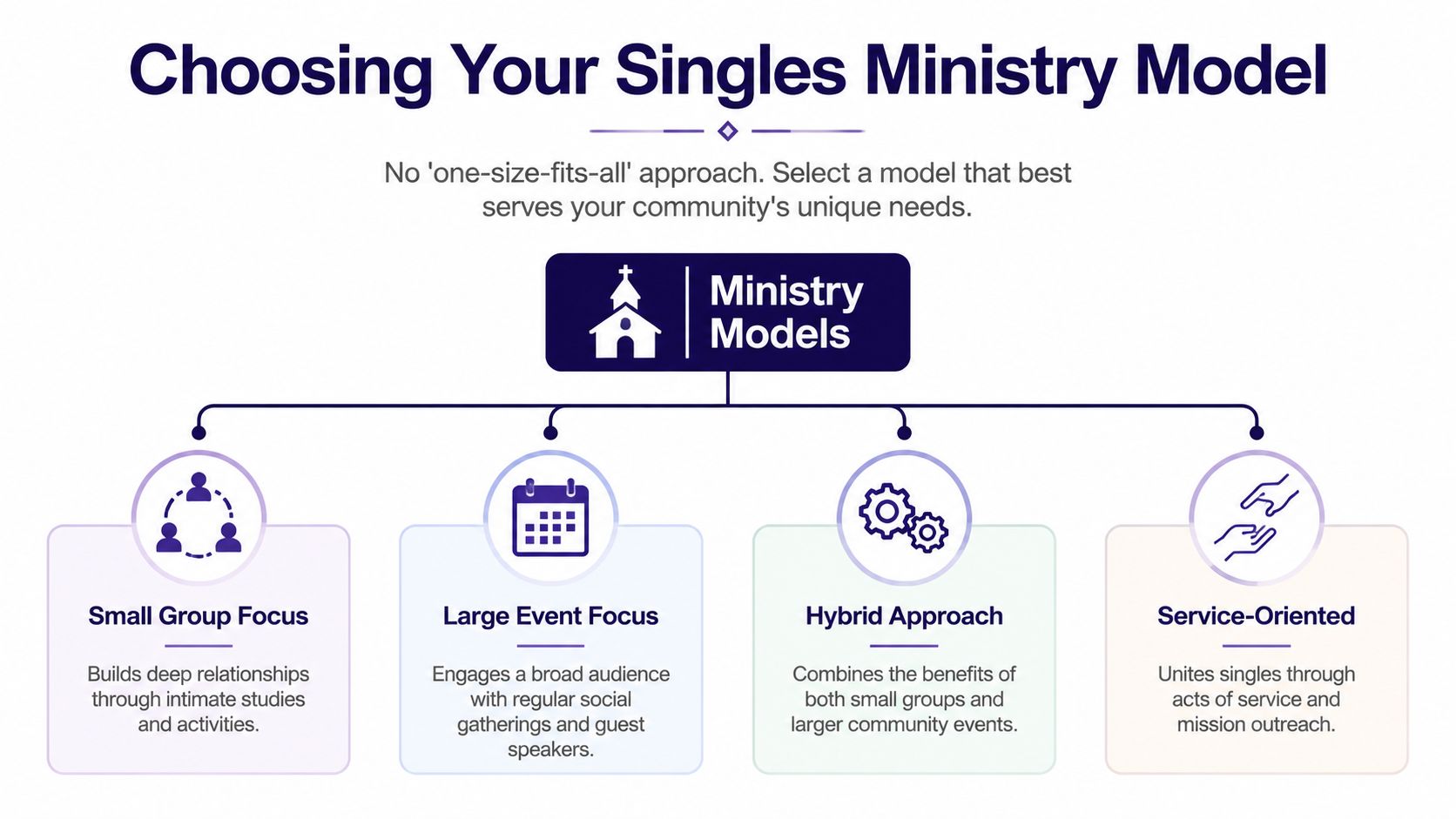
The most common models are straightforward. A small-group focus works well when the church wants depth and consistent relationships. A large-event focus works better when the goal is broad visibility and low-barrier entry. A hybrid approach gives you both, while a service-oriented model unites people around mission rather than social programming.
Pick the structure that solves the right problem
If people already know one another but need discipleship depth, small groups make sense. If nobody knows the ministry exists yet, larger gatherings can create awareness. If the biggest need is trust, shared service can sometimes do more than a social calendar ever will.
Decision filter: choose the model that fixes your real gap, not the one that looks easiest to run on paper.
The strongest ministries often start with one clear lane and expand later. That keeps leaders from overbuilding too soon and gives the church time to learn which subgroups need separate rhythms.
Engaging Program and Event Ideas for Single Adults
A single-adult calendar should feel like a living ministry, not a recycled event flyer. The best programs do one of three things, they deepen faith, create real connection, or put people to work in meaningful service. When those three are balanced, the ministry feels like church, not a social club.
Build around spiritual growth
Topic-specific Bible studies work because they meet people where they are. A study on identity, calling, grief, discernment, or friendships can speak directly to the realities of singleness without turning every meeting into relationship talk. Worship nights and prayer gatherings also help when they're structured for reflection instead of performance.
The key is to avoid the vague “let's just get together and talk” model. People need a reason to return, and content matters. Single adults often want depth, not filler.
Build around connection
Game nights, cooking classes, sports leagues, and low-pressure dinners can all work, but only if leaders treat them as relationship-building tools rather than one-off entertainment. A great event creates enough comfort for people to recognize one another the next time they show up.
Use mixed rhythms. A monthly larger gathering can create momentum, while smaller hangouts keep relationships alive between events. That balance helps prevent the ministry from becoming a monthly crowd with no memory.
Build around service
Service projects often reveal the quickest route to belonging. Partner with local nonprofits, join church-wide volunteer efforts, or create a singles team that serves in regular rotations. Shared work gives people something concrete to talk about and a reason to see one another outside the usual meeting room.
Practical insight: people bond faster when they solve a problem together than when they sit in a room waiting for conversation to happen.
The strongest calendars blend all three lanes. Spiritual formation grounds the ministry, connection keeps it human, and service keeps it outward-facing.
Promoting Your Ministry with a Smart Social Media Strategy
A strong singles ministry can still sit half-empty if nobody hears about it in time. Digital promotion has to do more than announce dates, it needs to communicate identity, tone, and belonging. That's where a modern content workflow matters, because single adults often decide whether a ministry feels credible long before they ever walk in.

Church social strategy works best when the feed feels human. One church-growth presentation recommends that 70% of posts feature community and real people, and it advises auditing the last 30 posts to see whether the feed is dominated by announcements instead of actual members or team moments, with announcement posts cut by 75% if they overwhelm the page (church social content benchmark presentation). That's a useful standard for singles ministry, because the audience is looking for signs of life, not just event promotion.
Use content that shows a real ministry culture
A strong mix starts with sermon clips on topics that matter to single adults, short reels from testimonies, and photos or carousels that show service, studies, and hangouts. If you need a practical comparison point for broader growth tactics, this guide on increase your social media followers is useful for thinking about consistency and audience habits.
ChurchSocial.ai fits this workflow well because it can turn sermon content into reels, generate posts and blogs from transcripts, and help create branded graphics and carousels with templates and an editor. Its drag-and-drop calendar also makes it easier to plan promotion around ministry dates, while Planning Center integration helps churches pull event details into the content calendar without rebuilding everything by hand.
For a broader planning framework, the church social media strategy guide at ChurchSocial.ai's strategy resource is a good companion when you're building the workflow.
Match the message to the medium
Short-form video works well for first contact because it quickly communicates tone. Carousels are stronger when you need to explain the ministry's purpose or upcoming event details. Static graphics still matter for clear calls to action, but they shouldn't carry the whole feed.
If your graphics show actual ministry life and your captions sound like a real person wrote them, the promotion starts doing real ministry work. That's especially important for singles, who are often deciding whether your church is a place where they'll be seen or merely scheduled.
How to Keep Singles Engaged and Connected
Attendance alone can fool leaders. A room can feel full while relationships stay thin, and thin relationships don't hold people for long. Ministry leaders who think carefully about engagement focus on relationship density, because attendance grows when relationships grow (Singles Network leadership article).

Create spaces that continue outside the room
The most effective leaders build community outside meetings through small hangouts, volunteer teams, interest groups, and online chat. That matters because a ministry can't depend on one big gathering to do all the relational work. People need touchpoints between events, otherwise the ministry becomes a calendar, not a community.
Online spaces help here, especially for midweek conversation, prayer requests, and last-minute invitations. The internal resource on online small groups is a good reminder that digital connection can extend the ministry's reach without replacing embodied fellowship.
Give people a path into ownership
Singles stay engaged when they can contribute. That means inviting them into planning, hospitality, communications, service coordination, and teaching roles, not just attendance. Ownership changes the emotional stakes, because people invest more fully in what they help build.
A ministry that only consumes attention burns people out. A ministry that distributes responsibility creates momentum.
People don't commit to a program. They commit to the people they know and the role they've been given.
Feedback matters too. Ask what meetings felt life-giving, which formats were awkward, and where the ministry feels disconnected from the rest of church life. That kind of listening keeps the group from drifting into routine.
Measuring Ministry Health and Planning for Growth
Healthy ministry needs simple measurement, not a spreadsheet obsession. A practical church analytics workflow can focus on reach, saves and shares, video completion rate, and profile visits that convert to website clicks, and it recommends reviewing those metrics monthly in a 15-minute session instead of treating analytics like a full-time job (church social media analytics guide).
Use that same discipline for your singles ministry. Track whether people are returning, whether leadership roles are multiplying, and whether digital content is leading people to real-world connection. The internal guide on community engagement metrics is a useful lens when you're deciding which signals matter.
A ministry grows sustainably when leaders measure the right things and adjust calmly. That means paying attention to what content gets saved or shared, what gatherings lead to repeat attendance, and where people begin serving. If the goal is belonging and discipleship, then metrics should help you see whether those things are really happening.
Start small, stay steady, and let the data keep you honest. Consistent communication, a clear ministry identity, and a simple content system will do more than a flashy launch ever could.
A CTA for ChurchSocial.ai.