You posted the recap, clipped the sermon, shared the event graphic, and answered comments during lunch. Sunday came and went, and now you're left with the question most church teams ask: Did any of that help people connect?
That question matters more than ever. Social media can swallow time fast, especially when one staff member or volunteer is trying to manage Facebook, Instagram, short-form video, event promotion, and follow-up at the same time. Without a clear way to measure progress, it's easy to drift toward vanity numbers or discouragement.
Churches need a better framework. Not a corporate dashboard for the sake of appearances, but a ministry tool for stewardship. The worldwide online communities market grew at a 24.3% compound annual rate to $1.2 billion by 2019, which shows digital community building has become a core strategy for organizations, including churches, and supports investing in tools that measure engagement (online community market growth data).
The point isn't to worship metrics. The point is to listen to what the numbers are saying so you can serve people better.
From Likes to Life-Change Why Your Church Needs Metrics
A church can be active online and still be unclear about impact. That happens all the time. A team posts faithfully, sees a few likes, notices occasional shares, and assumes things are either going fine or not working at all. Neither conclusion is very helpful.
What helps is treating social media like any other ministry environment. In kids ministry, you count attendance. In groups ministry, you watch participation and follow-up. In pastoral care, you notice who keeps showing up and who quietly disappears. Your digital ministry needs that same level of attention.
Metrics are ministry feedback
The phrase community engagement metrics can sound sterile, but in practice it answers very human questions.
- Are people seeing what we're sharing
- Are they responding in ways that show interest or trust
- Are online interactions leading toward prayer, attendance, service, or relationships
- Are the same people staying connected over time
Those are ministry questions, not marketing jargon.
Practical rule: If a metric doesn't help your church make a better pastoral or communication decision, it probably doesn't belong on your main report.
I've seen churches get stuck because they chase broad visibility without checking whether anyone is engaging. A sermon clip might collect views, but if nobody comments, shares, saves, messages, or clicks through, the number doesn't tell the whole story. On the other hand, a post with fewer views but several thoughtful comments, a prayer request in DMs, and a sign-up for a ministry event often carries far more ministry value.
Stewardship beats guesswork
Metrics also protect teams from burnout. When you know what matters, you stop spending equal energy on every platform, every post type, and every trend. You can identify what helps your church connect with people and what just creates more work.
That clarity is especially useful when you're planning content around sermons, events, and seasonal ministry moments. If your church uses a workflow that turns sermon transcripts into social posts, reels, blogs, and discussion prompts, measurement helps you see which outputs deepen connection and which ones only fill the calendar.
The Key Community Engagement Metrics for Churches
Churches don't need to track everything. They need to track the few signals that reveal whether people are moving from awareness to relationship.

Awareness metrics
Start with the simplest question. How many people are seeing your content?
Reach and impressions sit here. Reach tells you how many unique people saw a post. Impressions tell you total views, including repeat views. For churches, these metrics matter most when you're trying to widen the top of the funnel around events, sermon clips, holiday services, or a new ministry launch.
Still, awareness alone can fool you. A post can travel broadly and produce very little ministry fruit. Treat these numbers as diagnostic, not decisive.
Interaction metrics
Things become more insightful with interaction, which shows whether people did anything with what they saw.
- Likes and reactions show quick affirmation. They're useful, but shallow.
- Comments show conversation. In church communication, comments often reveal questions, agreement, prayer needs, or a readiness to engage.
- Shares matter a lot because they function like a member inviting someone else into the conversation.
- Direct messages often reveal the highest intent. People tend to move to DMs when the need is personal.
- Saves can matter on platforms that support them because they suggest lasting relevance.
Among key community metrics, Active Users and Member Retention Rate are the most important for tracking real participation, while a lower Churn Rate is better for long-term sustainability (community engagement metric definitions and priorities).
That matters for churches because a healthy digital ministry isn't just attracting occasional attention. It's helping the same people return, respond, and stay involved over time.
Shares are often more meaningful than likes. A like says, "I saw this." A share says, "I want someone else to see this too."
If your team wants a practical companion resource for content planning decisions, this guide to churches social media best practices is useful because it frames posting choices around ministry goals rather than trend chasing.
Action metrics
Churches should also track what happens after engagement. This is the point where content starts producing ministry movement.
A few action metrics matter more than the rest:
| Metric | What it tells you | Why it matters for churches |
|---|---|---|
| Website clicks | Whether people want more information | Helpful for sermons, events, next steps, and giving pages |
| Sign-ups | Whether content moved someone to commit | Useful for newsletters, classes, VBS, groups, and volunteer interest |
| Event RSVPs | Whether promotion translated into response | Reveals if messaging and timing worked |
| Volunteer inquiries | Whether content inspired service | Strong signal of mission alignment |
| Attendance patterns | Whether online activity is reinforcing connection | Helps connect digital effort to real ministry participation |
Retention metrics
Retention is where many churches under-measure. If a person comments once and disappears, that's not the same as someone who keeps engaging for months, attends events, and responds to invitations.
Look for signs that people return. Repeat online participation, recurring attendance, continued comments, and ongoing conversations all point to a stronger digital community. Churches that only celebrate spikes often miss the quieter sign of health, which is consistency.
How to Track Your Churchs Digital Pulse
Tracking engagement doesn't require an analyst. It requires a repeatable rhythm. Most churches can get useful clarity from a simple monthly review as long as they don't overcomplicate it.

Start with one monthly scorecard
Use one sheet or dashboard for each month. Keep the categories simple:
- Visibility with reach and impressions
- Interaction with comments, shares, saves, and DMs
- Actions with clicks, registrations, and volunteer interest
- Retention with returning participants and repeat engagement patterns
You don't need a giant spreadsheet with tabs nobody opens. You need one place where a pastor, admin, or volunteer can glance and understand what happened.
Use simple formulas
A few formulas are enough for most church teams.
- Engagement rate: total interactions divided by reach
- Response rate: respondents divided by total people reached
- Retention rate: active members who remain engaged over a set period divided by active members at the start of that period
- Churn rate: members who leave or become inactive over a set period divided by members at the start
The key is consistency. Use the same method each month so you can spot movement.
Response rate is also worth tracking for surveys, feedback forms, and campaign outreach. It's defined as respondents divided by the total people reached, and effective outreach campaigns often fall in the 15% to 25% range for targeted resident groups, with performance best understood when segmented by channel (response rate benchmark and definition).
For churches, that means a ministry survey sent by email may behave differently than an Instagram story question box or a Facebook post asking for input. Don't lump every channel together.
Look inside each platform, then centralize
Facebook, Instagram, YouTube, and TikTok all surface some version of reach, engagement, and audience activity. The manual process is straightforward but time-consuming:
- Open each platform's insights.
- Pull the same date range.
- Record your key metrics.
- Compare top-performing posts by topic and format.
- Note what led to conversations or next steps.
That works. It just doesn't scale well when you're also trying to write captions, clip sermons, build event graphics, and keep a calendar current.
That's why many church teams eventually move to one reporting workflow. Some teams use a general AI workspace such as LunaBloom AI for content and idea generation, then pair it with church-specific scheduling and reporting tools to keep ministry communication organized.
A practical option is ChurchSocial.ai, which combines planning, post creation, scheduling, sermon-based content generation, and analytics in one place. It can turn sermon transcripts into social posts and blog drafts, create AI-generated reels from sermons, support photo and carousel creation through templates and an editor, and manage publishing through a drag-and-drop calendar that also connects with Planning Center and other church calendars.
If you're building your own reporting habit first, this walkthrough on measuring social media engagement for churches gives a useful framework for deciding which signals belong on your monthly dashboard.
A clean dashboard doesn't replace discernment. It gives your team a starting point for better conversations.
What to review every month
At the end of each month, ask five questions:
- Which post started the most real conversation
- Which post drove the clearest next step
- Which format underperformed despite a lot of effort
- Which audience segment kept returning
- What should we repeat next month
That last question matters most. Metrics only help when they change what you do next.
Setting Realistic Goals With Church Benchmarks
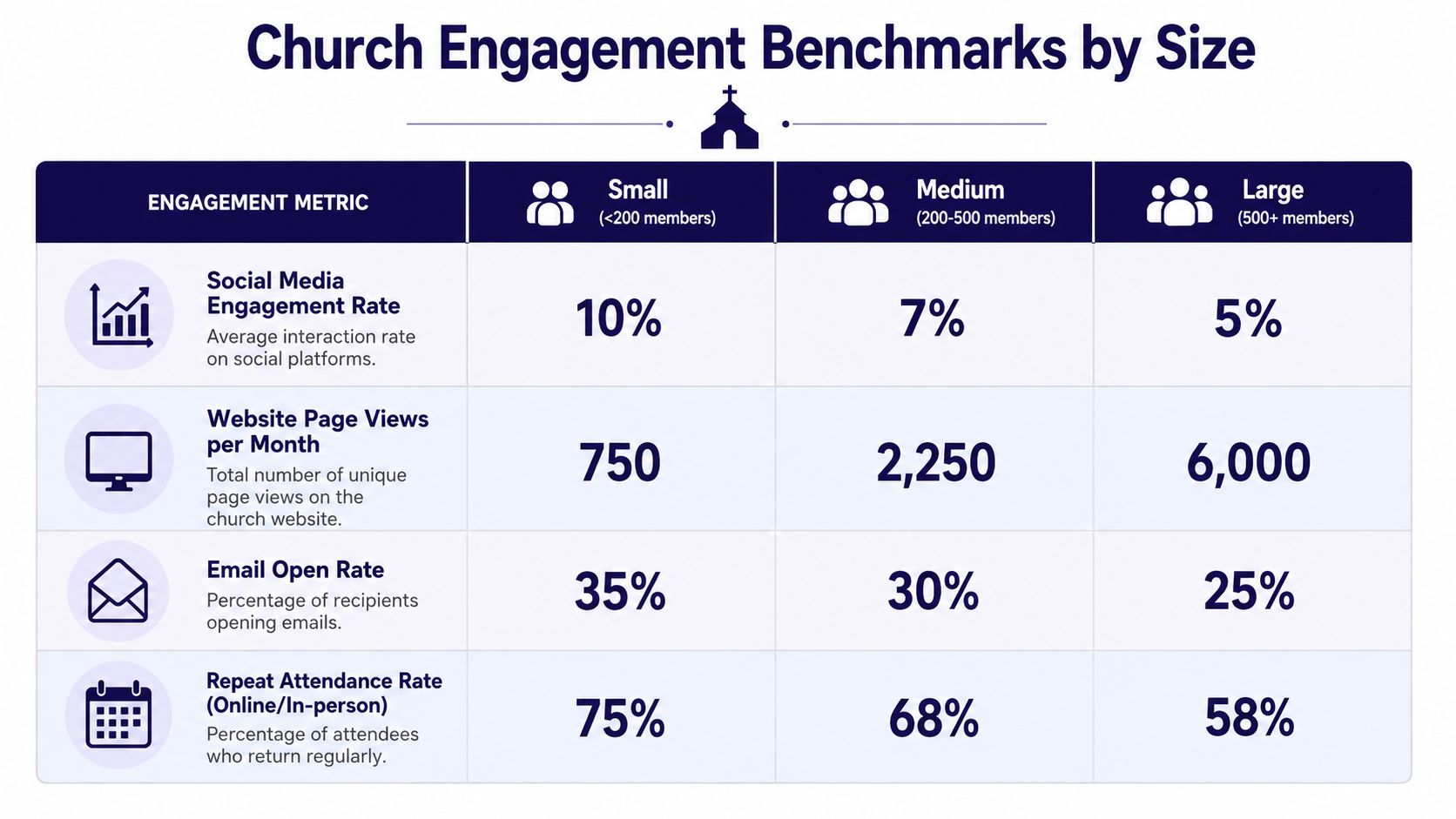
The hardest benchmark question isn't "What's possible?" It's "What's realistic for a church like ours?"
A small church with one volunteer shouldn't compare itself to a large multi-site team with a dedicated communications staff. Platform choice, content capacity, congregation habits, and local context all shape what good performance looks like.
Use platform benchmarks carefully
Platform averages can still give you a useful frame. Engagement rates vary by platform, with Facebook averaging about 5% to 6%, Instagram about 5%, and X about 1% to 2%, which makes platform selection a strategic decision for churches trying to maximize interaction (church social engagement platform comparison).
That doesn't mean your church must be on every platform. It means you should choose channels where your people respond.
A realistic way to benchmark by church size
Use church size as context, not as a verdict. Here's a practical way to think about it.
| Church size | Healthy focus | What to watch most closely |
|---|---|---|
| Small church | Conversation and consistency | Comments, DMs, shares, repeat participation |
| Mid-sized church | Systematic follow-up | Event clicks, sign-ups, volunteer interest, retention |
| Large church | Audience segmentation and pastoral pathways | Returning engagement, response by ministry area, next-step conversion |
A smaller church often has an advantage in relational depth. If people know each other offline, online comments and shares can feel more personal and more meaningful. Mid-sized churches usually need better systems so that growing attention doesn't slip through the cracks. Larger churches often need cleaner segmentation so they can tell whether young families, students, volunteers, or first-time guests are engaging.
Benchmarks should guide goals, not shame teams
Set goals that match your ministry season.
- If you're rebuilding consistency, aim for a stable posting rhythm and stronger response quality.
- If you're promoting events, watch clicks, registrations, and direct questions.
- If you're trying to deepen community, focus on recurring interaction and retention signals.
If your team needs help choosing the right reporting setup, this guide to social media analytics tools for churches can help you compare what belongs in a church workflow versus a general business stack.
The healthiest benchmark is the one that helps your team improve next month without making them feel like they're failing this month.
Proven Strategies to Boost Your Engagement
Most churches don't have an engagement problem as much as they have a content mix problem. They post what needs announcing, but not enough that invites response.
That can change quickly when the strategy gets simpler.
Fix the ratio first
The most useful adjustment for many church accounts is this: the optimal posting ratio is 2 to 3 connection-focused posts for every 1 promotional post, and churches posting 3 to 4 times per week on 1 to 2 platforms tend to see the most sustainable and effective engagement (church content ratio and posting frequency guidance).
Connection-focused posts include questions, testimonies, behind-the-scenes moments, prayer prompts, volunteer highlights, sermon takeaways, and stories about people being served. Promotional posts include service times, event reminders, registration pushes, and campaign asks.
If your feed is mostly announcements, people learn to scroll past you.
Turn sermons into conversation starters
Sunday's sermon is usually the richest content source your church already has. Don't treat it like a one-time event.
You can repurpose the message into:
- Short reels built from sermon moments that stand on their own
- Carousel posts with one idea, one Scripture, and one application point
- Discussion prompts pulled from the transcript
- Blog recaps for people who need the teaching in written form
- Prayer-oriented captions that invite direct response
This approach works because sermon-based content carries the voice of your church. It doesn't feel generic. It feels rooted.
Reduce design friction
A lot of inconsistency comes from one hidden issue. The team doesn't have time to design from scratch.
Templates solve that. When your graphics, carousels, and event posts start from a ready-made structure, you can spend your energy on message clarity instead of blank-canvas stress. Keep visuals clean. For church content, non-people imagery often works well for graphics, especially when the focus is Scripture, event information, sermon themes, or ministry prompts. If text appears in an image, it should feel intentional, like text on paper, a screen, or a proper overlay.
Build around the calendar you already have
A smart church social plan usually follows ministry rhythms that already exist:
- Weekend services
- Midweek ministries
- Seasonal events
- Volunteer moments
- Community care opportunities
When your social calendar reflects the church calendar, your content gets easier to plan and easier to measure. Event-related posts can tie directly to RSVP patterns. Sermon content can tie directly to comments, shares, and pastoral follow-up. Volunteer spotlights can tie directly to service interest.
For teams that want a practical framework for this, community engagement best practices for churches gives a helpful way to organize content around ministry outcomes rather than random posting.
Test one variable at a time
Church teams often try to improve everything at once. That's why they don't learn much.
Instead, test one variable:
- Post the same sermon idea as a reel one week and a carousel the next.
- Ask a direct question in one caption and a reflective prompt in another.
- Share a ministry story with a strong first sentence, then compare it to a graphic-heavy event announcement.
- Try posting at a different time for the same audience segment.
Keep the experiments small enough to repeat. The goal isn't novelty. It's clarity.
If a post format consistently produces comments, prayer requests, or shares, keep using it even if it isn't the trendiest thing on the platform.
Beyond the Numbers Measuring Trust and Spiritual Growth
Churches should be careful not to confuse measurable activity with meaningful discipleship. Some of the most important signs of health won't fit neatly into a dashboard.
A 2025 report noted that traditional metrics often miss the full impact of community building and that true engagement is better understood through indicators like trust and power-sharing, which are often absent from standard dashboards (trust and power-sharing in community measurement).
What trust looks like online
Trust often shows up as behavior before it shows up as a metric.
- A person moves from public comments to a private prayer request
- A member answers someone else's question before staff gets there
- People share vulnerable responses instead of surface reactions
- Volunteers start contributing ideas, not just consuming posts
- Online conversations lead to offline prayer, care, service, or attendance
Those moments matter because they reveal relational depth.
Add a qualitative review to your monthly process
Alongside your numbers, keep a short ministry log. At the end of each month, note:
| Qualitative signal | What to look for |
|---|---|
| Trust | More honest messages, prayer requests, and follow-up conversations |
| Shared ownership | Members initiating discussion or inviting others in |
| Spiritual response | Evidence that content prompted reflection, prayer, or action |
| Offline connection | Stories of someone attending, serving, or joining because of digital contact |
Church communication becomes pastoral. The numbers show patterns. The stories show meaning.
Your Next Step Toward a More Engaged Community
Healthy church communication doesn't come from posting more just to stay busy. It comes from paying attention to the right signals, adjusting your content based on what you learn, and keeping ministry outcomes in view.
The best community engagement metrics do exactly that. They help you separate noise from traction. They show whether your church is merely broadcasting or building connection. They also protect your team from wasting energy on content that looks active but doesn't move anyone toward trust, participation, or care.
That kind of clarity matters whether you're a solo volunteer running one Facebook page or a larger church managing multiple ministries across several channels. You need a workflow that connects planning, content creation, publishing, and measurement so that the data helps you make better decisions.

A church-specific system can make that process much easier. When sermon transcripts become social posts and blogs, when sermon moments become reels, when event content pulls from your calendar, and when your scheduling and reporting live in the same place, your team spends less time cobbling together tools and more time responding to people.
That also makes your metrics more useful. You're not just asking which post got attention. You're asking which ministry rhythm, sermon theme, event, or invitation built community.
If you're ready to turn scattered posting into a more intentional digital ministry, take a look at ChurchSocial.ai. It helps churches create AI-generated reels from sermons, generate social posts and blogs from sermon transcripts, build photos and carousels with templates and an editor, and manage everything in a simple drag-and-drop calendar that connects with Planning Center and other church calendars.