Your volunteer team just posted the Sunday recap, added a few hashtags, and moved on to the next task. A day later, the post barely reached anyone outside the regulars. That frustration is common in church social media, and it usually has less to do with the content itself than with how the hashtags were chosen.
Hashtags still work when they're used as discovery tools, not decoration. That matters for churches because people search for local services, ministry topics, Bible study content, youth events, and community updates in ways that are more specific than a generic tag like #church can handle. The strongest approach is simple, relevant, and tied to how each platform surfaces content.
Why Church Hashtags Matter More Than You Think
A volunteer staring at the hashtag box often reaches for the obvious tags first, then wonders why nothing changes. #SundayService, #church, and #worship feel safe, but they're usually too broad to help a local congregation stand out. That's where intentional tagging starts to matter.
The historical shift explains a lot. Hashtags began as a searchable way to organize posts, and their role has grown into a discovery system across major platforms, starting with the early use of #barcamp in the social era and later expanding into mainstream search behavior (Search Logistics on hashtag history). Today, the point isn't to collect tags, it's to connect content to the audience already looking for it.
For churches, that audience might include someone searching for youth group near me, a parent looking for holiday service times, or a newcomer following neighborhood and city-based conversations. A small set of descriptive hashtags can make a post easier to find without turning it into keyword clutter. That's also why the broader platform advice leans toward fewer, highly relevant tags rather than stuffing in every tag you can fit.
Practical rule: If a hashtag doesn't help a stranger understand your post, it probably doesn't belong there.
Church teams also do better when hashtags support a larger content system. If you're already planning posts with an algorithm-aware approach, like the guidance in ChurchSocial.ai's social media algorithm overview, hashtags become one part of a broader discovery strategy instead of a last-minute add-on. That shift is what turns a quiet post into one that reaches people beyond the pews.
How to Research and Choose Hashtags for Your Church
Good church hashtags don't start with a list, they start with listening. Open Instagram, TikTok, and Facebook search and look at what people in your city, neighborhood, and denomination are already using. Search your church's location, your campus name, and the kinds of events you post about, then pay attention to the tags that appear again and again in real conversations.
A useful way to think about this is to borrow a research-first workflow from a practical step by step hashtag research process. Start with your audience, study the tags they follow, then compare what local churches, ministries, and event organizers use. The point isn't to copy their lists. It's to notice which tags are active, specific, and still tied to the kind of content your church publishes.
For church teams, three questions keep the process honest:
- Is it relevant to this post? A tag should describe the actual content, not just the topic you wish the post had.
- Is it searchable by the people we want to reach? Local language often matters more than broad spiritual language.
- Is it specific enough to find our community? A neighborhood, ministry area, or event series usually works better than an oversized generic tag.
What to look for while you search
A church in Dallas posting about a Wednesday night Bible study might notice tags connected to the city, the neighborhood, or the age group it serves. A youth leader might find that teens respond to event-based or school-year language, while a missions team may do better with campaign-style tags that match the cause. The search bar tells you what people already understand, and that's more useful than guessing.
For a deeper look at how search and discovery shape posting behavior, the practical framework in ChurchSocial.ai's algorithm guide helps connect tag choice with broader content visibility. Once you see hashtags as audience language, not decoration, your choices get clearer fast.

Building a Strategic Hashtag Mix for Church Content
A church post usually performs better when its hashtags cover a few different discovery lanes instead of one giant bucket. The mix I recommend is built around four kinds of tags, branded, community, event-specific, and seasonal or campaign-based. That structure keeps your content recognizable without making every post look identical.
A simple mix that works across church content
A branded tag points back to your church, like #GraceCommunityChurch. A community tag anchors the post in a place or audience, like #DallasChurch or #SouthAustinMinistry. An event tag describes the actual moment, like #WednesdayBibleStudy or #ChristmasEveService. A campaign tag ties the post to a series or season, such as a retreat, Easter prep, or a sermon collection.
That mix matters because it gives each post a clearer job. A Sunday announcement needs different tags than a devotion written from a sermon transcript, and a volunteer signup post needs different language than a baptism highlight. Repeating the same block every time weakens that clarity and makes your feed feel mechanical.
For a Wednesday night Bible study, a church could use #GraceCommunityChurch, #WednesdayBibleStudy, and a local tag tied to the city or neighborhood. For a Christmas announcement, a church might lean on a branded seasonal tag and a service-specific tag that tells people exactly what they're being invited to. For a devotional clip, a content-based tag like #DailyDevotion can work better than a generic church tag alone.
Good hashtag mix rule: one branded tag, one local or community tag, and one or two content-specific tags is usually enough to give a post direction without clutter.
Church teams that also create community-centered visual content often benefit from the same logic used in community building for film success, where audience fit matters more than broad visibility. The lesson transfers well to ministry communication. The tighter the match between tag and message, the better the post serves the people you want to reach.
Platform-Specific Hashtag Best Practices for Churches
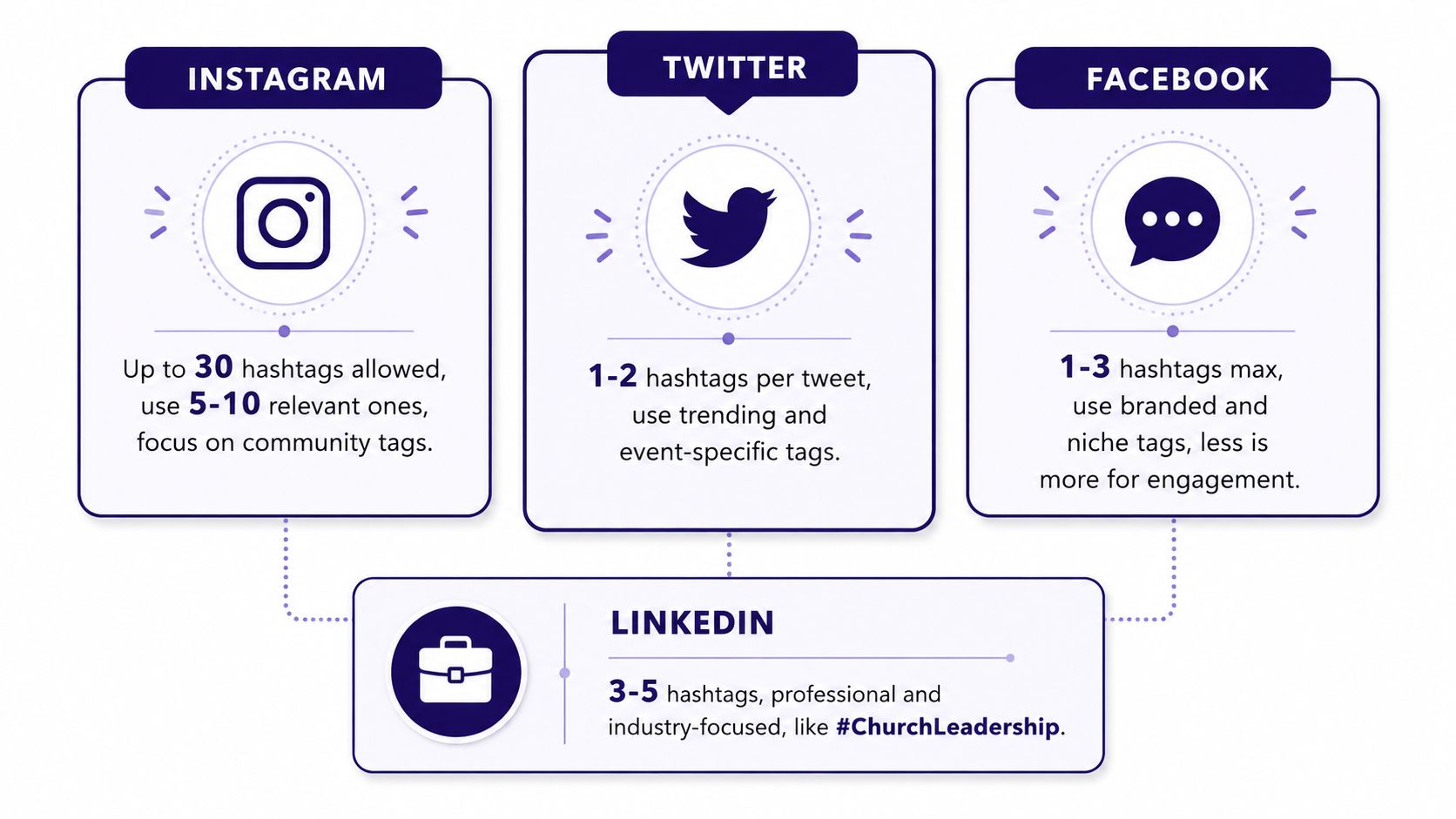
Church teams lose a lot of reach by treating every platform the same. Instagram, TikTok, Facebook, YouTube, and LinkedIn all reward different behavior, and hashtag count is only part of the picture. The practical rule is to keep the set small and make the tags fit the platform's culture.
What each platform actually wants
On Instagram, the evidence supports 1–3 tags as the best range across platforms, even though the U.S. Chamber of Commerce suggests 3–5 for Instagram and similar counts for TikTok, LinkedIn, and YouTube (Buffer's hashtag guidance, U.S. Chamber on hashtag counts). For small Instagram accounts, hashtags in the caption can boost reach by 36% (Cropink's Instagram hashtag statistics). That makes caption placement the safer default for small church accounts trying to be discovered by new people.
TikTok works best with a small, focused mix that matches the video's actual topic. Churches posting sermon clips or event promos should keep the tags tight and relevant, not broad and repetitive. For a focused TikTok workflow, ChurchSocial.ai's TikTok hashtag guide is useful because it aligns tag sets with content categories instead of pushing a one-size-fits-all block.
Facebook is different. It tends to work better with just 1–2 relevant hashtags, and the U.S. Chamber recommends a similarly restrained approach there (U.S. Chamber on hashtags). On YouTube, hashtags function more like metadata, so a few precise tags can help with search without crowding the title or description.
LinkedIn is the most professional of the group, so church leadership posts, staff updates, and nonprofit partnership content should stay specific and modest. Microsoft's LinkedIn guidance says hashtags add context, not a way to game reach, and recommends 1–3 relevant hashtags (U.S. Chamber on hashtags). The bottom line is consistent, more tags usually doesn't mean more visibility.
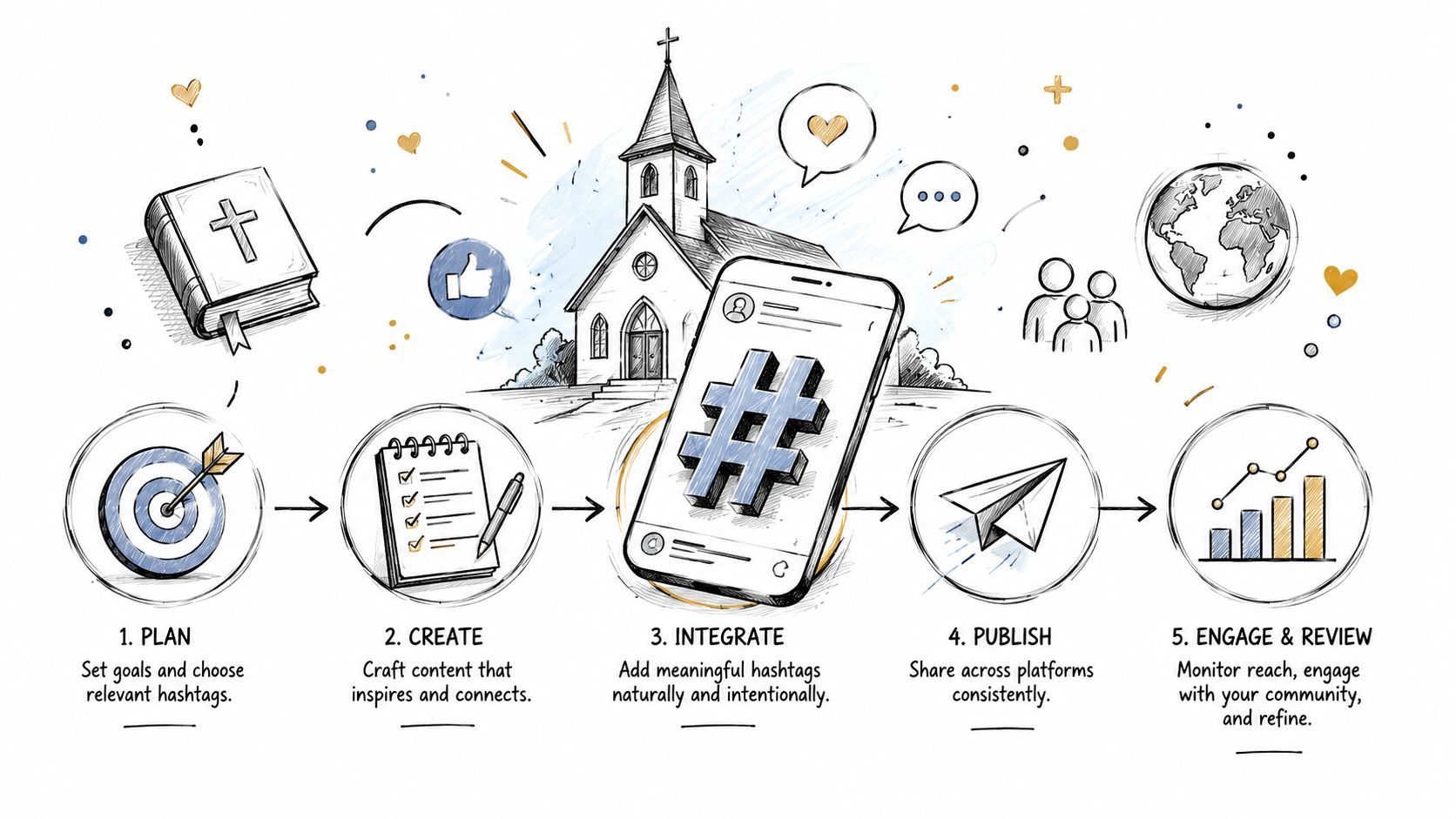
Integrating Hashtags Into Church Social Media Workflows
Hashtags become much easier when your team stops rebuilding them from scratch every time. The most reliable church workflow is to create reusable hashtag sets by content type, then store them where the whole team can find them fast. That keeps volunteers from improvising under pressure, especially on event-heavy weeks.
ChurchSocial.ai fits that kind of workflow because it combines a visual calendar, content planning, sermon-to-post tools, and integrations with Planning Center and other church calendars. In practice, that means your team can pair a post with the right hashtag set while they're building content for Sunday announcements, sermon clips, devotionals, or event reminders. The same planning space also helps you keep branded, local, and campaign tags organized across the month.
A workflow that saves time
Build a small library for recurring post types. One set can support sermon clips, another can support outreach events, and another can support congregation participation posts. When a post is drafted, the team can copy the appropriate set, adjust one or two tags for the topic, and schedule it without reopening the whole research process.
The best part is consistency without repetition. A church that posts from sermon transcripts can attach the right hashtags in seconds instead of debating whether to use the same block again. That matters because the job of the hashtag set is to match the post's purpose, not to feel clever.
A reusable hashtag library helps volunteers stay consistent even when they're posting on different days, from different devices, and with different levels of experience.
If your team already tracks church content in a calendar, planning and tagging should meet there. A post tied to an event in Planning Center should already have a matching content type, which makes the right hashtag set easier to choose. The less your team has to think about formatting, the more energy they can spend on writing something people want to read.
Measuring Hashtag Performance and Iterating Your Strategy
A hashtag set only earns its place if it helps real people find and engage with your content. That's why the numbers that matter most are the ones tied to behavior, not vanity. Look at reach, impressions, profile visits, saves, comments, and clicks inside the native analytics for Instagram, TikTok, Facebook, and YouTube.
The cleanest approach is to test small changes. Rotate one or two tags at a time, keep the post theme similar, and log which set performs better for the goal you care about. If one version consistently brings more saves or profile visits, that tells you the tags are doing useful discovery work. If the post gets views but no meaningful engagement, the tags may be too broad or too disconnected from the content.
How to review results without overcomplicating it
Use a simple note system or spreadsheet and record the post type, hashtag set, and key results. For churches, this often reveals patterns by content category, not just by platform. Sermon clips might respond to one kind of tag, while event reminders respond to another.
ChurchSocial.ai's content performance tracking guide is helpful here because it keeps the focus on measurable outcomes instead of guesswork. The point isn't to chase a perfect set forever. It's to build a repeatable habit of testing, reviewing, and trimming tags that don't help.
Measure this, not just that: a hashtag that creates impressions but no profile visits is weaker than a smaller tag set that brings a few qualified visitors.
Treat hashtags like a light experiment running alongside your content calendar. Over time, that gives your team a clearer picture of what your congregation engages with and what newcomers use to find you.
Church Hashtag Dos and Don'ts for Lasting Results
A church hashtag strategy works when it feels intentional, not recycled. Keep one branded tag consistent so people can find your posts across platforms, but build the rest of the set around the post itself. Use active, relevant tags that fit the congregation, the event, or the neighborhood you're trying to reach.
Do research tags before posting so you're not using something stale or irrelevant. Do rotate hashtag sets by content type so every post doesn't look the same. Do use ChurchSocial.ai templates and calendar planning to keep the process organized. Do check analytics often enough to see which tag groups support actual engagement.
Don't max out every post just because the platform allows it. Don't paste the same block into every caption. Don't rely on oversized generic tags like #faith or #Jesus alone, because they put your content into massive competition with posts that have nothing to do with your church. Don't ignore performance data and assume a tag is working just because it feels relevant.
A strong church hashtag strategy is less about chasing reach and more about guiding the right people toward the right post at the right time. When the tags match the message, the content becomes easier to find, easier to trust, and easier to share.
If your team wants a simpler way to plan sermon clips, event posts, graphics, and hashtag sets in one place, ChurchSocial.ai can help you organize the whole workflow. Visit ChurchSocial.ai to see how its calendar, AI content tools, and church-focused publishing features can support a more consistent social media strategy.