A prayer request board is so much more than a place to hang notes—it's the spiritual heartbeat of your church. It’s a dedicated space, whether physical or digital, where your community can share their burdens and lift each other up in prayer, making intercession a visible, active part of your church life.
The Unifying Power of a Prayer Request Board
A prayer board takes abstract needs and turns them into tangible prayer points. It’s a powerful testament to a church that truly cares.
Whether you use a simple cork board in the lobby or a digital feed on your website, you're creating a safe space for vulnerability. This simple tool can forge deep community bonds, turning passive attendees into active prayer warriors.

When you set up a prayer board, you send a clear message: Your struggles matter here, and you are not alone. This kind of organized, intentional prayer is a cornerstone of a healthy church.
Creating a Culture of Care and Connection
At its core, a prayer request board is all about cultivating an environment where people feel seen and supported. It’s a real, practical way to live out Galatians 6:2 and "Carry each other’s burdens."
- Builds Trust: Giving people a structured, safe outlet for sharing builds immense trust. They learn that their vulnerabilities will be met with prayer, not gossip.
- Fosters Empathy: Reading the requests of others helps people see beyond their own challenges. It grows empathy and compassion across the entire church body.
- Encourages Participation: A visible board is a constant reminder that prayer is a shared responsibility, not just a job for the pastoral staff. It’s an open invitation for everyone to get involved.
This culture of prayer can even extend beyond your church walls. Using tools like church signs encouraging prayer reinforces the message that prayer is central to who you are as a church.
A well-managed prayer request board is a visual representation of a church's health. It shows that people feel safe enough to be vulnerable and that the community is committed enough to pray.
Streamlining Prayer With Modern Tools
As your church and your prayer ministry grow, managing all those requests requires a solid system. This is where a platform like ChurchSocial.ai can make a huge difference, helping you bring the power of your prayer board to your online community consistently and beautifully.
Imagine easily creating a graphic for a praise report to share on Instagram or scheduling a Facebook post reminding your followers to visit the prayer board. ChurchSocial.ai is designed to help churches plan and manage their social media accounts.
You can use its graphic templates to create anonymous prayer posts or turn a sermon on intercession into engaging social media content. Our simple drag-and-drop calendar allows your church to easily manage and update all of its social media accounts. For more ideas, check out our guide on how to build your church online community.
Choosing the Right Prayer Board for Your Church
So, you’re ready to create a space for prayer requests. The first big question is: do you go with a classic bulletin board in the church lobby, or do you take it online?
This isn’t just a tech question; it's about knowing your people. What works best for your congregation’s culture and habits? The right choice will make it feel natural and easy for people to both share their needs and lift others up in prayer.
A physical board—think corkboard or a whiteboard in a busy hallway—has a powerful, tangible presence. It’s a constant, visible reminder that your church is built on prayer. Best of all, it’s simple. Anyone, regardless of their comfort with technology, can participate.
There's something deeply personal about writing a request by hand and pinning it to a board. It's a quiet act of faith that others can then physically see and rally around.
Physical vs Digital Prayer Board Comparison
Deciding between a physical and a digital prayer board involves weighing the unique benefits and challenges of each. One prioritizes tangible community connection, while the other offers broad accessibility. This table breaks down the key factors to help you determine the best fit for your church’s specific needs.
Ultimately, neither option is universally "better"—the best choice is the one that removes barriers and encourages more prayer within your specific community.
Digital Prayer Boards for Broader Reach
On the other hand, a digital prayer board can blow the doors wide open on accessibility. This could be a dedicated form on your website, a private Facebook group, or even a specialized app. It’s the perfect way to include members who are sick, traveling, or can’t make it to the building.
With a digital system, prayer requests can go out instantly to a wide network of people ready to pray. As you look into digital platforms, checking out an alternative to Kudoboard or other specialized tools can help you find one that fits your church's budget and goals.
A digital prayer board ensures your ministry’s reach isn't limited by your building's physical walls. It empowers your entire congregation to participate in intercession anytime, anywhere, fostering a 24/7 culture of prayer.
Finding the Perfect Hybrid Approach
Here's a thought: you don't have to choose. A hybrid model often gives you the best of both worlds, blending the personal touch of a physical board with the incredible reach of a digital one.
This is a great way to make sure you’re serving everyone in your congregation.
Here’s a practical look at how a hybrid system could work:
- One Central Inbox: Use a simple online form (like a Google Form or a form on your website) as the main way to collect all prayer requests. This makes moderation and privacy management so much easier from the get-go.
- Display in the Building: Have a volunteer write approved, anonymized requests on cards and post them to the physical board in your church.
- Share It Online: At the same time, take those same submissions and post them to your digital channels—your private Facebook group, email newsletter, or prayer app.
This integrated approach means that whether someone is standing in the lobby after service or scrolling through their phone at home, they are connected to the prayer needs of their church family.
Tools like ChurchSocial.ai can make this hybrid model feel almost effortless. You can manage incoming digital requests and then use our graphic templates and editor to quickly design beautiful, anonymous prayer graphics for social media. With a simple drag-and-drop calendar, your church can easily schedule everything out, ensuring a consistent stream of prayer needs and praises goes out to your community online. It’s maximum impact with minimal admin headaches.
How to Launch Your Prayer Board Effectively
Launching your church's prayer board is about more than just putting up a corkboard or flipping a switch on a webpage. A successful launch builds trust from the very first day. You're creating a sacred space where people feel safe enough to be vulnerable, and that requires a thoughtful, complete plan that protects your congregation while encouraging support.
Before your board ever sees its first request, you need to have your ground rules in place. This means simple, clear guidelines for both privacy and moderation.
This flowchart can help you think through the process, whether you're leaning toward a physical board or a digital one.
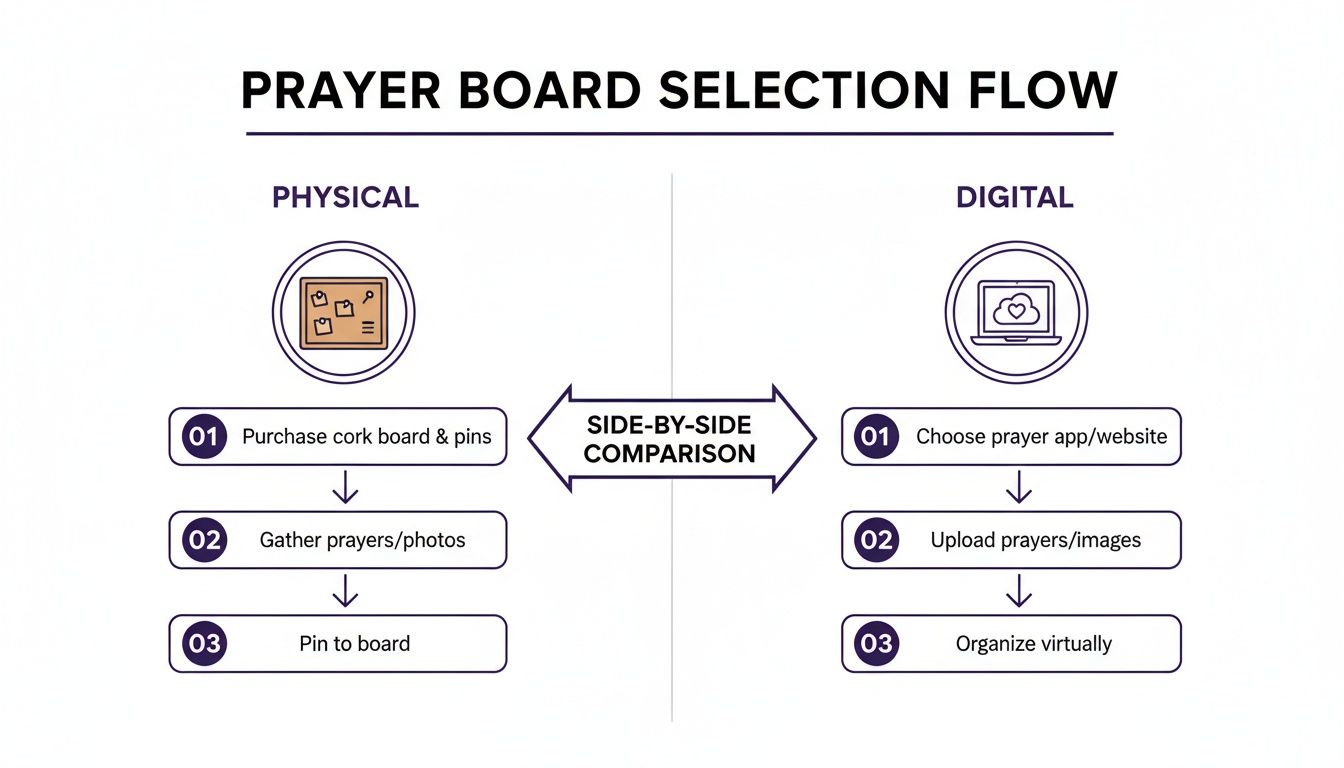
As you can see, both paths require a solid process that takes a request from submission all the way to its final, prayer-covered display.
Establishing Clear Policies and Guidelines
Your privacy and moderation policies are the bedrock of a trustworthy prayer ministry. Think of them less as legalistic rules and more as a promise to your church family—a promise that their vulnerability will be handled with incredible care and pastoral discretion. Asking for help is hard, and many people carry a sense of shame around their deepest needs. Your process should honor that by creating a safe pathway for them.
Make sure your submission guidelines are incredibly easy to find and understand. Here are a few key points to cover:
- Anonymity: Be explicit about how you'll protect someone's identity. Something as simple as, "We will only use first names or post requests anonymously, whichever you prefer," goes a long way.
- Confidentiality: Detail what happens with highly sensitive information. It’s a great practice to have a separate, private channel for these requests that goes directly to the pastoral team.
- Moderation: Let people know that a trusted leader or a small team will review every request before it's shared. This isn't about censorship; it’s about ensuring everything posted is appropriate and edifying for the whole community.
"Fear not; you will no longer live in shame. Don’t be afraid; there is no more disgrace for you." - Isaiah 54:4 (NLT). Your prayer board is a tangible way to help people step out of shame and right into the arms of a supportive community.
Building Your Volunteer Prayer Team
A ministry like this can’t rest on one person’s shoulders. A dedicated volunteer team is the engine that will keep your prayer board healthy, consistent, and effective. By defining clear roles from the start, you can prevent both confusion and burnout.
Consider creating a workflow with these key roles:
- Receivers: These are the point people who collect prayer requests from every source, whether it's an email, a website form, or a physical card dropped in a box.
- Reviewers: This should be a small, trusted group—often including a pastor—who reads each request. They'll make sure it fits the guidelines and flag anything that might need direct pastoral follow-up.
- Posters: These are the volunteers responsible for the public-facing side—either physically writing and pinning cards or formatting and publishing the digital requests.
- Archivers: To keep the prayer board current and relevant, you need team members who regularly and gently remove old requests after a set period.
Don't forget to shout about your new prayer ministry from the rooftops! A solid social media strategy can make all the difference in your launch's success. If you need a little help getting started, our guide on how to create a social media plan walks you through the entire process. It will give you the tools you need to communicate this new ministry clearly and effectively across all your channels.
Connecting Local Prayer to Global Missions
A prayer request board is a fantastic hub for what’s happening in your own backyard. But what if it could also be a window to the world? When you intentionally connect your congregation's prayers to global missions, you do more than just inform them—you help them see the vast work God is doing across continents.
This isn’t about just adding "pray for the nations" to the list. It’s about getting specific. It means sharing the real stories, the urgent needs, and the incredible victories from missionary efforts and unreached people groups. When your church family sees the faces and reads the numbers, their prayers catch fire.
Fueling a Passion for Worldwide Evangelism
You might be surprised how powerful a few key statistics can be. These aren't just cold numbers; they represent real people and urgent spiritual realities. Highlighting these facts on your prayer board, or in your digital channels, can mobilize your entire church to intercede.
Take the data from global mission organizations. The International Mission Board's 2026 Annual Statistical Report estimates that every single day, 166,338 people die without knowing Christ. The report also shows there are still over 3,100 unengaged unreached people groups with no active church-planting presence. Sharing a number like that transforms an abstract idea into an urgent, tangible prayer request. You can dig into the specifics in the full statistical report from the IMB.
A prayer board that includes global needs reminds your church that their intercession has an eternal impact far beyond their own community. It connects their personal faith to God’s global story.
Turning Statistics into Urgent Prayer Calls
The trick is to make this information feel alive, not like a dry report. You can easily do this by creating a dedicated spot on your physical board or a special category in your digital prayer space.
Here are a few ideas that work really well:
- Feature a Missionary of the Week: Post a photo (no faces if there are security concerns!), a short bio, and three specific prayer requests from a missionary family your church supports.
- Highlight an Unreached People Group: Share the name of a people group, their location, and a key statistic about their need for the Gospel.
- Share Praise Reports: Don't forget the wins! When missionaries report breakthroughs—like the 46,277 people who received discipleship in a single year—celebrate it. This builds so much faith and shows your church their prayers are making a difference.
This is where your communications team can really lean on a tool like ChurchSocial.ai. Instead of just having these stats sit in a report, you can schedule them as compelling posts for Facebook or Instagram. The AI in ChurchSocial.ai helps you write captions that turn raw numbers into heartfelt calls for prayer. Using our graphic templates, you can create eye-catching posts that grab attention and point your church’s heart toward what God is doing across the globe.
Amplify Your Prayer Ministry With Social Media
Your prayer request board is the heartbeat of your church’s prayer life, but its impact doesn’t have to stay within the four walls of your building. When you connect your prayer ministry to social media, you open the door for your entire online community to join in.
This is all about meeting people where they are—and these days, that’s on their phones. A dedicated tool built for churches can make this connection feel natural and powerful.
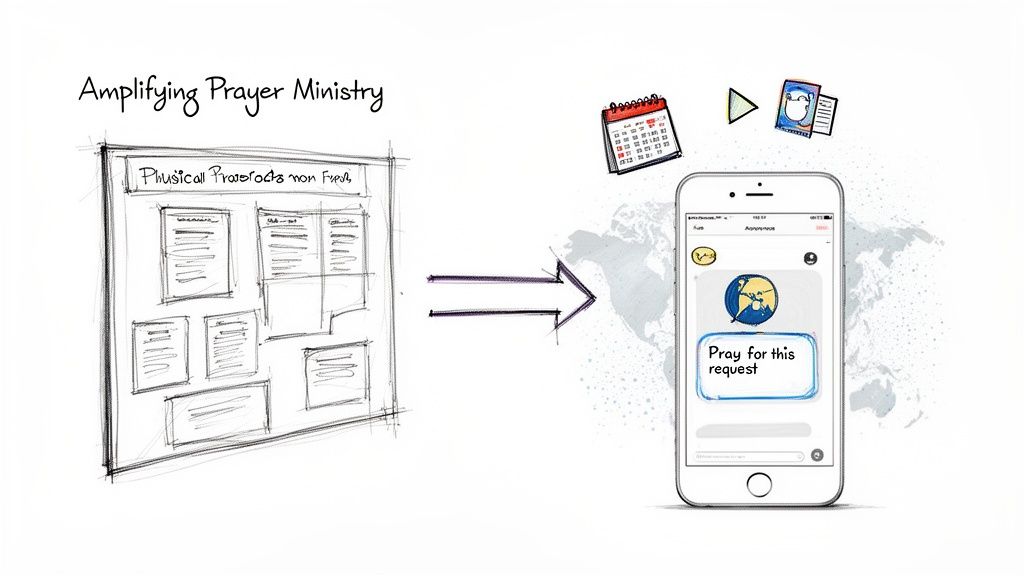
When you consistently post prayer prompts and celebrate answered prayers online, you send a clear message: prayer is a 24/7 part of your church's culture, not just something for Sunday mornings. This simple shift can re-engage people who have drifted and offer a vital connection for those who can't be there in person.
From Sermon to Social Post Seamlessly
Let's say your pastor gives a fantastic sermon on prayer, pulling from Psalm 5:3, "in the morning I will direct my prayer to you." You can keep that momentum going all week long. With a platform like ChurchSocial.ai, it’s surprisingly easy.
Just upload the sermon transcript, and its AI can generate a whole week's worth of content. Think AI-generated reels from your sermons, engaging social media posts, or short blogs encouraging people to use the prayer request board. A task that used to take hours for a church team can now be done in minutes.
This means your team isn't just posting a generic "don't forget to pray" reminder. They're sharing rich, sermon-based content that draws people into a deeper spiritual walk.
By repurposing your sermon content, you create a cohesive spiritual theme that connects your Sunday message to your congregation's daily life. This consistency shows that prayer isn't just a topic—it's a core practice of your church family.
Creating a Powerful Content Ecosystem
Keeping your church’s social media active requires a constant flow of fresh content. Manually creating graphics, writing captions, and scheduling everything can quickly burn out your staff or volunteers.
That's why having an all-in-one system is such a game-changer for churches. ChurchSocial.ai helps you build a strong content ecosystem that supports and grows your prayer ministry.
- Create Branded Graphics: Use our built-in graphic templates and editor to design beautiful, shareable photos and carousels for "Pray for this" posts. You can maintain anonymity for the requests while still looking polished and professional, with no design skills needed.
- Schedule with Ease: Our simple drag-and-drop calendar lets your church team plan and schedule all prayer-related content weeks in advance. This ensures you never miss a beat and frees up your team for actual ministry work.
- Integrate Your Calendar: ChurchSocial.ai integrates with Planning Center and other church calendars to help you automatically create content for events, like asking for prayer for a mission trip or a community outreach day.
Bringing all these functions together saves an incredible amount of time and creates a unified voice across all your platforms. For more tips on building out your strategy, check out our complete guide to social media for churches. This creates a workflow that turns social media from a chore into a powerful ministry tool, helping your church's prayer life flourish both online and off.
Building a Thriving Prayer Ministry FAQ
Once you get a prayer board up and running, you'll quickly run into some common questions. Thinking through these ahead of time will help you build a ministry that feels safe, sustainable, and truly impactful for your people.
How Do We Handle Sensitive or Confidential Prayer Requests?
Inevitably, someone will need prayer for something deeply personal. The absolute best practice here is to have a private, clearly marked channel for these requests.
This could be a dedicated pastoral-only email or a secure form on your website that routes directly to a small, trusted group of leaders. You want to make it obvious that this is the path for confidential matters.
For your public board (digital or physical), a gentle reminder goes a long way. A small note like, "Please only share details you're comfortable with the whole church seeing," is perfect. It's also wise to have a pastor or prayer leader review every request before it goes public. This isn't just about screening for appropriateness; it’s a huge opportunity for direct pastoral care when you spot a deeper need.
How Can We Keep the Congregation Engaged Over Time?
A prayer board that feels static will quickly be ignored. The secret to keeping it alive and active is consistency.
Make a habit of weaving prayer requests and, just as importantly, praise reports into your regular church life. Mention them in sermons. Highlight an answered prayer in the weekly announcements.
When the congregation sees prayers being answered, it builds collective faith and powerfully encourages continued participation. This transforms the prayer board from a simple list of needs into a living testament of God's faithfulness.
To keep things fresh, physically tidy up a bulletin board every few weeks so it doesn't look forgotten. For online engagement, a tool like ChurchSocial.ai can be a game-changer for churches. You can schedule weekly social media reminders, share anonymized praise reports, and create simple graphics that keep prayer right in front of your online community.
What Is the Best Way to Manage Online Prayer Requests?
If you’re not careful, online requests can end up scattered across DMs, emails, and comment threads. Your church needs a single, central hub to make sure nothing gets missed.
A simple online form that feeds all submissions into one spreadsheet or a dedicated email inbox is a great place to start. It brings order to the chaos.
For an even cleaner workflow, ChurchSocial.ai helps churches manage every digital submission in one spot. You can easily organize the requests you receive and use the platform's tools to turn them into beautiful, anonymous social media posts. This ensures every single request is seen, prayed for, and managed with care.
How Do We Balance Privacy With Community Connection?
The key here is to put the person submitting the request in the driver's seat. Give them clear, simple choices right on the submission form.
These options make all the difference:
- "Share with pastoral staff only" for complete privacy.
- "Share anonymously with the church community" to protect their identity.
- "Share with my first name" for those who are comfortable being known.
When you do share requests publicly, you can build connection without oversharing. Using just a first name or a general phrase like, "A member of our church family requests prayer for healing," works beautifully. This approach respects everyone's comfort level while still calling the whole community to care for one another.
Managing a vibrant prayer ministry requires consistent communication, and ChurchSocial.ai makes it simple for churches. From creating AI-generated reels from sermons to scheduling posts that celebrate answered prayers, our platform helps you plan and manage your church's social media accounts to keep your community connected and engaged. Visit ChurchSocial.ai to see how you can save time and amplify your church's prayer life.