Let’s be real for a moment. We've all been there. The pastor is sharing a powerful, life-changing message, but all you can focus on is the screeching feedback, the muffled words, or that persistent, maddening hum. In that moment, the connection is lost.
Great sound isn't just a technical nicety—it's a ministry multiplier. It’s what ensures the message from the stage actually lands in the hearts of the people in the seats.
Why Great Church Sound Is a Ministry Multiplier
A quality sound system is the invisible foundation for a powerful worship experience. It’s not about making things painfully loud; it's about delivering the message and music with absolute clarity. When the audio is clear and balanced, the distractions melt away. The congregation isn’t fighting to understand the sermon or straining to hear the worship leader. They’re simply able to receive.
This isn't some new-fangled idea, either. Churches have always been innovators in communication. In fact, many congregations were pioneering the use of professional sound reinforcement back in the late 1940s and early 1950s, long before it was standard in most public venues. You can read more about the early history of church sound technology and its impact on worship.
To put it simply, your sound system has a job to do. It's about much more than just volume.
Here's a quick look at what a modern system should be accomplishing for your ministry.
What a Modern Church Sound System Should Achieve
| Objective | Description |
|---|---|
| Clarity | Ensures every word of the sermon and every lyric of a song is perfectly intelligible, from the front row to the back. |
| Connection | Creates an immersive environment where the congregation feels connected to the worship and the message, not distracted by poor audio. |
| Consistency | Delivers a balanced, even sound to every seat in the room, eliminating "dead spots" or overly loud areas. |
| Content Creation | Provides a clean, high-quality audio source that can be recorded for podcasts, live streams, and social media content. |
Getting this right is the first, most crucial step. Once you have that clean, clear audio, you’ve unlocked a powerful resource to connect with people well beyond Sunday morning.
From Sunday Service to All-Week Engagement
A modern sound system does more than serve the people in the room. It’s the starting point for your entire digital outreach strategy. The moment you capture clear audio, you've created a powerful asset.
A great sound setup is basically a content creation engine waiting to be switched on.
- It captures a perfect sermon recording. A clean audio feed straight from your mixer gives you a pristine recording, totally free from room noise, coughing, or other distractions.
- It creates the raw material for your community. This high-quality audio file is the foundation for creating content that engages your church all week long.
- It engages people far beyond your walls. Your message can now reach those who were out of town, home sick, exploring faith, or connecting with your church online.
Investing in your sound system is an investment in the clarity and reach of your ministry. Once you have that clean audio, you've unlocked a powerful resource to connect with people anytime, anywhere.
Multiply Your Ministry with ChurchSocial.ai
So you have that perfect sermon recording… now what? Too often, it just sits on a hard drive, its potential wasted. This is where a tool like ChurchSocial.ai can transform your audio investment into real, ongoing engagement.
Instead of adding hours of work for your team, our platform puts that sermon file to work for you. With that one clean audio file, you can:
- Generate AI Reels: Automatically pull the most powerful moments from the sermon and create short, compelling AI generated reels for social media.
- Create Shareable Graphics: Turn impactful quotes into beautiful, shareable graphics using our easy-to-use graphic templates and editor.
- Produce Blog and Social Posts: Let our AI instantly transcribe the sermon and create AI generated content like social posts, blogs, and more.
By pairing your sound system with a platform like ChurchSocial.ai, you build a seamless workflow. You can easily manage and update all your social media with our simple drag and drop calendar. You turn one Sunday sermon into a full week of inspiring content that keeps your community connected, without overwhelming your staff or volunteers.
Breaking Down Your Church Sound System Components
Walking up to the sound desk for the first time can be intimidating. All those wires, knobs, and blinking lights can feel overwhelming. But at its heart, a sound system is just a chain of a few key pieces working together to deliver a clear message. Let's pull back the curtain on the essential building blocks.
Think about it like someone speaking. The thought is the message, the vocal cords create the sound, and the mouth projects it. A sound system works in almost the exact same way.
Microphones: The Ears of Your System
Everything starts with a microphone. Mics are the "ears" of your entire system, capturing sound waves and turning them into an electrical signal. And just like you have different tools for different jobs, you have different mics for specific tasks.
- Dynamic Microphones: These are the rugged workhorses of live sound. They can handle loud volumes without a problem, which makes them perfect for vocals or putting in front of an instrument amplifier. The Shure SM58 is a classic you’ve probably seen on countless stages.
- Condenser Microphones: These mics are much more sensitive, built to capture fine detail and nuance. They’re what you want for a choir, an acoustic guitar, a piano, or as overheads for a drum kit. They do need a bit of power to work, which is called "phantom power" and usually comes from the mixer.
- Lavalier (Lapel) Microphones: These are the small, clip-on mics you see on pastors and speakers. They’re fantastic for hands-free speaking and keep the sound level consistent, even when the speaker moves around. Every word gets picked up cleanly.
Choosing the right microphone is your first, most critical step toward clarity. A lapel mic on the pastor stops the audio from sounding muffled and distant, while a couple of well-placed condenser mics can make the choir sound absolutely heavenly. This initial sound quality is non-negotiable, especially if you plan on using the audio for anything else later on.
The Mixing Console: The Brain of the Operation
If mics are the ears, then the mixing console—or "soundboard"—is the brain. This is command central. Every audio signal from every single microphone and instrument comes here first. Your sound tech uses the mixer to balance levels, shape the tone (EQ), and blend all the parts into one cohesive, pleasant sound.
A sound tech is like an orchestra conductor. They use the mixer to make sure no single instrument or voice overpowers the others, creating a balanced mix where everything has its own space to be heard.
Modern digital mixers are a massive gift to volunteer-run teams. They let you save all your settings as "scenes" or "snapshots." This means you can get the perfect mix for the sermon, the full worship band, or a quiet acoustic song and recall it instantly. That kind of consistency is a game-changer for churches, guaranteeing a great experience every Sunday, no matter who's at the controls. Beyond just mics and speakers, a modern setup also relies on digital audio networks and reliable data connectivity to function smoothly.
Amplifiers and Loudspeakers: The Muscle and the Mouth
Once the brain (mixer) has everything balanced, it sends that finished mix to the amplifier. You can think of the amp as the "muscle." It takes that small, low-level signal from the mixer and gives it a huge boost of power—enough to drive the loudspeakers.
Finally, the loudspeakers are the "mouth." They take that powerful electrical signal from the amp and turn it back into the sound waves your congregation hears. The quality, type, and placement of your speakers are what determine if everyone in the sanctuary gets the same clear, even sound.
This next chart shows how getting these audio fundamentals right is the very foundation for multiplying your ministry's reach.
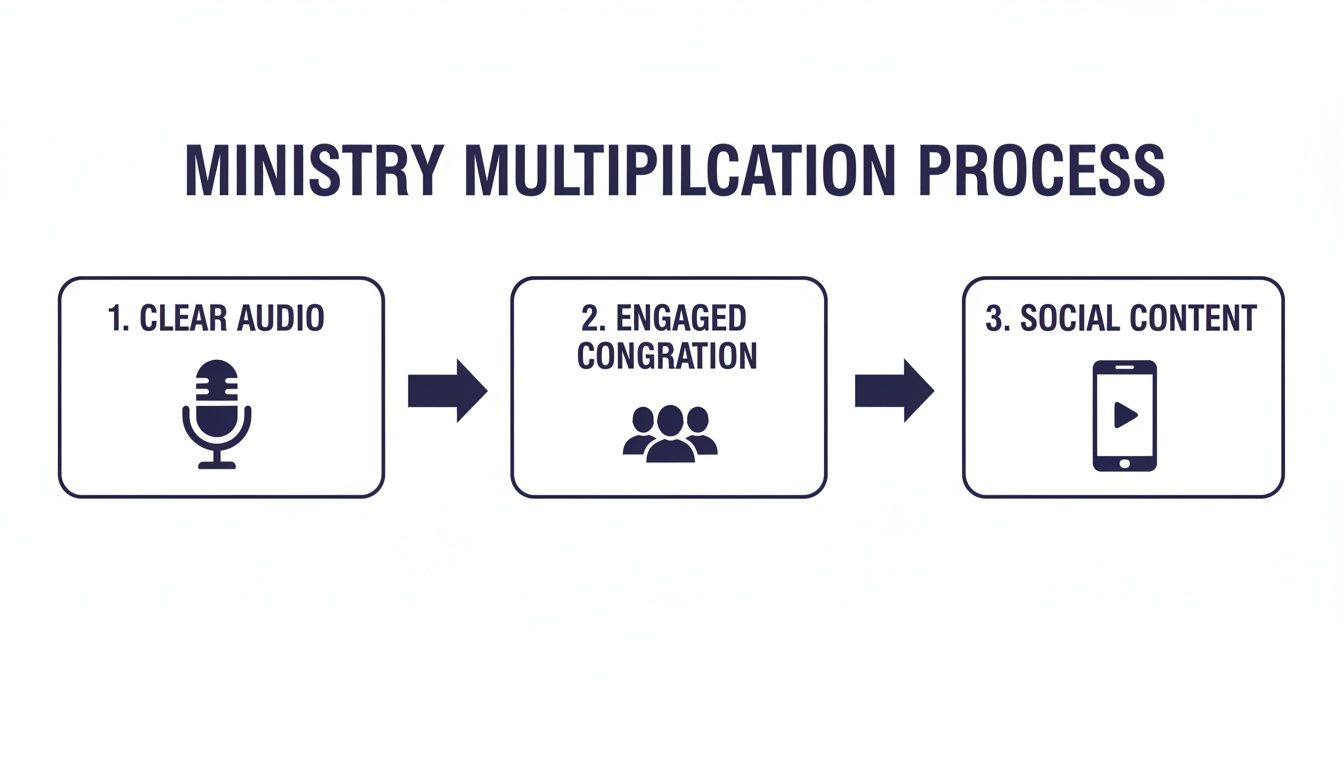
The process is simple: great audio leads to an engaged congregation. That engagement, captured as a clean audio feed, becomes the raw material for compelling social content that extends your message all week long.
Once you have that pristine sermon audio, you can use ChurchSocial.ai to automatically generate AI-powered Reels from the best moments, create shareable quote graphics and carousels, and draft blog posts. You can manage and schedule all this content from a simple drag-and-drop calendar, turning your sound system into a content creation powerhouse without overwhelming your team.
The Hidden Factor That Makes or Breaks Your Sound
Have you ever invested in good microphones, a decent mixer, and powerful speakers, only to find the sound in your sanctuary is still muddy? If the music feels chaotic and words are hard to understand, you've likely fallen into a common trap: focusing on the gear while ignoring the room itself.
Your sanctuary’s acoustics are the single most influential—and often most overlooked—factor in your sound quality. No amount of expensive equipment can truly fix a room filled with echo, harsh reflections, and dead zones.
Why Your Room Fights Your Sound System
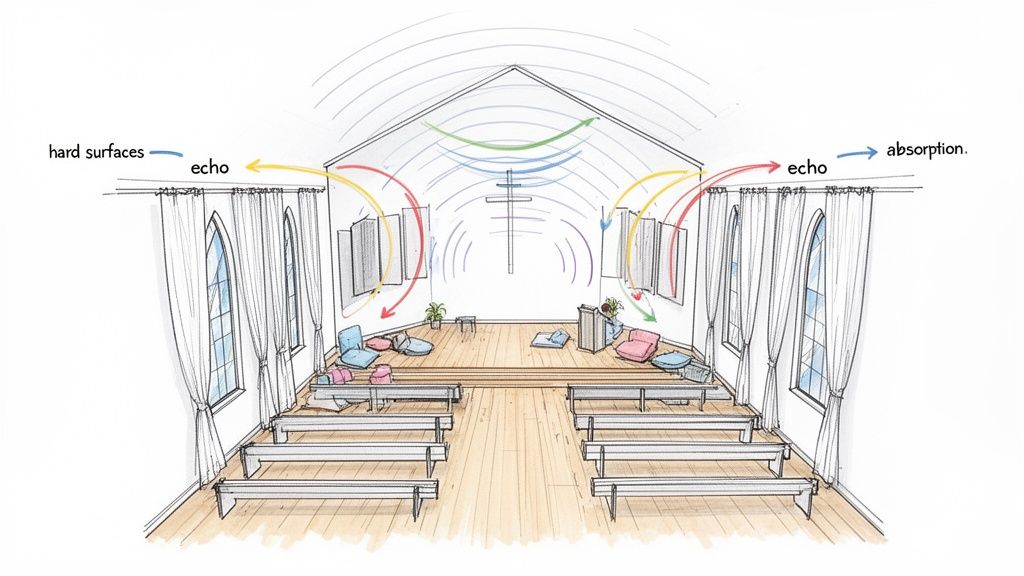
Think of your sanctuary as its own instrument. Every surface, from the soaring ceilings and stained-glass windows to the wooden pews and tile floors, plays a part. When sound leaves the speakers, it doesn’t just go straight to the congregation. It bounces off everything.
Hard Surfaces are the Enemy of Clarity: Materials like glass, plaster, hardwood, and concrete act like mirrors for sound, creating a wash of echo and reverberation that turns speech and music into mush.
High Ceilings Create Long Delays: The taller your ceiling, the longer it takes sound to travel up, reflect, and come back down. This delay blurs the original sound, making it incredibly difficult to understand spoken words.
Room Shape Matters: Oddly shaped rooms, parallel walls, and domes can create "standing waves" where bass frequencies build up unpleasantly, or "flutter echoes" that sound like a rapid, distracting slap.
This acoustic chaos often forces sound techs to turn the volume up just to be heard over the room's own noise, which ironically makes the problem worse. It’s a frustrating cycle that leads many to believe their equipment is failing them.
Many churches find themselves in a costly cycle of replacing sound equipment, believing the gear is the problem. In reality, the room’s acoustics are often the true culprit, and no new speaker can fix a fundamentally flawed sonic environment.
The Costly Cycle of Ignoring Acoustics
This is where things get expensive. Many churches end up replacing entire sound systems in churches again and again, hoping the next big purchase will finally solve the problem.
This cycle can become a huge drain on the budget. In fact, research shows the average church might buy around ten different sound systems in its lifetime, with the total cost often exceeding what it would take to make major facility improvements. By contrast, investing in proper acoustic upgrades can lead to dramatic performance improvements—often between 400% and 2500%—for a fraction of the cost. You can learn more about how acoustic treatments can break the cycle of sound system replacement and save your ministry serious money.
Practical Steps to Improve Your Room’s Sound
So, what can you actually do? The good news is you don't always need a complete, costly overhaul. Improving your room's sound can start with simple changes and scale up to professional treatments.
Here are a few steps to get started:
Add Soft Surfaces: The easiest first step is to bring in materials that absorb sound. Think carpets, rugs, upholstered chairs instead of hard pews, and even heavy curtains or banners on bare walls.
Identify Problem Areas: Have someone speak from the stage and walk around the sanctuary. Listen for spots where the sound is garbled, boomy, or faint. These are your "hot spots" that need the most attention.
Install Acoustic Panels: For more targeted control, professionally made acoustic panels are your best bet. When placed strategically on back and side walls, they absorb those damaging reflections and dramatically improve clarity for both speech and music.
Tackling your room’s acoustics first is the smartest investment you can make for your church’s sound. It stops the expensive gear-replacement cycle and makes sure your message is heard with the clarity it deserves.
Designing a System for Your Church's Unique Needs
Once you have a handle on your room’s acoustics, it’s time to design a sound system that fits your church like a glove. The single biggest mistake I see churches make is assuming a one-size-fits-all solution actually exists. A system that’s perfect for a 100-seat chapel will be a complete disaster in a 1,000-seat auditorium.
Picking the right sound systems in churches isn't about buying the most expensive gear you can find. It’s about making a smart, informed decision that serves your ministry’s unique needs. Overspending on a system your volunteers can't operate is just as bad as underspending on one that can't reach the back row with clear audio.
Start by Assessing Your Real Needs
Before you even glance at a piece of equipment, you need a crystal-clear picture of what you’re trying to achieve. Taking the time to do a thoughtful needs assessment now will save you from expensive mistakes down the road.
Start by asking a few fundamental questions:
- How large is our congregation? This number directly impacts the power and coverage your speakers need. A small church plant might do great with a simple portable PA, while a large sanctuary demands a more engineered approach.
- What is our worship style? A service with just a pastor on a lapel mic and an acoustic guitar has wildly different audio needs than one with a full rock band, drums, and a team of vocalists.
- What are our plans for growth? Are you expecting to grow? Designing your system with some headroom for expansion can prevent you from having to replace the whole thing in just a few years.
- What are our digital outreach goals? If you plan to live stream or record services, your system must be able to provide a clean, separate audio mix for online use. You can learn more about this in our guide to building a video recording system for your church.
Answering these questions honestly creates the blueprint for your entire sound system.
Matching the System to the Space
With your needs clearly defined, you can start looking at solutions built for your specific environment. A small, simple room might just need a good pair of speakers on either side of the stage. But larger or acoustically tricky spaces require a much more specialized design.
For instance, a long, narrow sanctuary with high ceilings and lots of hard surfaces is a classic audio challenge. A single, powerful speaker system up front will likely blast the people in the front rows while sounding like a muffled, echoey mess for everyone in the back.
In cases like this, a "distributed" sound system can be the perfect answer. This approach uses many smaller speakers placed throughout the sanctuary—on pillars or under balconies—to provide even, clear sound at a comfortable volume for everyone.
This idea isn't new. The development of pew-back speaker systems in the 1960s and 1970s was a major breakthrough for large, reverberant churches. By using digital delay, designers could time the sound from each small speaker to arrive at the listener's ear at the same exact moment as the sound from the stage, killing those distracting echoes. You can read more about the groundbreaking history of pew-back systems and their incredible impact.
For modern auditoriums with wide seating, a line array is now the go-to standard. These are the curved vertical stacks of speakers you see hanging beside large stages. They are expertly designed to throw sound over long distances, delivering consistent volume and clarity from the very front to the very back.
Choosing the right design is the final piece of the puzzle. It’s what ensures the message is delivered with impact and clarity, no matter where a person is sitting.
Turn Your Sermon Into a Week-Long Ministry
Your message is far too important to be confined to a single hour on Sunday morning. A great church sound system does more than just fill the room with clear audio; it gives you the power to turn your weekly sermon into a ministry that reaches people all week long. The hard work of preparing and delivering the message is already done—now it's time to extend its impact.
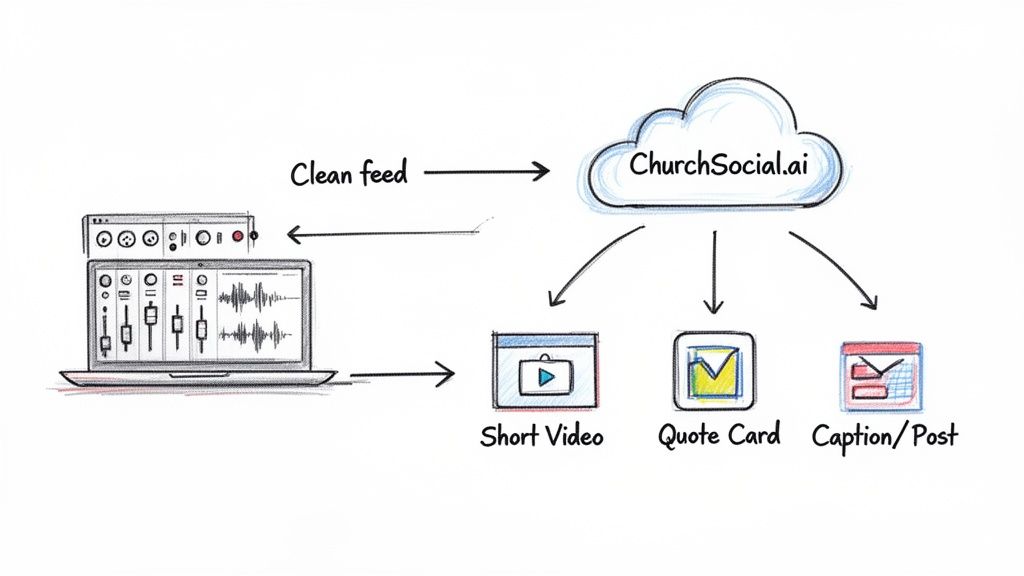
This is where your investment in high-quality audio really pays off a second time. By capturing a clean recording straight from your soundboard, you have a pristine audio file that’s ready for a much bigger purpose.
Capturing Your Core Content
The first step is crucial: you must get a clean audio recording of the sermon. This means more than just setting up a recorder in the room, which will inevitably pick up distracting coughs, chair shuffles, and room echo. What you need is a direct feed from your mixing console.
Most modern mixers have several outputs for this exact reason. You can send one mix to the main speakers for the people in the room and a completely separate, clean mix directly to a computer or recording device. This ensures your recording has only the pastor's microphone and any other intended audio, totally isolated from room noise.
A clean audio recording is the single most important asset for your digital ministry. It’s the raw material that lets you repurpose your message into dozens of formats without having to create anything from scratch.
This one audio file is the starting point. With it, you can build a powerful, automated system that keeps your church community engaged long after the Sunday service has ended.
From Sermon Audio to Social Engagement
Once you have that clean sermon file, the next challenge is figuring out how to use it without burning out your staff or volunteers. Manually sifting through a sermon for clips, designing graphics, and writing social media posts is a huge time sink. This is where the right tools can completely change the game.
ChurchSocial.ai was built specifically for this process. Our platform takes your sermon audio and transforms it into a full week of engaging content.
- Create AI-Generated Reels: Our AI finds the most powerful, shareable moments in your sermon and automatically creates AI generated reels from your sermons. These clips come complete with captions, making them perfect for grabbing attention on Instagram, TikTok, and YouTube Shorts.
- Design Beautiful Graphics: Pull out the most impactful quotes from the sermon and instantly turn them into beautiful photos and carousels. Our graphic templates and simple editor make it easy, with no design skills required.
- Generate AI Generated Content: Get a full transcript of your sermon in moments. From there, our AI can help you draft blog posts, write social media captions, or even create discussion questions for small groups.
This whole workflow is managed through a simple drag-and-drop calendar. You can plan, schedule, and post content across all your social media accounts from one central place. Exploring different ways to present your message is key, and you might be interested in our guide on how to approach getting your sermon on video for even greater reach.
By connecting your sound system to a platform like ChurchSocial.ai, you create a sustainable ministry machine. You can stop spending all your time creating content and instead become a content director, guiding an automated process that ensures your message continues to inspire and encourage people right where they are—online, every day of the week.
Solving Common Church Sound Problems
Even with the best gear and a perfectly treated room, things can still go wrong. A sudden squeal of feedback during a quiet prayer or a muffled sermon can pull everyone out of the moment. Let's walk through how to diagnose and solve the most common issues your sound team will face.
The secret is to be systematic instead of just twisting knobs and hoping for the best. When an issue keeps popping up, a methodical approach is your best friend. In more complex situations, a formal process like root cause analysis engineering is used to find the core problem, but for your team, it just means starting with the simplest fix first.
The Dreaded Squeal of Feedback
We've all heard it—that high-pitched scream or low rumble that happens when a microphone picks up its own signal from a speaker. It’s called a feedback loop, and it's easily the most disruptive problem in live sound.
Here’s your checklist to shut it down fast:
- Move the Microphone: Is a pastor or singer standing right in front of a main speaker or monitor? Often, just adding some distance between the mic and the speaker is the easiest fix.
- Lower the Volume: Before touching the main fader, try nudging down the volume for that specific microphone channel. If that doesn't work, reduce the level of that mic in the stage monitor. A small adjustment is usually all you need.
- Check Mic Position: Make sure your directional mics are pointed at the person speaking or singing, and aimed away from any monitors or main speakers.
Muffled Vocals and Inconsistent Volume
It’s incredibly frustrating for the congregation when the pastor’s voice is clear one minute and nearly gone the next. This almost always comes down to microphone technique or a simple mixer setting.
Always check the easy stuff first. Is the mic on? If it's wireless, is the battery fresh? Are the cables plugged in tight on both ends? You’d be surprised how many "big" problems are solved with these simple checks.
A regular sound check isn't just a pre-service ritual; it's preventative maintenance. It gives your team a chance to catch problems like dead batteries, bad cables, or incorrect settings before the service begins, ensuring a smooth and distraction-free worship experience.
Once you’ve ruled out the basics, look at the mixer. Find the gain knob for that channel (it might also be labeled "trim" or "sensitivity"). If the gain is set too low, the signal will sound weak and thin. If it’s too high, you'll get harshness and distortion.
A great sound check leads to a great service. But what do you do with the sermon audio afterward? ChurchSocial.ai helps you extend your message beyond Sunday. Our platform takes your sermon recording and automatically generates viral Reels, creates beautiful quote graphics in our editor, and drafts social media posts, all organized on a simple drag-and-drop calendar. You can even pull in event details by integrating with Planning Center. This transforms your sound system from a Sunday tool into a full-week ministry engine.
Frequently Asked Questions About Church Sound
Thinking about audio can definitely bring up a lot of questions. Let’s tackle some of the most common ones we hear from church leaders, with straightforward answers to help you get it right.
How Much Should a Church Sound System Cost?
This is the big one, but the honest answer is: it depends. The cost of a good sound system is tied directly to your church's unique situation—the size of your room, your style of worship, and what you want to do online.
A small, portable church might find a great starting point for $2,000 - $5,000. For a more established, mid-sized church looking at an installed setup, a budget of $15,000 - $50,000 is more realistic. Once you get into large auditoriums needing line arrays and broadcast-level gear, costs can easily jump past $100,000.
The real key is to start by figuring out your needs, not by picking a price. That’s how you avoid spending too much or, even worse, not enough.
What Is the Easiest System for Volunteers to Use?
When your sound team is made up of volunteers, simplicity is everything. Your best friend in this scenario is a modern digital mixer.
Why? Because digital mixers let you create and save presets, often called "scenes" or "snapshots." An experienced tech can come in and dial everything in perfectly—one scene for the full worship band, another for the pastor's sermon, and maybe a third for a stripped-down acoustic set.
From there, any volunteer can walk up, press a single button to recall the right scene, and get great, consistent sound every time. It removes the guesswork and stress.
How Can We Use Our Sermon Audio for More Than Just Sunday?
Your sermon audio is a huge asset that’s often left on the table after Sunday morning. The first step is getting a clean recording straight from the soundboard, without all the room noise and coughing. You can learn more about how to transcribe this video or audio to text to create a solid foundation for all your content.
Once you have that clean audio file, you can start turning it into content that serves your community all week long. This is where you see a huge return on the investment you made in your sound system.
Don't let your powerful Sunday message disappear on Monday. With the right tools, a single sermon recording can become a full week of inspiring social media content, keeping your community connected and engaged online.
With ChurchSocial.ai, you can drop in that single sermon file and automatically generate AI generated reels from your sermons, design stunning graphics and carousels with pre-made templates, and create drafts for blog posts and social media captions. Our simple drag-and-drop calendar and integrations with tools like Planning Center make it easy to manage your entire online presence, turning your sound system into a content creation engine. See how it works at https://churchsocial.ai.