You know the feeling. Someone on staff or a faithful volunteer spends part of the week making a post for Sunday, VBS, a women's study, or a food drive. The graphic looks good. The caption is thoughtful. You publish it, check back later, and almost nobody has seen it.
That can make social media feel discouraging fast.
Most churches don't have a message problem. They have a distribution problem. Social platforms don't just show every post to every follower in order. They use ranking systems that decide what each person is most likely to see first. Once you start understanding social media algorithms, the online world becomes less mysterious and much more usable for ministry.
For churches, that matters. Your congregation and your community spend time online all week long. If social media is one of the places people look for connection, information, and encouragement, then it isn't just a marketing channel. It's part of the mission field.
From Empty Pews to Engaging Posts
A lot of church leaders treat social media like a bulletin board. Post the announcement, share the event graphic, remind people once or twice, and assume the right people will see it.
That's not how platforms work anymore.
Social media acts more like a busy church lobby after service. Conversations overlap. Some people stop and engage. Others walk right by. The platform watches those interactions and starts making guesses about what each person wants to see next. If your church post sparks interest, the platform often shows it to more people. If people scroll past it, the post usually loses momentum.
Why good posts still get ignored
Churches often confuse publishing with distribution. Those aren't the same thing.
You can publish a strong post and still get weak results if:
- The format doesn't fit the platform. A square event graphic may work differently than a short video or carousel.
- The audience match is off. A post aimed at volunteers may be shown first to people who rarely engage with volunteer content.
- The early response is weak. Social platforms pay attention to how people react when a post first appears.
Social media doesn't ask, “Did this church work hard on the post?” It asks, “Will this person likely care enough to stop, watch, click, comment, or share?”
That can sound harsh, but it's also useful. It means church leaders can stop guessing and start making better decisions.
A better way to think about it
Think of the algorithm as a sorting system, not a villain.
If your church keeps posting content that helps people, answers real questions, encourages conversation, and fits the habits of each platform, the system has more reasons to keep putting that content in front of people. That shifts social media from a frustrating chore into a form of digital stewardship.
Understanding social media algorithms helps you do two things at once. You serve your current church family better, and you make it easier for new people in your area to discover your ministry.
How Social Media Algorithms Actually Work
Think of an algorithm like a helpful usher at a large church event. The usher doesn't hand every guest the exact same stack of announcements. They notice what matters to each person and guide them toward the most relevant information.
That's close to how social feeds work. They are recommender systems built to rank posts by predicted engagement rather than simple chronology. One published explanation describes Facebook's feed as an Inventory → Signals → Predictions → Score process, and another explains that Instagram may evaluate roughly 500 candidate posts before ranking a person's feed through a similar recommendation pipeline, as explained in this overview of how social media algorithms rank content and this practical breakdown of major platform recommendation systems.
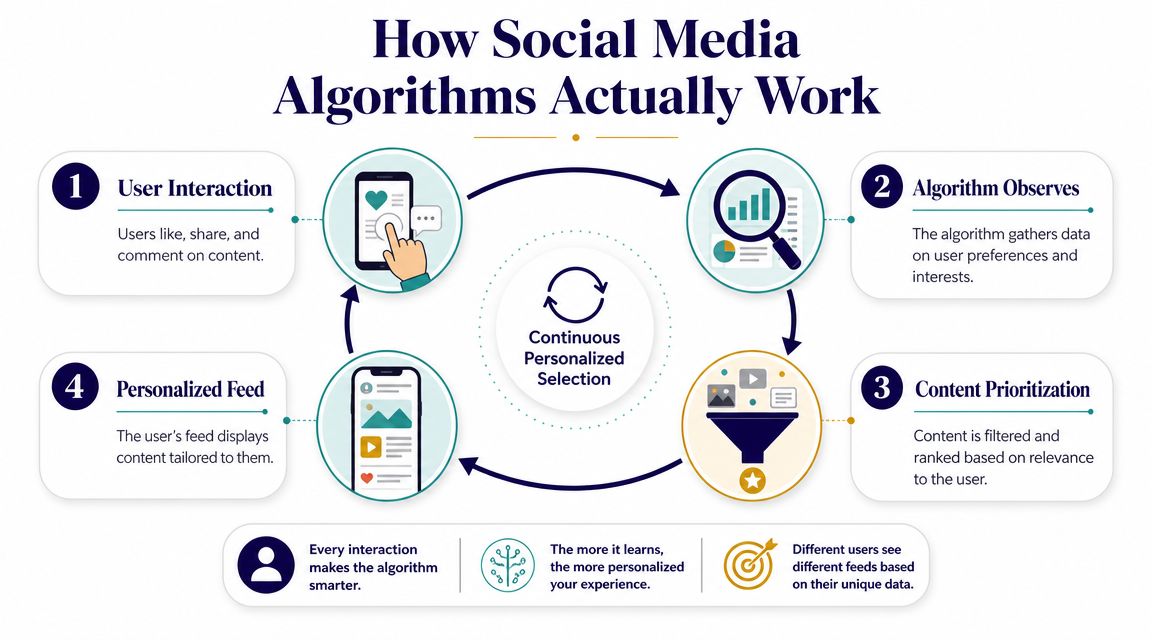
Inventory
First, the platform gathers the content that could appear for a specific person.
That might include posts from friends, followed accounts, recommended videos, local content, or material similar to what the person engaged with before. For a church page, this means your post is entering a pool of competing content, not going straight to everyone who follows you.
Signals
Next, the platform looks at clues.
These clues often include things like past interactions, content format, and topic match. If someone regularly watches short sermon clips, comments on church event posts, or saves encouraging Scripture graphics, those actions become signals.
A few examples help:
- A member who comments on prayer updates may get more of that kind of content.
- A parent who watches kids ministry recaps may see more family-oriented posts.
- A newcomer who lingers on a welcome video may be shown more introductory church content.
Predictions and score
Then the system makes predictions. It asks questions like, “Will this person stop scrolling?” “Will they watch?” “Will they comment or share?”
Those predictions become a score. Posts with stronger predicted relevance usually get better placement in the feed.
Practical rule: Your church isn't competing only on message quality. You're competing on relevance to the person seeing the post.
That's why the same post can perform well with one group and poorly with another.
What this means for church leaders
You don't need to become a machine learning expert. You do need to understand the ministry implication. Platforms reward content that fits a real audience and earns meaningful response.
For example, a sermon clip with a clear opening line may earn stronger attention than a flyer-style image. A carousel that answers “What should I expect on my first Sunday?” may be more useful to a local visitor than a generic announcement graphic.
If your team also publishes on video-first channels, it helps to separately understand YouTube algorithm for channel success, because YouTube discovery works differently from a Facebook or Instagram feed and deserves its own strategy.
Key Ranking Signals on Major Platforms
Churches often ask, “What does the algorithm want?” The better question is, “What kind of response is this platform built to reward?”
Each network has its own personality. Facebook leans into relationships and community behavior. Instagram pays close attention to how people interact with visual content. TikTok pushes discovery. YouTube behaves more like a recommendation engine mixed with search.
Social platform algorithm priorities
| Platform | Primary Goal | Key Ranking Signals | Best Content for Churches |
|---|---|---|---|
| Show people content that feels relevant to their connections and interests | Comments, shares, time spent, content that fits what a user usually engages with | Community updates, event invitations that prompt conversation, testimonies, ministry highlights | |
| Keep people engaged with visually strong content and surface-specific experiences | Past interactions, format fit, likely engagement, watch behavior on short video, swipe interest on multi-image posts | Reels from sermons, carousels with quotes or teaching points, polished event visuals | |
| TikTok | Help users discover content they'll keep watching and interacting with | Watch behavior, shares, comments, topic and format match, how well the video holds attention | Short teaching clips, behind-the-scenes ministry moments, simple answers to spiritual questions |
| YouTube | Recommend videos that match viewer interests and keep them watching | Watch behavior, topic relevance, click interest, ongoing viewing patterns | Sermon clips, testimony videos, explainer videos, livestream replays with useful titles and thumbnails |
What churches should adjust on each platform
A post that works on one platform may feel out of place on another.
On Facebook, posts often do better when they invite conversation or reflect real community life. A caption that asks for prayer requests or invites people to tag someone can fit naturally if it's genuine. If Facebook is a major channel for your church, this guide on how to increase organic reach on Facebook is useful because it focuses on organic visibility rather than paid promotion.
On Instagram, visual structure matters. Reels, carousels, and clean graphics usually give churches more room to hold attention than text-heavy images. A short sermon clip with captions can work well because it gives people a reason to pause. A carousel can also work when each slide delivers one simple thought instead of cramming a whole announcement onto one graphic.
On TikTok, churches usually do better when they stop sounding like a bulletin and start sounding like a person. Short clips that answer real questions often fit better than polished announcements.
On YouTube, long-form teaching and searchable topics matter more. A helpful title like “What does prayer look like when life feels heavy?” is often more useful than “Sunday message 11 AM.”
The platform changes. The ministry principle doesn't. Make content for real people, in the format they already expect in that space.
If your church staff also manages professional networking or nonprofit partnerships, a platform-specific resource like this comprehensive guide on LinkedIn engagement can help for audiences that behave very differently from Facebook, Instagram, TikTok, or YouTube.
Common Algorithm Myths Your Church Can Ignore
Church social media teams lose a lot of energy chasing advice that sounds smart but doesn't hold up in practice. Some myths survive because they offer the comfort of control. If you just do one tiny trick, the platform will reward you.
Most of the time, it doesn't work that way.

Myth one says frequency fixes everything
Many churches assume they need to post constantly or disappear. That belief usually creates rushed content, volunteer burnout, and a feed full of low-value announcements.
Consistency matters more than volume. If your church can sustain thoughtful, useful posts on a realistic schedule, that's far healthier than flooding every platform with content people ignore.
Myth two says you can fully train the algorithm
This one sounds attractive. Just like enough positive content, avoid the wrong content, and the feed will become exactly what you want.
The actual situation is more limited. Guidance on young people's feeds notes that many people assume they can reliably “train” or “clean” the algorithm, but evidence is mixed, and attempts to reshape recommendations through changed engagement patterns do not always work. Users have influence, but not total control, according to this youth-focused explanation of how to understand social media algorithms.
That matters for churches too. You can influence distribution through content quality and audience fit, but you can't force perfect results every time.
Myth three says low reach always means punishment
When a post underperforms, some teams jump straight to “We've been shadowbanned.”
Sometimes a post didn't connect. Maybe the opening wasn't strong. Maybe the format wasn't right for the platform. Maybe the content was important to your staff but not immediately useful to the audience seeing it.
A calmer response helps more than a conspiratorial one.
- Review the first few seconds if it was a video.
- Check whether the post was clear about who it was for.
- Look at the comments and shares, not just likes.
- Compare format choices across recent posts.
You can influence the system, but you can't command it. That's why quality beats hacks.
Church leaders usually don't need more secret tricks. They need better judgment about audience, format, and consistency.
Why Algorithms Matter for Your Ministry's Mission
If algorithms only affected marketing, this would still matter. But they shape something deeper than promotion. They shape visibility, attention, and repeated exposure.
That's important because social platforms don't just reflect behavior. They can reinforce it over time. Research on recommendation systems points to a larger concern that many explainers skip: these systems optimize for engagement metrics tied to platform and advertiser goals, and those feedback loops can amplify harms such as loneliness and anxiety, as discussed in this research article on recommendation systems, behavior, and mental health.
Why this creates a ministry opportunity
Churches can't rewrite platform incentives. But they can choose what kind of content they place into those systems.
When a church posts material that encourages prayer, hope, local connection, service opportunities, or honest biblical reflection, it offers an alternative to the noise that often dominates people's feeds. If people engage with that content because they find it helpful, the same recommendation logic that often spreads shallow material can also spread something healthier.
That doesn't make the system holy. It does make it usable.
Digital stewardship, not digital vanity
A lot of church leaders resist social media because they don't want to become performance-driven. That concern is fair.
But understanding social media algorithms doesn't require turning ministry into show business. It means learning how people discover content so your church can show up with wisdom. In practice, that looks like:
- Serving real needs with content people can use
- Reducing friction for newcomers who are deciding whether to visit
- Making church life visible to people who would never walk in cold
- Building connection during the week instead of going silent between Sundays
A church post can be more than an announcement. It can be a doorway.
For some people, their first interaction with your church won't be a handshake in the lobby. It will be a Reel, a Facebook post, or a YouTube clip that appears in a hard week. If the algorithm helps that moment happen, learning how it works becomes part of faithful outreach.
A Simple Social Media Workflow for Your Church
Most churches don't fail on social media because they lack ideas. They fail because the process is messy. Content gets created late, volunteers scramble, event details change, and every post feels like starting from zero again.
A simple workflow fixes more than most algorithm hacks ever will.

Plan the month before the scramble starts
Start with the calendar, not the caption.
Map out sermon series, events, ministry emphases, seasonal moments, and volunteer needs. When your team can see the month clearly, you stop reacting and start preparing. A church-specific planning process like the one outlined in this guide on how to create a social media plan helps teams keep content tied to ministry goals instead of random posting.
For churches using a dedicated tool, ChurchSocial.ai includes a drag-and-drop calendar and Planning Center integration so event-related content can be organized alongside weekly posts.
Build one week of content from one sermon
Many churches already create the raw material they need every Sunday.
A single sermon can become multiple pieces of content if you break it into formats that fit different platforms:
Short Reel or vertical video
Pull a clear, emotionally resonant moment from the sermon. Choose a clip that makes sense without full context.Carousel post
Turn a few teaching points, quotes, or application steps into swipeable slides.Caption-based encouragement post
Use one key takeaway and write a short reflection for Facebook or Instagram.Blog or devotional recap
Adapt the sermon transcript into a written piece for your website or email audience.
This approach saves time because you're not inventing content. You're repurposing ministry.
Design for clarity, not clutter
Churches often overload graphics with too much text, too many fonts, or every announcement at once.
A better standard is simple. One message per post. One audience in mind. One action, if an action is needed.
Try this filter before publishing:
- Can someone understand it fast?
- Would a newcomer know why it matters?
- Does the image support the message, or compete with it?
Graphics, sermon clips, and event visuals all work better when they feel native to the platform instead of copied from a bulletin insert.
Schedule, then stay available
Scheduling helps churches stay consistent. But don't confuse scheduled posting with completed ministry.
Once content goes out, someone should still watch for comments, questions, and messages. If a post invites conversation, your team needs to respond. Social media performs better when it feels social.
Strong workflow creates better ministry content because it gives your team enough margin to be thoughtful.
A healthy system usually beats a heroic last-minute effort.
Measure and Test Your Way to Greater Reach
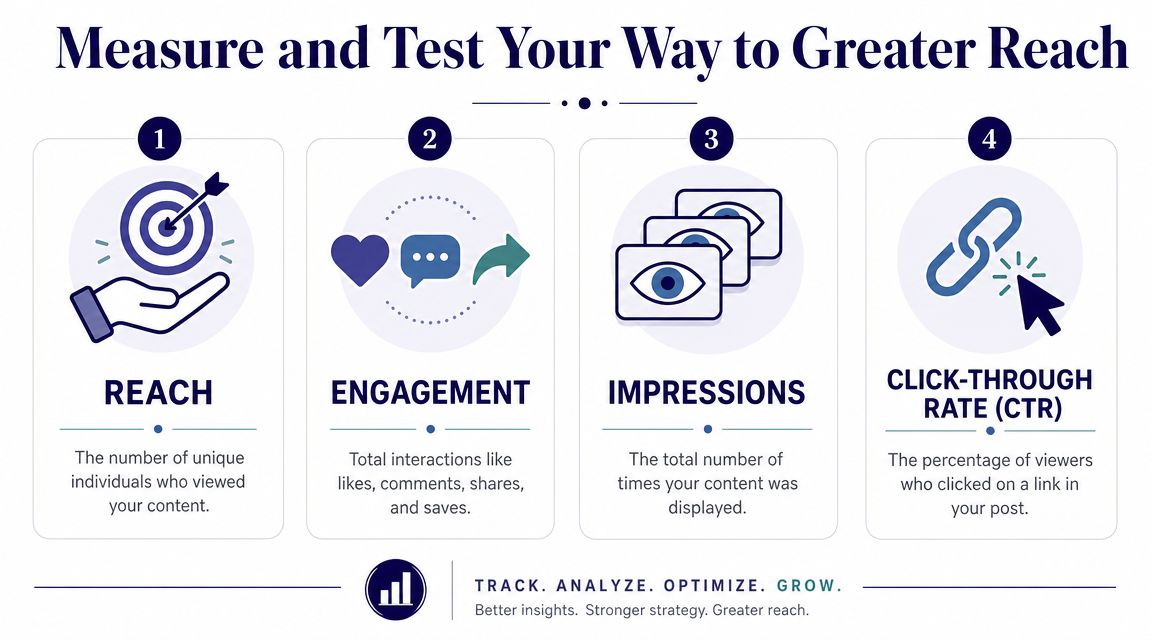
You don't need a complicated dashboard to get smarter about church social media. You need a few metrics and the willingness to test.
Look first at reach. That tells you how many unique people saw the content. Then look at engagement, which includes actions like likes, comments, shares, and saves. Impressions help you see total displays, and click-through rate matters when a post is sending people to a signup page, event registration, or your website.
Keep your testing simple
Don't test everything at once. Pick one variable.
For example:
- Compare two formats. A sermon Reel one week, a quote carousel the next.
- Change the opening line. Ask a question in one post and state a clear takeaway in another.
- Test ministry categories. Event promotion versus encouragement versus testimony.
You're not trying to impress an analytics team. You're trying to learn what your community responds to. A practical analytics process like the one described in these best social media analytics tools for churches can help teams review what worked and adjust without drowning in data.
Watch for patterns over time. If people consistently comment on testimony videos, make more of them. If event graphics get seen but not clicked, rethink the design or the call to action. Small adjustments compound.
If your church wants a simpler way to plan, repurpose, schedule, and review social content, ChurchSocial.ai brings those tasks into one workflow built for church teams. It can help turn sermons into short clips and written content, organize posts on a visual calendar, support event-based planning, and make ongoing social media management more sustainable for staff and volunteers.