Your church probably didn't set out to create confusion online.
But it happens fast. One volunteer posts a last-minute event graphic in a different style than the church usually uses. Another shares a heartfelt thought that sounds more personal than pastoral. Sunday's sermon clip never gets posted because nobody knew who was supposed to edit it. The women's ministry event goes live on Facebook, but the youth team uses Instagram Stories and never tells anyone else. Everything is done with good intentions, yet the overall effect feels scattered.
That's where a lot of churches live. They care about people, they care about the gospel, and they want their communication to serve the mission. They just don't have a simple system that helps volunteers and staff work together clearly.
If you've ever asked, what is content governance, the short answer is this: it's the set of decisions and habits that help your church communicate consistently, responsibly, and without unnecessary stress. It's less about rules for rules' sake and more about giving your team a shared way to plan, create, review, and publish content that reflects your ministry well.
Is Your Church's Social Media a Blessing or a Burden
A small church often starts social media with energy. Someone creates an Instagram account. A volunteer designs a few graphics. Another person records announcements. Then real ministry life takes over.
A funeral happens. VBS planning gets busy. The pastor forgets to send sermon notes. A volunteer moves away. Suddenly the church feed becomes a mix of old event posts, random photos, and announcements that go out too late to help anyone.
That kind of chaos usually isn't a character issue. It's a process issue.
When good people still create messy communication
Most churches don't have a formal communications department. They have a pastor, an admin, a faithful volunteer, or a college student helping when they can. That's why corporate advice often feels unhelpful. It assumes job titles, approval layers, and spare time that many churches don't have.
Research highlighted by Content Science's overview of content governance notes that 82% of enterprises feel unprepared for governance, and 65% of nonprofits report volunteer-driven content chaos with no clear role definitions. That same source points out that church and nonprofit teams often need lightweight, automated workflows that work even when nobody has a formal title.
That's a very church-shaped problem.
What the burden feels like on the ground
Here's what it often looks like in practice:
- Missed promotion: The church planned a food drive, but the reminder post went out after the collection weekend had already started.
- Mixed messaging: A volunteer writes in a playful tone on one platform, while another writes formal ministry updates somewhere else.
- No review step: Someone shares a photo that should have stayed private, or posts a statement that doesn't reflect the church's values clearly.
- Volunteer burnout: One reliable person becomes the bottleneck for every caption, graphic, and calendar update.
Churches don't need more complexity. They need a calmer way to decide who does what, what gets posted, and how to keep the message aligned with the mission.
Content governance solves that problem. Not with red tape, but with clarity. It helps your church turn social media from an ongoing scramble into a ministry tool people can trust and sustain.
Creating a Guardrail for Your Ministry's Message
Content governance sounds corporate until you put it in church language.
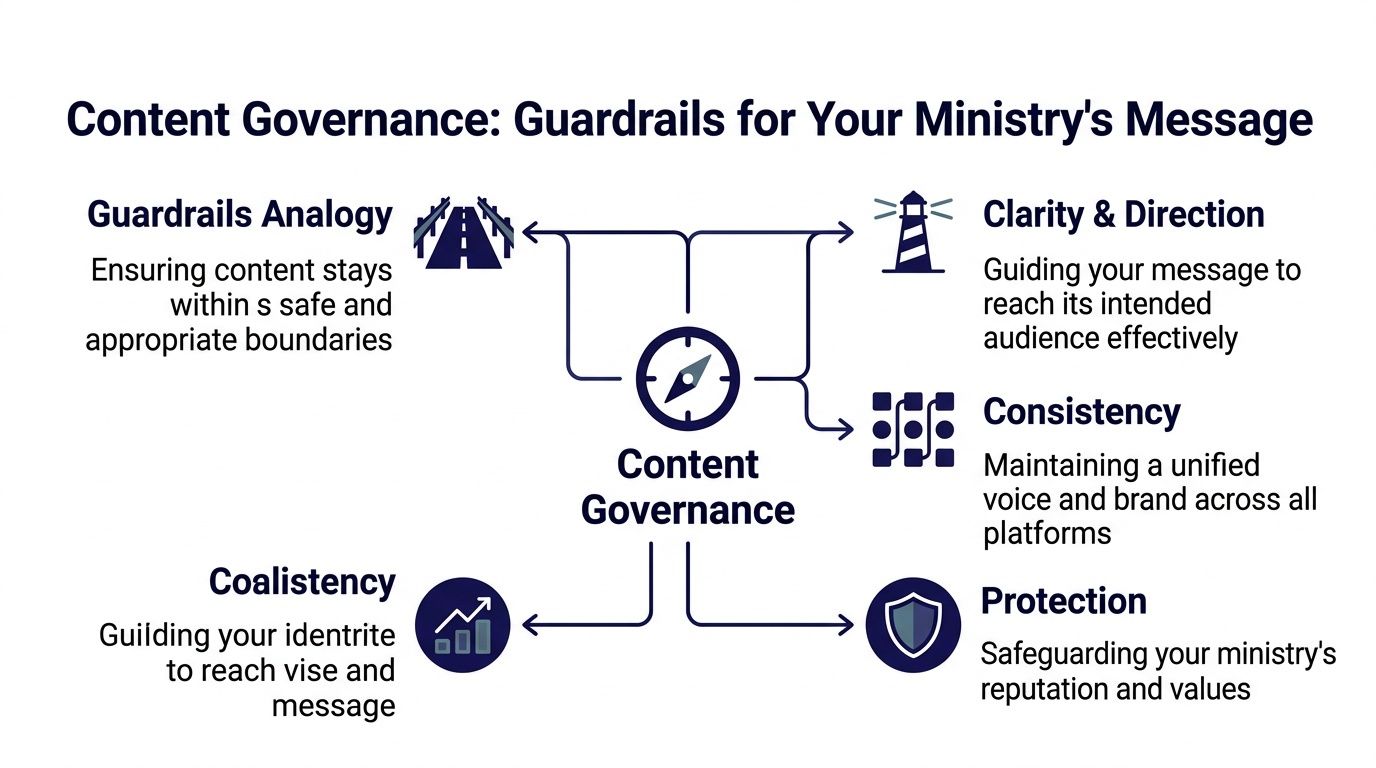
Content governance is akin to guardrails on a bridge. Guardrails don't stop the car from moving forward. They help it stay on the road and arrive safely. In the same way, content governance doesn't stop creativity. It helps your church communicate with freedom and wisdom, without sliding into confusion, inconsistency, or avoidable mistakes.
What content governance means in church life
Content governance is the foundational framework that helps your church decide:
- What should be posted
- Who can create it
- How it gets reviewed
- Where it gets published
- What standards guide it
That matters because a church doesn't just post information. It represents a ministry. Every sermon clip, event reminder, photo carousel, and caption communicates something about your church's doctrine, culture, and care for people.
If the message changes tone from week to week, people notice. If event details are unclear, guests feel it. If a post sounds sharp, careless, or too casual about something sensitive, trust can weaken quickly.
Guardrails protect both mission and volunteers
A good governance system gives volunteers confidence. Instead of guessing, they know the boundaries. They know the voice, the expectations, and the review path.
That kind of clarity helps with things like:
- Theological consistency: Posts support the church's beliefs and don't drift into personal opinions presented as church teaching.
- Tone and care: Captions stay truthful, warm, and appropriate for a broad church audience.
- Brand trust: Graphics, colors, and recurring formats feel like they come from one church, not five different creators.
- Privacy and discernment: Sensitive stories, prayer requests, and photos get handled with more care.
For a practical outside example of how clear standards support regular posting, Narrareach's social media consistency plan is a useful companion resource. For a church-specific version of that same idea, this guide to church social media branding guidelines helps translate consistency into ministry communication.
Practical rule: Governance should answer common volunteer questions before they become stressful mistakes.
A stewardship mindset
Church leaders already govern sermons, classrooms, finances, and pastoral care. Social media deserves the same stewardship. Not because it's the center of ministry, but because it shapes how people encounter your ministry.
That's the best answer to what is content governance. It's a set of guardrails that keeps your church's digital voice clear, faithful, and useful.
The Four Pillars of Church Content Governance
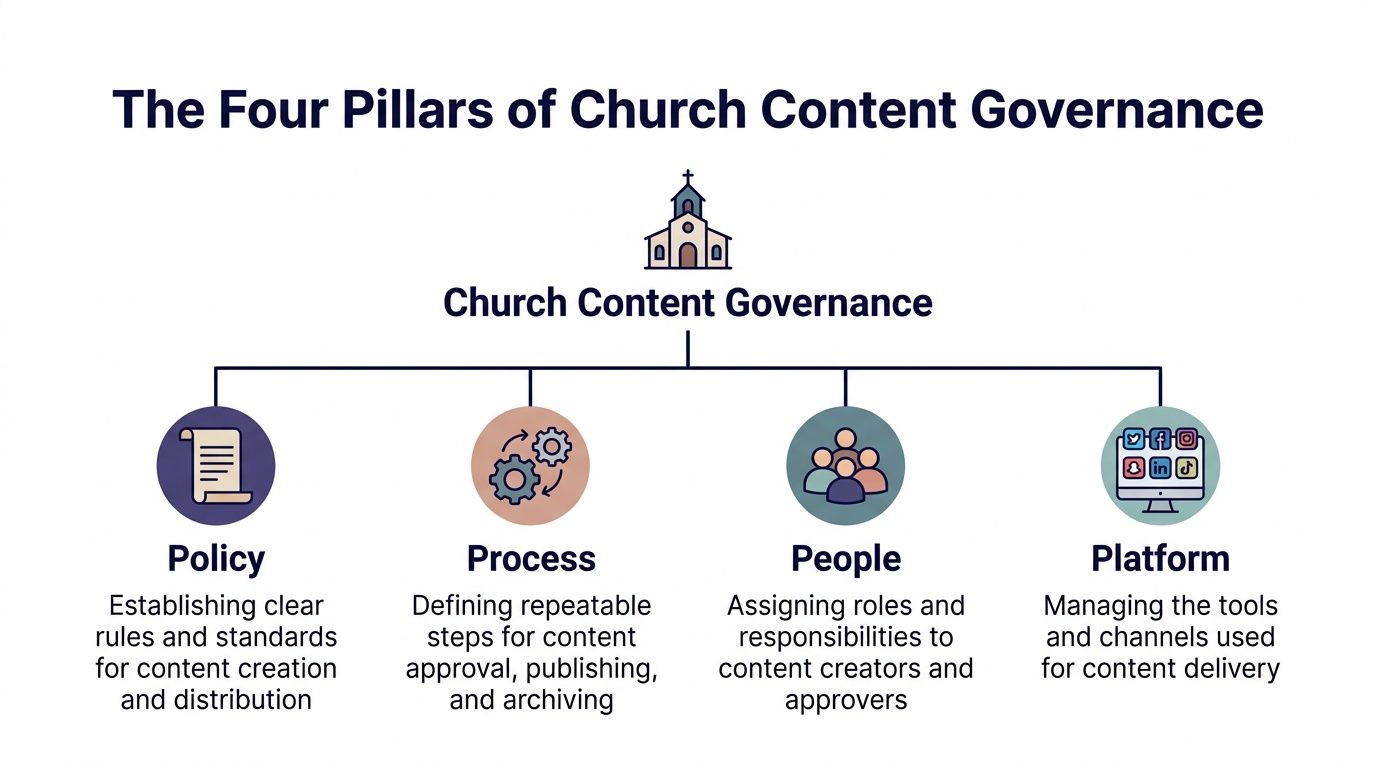
The easiest way to make governance manageable is to reduce it to four parts your church can remember.
According to Acrolinx's explanation of content governance, an effective governance framework can be simplified into the 4 P's: People, Process, Policy, and Platform, and that structure creates accountability across distributed teams. For churches, those same four pillars work well when you strip away corporate jargon and keep them practical.
People
Start with names, not departments.
Your church may not have a content team. That's fine. You still need clear roles. One person may wear several hats, but the hats should still be named.
A simple church setup might look like this:
- Creator: Writes captions, drafts announcements, or builds graphics
- Reviewer: Checks for accuracy, tone, and ministry fit
- Publisher: Schedules or posts the approved content
- Owner: Makes final calls when questions come up
If one admin does all four, that still counts. Governance gets clearer the moment those responsibilities are defined.
Policy
Policy sounds intimidating, but in a church it can fit on one page.
It involves writing down the standards that protect your ministry's message. Many churches get tripped up here because they think policy must be legalistic. It doesn't. It just needs to be clear enough that volunteers can use it.
A useful church policy might cover:
- Voice: Warm, faithful, welcoming, and clear
- Content boundaries: Don't share private pastoral details, unverified stories, or personal opinions as official church positions
- Photo guidance: Use images that fit the ministry context and respect privacy
- Caption standards: Include correct dates, locations, and next steps when promoting events
If a volunteer has to guess whether something is appropriate, your policy is too vague.
Process
Process is the path a post follows from idea to publish.
Churches often experience the most chaos. Without a process, everything becomes urgent and nothing is consistent. The fix is a repeatable rhythm, not a heavy approval chain.
A lightweight workflow could be:
- Ministry leader submits event details or sermon notes.
- Creator drafts the post.
- Reviewer checks theology, clarity, and timing.
- Publisher schedules it.
- Owner revisits high-impact posts if needed.
That's enough structure to prevent confusion without creating bottlenecks.
Platform
Platform is the toolset that supports the system.
Your platform should make it easier to store graphics, review captions, schedule posts, and keep the calendar visible. If your team is juggling text threads, scattered Canva files, and verbal approvals in the hallway, the toolset is working against you.
Here's a simple way to think about the four pillars together:
| Pillar | Church question it answers |
|---|---|
| People | Who is responsible? |
| Policy | What standards guide us? |
| Process | How does a post move forward? |
| Platform | Where do we manage the work? |
When those four pillars are in place, governance starts to feel less like a management concept and more like ministry order.
How to Build Your Governance Plan Without the Bureaucracy
Church teams usually resist governance for one understandable reason. They think it will slow everything down.
That fear is real, especially when volunteers already feel stretched. But the answer isn't to avoid structure. It's to make the structure so simple that it removes friction instead of adding it.
A helpful place to start is a basic planning rhythm like the one described in this guide on how to create a social media plan. The key is to build a plan small enough that your team will use it.

Start with one ministry goal
Don't begin by writing a large policy document. Begin with one question: what is your church trying to accomplish online right now?
Examples include:
- Help first-time guests know what to expect
- Keep members informed about upcoming ministry events
- Extend the Sunday sermon through weekday content
- Support outreach efforts with clear invitations
One clear goal helps your team decide what belongs on the calendar and what doesn't.
Keep roles small and realistic
Many churches stall because they try to mirror a corporate org chart. That won't work for a volunteer-led team.
Instead, assign simple functions:
- Someone gathers details
- Someone creates
- Someone checks
- Someone schedules
Those can be four people or one person. The point is clarity.
Create one short guide
A useful governance plan often begins as a one-page document. It doesn't need fancy formatting. It needs answers.
Include things like:
- Approved voice words: encouraging, biblical, clear
- Avoid words or habits: sarcasm, vague details, personal hot takes
- Visual standards: logo use, recurring colors, preferred templates
- Review rules: what must be checked before publishing
That one page becomes your team's shared memory.
Use automation where it removes bottlenecks
This matters for churches because volunteers don't have endless time. Simpplr's glossary entry on content governance notes a common fear that governance slows down volunteer creators, while also pointing to AI-powered automation, including AI caption writers, as a way to enforce standards in real time without human bottlenecks.
That's exactly the kind of support church teams need. If a tool can help draft captions, repurpose sermon transcripts, organize the publishing calendar, and keep brand standards visible, governance becomes less visible and more usable.
The best governance plan is the one volunteers can follow on a busy Tuesday, not the one that looks impressive in a staff meeting.
Build in a review rhythm
You don't need a daily meeting. A short weekly check-in is often enough.
Ask:
- What content is going out this week?
- Does it support ministry priorities?
- Is anything missing?
- Did any post create confusion that our guide should address?
Governance improves through repetition. Keep the plan light, keep it written down, and keep adjusting it based on real church life.
Practical Examples for Your Church's Social Media
Theory helps. Real church workflows help more.
The easiest way to understand content governance is to see how it shapes ordinary ministry communication. When the rules are clear, routine tasks get faster and volunteers feel less pressure to reinvent everything.

Turning one sermon into a full week of content
A pastor preaches on Sunday. By Monday, the team has the sermon transcript and video.
With a governance plan in place, the church already knows:
- which sermon moments fit short-form video
- what tone quote graphics should use
- who approves theological wording
- where the final assets live
That lets the team create sermon-based reels, social posts, blog drafts, and discussion prompts from one message without each volunteer making separate style decisions from scratch. The content stays aligned because the standards were decided earlier.
Promoting an event without the usual scramble
Now take a VBS signup, food drive, or prayer night.
A healthy governance process means event promotion starts with a standard checklist. The ministry leader submits the title, date, time, location, registration link, and the one action people should take. The creator uses the church's approved visual style. The reviewer confirms that all details are correct. The publisher adds it to the calendar with enough lead time for reminders.
That may sound basic, but it often brings many churches the most relief. Order removes last-minute guessing.
Helping volunteers contribute without making the feed messy
Churches often have willing contributors. A youth volunteer has great photos. A missions leader has testimony ideas. A children's ministry coordinator wants to highlight volunteers.
Governance lets them contribute inside a clear lane.
Instead of posting directly, they submit material into a shared process. That protects quality while still inviting participation. It also prevents the church account from sounding like whoever happened to have the password that day.
Good governance doesn't silence volunteers. It gives their effort a shape that serves the whole church.
A sustainable posting rhythm
Many churches burn out by trying to post constantly. That usually leads to inconsistency, not fruitfulness.
According to GuideStone's church social media policy guidance, for churches starting out, a sustainable target is 3–4 posts per week on Instagram, and consistency matters more than quantity. That's a wise ministry principle. It's better to maintain a steady rhythm than to sprint for a month and disappear.
A simple weekly mix might include:
- One sermon-based post
- One event or ministry reminder
- One community story or testimony
- One invitation-focused post for guests
That's manageable. What's more, it's repeatable.
Measuring What Matters for Your Ministry
Church social media gets fuzzy when success is defined only by likes.
A wiser approach is to measure whether your content is serving ministry goals. Governance helps here because it creates categories, roles, and routines you can evaluate. Without that structure, it's hard to know what's working or why.
One useful starting point is to think about the same discipline other ministry media teams use when reviewing shows and episodes. If your church publishes audio content, this guide to measuring podcast performance offers a helpful example of how to look beyond surface-level numbers.
Four ministry-focused measures
A practical church dashboard can stay very simple:
- Consistency: Did you publish the content you planned to publish this week?
- Meaningful engagement: Are people asking questions, sharing prayer needs, tagging friends, or responding to invitations?
- Mission alignment: Did your posts support worship, discipleship, care, outreach, or another clear ministry goal?
- Efficiency: Is your team spending less time chasing approvals, missing files, and rewriting the same kind of content?
For churches wanting a stronger way to track interaction quality, this guide on measuring social media engagement can help frame what to watch.
Why governance matters for measurement
At this point, governance becomes more than organization.
As explained in Aprimo's guide to content governance, 68% of organizations using AI for content report increased ROI, while 63% struggle to attribute that success without a governance framework. The point for churches is simple. Tools may help produce more content, but without structure you won't know what's helping your ministry and what's just filling the feed.
If your team can't explain why a post was made, who it was for, and what ministry purpose it served, measurement will always feel vague.
Ministry leaders don't need complicated analytics. They need enough clarity to say, “This content is helping us communicate faithfully and consistently.”
Your Simple Church Content Governance Checklist
You don't need a committee, a long manual, or a full-time communications director to start. You need a workable plan your church can follow next week.
If you want one more practical planning resource to compare notes with your own process, this checklist for effective church social media planning offers a useful outside perspective.
Getting Started Checklist
| Step | Action Item | Done |
|---|---|---|
| 1 | Pick one main purpose for your church social media right now | ☐ |
| 2 | Name who gathers details, creates content, reviews it, and schedules it | ☐ |
| 3 | Write a one-page guide for voice, tone, visuals, and boundaries | ☐ |
| 4 | Decide what content needs review before publishing | ☐ |
| 5 | Create a simple weekly workflow from idea to scheduled post | ☐ |
| 6 | Organize files, drafts, and graphics in one central place | ☐ |
| 7 | Choose a sustainable posting rhythm your team can maintain | ☐ |
| 8 | Review results regularly and adjust the plan when needed | ☐ |
Keep it light enough to last
The goal isn't control for its own sake. It's to make ministry communication steadier, safer, and easier for the people serving behind the scenes.
When someone asks what is content governance, the best church answer is this: it's the simple structure that helps your message stay faithful while making the work lighter for volunteers.
ChurchSocial.ai gives churches a practical way to put governance into action without adding bureaucracy. You can create AI-generated reels from sermons, turn sermon transcripts into social posts and blogs, build branded graphics with templates and an editor, and manage everything in a simple drag-and-drop calendar. It also integrates with Planning Center and other church calendars to help create content for events. If your church wants a calmer, easier way to plan and manage social media, explore ChurchSocial.ai.