The strongest worship sermon series ideas don't stop at a weekly topic. They create a shared spiritual journey that connects preaching, music, prayer, visuals, small groups, and church communication. That matters because a sermon series works best when each message builds on the previous one, anticipates the next, and still stands on its own. Planning guides also describe series development as an 8-to-12-week creative and logistical process, rather than a last-minute writing task. Calvin University's worship planning guide explains how theme, worship elements, congregational needs, and the Christian year can shape the series from the beginning.
The eight ideas below move from biblical depth to practical discipleship, seasonal outreach, cultural discernment, and honest questions from seekers. Each one includes a teaching direction, suggested duration, worship atmosphere, visual treatment, sample titles, and social content you can organize through ChurchSocial.ai. You can turn a transcript into AI-generated sermon reels, captions, blog posts, discussion questions, quote graphics, and carousels, then schedule the full campaign through a visual drag-and-drop calendar.
If your team is still refining its preaching and worship plans for the coming year, you can also browse the 2026 conference for additional ministry-development context.
1. Books of the Bible Deep Dive Series
A book-by-book series gives your congregation a clear path through Scripture. Rather than jumping between unrelated themes, the church follows one biblical witness across its argument, characters, tensions, and promises. Romans, John, Proverbs, Philippians, and James can all support a sustained series, although the preaching team should decide early whether the book will be handled chapter by chapter or through a set of major themes.
For most congregations, 8 to 12 weeks gives enough room for substantial teaching without requiring a commitment as long as a full chronological Bible journey. A shorter book may need fewer weeks, while a dense book can be divided into more than one series. This guide to expository sermon preparation can help pastors organize the movement from text, to theological claim, to application.
Build a recognizable worship identity
Keep one visual system throughout the series. Use a consistent title treatment, a restrained color palette, and imagery connected to the book's central metaphor. For Romans, consider roads, letters, or layered manuscript pages. For John, use light, water, bread, and open space. Avoid placing words on random objects in an image. Text belongs on intentional surfaces, such as a paper page, a projected title card, or a clean overlay added after the image is created.

Possible titles include “The Gospel in Romans,” “Come and See,” “Wisdom for the Way,” and “Faith That Works.” The worship atmosphere should reflect the book's tone. A wisdom series may use reflective music and spacious prayer, while Romans may call for a stronger emphasis on confession, grace, and congregational response.
ChurchSocial.ai can map every sermon date and title on its calendar, create social posts from transcripts, generate sermon reels for Instagram Reels and TikTok, and keep series artwork consistent through graphic templates. Planning Center integration can also help populate sermon dates and event details, while AI-generated discussion questions can support small groups and Sunday school classes.
2. Topical Series on Life Issues
Topical preaching should bring biblical teaching into the pressures people carry into the sanctuary. Money, relationships, parenting, anxiety, grief, work, and mental health need pastoral wisdom, theological clarity, and practical next steps. Start with a felt need, then let Scripture define the issue and shape the response. For additional topic development, review these sermon topic ideas.
A focused 4-to-6-week series creates momentum without letting one theme become repetitive. Give every week a primary text, a one-sentence big idea, an application verb, and a question or tension the sermon will address. That framework keeps the series connected while allowing each message to serve a distinct pastoral purpose.
Choose felt needs without reducing Scripture
The main risk is motivational advice with a Bible verse attached. Build each sermon from the human problem, examine what the biblical text reveals about it, and end with a response the congregation can practice. Titles might include “Peace in an Anxious World,” “Money and the Heart,” “The Work of Reconciliation,” and “Home as a Place of Grace.”
Shape the worship atmosphere around the subject. Warm acoustic arrangements, guided prayer, testimony, and silent reflection can support themes involving anxiety, grief, or reconciliation. For sensitive topics, choose calm symbolic visuals rather than images that sensationalize distress. An unmade table, a window at dawn, a handwritten prayer, or an empty chair can carry emotional weight without exposing anyone's pain.

Turn each sermon into a coordinated weekly content set: one concise insight, one reflection question, one application step, one carousel, and one short clip. ChurchSocial.ai's AI Caption Writer can adapt captions for different platforms, while its graphics studio can format sermon points into branded carousels. A transcript can also become an accessible blog post, discussion prompts, and follow-up posts scheduled across the week.
Testimonial clips may strengthen the series, but protect privacy and obtain clear consent. Vulnerable stories should serve pastoral care, not merely social performance.
3. Character Study Series
Character studies give a congregation a story it can follow. David, Ruth, Peter, Esther, Paul, Mary Magdalene, and Joseph each offer more than a list of moral lessons. Their lives include fear, ambition, failure, loyalty, doubt, courage, repentance, and change. That complexity gives the preacher room to show how God works through imperfect people without flattening the biblical narrative.
A 6-to-8-week format suits a character whose story spans several passages or whose development needs careful attention. Each week should move the story forward. One message might establish the character's setting, another may expose a defining failure, and a later sermon can explore restoration, responsibility, or faithful leadership.
Let the narrative shape the room
Use a visual timeline as the series' recurring device. A simple line with locations, turning points, and Scripture references can appear on screens, social graphics, and downloadable study guides. Keep the design uncluttered. Images without people often work best, especially when you're using symbolic objects such as a crown, a sling, a cloak, a locked door, or a road through the wilderness.
Potential titles include “Ruth and the Risk of Belonging,” “Peter: From Failure to Faithfulness,” “Esther for Such a Time,” and “David's Whole Heart.” The worship atmosphere should follow the emotional movement of the story. Use lament and silence around failure, stronger communal singing during moments of courage, and prayer for restoration when the text turns toward redemption.
ChurchSocial.ai can extract transformation moments from sermon transcripts for reels, then generate profile posts, quote cards, and discussion questions. A weekly character post might identify the passage, the central struggle, and one question for reflection. A longer transcript can become a downloadable guide for groups. If congregants share related testimonies, connect them to the biblical theme carefully. The point isn't to equate anyone's experience with Scripture. It's to help people recognize where the story invites honest reflection.
4. Seasonal and Holiday-Centered Series
Seasonal preaching gives people a familiar starting point. Advent, Christmas, Lent, Easter, Thanksgiving, and the beginning of a new year also bring a risk: repeating language and themes without fresh theological direction. Choose one question for the season, then let Scripture, worship, visuals, and communication answer it together.
Begin planning early. Set the series title, weekly texts, and central goal first. Then prepare the synopsis, graphics, invitations, and social content before the season begins. The planning sequence in The Calvin University workflow recommends completing those stages at defined points before launch and coordinating the work across worship teams.
Give the season a clear arc
A Christmas series might move from longing, to promise, to incarnation, to response. Lent can examine repentance, release, mercy, or practices that prepare people for Easter. A post-Easter series can trace how the disciples learned to live out resurrection in ordinary life.
Possible titles include “The Light We're Waiting For,” “At the Table of Grace,” “The Road to Resurrection,” and “A New Way Forward.” Match the worship atmosphere to the arc. Use quiet reflection and restrained arrangements for longing or repentance, then fuller congregational singing as the series turns toward hope. Keep the visual system consistent through candles, stars, ashes, branches, empty cloth, bread, water, or dawn light. Put supporting words in intentional overlays rather than scattering text across images.
ChurchSocial.ai can organize the plan into invitations, devotional prompts, family discussion questions, quote graphics, and short sermon clips. Planning Center can supply dates and event details, while selected public events can be shared through Church Center. Planning Center's calendar documentation explains that churches can publish selected events and embed a calendar on a website with a script, URL, or iFrame.
The trade-off is volume. More communication can help people prepare, attend, pray, or take a next step, while excessive posting can make worship feel like advertising. Assign a ministry purpose to every post before scheduling it.
5. Doctrinal Foundation Series
A doctrinal series helps a congregation name what it believes and why it matters. Themes might include grace, justification, the Trinity, redemption, the Holy Spirit, biblical authority, sanctification, atonement, or the nature of the church. These subjects require precision, but they don't have to sound inaccessible.
A 4-to-6-week series can introduce foundational doctrines without attempting a complete theology course. Each message should answer one question in plain language. For example, “What Is Grace?” can define the term, locate it in Scripture, correct a common misunderstanding, and show how grace changes prayer, relationships, and service.
Teach depth in layers
Use the sermon for the central explanation, then let digital content provide optional depth. A single sermon can become a brief definition post, a longer blog article, an FAQ video, a downloadable study guide, and a small-group discussion. ChurchSocial.ai can generate these formats from the transcript, but a pastor or trusted theological editor should review every draft before publication.
Sample titles include “What We Believe,” “Grace at the Center,” “The God Who Saves,” and “The Spirit Among Us.” Visually, diagrams can clarify relationships among ideas. Use circles, pathways, open books, and simple connected shapes. Don't crowd the design with dense paragraphs. A graphic should invite attention, while the blog or guide carries the fuller explanation.
The worship atmosphere should balance reverence and accessibility. Read a historic confession or creed, pair it with a brief explanation, and connect the doctrine to congregational prayer. Avoid treating worship as a classroom with music added between lectures. Doctrine belongs in praise, confession, communion, testimony, and the church's shared life.
The best doctrinal series also acknowledges where Christians disagree. That doesn't weaken conviction. It teaches the congregation how to speak truthfully, listen carefully, and distinguish central beliefs from matters where faithful traditions differ.
6. Chronological Bible Reading Series
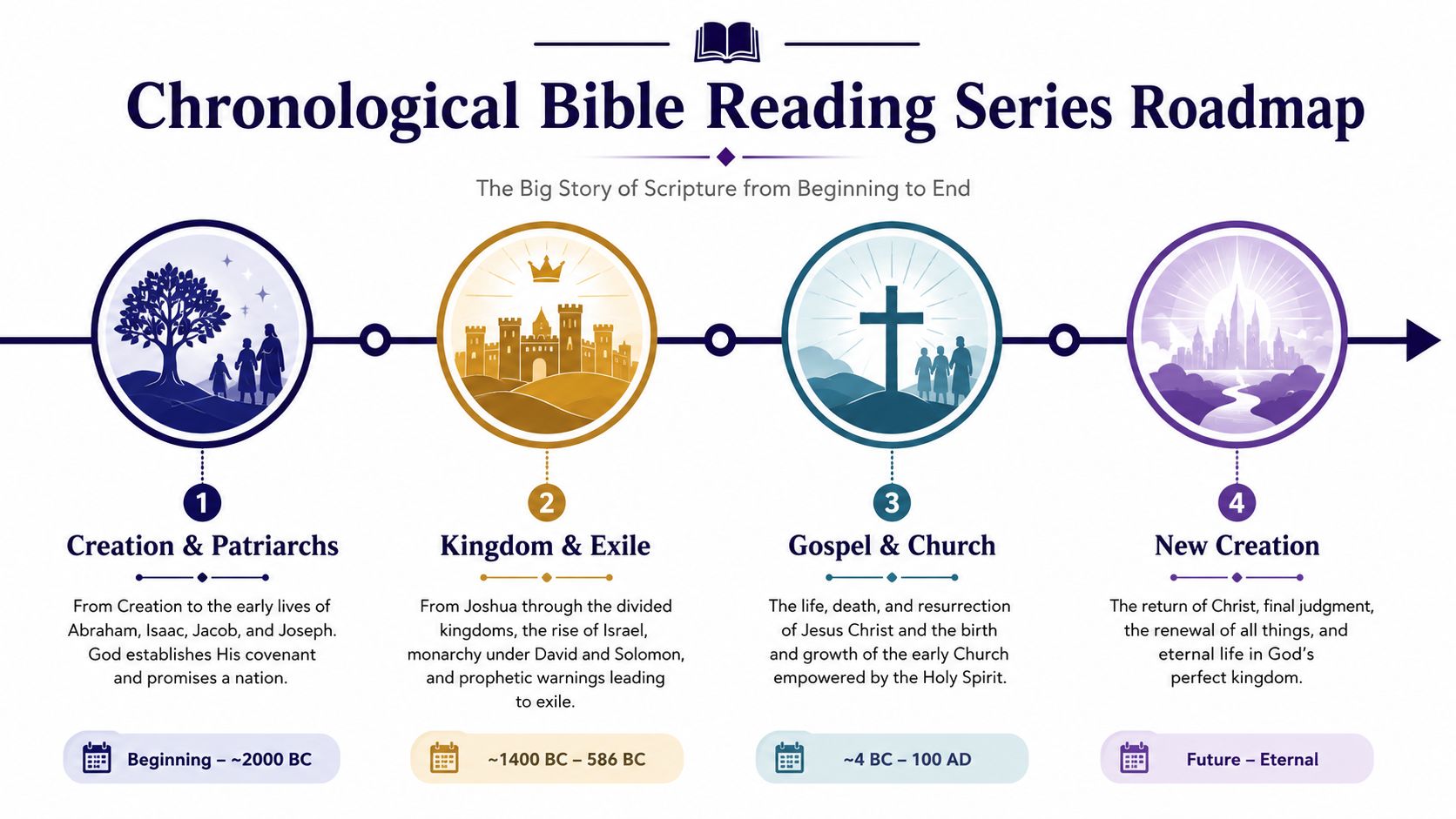
A chronological series follows the Bible's unfolding story rather than treating passages as isolated lessons. The congregation can trace creation, covenant, kingship, exile, prophetic hope, Jesus' ministry, the early church, and the hope of new creation. The framework gives people a map for understanding how individual books and events relate to one another.
A complete chronological journey requires a long commitment, potentially 40 or more weeks, while focused versions can follow a particular era, such as the life of Jesus, Paul's missionary journeys, or the history of Israel's kings. That makes this format flexible. A church can announce a long-term journey or create a shorter seasonal version around one narrative period.
Make the timeline do real work
Sample titles include “The Story That Holds,” “From Garden to New Creation,” “Following the Promise,” and “The Gospel in Time.” Use maps, manuscript textures, geographic markers, and a recurring timeline. Images without people are especially useful here. A parchment, mountain route, city gate, river, or constellation can communicate historical movement without producing artificial portraits.
The worship atmosphere should feel cumulative. Repeat a musical refrain, prayer response, or visual symbol so people sense that each week belongs to a larger story. At the same time, don't allow continuity to become monotony. Change one meaningful worship element each week while keeping the series identity recognizable.
ChurchSocial.ai can hold the full schedule in its visual calendar, generate historical-context captions, and turn sermon summaries into reading guides. A weekly post might answer, “Where are we in the story?” Another can explain geography, customs, or the relationship between two passages. Short videos can prepare viewers for the historical setting before Sunday, while blog posts can explore connections that don't fit into the sermon.
Use a clear naming system for every asset. A structure such as “Chronological Series, Week 04, Exile, Social Clip” helps volunteers find the right graphic or caption without searching through disconnected folders.
7. Discipleship and Spiritual Growth Series
A discipleship series should move people from agreement to practice. Prayer, Bible study, spiritual disciplines, the fruit of the Spirit, spiritual gifts, community, generosity, and witness all lend themselves to weekly actions that continue beyond the service.
A 4-to-6-week run is often enough to establish a rhythm. Each week needs one practice, not a long menu. A sermon on prayer might invite a daily pause and a written prayer. A message on Scripture might introduce a reading method. A sermon on community might ask people to move toward a relationship they've avoided.
Build a weekly practice loop
Sample titles include “Practicing the Presence,” “Rooted,” “The Shape of a Faithful Life,” and “Growing Together.” Worship should make room for participation. Use guided prayer, Scripture meditation, commissioning, testimony, and a clear invitation to practice the week's discipline. The atmosphere can be quieter than a topical outreach series, but it shouldn't feel passive.
A strong social rhythm might include a Sunday sermon clip, a Monday prayer prompt, a midweek carousel explaining the practice, and a weekend accountability question. ChurchSocial.ai can generate discussion questions and social variations from the transcript, create branded challenge graphics, and schedule the full sequence. For theological reflection on costly obedience, link readers to this resource on the cost of discipleship.
Don't promise transformation through a content campaign. Digital prompts can support a practice, but they can't replace pastoral care, accountable relationships, or the work of the Holy Spirit. Pair online encouragement with groups, prayer partners, classes, and tangible opportunities to serve.
8. Apologetics and Faith Questions Series
A faith-questions series gives people permission to bring honest doubts into the church. Why does God allow suffering? Can faith and science coexist? Is the Bible reliable? What about other religions? Does prayer work? These questions attract seekers, skeptics, young adults, and longtime believers who've never had language for their uncertainty.
A 4-to-6-week structure keeps the series focused. Begin with questions your congregation is asking, gathered through a moderated survey, small-group conversations, pastoral appointments, or a question box. Don't select topics only because they generate attention online. A controversial subject needs a pastoral reason and a plan for protecting the dignity of people who disagree.
Keep the series worship-centered
Possible titles include “Questions Worth Asking,” “Faith in the World,” “When Doubt Speaks,” and “Reason and Hope.” The worship atmosphere should be thoughtful rather than combative. Use testimony, confession, Scripture reading, and prayer for wisdom. A question-and-response format can work well, but the preacher should distinguish between a concise answer and an issue that deserves continued study.
Visuals can use question cards, open notebooks, magnifying glasses, stars, pathways, and contrasting light. Avoid mocking images of atheists, scientists, other religions, or people with doubts. The design should communicate welcome and seriousness.
ChurchSocial.ai can turn each sermon into an FAQ post sequence, a blog article, a short pastor-answering clip, and a discussion prompt for groups. Use a weekly “Question Monday” invitation, then moderate responses throughout the week. AI can help organize recurring questions and draft content, but it shouldn't decide theological conclusions or generate confident answers without human review.
This series also offers a useful guardrail for cultural topics. Lifeway Research's reporting on sermons and cultural issues describes a desire for help understanding cultural questions without turning the pulpit into partisan endorsement. Frame difficult subjects through biblical discernment, lament, justice, neighbor-love, and unity rather than political slogans.
8-Point Comparison: Worship Sermon Series
| Series | Implementation Complexity 🔄 | Resource Requirements ⚡ | Expected Outcomes ⭐📊 | Ideal Use Cases & Tips 💡 | Key Advantages 📊 |
|---|---|---|---|---|---|
| Books of the Bible Deep Dive Series | High 🔄, intensive exegesis and multi-week sequencing | High ⚡, significant pastor prep, research tools, content repurposing resources | ⭐⭐⭐⭐ 📊, deep biblical literacy, steady long-term engagement, reusable clip library | 💡 Ideal for formation-focused churches; tip: map 8–12+ weeks in calendar and batch-create clips | Consistent narrative, strong theological depth, predictable content calendar |
| Topical Series on Life Issues | Medium 🔄, topical research and pastoral sensitivity required | Medium ⚡, testimony collection, short-form media, marketing support | ⭐⭐⭐⭐ 📊, high social engagement, SEO traffic, attracts first-time visitors | 💡 Great for outreach and social growth; tip: plan 3 months ahead and use AI captions for shareable snippets | Highly relatable, immediately applicable, strong shareability |
| Character Study Series | Medium 🔄, storytelling craft and narrative arcs | Medium ⚡, creative media, timelines, testimony sourcing | ⭐⭐⭐⭐ 📊, emotional engagement, shareable transformation stories, small-group material | 💡 Suited for narrative-driven preaching; tip: extract failure→redemption moments for Reels | Strong emotional appeal, relatable teaching, versatile content angles |
| Seasonal/Holiday-Centered Series | Medium 🔄, time-sensitive coordination and thematic focus | Medium–High ⚡, event production, seasonal graphics, coordinated marketing | ⭐⭐⭐⭐ 📊, peak attendance spikes, high search interest, community outreach impact | 💡 Best around Easter/Christmas or cultural moments; tip: begin planning 12 weeks out and prepare holiday assets | Leverages cultural momentum, natural hashtags and outreach tie‑ins |
| Doctrinal Foundation Series | High 🔄, deep theological clarity and careful exposition needed | Medium ⚡, scholarly resources, long-form content production | ⭐⭐⭐⭐ 📊, builds doctrinal maturity, lasting long-form resources, authority in teaching | 💡 Ideal for theological formation and leadership training; tip: break doctrines into digestible social posts | Establishes theological credibility, rich downloadable resources |
| Chronological Bible Reading Series | High 🔄, extensive timeline mapping and sustained commitment | High ⚡, ongoing research, timeline graphics, extended multimedia | ⭐⭐⭐⭐ 📊, strong educational value, long-term engagement, timeline-based content | 💡 Best for long-term discipleship plans; tip: schedule series 6–12 months ahead and share weekly timeline graphics | Demonstrates Scripture unity, built-in long-term content calendar |
| Discipleship and Spiritual Growth Series | Medium 🔄, requires follow-up systems and accountability | Medium ⚡, discipleship guides, email sequences, daily content creation | ⭐⭐⭐⭐ 📊, high actionable engagement, habit formation, small-group growth | 💡 Suited to growth-oriented communities; tip: run daily challenges and weekly accountability posts | Actionable practices, strengthens community and spiritual disciplines |
| Apologetics and Faith Questions Series | Medium–High 🔄, careful argumentation and sensitivity required | Medium ⚡, research, subject-matter expertise, moderation for online debate | ⭐⭐⭐ 📊, attracts skeptics/searchers, strong SEO, potential for contentious engagement | 💡 Good for university or seeker contexts; tip: publish FAQ posts and moderate Q&A carefully | Positions church as intellectually open, effective myth‑busting content |
Build the Series Once, Extend Its Reach All Week
Choose the idea that matches your congregation's present need, not the one that sounds most impressive in a planning meeting. A book study serves a church seeking biblical depth. A life-issues series may help people connect Scripture with immediate struggles. A seasonal series can support outreach during a familiar calendar moment. A discipleship series works best when leaders are ready to provide practices and relationships beyond Sunday. An apologetics series requires humility, moderation, and a willingness to let hard questions remain hard for a while.
Once you've chosen the concept, define the weekly arc before producing promotional content. Write down the primary text, the big idea, the application verb, the question or tension, the worship response, and the next step for each week. The series theme should guide the music, prayers, visuals, stage design, email language, website copy, and social posts. If every ministry team creates its own interpretation, the congregation receives disconnected messages instead of one coherent invitation.
Set the duration according to the teaching task. Compact series commonly run 4 to 6 weeks, while shorter expository series may extend to 6 to 8 weeks, and longer biblical books may require 12 to 16 weeks across multiple series. The planning guidance from Influence Magazine explains how defined week counts and repeatable content architecture make it easier to create clips, captions, questions, and graphics from the same message.
Then create one repeatable promotion workflow. After the sermon is delivered and the transcript is available, identify a strong clip, a concise teaching point, a reflection question, a blog angle, and one visual statement. ChurchSocial.ai can help generate AI sermon reels, social posts, blog drafts, discussion questions, photos, and carousels. Its templates and editor give volunteers a consistent design system, while the drag-and-drop calendar keeps Facebook, Instagram, TikTok, YouTube, and other channels organized in one place.
Measure engagement without confusing attention with discipleship. For livestreams, track peak concurrent viewers, average watch time, drop-off points, returning viewer rate, and engagement actions. This online worship analytics guide identifies retention graphs as a useful diagnostic for sermon packaging and segment order. For clips, YouTube Studio can compare views across a 28-day window, while Facebook insights include minutes viewed and specific viewing thresholds, as explained by the Church of England's digital guidance.
Church calendars should support the same workflow. Planning Center can publish selected events to Church Center, and its documented APIs and webhooks provide a way to connect calendar information with downstream systems such as websites and automation tools. The Planning Center Calendar API documentation shows that Calendar is part of a broader set of documented product integrations.
Select one series, assign its length and worship identity, prepare reusable templates, and schedule the first week before launch. Don't wait until Sunday afternoon to decide what the sermon means for the rest of the week. Build the communication path while you build the preaching path, then let every asset point people toward worship, relationship, practice, and the next faithful step.
ChurchSocial.ai helps churches turn sermon transcripts into AI-generated reels, captions, blog posts, and discussion questions, while its graphic templates, editor, and visual calendar support branded creation and scheduling across social channels. Visit ChurchSocial.ai to organize your next worship sermon series from the first planning meeting through weekly promotion and event communication.