The most effective church discussion questions don't keep a group talking. They help people understand a sermon, speak openly, connect faith with ordinary decisions, and choose a practical next step together. That matters because discussion-based groups remain a significant engagement channel. One U.S. study of more than 78,000 worshippers across over 400 congregations found that 21% participated in a prayer, discussion, or Bible study group through their congregation, and participants reported higher belonging, attendance, and giving than non-participants. (Study of small groups in religious congregations)
The eight packs below organize church discussion questions by audience, purpose, and participation format. You'll find options for sermon groups, teenagers, seekers, couples, seasonal events, interactive social engagement, mixed-age gatherings, and ministry leaders. Choose the pack based on who's in the room and what you want people to do afterward.
ChurchSocial.ai can help churches turn sermon transcripts and event plans into discussion questions, social posts, blogs, reels, graphics, carousels, and scheduled publishing. Its visual calendar also helps teams coordinate promotion across church social media accounts, while Planning Center and other church-calendar integrations can connect event details to the content workflow.
1. Sermon-Based Small Group Discussion Packs
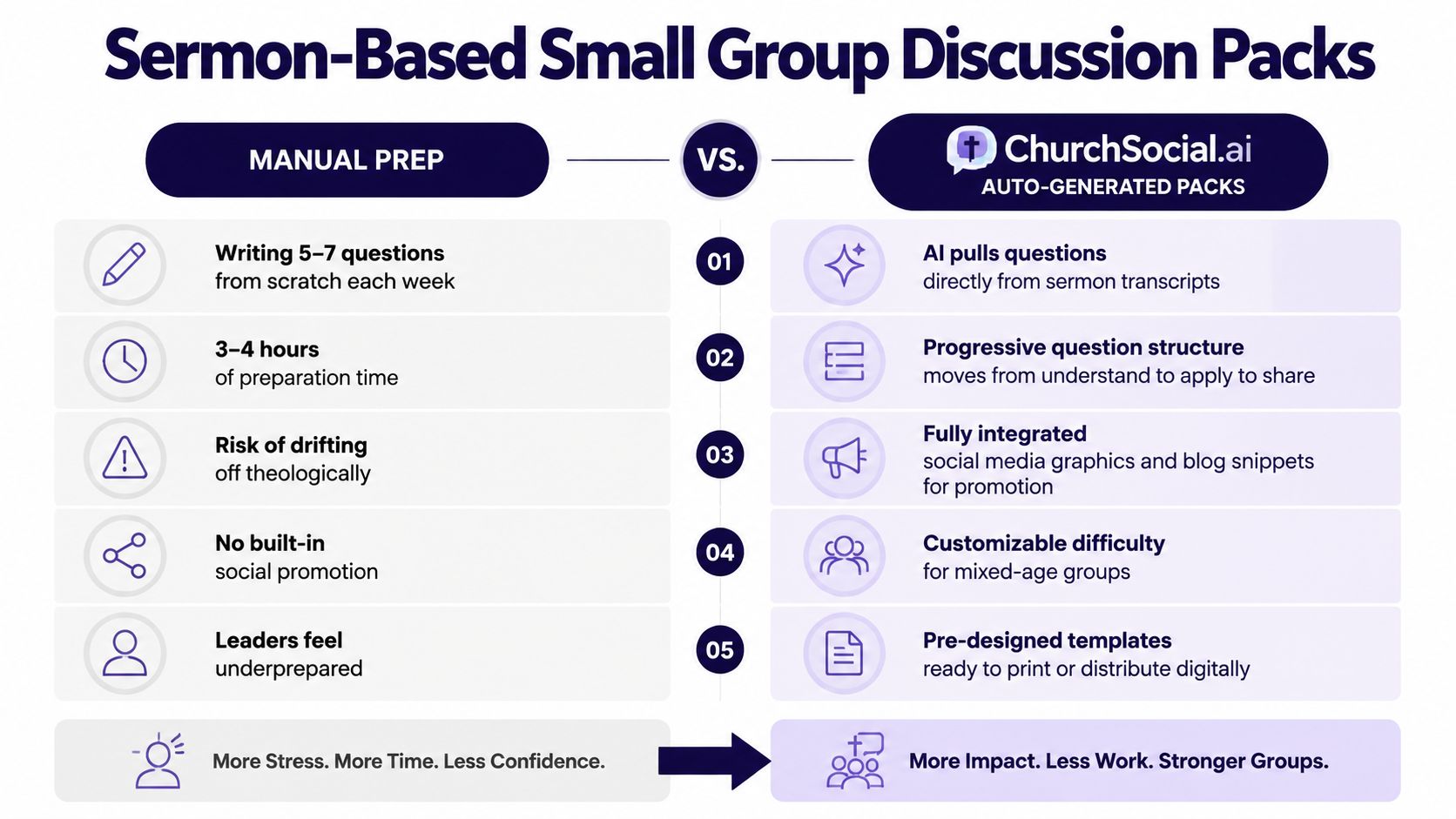
A sermon-based pack gives a small group a clear path from listening to responding. Instead of asking broad questions such as “What did you think of the sermon?”, build a sequence that starts with what the passage says, moves toward interpretation, and finishes with personal application. This structure follows widely used small-group guidance that separates icebreakers, warm-up questions, observation, interpretation, and application. (Lifeway's small-group question guidance)
A practical pack might contain five to seven guided questions, with the first question helping everyone recall the central idea and the final question asking what should change during the coming week. ChurchSocial.ai can generate a first draft from a sermon transcript, then produce related social content for group signups and attendance. Leaders should still review the questions for theological accuracy, pastoral sensitivity, and relevance to the specific congregation.
Practical rule: Let AI create the structure, but let a pastor or group leader decide whether the questions sound like this church and this group.
Build consistency without flattening the conversation
Multi-site churches can use a shared core set across locations while allowing each campus to add a local opening or closing question. A church might publish a discussion prompt in Instagram Stories for remote participants, then invite members to share selected insights in a private Facebook group. Those formats extend the conversation, but they shouldn't replace a facilitated space where people can respond carefully.
Customize the first question around the group's current context. Customize the last question around a specific action, prayer, conversation, or act of service. Schedule promotion several days before the meeting, batch-create a month of discussion content in ChurchSocial.ai, and ask group leaders which questions created genuine conversation rather than short answers.
For guidance on constructing the questions themselves, use this guide to writing discussion questions for church settings.
A short video from a group leader introducing the upcoming conversation can make the invitation feel personal. Keep the message focused on the question people will explore, not only the meeting logistics.
2. Youth Group Engagement Discussion Packs
Teenagers rarely need church discussion questions that sound like adult curriculum with younger vocabulary. They need prompts connected to identity, friendships, purpose, pressure, relationships, doubt, and the decisions they're already making. Biblical depth still matters, but the questions should create room for honest uncertainty and concrete situations rather than demanding polished testimony-style answers.
A youth leader might begin with a scenario: “A friend says faith is only useful when life is difficult. How would you respond, and what part of that statement do you understand?” That question invites reflection without assuming every student already knows what to say. ChurchSocial.ai can help create variations for TikTok, Instagram Reels, and YouTube Shorts, but leaders should review every generated prompt before publishing.
Give students a real role
Youth engagement improves when students help shape the conversation and its promotion. Invite them to submit questions, vote in Stories on topics, or record a short invitation for the next gathering. A discussion trailer can introduce one tension without giving away the answer. For example, a brief reel might ask whether following Jesus should affect online behavior, friendships, or future plans, then direct viewers to the youth group conversation.
A hybrid meeting may need questions that work in a room and on Zoom. Ask one question at a time, use chat for quieter participants, and avoid forcing every student to answer publicly. The facilitator should know when a topic needs pastoral follow-up rather than a group debate.
Use ChurchSocial.ai to repurpose an approved youth discussion clip into devotional content for parents. Its templates can also support bulletin boards, event graphics, and carousels. For additional ideas that help make youth communication visible and inviting, see these church youth bulletin board ideas.

When a question touches anxiety, safety, abuse, or serious mental-health concerns, leaders need a clear escalation path. A discussion can open a door, but it shouldn't pretend to provide professional care. Churches can also point families toward appropriate local support, including Kelowna teen therapy options where relevant.
3. Outreach and Evangelism Discussion Packs
Outreach questions work best when they lower social pressure without hiding the church's purpose. “What makes life meaningful?” or “Where do you look for hope when your plans collapse?” creates a more approachable entry point than an invitation built around insider terminology. The facilitator's job is to listen carefully, ask follow-up questions, and resist turning every response into a sermon.
A coffee conversation, neighborhood gathering, or community discussion night can use a short sequence:
- Start with experience: Ask what people have been thinking about or noticing.
- Explore assumptions: Ask what they believe makes an answer trustworthy.
- Invite comparison: Ask how Christian faith approaches the issue.
- Offer a next step: Invite people to continue the conversation, read a passage, or attend another gathering.
Design invitations for curious people
Promotional content should reflect the tone of the event. A graphic titled “Exploring Big Questions Over Coffee” can feel more welcoming than a generic church service announcement. A short testimonial-style post can describe the question discussed without inventing a dramatic outcome or putting words in someone's mouth. ChurchSocial.ai can turn approved discussion themes into social captions, graphics, blog posts, and reels that point people toward registration or event details.
Churches can share invitations in community Facebook groups and neighborhood apps when the rules allow it. They should also prepare volunteers to explain the format clearly. People are more likely to participate when they know they won't be pressured to speak, agree, or make an immediate commitment.
Use the outreach ideas for small churches as a starting point for adapting the invitation to your setting.

After the event, publish follow-up content that addresses themes people raised. Don't identify participants without permission, and don't turn private questions into public marketing material.
4. Couples and Marriage Discussion Packs
Couples need church discussion questions that move beyond abstract statements about love and commitment. Useful prompts address communication, conflict, intimacy, finances, parenting, spiritual practices, and changing seasons of marriage. The questions should be specific enough to start a meaningful conversation, but gentle enough that couples aren't pushed into exposing private details in front of others.
A church might offer a monthly date-night guide with questions such as:
- Notice the pattern: Where do we communicate well, and where do we keep missing each other?
- Name the tension: What conflict do we tend to postpone?
- Connect faith and practice: What would it look like to pursue reconciliation in this situation?
- Choose a next step: What small action can we take before our next conversation?
Offer privacy and accessibility
Not every couple will want an in-person group discussion. Provide a downloadable guide for home use alongside a facilitated event, and explain whether participants will be expected to share publicly. A church can pair a discussion series with a marriage book study, counseling referrals, or pastoral conversations, while making clear that group discussion isn't a replacement for professional help when serious problems require it.
Content promotion should preview the value without oversharing. An Instagram carousel might present “Questions Every Couple Should Discuss” with one question per slide, followed by a clear invitation to the event or download. ChurchSocial.ai's graphic templates and editor can help a volunteer create that carousel without starting from a blank design. The platform can also turn a sermon or teaching transcript into captions, blog content, and event reminders.
Segment the series by relationship season when appropriate. Newlyweds, engaged couples, parents of young children, and empty nesters may share biblical foundations while needing different examples and applications.
A strong couples pack doesn't ask couples to perform closeness in public. It gives them a safe structure for practicing honesty in private.
5. Seasonal and Holiday Event Discussion Packs
Seasonal questions should feel connected to the event, not copied from an evergreen small-group guide. Easter, Christmas, baptisms, church anniversaries, and generosity campaigns each create a distinct moment for reflection. A baptism discussion, for example, can help people explore testimony, public faith, community support, and the meaning of a next step.
Start early enough to create a complete communication rhythm. For major events, churches may begin preparing discussion content six to eight weeks ahead, then increase reminders as the event approaches. In the final stretch, use countdown graphics and direct calls to register, attend, invite a friend, or download the guide. Any precise scheduling plan should reflect the church's capacity rather than becoming a rigid formula.
Connect the event record to the content plan
Planning Center Calendar lets churches connect events with products such as Registrations, Groups, and Services, and published events can be embedded on a website with Script, URL, or iFrame code. (Planning Center Calendar) ChurchSocial.ai can use event information from Planning Center and other church calendars to help create coordinated discussion content for social channels.
Administrators should check the event's publishing setting and use the View on Church Center option to verify what the public sees. (Planning Center guidance for publishing events to Church Center) A beautiful post won't solve an incorrect time, missing registration link, or unpublished event.
Use printable discussion guides in the Sunday lobby, QR codes where appropriate, and short videos that explain why the conversation belongs with the celebration. For baptism content, churches can feature candidate stories only with clear permission. The same applies to photographs and video. GuideStone advises churches to gather imagery in advance and obtain written permission before posting it. (GuideStone church social-media policy guidance)
6. Interactive Polling and Engagement Discussion Packs
Polls can reveal where a congregation wants to talk, but a poll alone isn't a discipleship process. Use interactive questions as an opening move, then invite people into a deeper conversation that examines why they chose an answer and how Scripture informs the issue.
An Instagram Story might ask a values-based question, present a Bible knowledge prompt, or offer a moral dilemma. The follow-up should avoid shaming people whose answers differ. Instead, group the responses into themes and ask what assumptions shaped them. A small group can then discuss the results without treating the most popular answer as automatically correct.
Turn interaction into participation
ChurchSocial.ai can help churches create social graphics, carousels, reels, and follow-up posts from an approved question set. The visual editor is useful for keeping polls recognizable across a series. A church might publish a question, share a summary of the responses, and invite people to a gathering where the issue receives more thoughtful treatment.
Keep the visual design readable. Short-form video captions should be burned into the video file rather than relying only on platform auto-captions, and captions should sit in the upper or center third with an 8% to 12% margin from every edge so they don't cover the speaker's face. (Short-form video caption guidance)
Avoid gamification that makes attendance feel like a competition for belonging. Points or prizes can add energy to a low-stakes activity, but they shouldn't become the reason people participate. Poll results can inform future questions and sermon applications, but leaders should interpret them carefully rather than treating an online response as a complete picture of congregational belief.
7. Multi-Generational Discussion Packs
Mixed-age conversations become frustrating when every participant receives the same question in the same form. Children may need an image, story, or drawing prompt. Teenagers may respond to a scenario. Adults may be ready to compare experiences, and older members may contribute historical perspective. The shared topic can stay constant while the route into it changes.
A family service might provide separate children's and adults' sheets, then bring everyone together for one closing question. At a Grandparents Day gathering, younger participants could draw a picture of a faith lesson they've learned while older participants share a story about a difficult season. The facilitator then connects both responses to a common biblical theme.
Design for different ways of speaking
Use visual cards, short stories, paired conversations, and breakout groups before asking the full room to respond. Children shouldn't be expected to compete with adults for speaking time, and adults shouldn't assume that a quiet child has nothing to contribute. A mixed-age session works better when leaders establish that listening is participation.
ChurchSocial.ai can create age-appropriate variations from the same source material. A sermon transcript or event plan can become a family devotional, an adult discussion guide, a youth prompt, and a carousel for parents. Keep images simple and intentional. Whenever possible, use objects, illustrations, paper, whiteboards, or symbolic scenes instead of identifiable people. If people appear, secure the necessary permission before publishing.

A useful family pack might end with one home-based action, such as sharing a gratitude story, reading a short passage, or asking a grandparent about a formative faith experience. That gives families a way to continue after the event without requiring another complicated program.
8. Leadership and Training Discussion Packs
Leadership discussions need more structure and more trust than ordinary conversation. Volunteer teams, staff groups, boards, and ministry coordinators may need to discuss change, conflict, delegation, spiritual leadership, developing others, and difficult ministry decisions. The questions should lead toward decisions and ownership, not merely produce a collection of opinions.
A leadership pack can move through four stages:
- Diagnose: What's happening, and what evidence do we have?
- Discern: What biblical, pastoral, or organizational principles should shape our response?
- Decide: What will we change, continue, or stop?
- Develop: Who owns the next action, and how will we review it?
Protect candor and document action
Sensitive conversations need clear boundaries. Establish confidentiality expectations before discussing staff concerns, volunteer performance, conflict, or congregational decline. At the same time, record agreed actions, responsible people, and review points so confidentiality doesn't become an excuse for vague follow-through.
Historical church practice gives this format a deep foundation. A 2014 survey article traces Protestant small-group practices across roughly 300 years, including the work of Luther, Bucer, the Puritans, Pietists, Moravians, and Methodists. (Historical survey of Protestant small-group practices) Discussion groups have repeatedly helped churches strengthen faith, community, prayer, and shared responsibility.
ChurchSocial.ai can turn approved leadership discussions into internal summaries, training resources, and carefully edited best-practice content for multi-site teams. Don't publish sensitive material automatically. Review names, context, and permissions first, then create a version suitable for the wider volunteer base or a leadership network.
Churches should also use these conversations to identify emerging leaders. Someone who listens well, asks a clarifying question, or helps a team move from disagreement to action may be ready for additional responsibility. Schedule recurring leadership discussions around specific competencies, and revisit the action items before starting a new topic.
Church Discussion Packs: 8-Point Comparison
| Pack | 🔄 Implementation Complexity | ⚡ Resource Requirements | 📊 Expected Outcomes | Ideal Use Cases | ⭐ Key Advantages / 💡 Tips |
|---|---|---|---|---|---|
| Sermon-Based Small Group Discussion Packs | Medium, set up sermon transcript pipeline | Low–Medium, transcripts, group leaders, social promo | Increased small-group engagement; saves ~3–4 hrs/wk prep | Small groups, multi-site sermon series | Sermon-aligned Qs; built-in promo. 💡 Customize first/last question; schedule posts 3 days prior |
| Youth Group Engagement Discussion Packs | Medium, needs cultural tailoring & vetting | Medium, short-form video assets, youth leader review | +25–40% youth attendance; higher online reach | Teen/youth groups; social-first outreach | Age-appropriate, platform-optimized content. 💡 Have youth review Qs; create 15–30s “trailers” |
| Outreach & Evangelism Discussion Packs | Medium–High, requires volunteer training | Medium, targeted ads, trained facilitators | Attracts seekers; measurable long-term conversions | Community outreach events, seeker-friendly meetings | Seeker-sensitive progression & objection-handling. 💡 Frame as “exploring big questions”; train listening skills |
| Couples & Marriage Discussion Packs | Medium, sensitive topics, possible counselor input | Medium, promo, printable guides, occasional professional support | Stronger marriages; higher couples attendance (+35–50%) | Marriage ministry, date-night groups, premarital classes | Builds safe space for vulnerability and prevention. 💡 Offer both digital & in-person formats |
| Seasonal & Holiday Event Discussion Packs | Medium, advance scheduling and event-sync | Medium, event branding, Planning Center integration | Higher event signups and social engagement (+30–50%) | Easter, Christmas, baptisms, anniversaries | Event-aligned content with countdowns. 💡 Create content 6–8 weeks before major events |
| Interactive Polling & Engagement Discussion Packs | Low–Medium, template-driven but needs moderation | Low–Medium, social posts, monitoring, follow-up content | 3–5x higher engagement; strong data for planning | Social campaigns, entry-level engagement, youth outreach | High engagement and data capture. 💡 Use polls as starters and analyze results together |
| Multi-Generational Discussion Packs | High, design & facilitation complexity | Medium, visual aids, extra volunteers | Increased family attendance; intergenerational faith transfer | Family services, intergenerational events, family devos | Inclusive tiers for ages; models family faith. 💡 Use storytelling and breakout reconvene format |
| Leadership & Training Discussion Packs | High, confidentiality and skilled facilitation needed | Medium, facilitators, documentation tools | Stronger aligned leadership; institutional knowledge | Staff teams, boards, leadership networks, conferences | Case-study driven development and documentation. 💡 Record action items and use confidentiality agreements |
| Outreach & Evangelism Discussion Packs | Medium–High, requires volunteer training | Medium, targeted ads, trained facilitators | Attracts seekers; measurable long-term conversions | Community outreach events, seeker-friendly meetings | Seeker-sensitive progression & objection-handling. 💡 Frame as “exploring big questions”; train listening skills |
Make Every Question Part of a Repeatable Ministry Rhythm
The best church discussion questions don't live in a document that disappears after the meeting. They belong to a repeatable ministry rhythm: prepare the material, invite the right people, facilitate the conversation, record the next step, and follow up while the subject is still fresh.
Start with one pack, not all eight. A sermon-based small group pack is a sensible choice when your immediate need is deeper weekend engagement. A youth pack fits a conversation shaped by identity, doubt, and belonging. An outreach pack works better when the audience includes neighbors or skeptics who may not be ready for church language. Choose the format according to the people you're serving and the outcome you want.
Adapt the questions before publishing them. Review the biblical references, remove wording that could embarrass participants, and replace generic applications with situations your group recognizes. A facilitator should know which question opens the discussion, which question may require extra care, and what action the group will take before it leaves.
Then create a simple follow-up plan. Send the discussion resource, publish a reminder, and share one approved reflection after the meeting. A church survey framework can help leaders diagnose engagement and participation barriers with questions about belonging and obstacles to fuller involvement. (Church survey question examples) Use feedback to improve the next pack, not to judge individual participants.
ChurchSocial.ai can support this workflow from the source material forward. Churches can turn sermon transcripts into discussion questions, social posts, blog articles, AI-generated reels, graphics, and carousels. Its drag-and-drop calendar helps staff and volunteers manage, update, and schedule content across social accounts, while Planning Center and other church-calendar integrations help connect event details with promotion.
Keep the visual plan disciplined. Use images without people whenever possible, especially for general announcements. Place text only where it belongs, such as on a paper, whiteboard, sign, or deliberately designed overlay added after the image is created. For photographs and videos that include members, gather written permission before publishing and keep the consent record with the content plan.
Finally, ask two questions after every gathering: Did the questions help people speak, and did the conversation lead to a meaningful next step? Combine participant feedback with leader observations, revise the weak prompts, and preserve the questions that created thoughtful engagement. Over time, your church won't just collect discussion questions. It will build a dependable system for turning teaching, events, and real congregational needs into shared conversation.
ChurchSocial.ai helps churches turn sermon transcripts and event plans into church discussion questions, reels, social posts, blogs, graphics, and carousels. Visit ChurchSocial.ai to plan and manage that content in one visual calendar, then build a consistent promotion and follow-up rhythm for your groups.