Last Sunday, a volunteer posted a warm caption about a church event, then watched the replies turn puzzled. Nobody was angry, but a few people seemed unsure whether the invite was casual, urgent, or even meant for them. That's how tone problems usually show up in church communication. The words are fine, the heart is fine, and the post still lands oddly once it's read on a screen without a voice behind it.
That gap matters because churches publish in a mix of voices all week, pastors, staff, volunteers, and designers all writing from different instincts. A sermon recap can sound reverent in one draft, rushed in another, and overly promotional in the next. When a team doesn't name tone clearly, people start guessing at intent, and the audience ends up doing extra interpretive work the church never meant to ask of them.
Why Tone Trips Up Church Posts
A church volunteer can write a cheerful caption on a Wednesday, and by Thursday morning someone has replied, “Just checking, is this serious?” The post may have been well meant, but the reader had no vocal cues to lean on. In church settings, that happens all the time because posts often move quickly from sermon notes to captions to comments, and each handoff changes the feel of the message.
The problem is usually not bad intent
Most church teams aren't trying to sound cold or confusing. They're writing from different places, a pastor's sermon language, a volunteer's friendly text style, a staff member's formal announcement voice. Without a shared standard, the same ministry can sound warm on one platform and stiff on another.
That's where tone of voice stops being a soft preference and starts becoming a communication problem. Once a post is written, the reader has no tone of voice from the speaker's mouth, only the words, punctuation, and spacing on the screen. A caption that feels encouraging to the writer can read as abrupt to a grieving member, vague to a first-time guest, or too casual for a funeral acknowledgment.
Practical rule: if your audience has to guess your attitude, the tone is already doing too much work.
ChurchSocial.ai can help teams keep that tone steadier by turning sermons into clips, captions, blogs, and scheduled posts from one workflow, so the wording comes from the same source instead of being reinvented every time. That matters because tone drift usually grows when content gets copied, shortened, or rewritten by different hands.
What Tone of Voice Means
When someone speaks, you do not just hear the words. You hear rhythm, intonation, speed, volume, and pitch, and those vocal qualities shape meaning as the sentence is spoken, which is why the same line can sound caring in one moment and sharp in another. Cambridge's teaching materials treat those features as concrete tools, not vague flourishes, and they use contrasting talks to show how pace changes what listeners remember and retain. You can see that teaching approach in Cambridge's tone of voice lesson.
Voice is steady, tone is situational
In the Indian Affairs web standards guidance, voice is the organization's unique personality, while tone is the emotional context or attitude of a particular piece. That distinction helps church teams stop trying to make every post sound identical. A church can keep a steady voice, calm, faithful, welcoming, and still shift tone for a prayer request, a volunteer invite, or a holiday announcement. The structure is easier to manage when brand rules are documented clearly, as described in how to create brand guidelines, and it also supports brand consistency guidance for church teams.
The simplest way to hold the idea in your head is this, voice answers “Who are we?” and tone answers “How should this sound right now?” A church can sound consistent across a Facebook post, a sermon clip, and a newsletter without sounding flat. The personality stays recognizable, but the emotional setting changes with the moment.
A simple test helps here. If you read a line aloud and the meaning changes when you slow it down, soften it, or add warmth, you are hearing tone do its work. Written communication is trickier than spoken communication, because once the vocal cues disappear, readers infer the attitude from the text alone. That is why a message can feel clear to the writer and uncertain to the reader, especially when the post has moved through several hands before it goes out.
The Four Dimensions That Make Tone Measurable
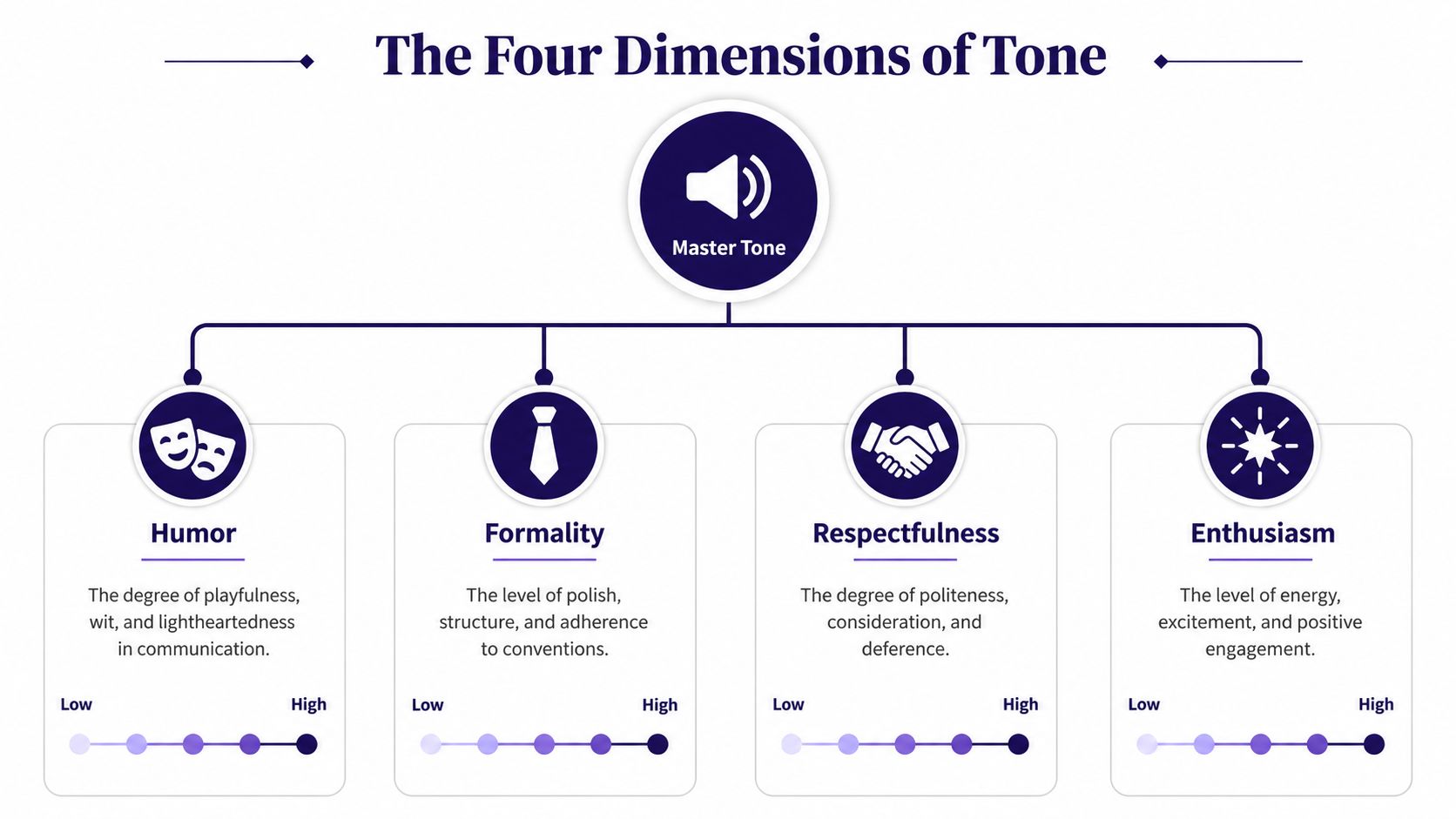
A church team can read a caption and feel that something is off long before anyone can explain why. Nielsen Norman Group treats tone as something you can measure, not just describe. They identify four dimensions, humor, formality, respectfulness, and enthusiasm, and recommend testing tone with users on 3-point or 5-point Likert scales. Their brand-perception research also found that casual, conversational, and enthusiastic tones performed best on measures like friendliness, trustworthiness, desirability, and willingness to recommend a brand. You can read their framework in NN/g's tone of voice dimensions article and their user-perception findings in their brand tone study.
The same idea shows up in sentiment analysis for video creators. The method is different, but the logic is similar. Viewers and readers react to signals, then form a judgment about the speaker behind them.
Turn each dimension into a church question
For churches, those dimensions become useful once they are translated into drafting questions that volunteers and staff can answer.
- Humor: Is this a place for a light touch, or would that undercut the moment?
- Formality: Does this announcement need a polished, official feel, or a conversational one?
- Respectfulness: Are we honoring the emotional weight of the situation, especially in grief or crisis?
- Enthusiasm: Are we inviting people warmly, or pushing the language so far that it feels forced?
That kind of scoring gives a team something concrete to compare across posts. A Sunday event recap, a volunteer call, and a condolence message should not sit at the same setting on every slider. The church's personality can stay steady while the tone changes to fit the moment.
The practical test is simple. Read the post as if you were a first-time guest, a grieving family member, or a volunteer deciding whether to show up. If one of those readers would hear the wrong emotional cue, the draft needs another pass.
If your team already thinks in terms of brand consistency, this frame adds a sharper lens. It does not ask whether the post sounds nice. It asks whether the tone supports the actual purpose of the message, whether that is welcoming new families, coordinating leaders, or responding to a difficult loss. That is where a caption review guide helps. A church-specific process like how to write captions for church social posts gives your team a repeatable way to check tone before anything goes live.
A good church post does not just sound positive. It sounds appropriate for the moment, the audience, and the ministry goal.
Do and Don't Captions from Real Churches
A sermon recap can go wrong without anyone noticing on the draft screen. One version says, “Great message today, thanks for being there.” Another says, “We're grateful for the hope we heard together this morning.” The second one usually lands better because it names the shared experience, not just the writer's enthusiasm. Small shifts like that change how people feel seen.
Common church tone swaps
| Post Type | Weak Tone Example | Strong Tone Example |
|---|---|---|
| Sermon recap | “Good word today. Hope you caught it.” | “We're grateful for the reminder that grace meets us in ordinary moments.” |
| Funeral acknowledgment | “Praying for the family. Service details soon.” | “We're holding this family close and will share service details as soon as they're ready.” |
| Event invite | “Don't miss this. It's going to be amazing.” | “Join us for a night of fellowship, worship, and a clear next step for families.” |
| Volunteer call | “Need help. Sign up if you can.” | “We'd love your help serving this weekend. If you're available, there's a place for you.” |
The difference isn't just polish. It's clarity about relationship. A sermon recap can be warm without sounding generic, and a funeral acknowledgment can be brief without sounding distant. If you want another practical frame for drafting, the church-specific guidance in how to write captions pairs well with this kind of tone review.
The wording that usually needs the most care
- Short replies: “Thanks” can feel fine in one thread and clipped in another.
- Urgent invites: “Don't miss this” can sound helpful or pushy depending on context.
- Grief-related posts: extra enthusiasm usually feels out of place.
- Volunteer asks: direct language helps, but it still needs warmth.
The main habit is to read the post as if you were the person receiving it for the first time. If the emotional setting feels off, change the tone before you change the content. Churches often don't need more words, they need the right level of warmth, respect, and directness.
A Five-Step Tone Audit You Can Run This Quarter
A tone audit works best when it feels ordinary, not dramatic. Pick a small batch of recent posts, maybe a sermon clip caption, an event announcement, a prayer request, and a volunteer ask, then read them side by side. You're looking for patterns, not perfection, because the goal is to see whether the church sounds like one church or like four people taking turns.
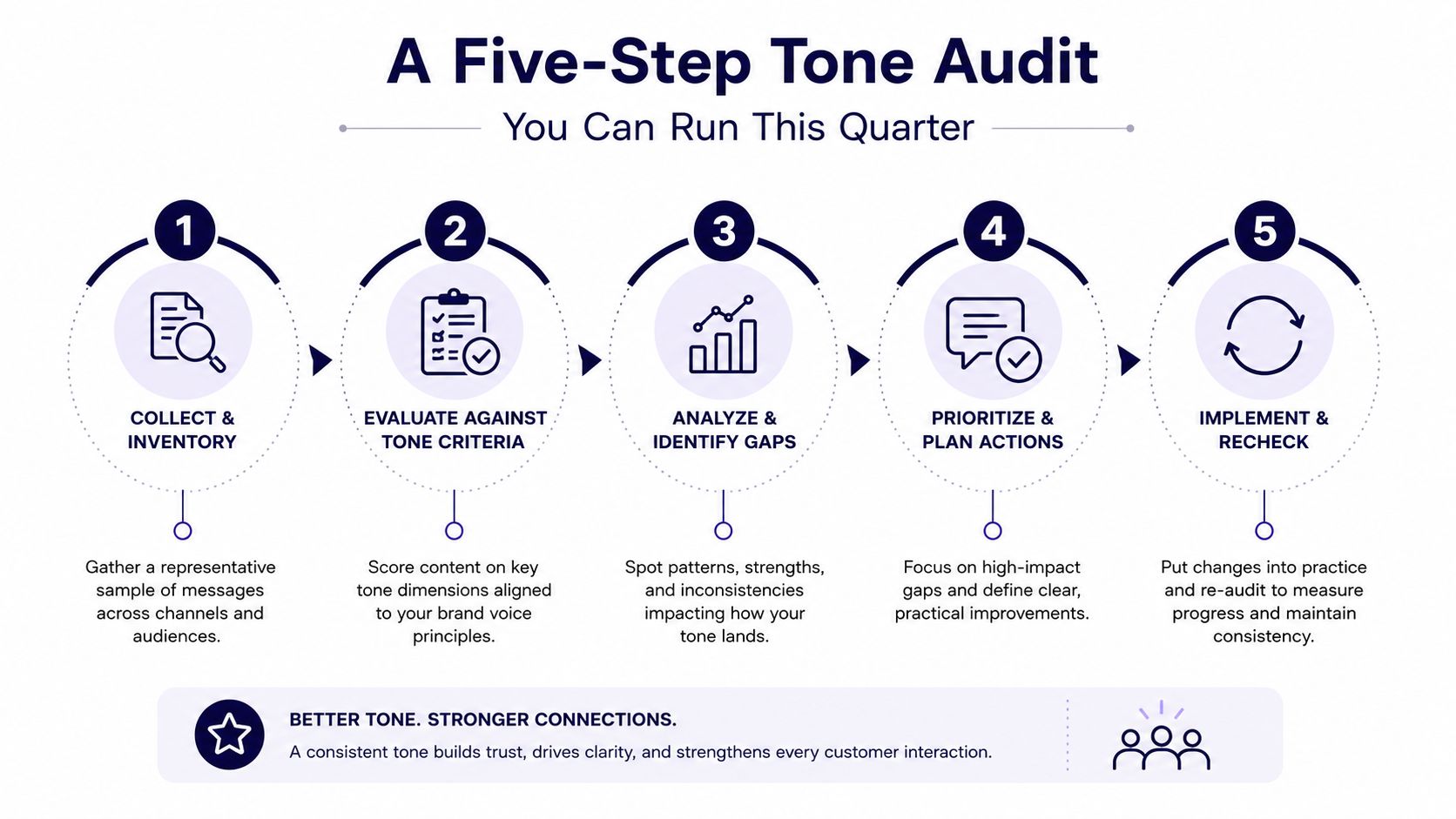
Step one, collect a realistic sample
Pull posts from the channels your church uses. Include a mix of Facebook, Instagram, YouTube, TikTok, and email, because tone drift often shows up when a message crosses platforms. If the same event sounds formal in one place and breezy in another, your team needs a shared reference point.
Step two, score the post against the four dimensions
Read each piece for humor, formality, respectfulness, and enthusiasm. You don't need a complex system, just a simple judgment about where the post sits on each scale. One volunteer can score, then another can check whether the result feels believable.
Step three, write a one-page voice chart
Keep the chart short enough that a new volunteer will read it.
- Warmth: friendly, steady, never gushy
- Formality: conversational for most posts, more formal for announcements that carry weight
- Humor: light only when the moment allows it
- Directness: clear enough that readers know what to do next
A shared chart like that becomes especially useful when a team member joins midseason. If you want a broader framework for reviewing content systems, this church social media audit guide gives a helpful companion lens.
Step four, pressure-test one future post
Before publishing, compare the draft against the voice chart. Ask whether the caption sounds like your church, whether the tone fits the moment, and whether anything reads more playful, formal, or intense than intended.
Step five, revise with the team
Read it once for meaning, then once for tone. If either pass feels uncertain, the post needs another edit.
A short quarterly checklist works well in a shared doc, especially for volunteer teams:
- Check the audience
- Check the situation
- Check the emotional weight
- Check the call to action
- Check whether the wording matches the voice chart
Applying Your Voice Across Social Platforms
A church voice should stay recognizable whether the post appears on Facebook, Instagram, TikTok, YouTube, or email. The tone changes because the context changes, but the personality should still feel like the same church speaking. A Facebook event post may need a little more detail, while a TikTok clip caption should stay tighter and more conversational.
Keep the person, change the setting
A sermon transcript often needs trimming before it works as a post. If you turn it into a caption verbatim, the result can sound like notes instead of communication. ChurchSocial.ai can help with that workflow by taking sermon transcripts and turning them into social posts or other formats in the church's own voice, while its AI Caption Writer can draft from a voice chart instead of from a blank page.
That same voice chart helps on every platform. You can keep the wording warmer for Instagram, more explanatory for YouTube descriptions, and more direct for email reminders. A shared visual calendar also helps teams spot tone drift before a post goes live, because everyone can see what's scheduled alongside the rest of the week's communication.
Match tone to the channel
- Facebook: slightly fuller context, especially for events and community updates
- Instagram: compact, readable, and visually aligned
- TikTok: brief, clear, and natural enough to match short-form video
- YouTube: informative, with enough detail to help people understand the clip
- Email: direct, calm, and easy to scan
The platform is not the voice. The church is. The platform only changes how that voice should be expressed so it still reads clearly in the format people expect.

Keeping Your Voice Steady When Signals Disappear
Written copy loses the cues people normally hear in a person's speech. AI-assisted drafts can lose them too if nobody checks the wording against the church's actual voice. That's why a short voice chart matters so much, because it gives volunteers and staff a shared way to notice when a post sounds too stiff, too casual, too rushed, or too polished to feel like the same church.
A simple warning sign is inconsistency. If one post sounds like a pastor, the next like a fundraiser, and the next like a text message from a friend, the audience has to keep recalibrating. The fix is usually not a new brand identity, just a clearer standard for warmth, formality, humor, and directness.
Keep the audit small, repeat it at least once a quarter, and let one or two trusted people read the draft before it ships. The goal isn't to make every line perfect. The goal is to make sure your church sounds like itself, even when the voice cues are gone and the only thing left is the copy on the screen.
ChurchSocial.ai helps churches turn sermons into clips, posts, blogs, and event content while keeping the wording aligned with a shared voice chart. If your team needs a simpler way to plan, draft, and schedule church social media without losing tone, visit ChurchSocial.ai and see how the workflow fits your next season.