If you're trying to get a sermon recorded, a baptism captured, or a special service livestreamed, you've probably already run into the same problem most churches do. The quote templates online look like they were built for ad agencies, production houses, or corporate teams with marketing budgets and in-house legal review. They don't sound like church work because they weren't made for church work.
A church videography quote template needs to do two jobs at once. It needs to help you look organized and professional, and it needs to protect the ministry when the project involves volunteers, congregants, sermon content, and footage that may later be reused across social platforms. That's a different set of concerns than filming a product commercial.
Why Your Church Needs a Professional Videography Quote
A lot of churches start with a text message, a quick email, or a verbal agreement. Someone says, "Can you film Sunday?" Someone else replies, "Sure." That feels simple until expectations split. One person thought they were getting a full edited message, social clips, thumbnails, and raw footage. The other thought they were just running one camera in the back of the room.
That's where a real videography quote template earns its place. It turns an informal request into a documented agreement before anyone sets up a tripod.
Generic templates miss church-specific needs
Most templates in circulation focus on commercial work and overlook faith-based use cases. A church-specific gap remains, with no real church-adapted examples showing up in common searches despite a 40% surge in church video needs in 2025 according to this research on church video template gaps.
That gap matters because church projects aren't just "small corporate shoots." They often include:
- Sermon usage questions such as who can repost clips and where
- Volunteer coordination where roles and handoff points need to be clear
- Sensitive community footage involving kids, guests, testimonies, or prayer moments
- Budget limits that require transparency instead of vague package pricing
A generic commercial quote won't usually prompt you to think about any of that.
Churches don't get into trouble because they meant harm. They get into trouble because nobody wrote down what was actually agreed to.
Professional doesn't mean complicated
A strong quote doesn't need legal jargon on every line. It needs clarity. It should tell the videographer what to capture, tell the church what it will receive, and tell both sides what happens if timing, edits, or expectations change.
If you're also thinking ahead to how that footage might be repurposed later, it helps to understand the broader workflow around AI for video creation. The better the original quote defines deliverables and rights, the easier the next editing and distribution steps become.
A professional quote also sets the tone. It tells a freelancer, staff member, or skilled volunteer that the church respects the work enough to define it well. That alone prevents a lot of friction.
Essential Elements of a Church Videography Quote
The easiest way to build a usable quote is to follow the same structure used in professional video budgeting. Video budgets are commonly organized into pre-production, production, and post-production, and modern digital quote systems use that structure to calculate costs and turn the project into a client-ready PDF, as explained in this video production budgeting guide.
That framework works well for churches because it keeps the project grounded in actual tasks instead of one lump sum.
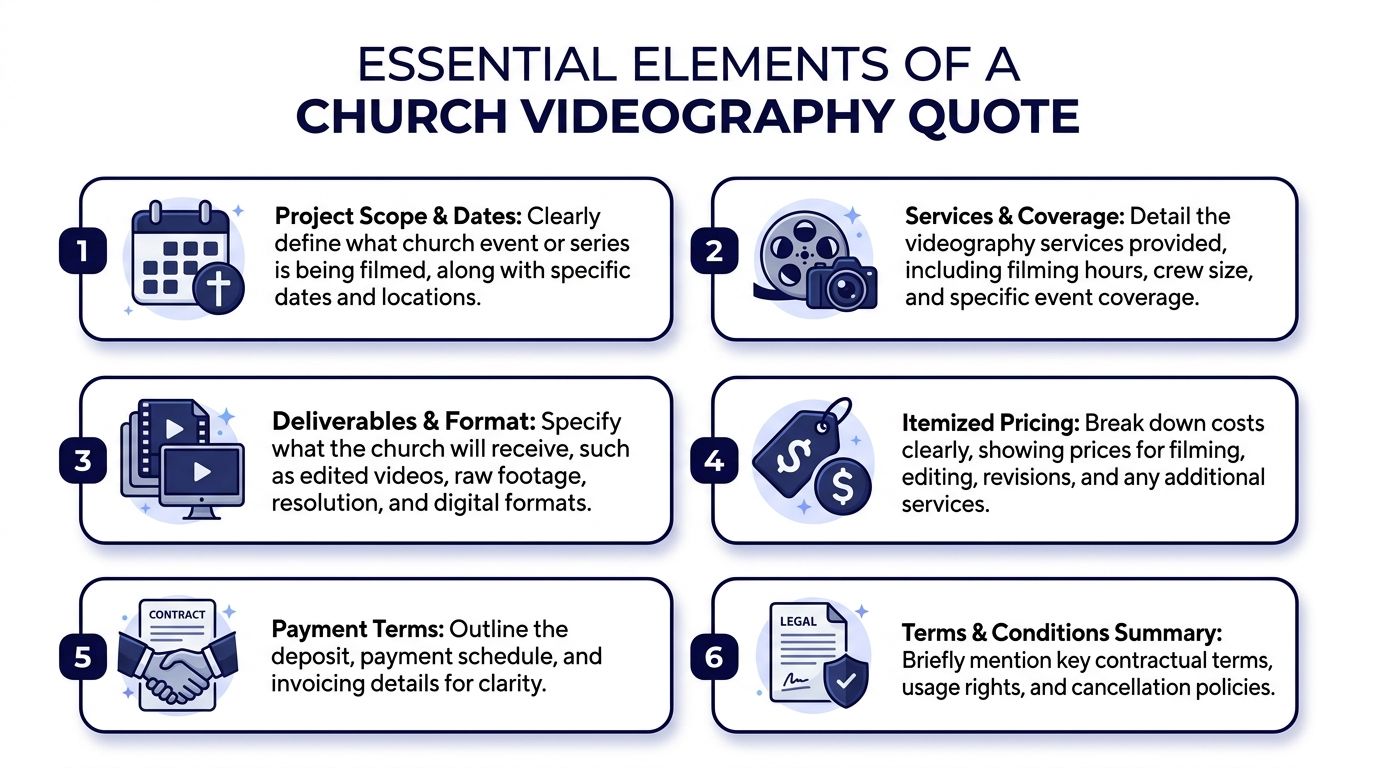
Start with project identity
Before you list a single service, identify the project clearly. Include the church name, contact person, email, phone number, venue address, and a unique quote number. Add the issue date and the date by which the church should approve or decline it.
That sounds administrative, but it solves real problems. Churches often run multiple seasonal projects at once. Easter, VBS, conferences, youth retreats, testimonies, and sermon series can start overlapping fast.
Use a simple opening block like this:
- Client details with the church office or ministry lead as the primary contact
- Project title such as "Easter Sunday Livestream Coverage" or "Sermon Clip Package"
- Quote number for tracking and later invoicing
- Key dates including shoot day, edit review window, and final delivery target
Organize the scope by production phase
Therefore, a church videography quote template becomes much easier to read.
Pre-production
Pre-production covers planning before the camera turns on. For church projects, that often includes run-of-show review, shot planning, volunteer assignments, equipment prep, location walk-through, and confirmation of who is speaking or being featured.
If your church is still working out cameras, switching, and audio flow, this guide to a church video recording system is a useful companion. Better systems lead to better quotes because you can define the actual scope instead of guessing.
Production
Production is the actual capture day. Spell out filming hours, crew count, camera count, audio capture, lighting, livestream operation, and whether setup and teardown are included.
Church teams often forget to specify whether the quote covers only the service itself or also rehearsal, prelude music, announcements, worship, altar calls, and post-service interviews. That omission creates confusion more than almost anything else.
Post-production
Post-production should define every expected output. Don't say "edited video" if what you mean is "one full sermon edit plus three vertical clips." Name the deliverables.
Practical rule: If a deliverable matters enough to disappoint someone when it's missing, it belongs in the quote.
Include the finish line
A good quote ends with a short summary of what the church receives and when. That should include:
- Final deliverables such as full-length sermon file, social clip exports, raw footage, or thumbnail graphic
- Format details like horizontal service archive or vertical social clips
- Review process explaining how revisions will be requested
- Acceptance area with signature, name, and date
That final summary keeps everyone looking at the same finish line.
Building Your Quote Line by Line
This is the part most volunteers find intimidating. It shouldn't be. Good pricing starts with naming the work accurately.
The strongest quoting method in video work is an itemized breakdown, not bundled mystery pricing. Experts also recommend listing services at full rates and quoting 20-30% higher initially so there's room to negotiate without undercutting the work. That approach is tied to 80% quote acceptance in the source material from this video quote methodology guide.
Why line items work better than packages
A package sounds simple, but it usually creates trouble in church settings. If the quote just says "Sunday video package," nobody knows whether that includes setup, camera operators, editing, clip extraction, graphics, upload assistance, or revisions.
Itemizing solves that. It also helps when a ministry lead says, "We need to trim the budget." You can reduce the scope intelligently instead of arguing over a vague total.
For churches that regularly compare contractor pricing or outside creative help, this article on grow your agency with smart pricing is helpful because it frames the bigger pricing logic behind structured service quotes.
Build the quote in layers
Start with labor. Then add tools. Then add outputs. That's usually the cleanest order.
Layer one includes the people
List every role separately if possible. Even if one person handles multiple tasks, separate the work categories so the church can see what's being paid for.
Examples include camera operator, livestream operator, audio capture support, editor, motion graphics support, and project coordination.
Layer two covers gear and access
Some church teams own all gear. Some rent. Some bring in outside operators with their own kits. Your quote should show what is included and what is not.
This can include camera package, tripod, switcher access, wireless audio capture, lighting kit, storage media, or internet support for livestreaming.
Layer three defines deliverables
Many quotes often lack specificity. Be specific.
Instead of "video edits," write out the actual outputs:
- full service archive
- sermon-only edit
- vertical sermon clips
- lower thirds cleanup
- audio sync and mastering
- thumbnail or title slide insertion
- upload-ready file delivery
Itemized quotes are easier to approve because they answer the question every church treasurer asks first: "What are we actually paying for?"
Example line items for church video projects
| Service/Item | Simple Sermon Recording (1-2 min clip) | Event Livestream (e.g., Christmas Service) |
|---|---|---|
| Pre-production planning | Confirm speaker, run-of-service, clip goal, permissions | Service flow review, tech rehearsal coordination, cue planning |
| On-site filming | Single camera coverage | Multi-camera coverage with live switching needs |
| Audio capture | Direct board feed plus backup check | Board feed, room sound, and redundancy planning |
| Editing | Select sermon moment, trim, color, audio cleanup | Archive edit, livestream file cleanup, possible segment exports |
| Social formatting | Vertical crop for short-form use | Optional follow-up clips from service moments |
| Graphics | Basic title card if needed | Event opener, lower thirds, or end slate if requested |
| Revisions | Limited review round | Limited review round with final approval deadline |
| Delivery | Short clip file delivered digitally | Full service file plus agreed secondary outputs |
The table doesn't assign pricing because your context matters. A volunteer honorarium, a part-time contractor, and a full production vendor won't quote the same way. But the line-item logic should stay the same.
Leave room without underpricing
When churches ask for changes, they're rarely trying to be difficult. They're reacting to ministry realities. The pastor rewrote the close. The event ran long. The youth choir got added late. That's normal.
Quoting with a buffer gives you room to absorb discussion without immediately losing margin or goodwill. The key is to keep the visible quote detailed and the internal minimum clear. If you know your floor, you can negotiate calmly.
Defining the Fine Print That Matters
Most quote templates treat terms and conditions like an afterthought. For churches, that's where the highest-risk issues usually live.
Legal and revision language in many videography templates is too generic for sermon content, congregation appearances, and ministry reuse. That's a serious gap because 55% of videographers face IP conflicts, according to this video production quote template reference.

Clarify ownership before filming starts
Sermon footage feels straightforward until someone wants to reuse it outside the original plan. Can the church post clips on YouTube, Instagram, and Facebook? Can the videographer use the footage in a portfolio? Can raw files be handed to another editor later?
Write that down. Don't leave it to assumptions.
A useful clause usually addresses:
- Who owns the final edited files
- Whether raw footage is included or licensed separately
- Whether the videographer may use excerpts for promotion
- Whether sermon content may be repurposed into clips, reels, or derivative edits
If your church has already run into platform disputes or copyright confusion, this guide on a YouTube copyright claim dispute can help frame the downstream risks.
Set revision limits with kindness
Church teams often avoid revision language because they don't want to sound rigid. That's understandable, but vague revision policies create awkwardness fast.
State how feedback should be submitted, who gives final approval, and how many revision rounds are included. Keep it warm, but keep it firm.
For example, a quote can say that one designated ministry lead will consolidate feedback and send one response per round. That protects the editor from getting five separate opinions from staff, worship leaders, and volunteers.
One approval voice saves more stress than any editing shortcut.
Add model release and privacy language
Churches film real people in emotionally meaningful moments. Baptisms, prayer ministry, testimony videos, child dedications, and community events all raise visibility and privacy questions.
Your quote doesn't need to become a full legal packet, but it should mention that the church is responsible for obtaining any required permissions for featured participants, especially when individuals are interviewed, highlighted, or shown prominently. For minors, this should be handled with extra care and with the church's existing release processes.
This isn't about being fearful. It's about being careful.
Example Quotes for Common Church Video Needs
The same videography quote template won't fit every ministry request. A sermon clip job and a wedding video inside the church building may use the same document, but the quote details should look very different.
Four common scenarios show how that changes in practice.
Weekly sermon recording
A pastor wants short clips from Sunday's message for social media during the week. The quote should focus on one capture setup, clean audio, sermon-only editing, and clearly defined short-form outputs.
Format matters. Social platforms reject or penalize content that doesn't fit the platform well. The source material notes that ignoring specs like Instagram Reels' 9:16 format and under-90-second length can cause 50% of videos to be rejected or perform poorly, and that AI tools can help streamline edits for those formats in this short-form video formatting reference.
For this kind of quote, include:
- the camera and audio setup
- whether the full sermon archive is included
- how many short clips are expected
- whether clips will be delivered vertical and platform-ready
Christmas or Easter livestream
This quote needs broader operational detail. A holiday service often includes extra music, more transitions, more volunteers, and a larger audience expectation. The church isn't just paying for filming. It's paying for reliability.
The quote should identify rehearsal involvement, stream operation, graphics triggers, backup plans, and post-event archive delivery. If someone is only quoting "livestream service," the church still won't know whether that includes setup, operator support, or post-service fixes.
A cleaner approach is to separate:
- pre-event planning
- on-site production coverage
- stream monitoring
- archive cleanup after the event
Church wedding
Weddings often create confusion because they happen on church property but don't necessarily follow the church's normal content rules. The quote should state who the client is. The church office, the couple, or both.
It should also spell out what is being captured:
- ceremony only
- rehearsal coverage
- audio from officiant and vows
- edited highlight film
- full-length ceremony export
This is also a place where rights language matters. A wedding video isn't the same as a sermon archive. Keep the usage terms suited to the event.
Welcome or promotional video
A church welcome video often looks simple on paper but takes planning. Script review, location choices, b-roll, volunteer coordination, and editing tone all matter more here than in a straightforward service recording.
The quote should define the message goal first. Is this for the homepage, social media, visitor follow-up, or Easter promotion? Then tie the deliverables to that goal.
Typical line items might include:
- planning call with ministry lead
- half-day filming at campus locations
- interviews or voiceover capture
- edit with music and branded titles
- final exports in more than one aspect ratio if needed
The best church video quotes don't just price the shoot. They price the decisions, approvals, and handoffs around the shoot.
From Quote to Content The Smart Way
A strong quote does more than approve a project. It creates a clean chain from idea to delivery. The church knows what it's buying. The videographer knows what they're making. The editor knows what to hand off. That's how video ministry stays sustainable instead of chaotic.
That clarity matters even more once the footage is finished. A sermon recording, event video, or welcome piece has value far beyond the first upload. It can become clips, posts, blogs, carousels, and event promotion if the original agreement made those uses possible.
If you're building a church workflow that goes beyond filming, this article on sermon on video strategy is worth reading. It helps connect the production side with the ministry side.
The churches that handle video best usually aren't the ones with the biggest gear budget. They're the ones that define scope clearly, protect people well, and use the finished content consistently.
Once your church has the right videography quote template in place, the next step is making that footage work harder for ministry. ChurchSocial.ai helps churches turn sermons into AI-generated reels, create posts and blogs from sermon transcripts, design graphics with ready-made templates, and schedule everything from one simple drag-and-drop calendar. If your team wants a smoother path from recorded content to weekly outreach, it's a practical next step.